


 October 17, 2026
Most businesses we speak to in 2027 have already tried a chatbot. It answered questions, deflected a few support tickets, and then hit a wall the first time someone asked it to actually do something: update the CRM, chase an approval, reconcile two spreadsheets, prepare a quote. That wall is where AI agents begin.
This guide is written from the build side. Akoode Technologies was founded in 2023 by a leadership team with more than a decade of experience in AI consulting and technology development. Everything we design, build and test is done in house by our own qualified, certified developers, so what you read here comes from systems we have shipped and supported, not from vendor brochures.
By the end you will know what an AI agent is, how it differs from a chatbot, how it automates real work, which industries get the most from it, whether your business needs one, and whether it can replace software you already run. You will also have a five-question test and a step-by-step way to move an existing process onto an agent without breaking it.
What Is an AI Agent in 2027?
Quick answer: An AI agent is software that takes a goal, works out the steps, uses your business tools to carry them out, and checks its own result. Unlike a chatbot, which replies to a message, an agent completes a task and hands off to a person when it reaches a decision it should not make alone.
Every working agent we have built has the same four parts, whatever the industry:
A goal. A clear outcome such as "qualify this enquiry and book a site visit" or "extract quantities from this drawing set." Vague goals produce vague agents.
A reasoning model. A large language model, sometimes paired with a vision or classification model, that interprets the input and decides the next step.
Tools. The permissions and connections that let it act: read a record, write a field, send a message, call an API, trigger a workflow.
Guardrails and memory. Rules about what it may do alone, what needs approval, what it must never touch, plus the context it carries between steps.
The fourth part is the one buyers underestimate. A model without guardrails is a demo. A model with scoped permissions, an audit trail and a clear route to a human is a system you can put in front of customers. If you want the definition in more depth, including a five-level scale of autonomy, our explainer on what agentic AI is covers it.
What Is the Difference Between AI Agents and Chatbots?
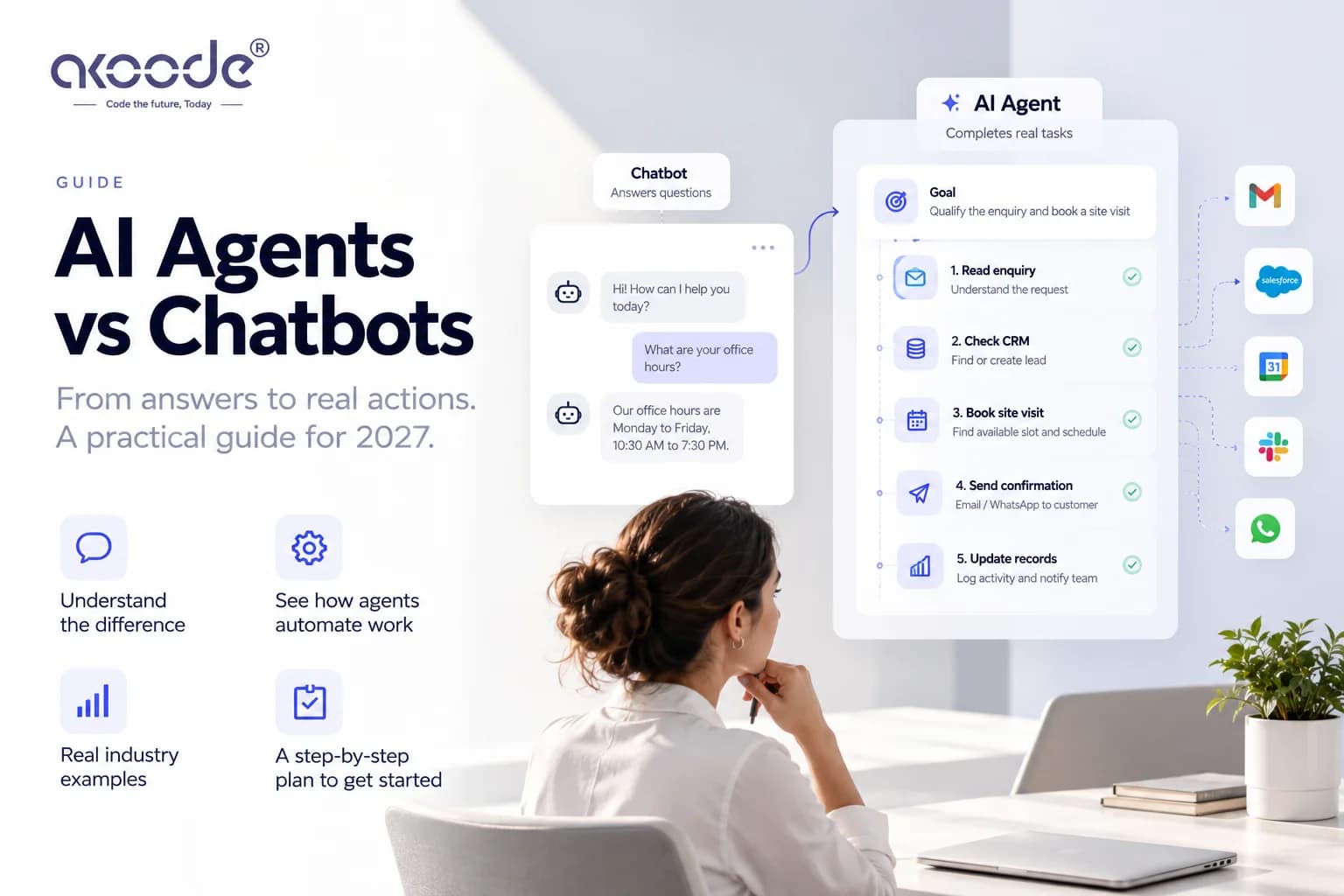
Quick answer: A chatbot talks and an agent acts. A chatbot answers from a script or a knowledge base and stops at the reply. An agent reads and writes inside your systems, follows multi-step logic, verifies what it did, and escalates exceptions. Many useful agents include a chat interface, so the two are often built together.
The confusion is understandable, because the front end of both can look identical: a text box and a reply. The difference sits behind it.
Question | Chatbot | AI agent |
|---|---|---|
What does it produce? | A reply | A completed task, plus a reply if needed |
Can it change data in your systems? | Rarely | Yes, within set permissions |
How many steps can it handle? | One exchange at a time | A chain of dependent steps |
What happens when something goes wrong? | It apologises or loops | It retries, checks, or escalates to a person |
How is success measured? | Deflection, satisfaction | Task completion, accuracy, time saved |
What does it need to be built? | Content and a conversation design | Integrations, permissions, evaluation and monitoring |
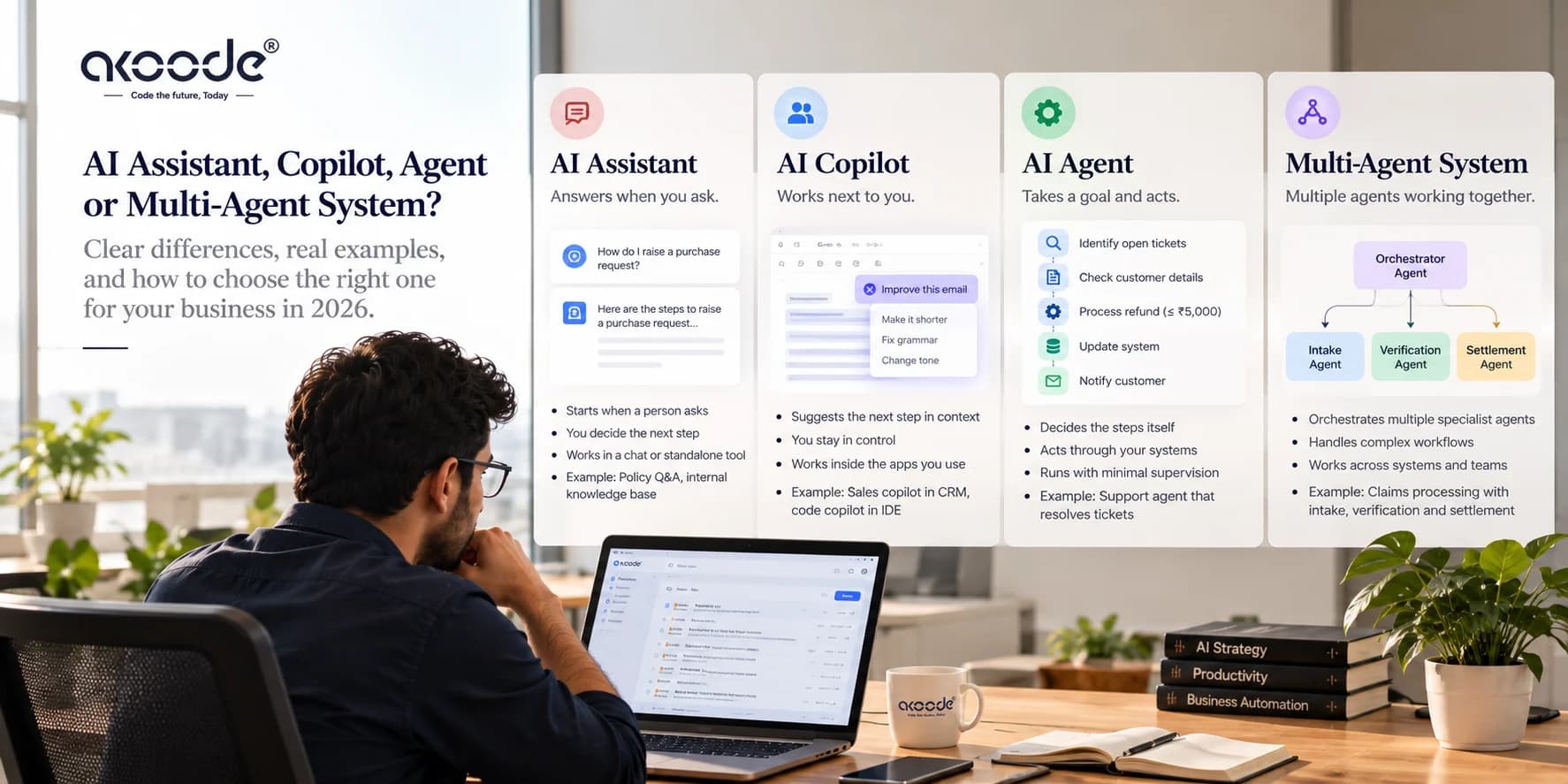
It helps to think of four levels, which is the ladder we use when scoping projects with clients:
Scripted chatbot. Fixed flows and canned answers. Cheap to run, easy to outgrow. Our AI chatbot development work starts here when that is the honest fit.
Assistant or copilot. Understands natural language, drafts, summarises and suggests. A human still presses the button.
Single agent. Takes a goal and executes it across your tools within defined permissions. This is where most businesses get their first clear return.
Multi-agent system. Several specialised agents coordinated by an orchestrator, for example one that reads documents, one that checks rules and one that writes to the system of record. We cover the patterns and failure modes in agentic AI orchestration.
Most companies should not jump to level four. Move up one level at a time and only when the level below is working and measured.
How Do AI Agents Automate Business Tasks?
Quick answer: An agent runs a loop. It receives a trigger, interprets the input, plans the steps, calls your tools to act, checks the outcome, and either finishes or hands the case to a person. The automation comes from repeating that loop on every case without waiting for someone to start it.
Take an enquiry that lands in a real estate firm's inbox at 9 pm. A traditional workflow drops it into a queue. An agent reads it, identifies the property and the buyer's intent, checks availability in the listing system, replies with relevant options, logs the conversation in the CRM, and books a callback slot with the right agent. If the buyer asks something it cannot verify, it flags the case rather than guessing.
The same loop shows up in very different work:
Document-heavy work. Reading drawings, invoices, claims or contracts, extracting the fields that matter and validating them against rules.
Follow-up work. Chasing approvals, payments, signatures and missing information across email and messaging.
Coordination work. Moving a case between systems and teams, updating each record as it goes.
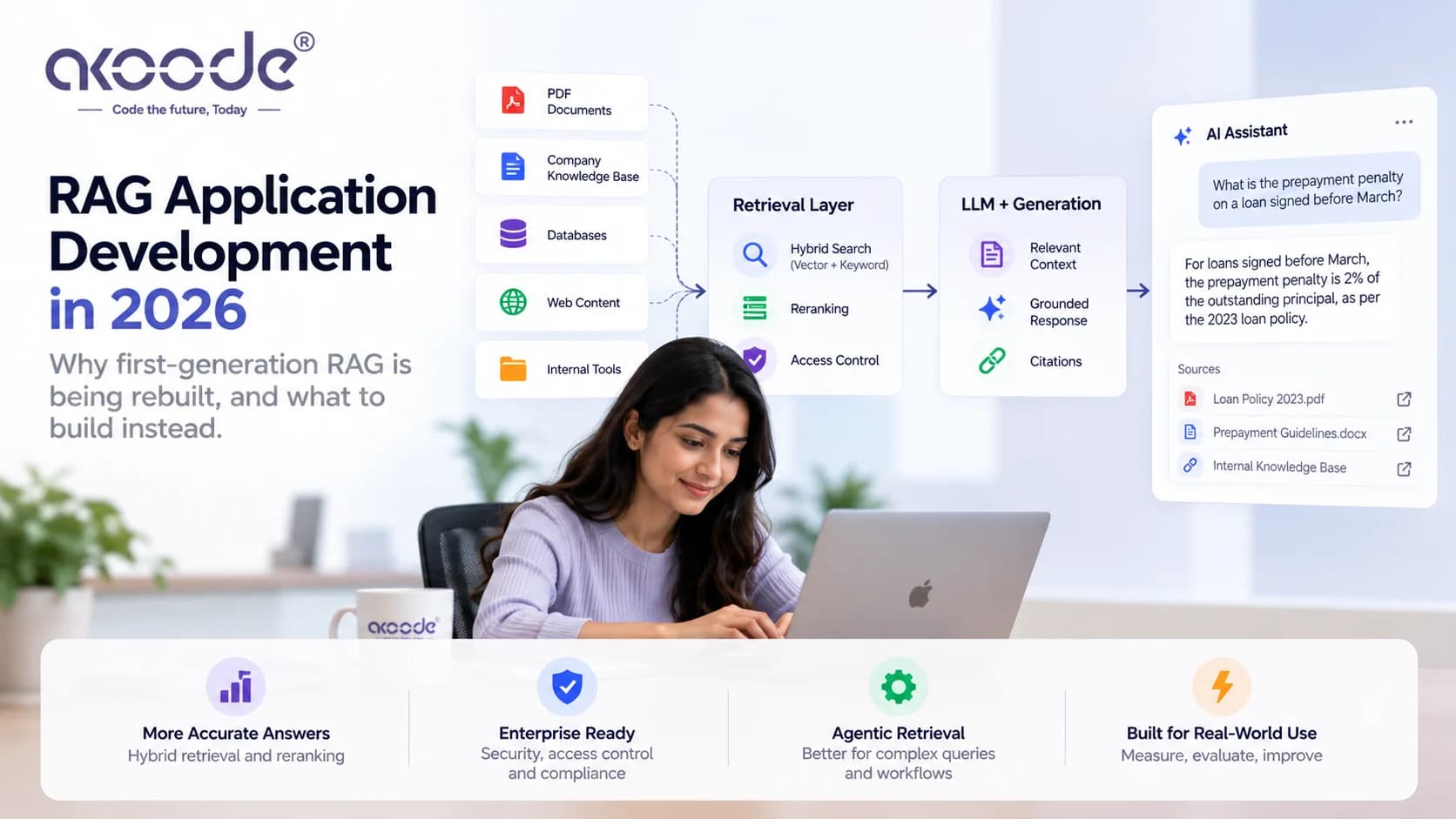
Retrieval and answer work. Pulling the right policy, price or specification from internal knowledge and answering with a source, using a RAG applicationas the memory layer.
Content and communication work. Drafting quotes, summaries, product descriptions and outreach from structured data, using generative AI development with human review on anything customer-facing.
What agents do badly is just as important. They struggle with tasks that have no written rules, with messy or missing data, and with decisions that carry legal or safety consequences and no human check. Good design keeps agents inside the work they are reliable at and routes everything else to people.
Which Industries Benefit Most From AI Agents?
Quick answer: Agents fit best where work is high volume, rule driven, document or data heavy, and costly when delayed. Real estate, retail and e-commerce, healthcare administration, finance, insurance, logistics and manufacturing all match that profile. Regulated sectors benefit too, as long as a human signs off on high-stakes decisions.
Akoode has delivered software across 15 industries, and the pattern is consistent: the industries that gain most are the ones with a lot of repeated, document-shaped work between a customer and a system of record.
Property and travel. Real estate teams lose deals to slow replies and stale listings, which makes enquiry handling, matching and follow-up natural agent territory. Travel and hospitality has the same shape: lots of questions, many systems, and high expectations for speed. We go through the full catalogue in our guides to AI agents for real estate and travel and hospitality.
Commerce. Retail and e-commerce teams use agents for product content, catalogue operations, order support and merchandising decisions. Our guide to AI agents for retail and e-commerce maps the options.
Regulated work. Healthcare, finance and banking, insurance and the public sectorcarry the heaviest document and compliance load, so the upside is large, and so is the need for audit trails, explainability and human approval. Agents here assist and prepare, and people decide. See our guides for healthcare, finance and banking and insurance.
Operations-heavy industries. Logistics and manufacturing produce constant streams of events, exceptions and paperwork, which is exactly what agents are good at triaging. Read more in AI agents for logistics and AI agents for manufacturing.
If your industry is not named here, check the full industries we build for list. The test is not the sector name. It is whether you have repeated, rule-bound work sitting between people and systems.
How Do I Know If My Business Needs an AI Agent?
Quick answer: Answer five questions about one process: is it repeated daily, does it cross several tools, can its rules be written down, does delay or error have a measurable cost, and can a person review the exceptions. Four or five yes answers make it a strong agent candidate. Fewer usually points to simpler automation.
Run this test on one specific process, not on your whole business:
Is it repeated every day or every week? Frequency is what turns a small saving into a large one.
Does it cross more than one tool? Work that stays inside a single system is often solved with that system's own automation.
Could you write the rules on one page? If your best employee cannot explain how they decide, an agent will not either.
Does delay or error cost you something you can count? Lost enquiries, late payments, rework, compliance penalties.
Can a person review the exceptions? Every agent needs somewhere to send the cases it should not handle.
Four or five yes answers: a strong candidate for a single agent. Two or three: start with an assistant or copilot, or fix the process first. Zero or one: you probably do not need an agent yet, and a good partner will tell you so.
That last point matters when you choose who builds it. A vendor who says every business needs an agent is selling, not scoping.
Can AI Agents Replace My Current Software?
Quick answer: Usually no. Agents most often sit on top of your existing software and do the work between systems. They replace software only when that software is mostly manual workflow glue, such as a tangle of spreadsheets and email. Your systems of record, like your ERP or CRM, normally stay.
There are three situations, and the right move differs for each:
Your situation | Right move | Why |
|---|---|---|
Core systems work, but people spend hours moving data between them | Add an agent on top | The systems are fine. The gaps between them are the cost. |
Data lives in spreadsheets, inboxes and memory | Build proper software first, then add intelligence | An agent needs a clean place to read and write. |
Software is old, unsupported or blocks integration | Modernise, then connect an agent | An agent on a brittle base inherits every weakness underneath it. |
We saw the second situation with WeGrow InfraVentures. Their brokerage ran on duplicated spreadsheet habits, so the first job was a single system where listings, enquiries and agents' daily work lived together. Adding intelligence before fixing where the data lived would only have created a fourth place to look.
Where integration is the real work, our enterprise AI integration team designs how an agent connects to what you already run, and our enterprise AI agent architecture guideexplains the technical shape of it.
How Do I Move an Existing Process to an AI Agent?
Quick answer: Pick one process, document every step and exception, list the systems it touches, decide what the agent may do alone and what needs approval, run it in shadow mode beside your team, measure it against the current process, then widen the scope. Shadow mode is the step most teams skip and later regret.
Pick one process. Choose something frequent, bounded and painful. Do not start with your most complicated workflow.
Write down what really happens. Shadow the person doing it. The real process includes workarounds that never made it into the documentation.
List every exception. The exceptions decide how hard the project is. Count them honestly.
Map the systems and permissions. For each system, note what the agent must read, what it may change, and what must stay off limits.
Set the autonomy line. Decide which actions the agent takes alone, which it proposes for approval, and which it never takes.
Run in shadow mode. The agent processes real cases while people keep doing the work. Compare outputs without any customer impact.
Measure against the old way. Accuracy, time per case, exceptions caught, errors that reached a customer.
Go live in stages. Hand over the simplest cases first, keep a human review path, and widen only when the numbers hold.
For the budgeting side of this plan, see our breakdown of AI agent development cost. For a practical build walkthrough, how to build an AI app covers the engineering steps.
What Does Akoode's Own Work Show About Building Agents That Hold Up?
We prefer to show work rather than make claims. These are projects where the lessons carry straight into agent development. Some are specialised AI systems rather than agents in the strict sense, and in a larger build that is often what a single node of a multi-agent system looks like.
Reading documents accurately. For Qualis Construction we built an AI quantity takeoff platform. The lesson that applies to every document-driven agent: precision on structured output matters more than fluent language, so the checking layer deserves as much design time as the model.
Putting AI inside a real business workflow. For BigCat Realty, a Gurgaon real estate firm, we built BigCatGPT, an AI layer designed around how the brokerage actually works rather than a generic chat window bolted on. The lesson: adoption follows fit. If the tool matches the way the team already works, it gets used.
Coordinating specialist steps. Our AI-powered advertisement catalogue generatorchains several steps into one output. It taught us that the handoffs between steps, not the individual models, are where quality is won or lost.
Safety and review in high-stakes settings. Our AI medical diagnostic system for an Indian healthcare client is built around orchestration and review, with clinicians in the loop. The lesson: in regulated work, the human review path is a core feature, not an afterthought.
An AI that teaches and responds. M2 Method in the USA uses an AI instructor for coaching, which showed us how much conversation design and trust matter when the AI speaks directly to end users.
Three habits run through all of it. We scope narrowly before we build widely. We design the evaluation before the interface. And the same in-house team that builds the system also tests and supports it, so nobody has to explain the project twice. Clients rate that: Akoode holds a 4.9 rating on Google from 126 reviews and a 5.0 out of 5 on GoodFirms.
Why Does Who Builds Your Agent Matter?
An agent is not a purchase you finish and forget. It reads your data, acts in your systems and speaks to your customers, so the team behind it becomes part of your operations.
That is why we build with our own people. Akoode's developers are qualified, certified and in house, and everything we design, build and test happens inside the company. There is no subcontracting chain between your requirement and the code. When something needs changing six months from now, the person who built it is still a message away. If you are comparing partners, our overview of AI development companies in India sets out criteria worth checking with anyone, including us.
For teams in the NCR who prefer to meet in person, see our custom AI agent development in Gurgaon guide.
What Should You Read Next?
This guide is the starting point for a series that answers the questions buyers ask before, during and after an agent project. Each article goes deep on one decision:
AI agent development services: how Akoode scopes, builds and supports agents.
Artificial intelligence services: the wider AI practice, including computer vision, generative AI and integration.
How to hire a dedicated AI developer in India: roles, steps and trial structure.
AI agent development cost: what drives the price.
Enterprise AI agent architecture: the technical blueprint.
Frequently Asked Questions
What is an AI agent in simple terms?
An AI agent is software that takes a goal, works out the steps, uses your business tools to carry them out, and checks its own result. A chatbot replies to a message. An agent finishes a task, such as qualifying a lead, preparing a quote or reconciling records, and hands off to a person when it reaches something it should not decide alone.
How is an AI agent different from a chatbot?
A chatbot talks. An agent acts. A chatbot answers from a script or a knowledge base and stops at the reply. An agent can read and write inside your CRM, ERP, inbox or database, follow multi-step logic, and verify what it did. Most useful business agents still include a conversational layer, so the two are often built together.
Do small businesses need AI agents?
Not by default. A small business benefits when one repeated task eats real hours every week, such as enquiry handling, follow-ups or document processing, and the rules are clear enough to write down. If the work is rare or mostly judgement, simpler automation or a copilot is usually the better first step. A scoping call can settle this quickly.
Can AI agents work with the tools I already use?
Yes, in most cases. Agents connect through APIs, webhooks and database access to CRMs, ERPs, helpdesks, spreadsheets and messaging tools. The real question is permissions: what the agent may read, what it may change, and what needs human approval. Systems with no API or poor data quality take extra work before an agent can use them safely.
Will AI agents replace my team?
Agents take over repeatable, rule-bound tasks. People keep exceptions, relationships and decisions with real consequences. In well-built systems, staff spend less time on data entry and chasing, and more time reviewing what the agent flags. Every agent we build has a clear route to a human, because removing the repetitive load is the goal.
How long does it take to build a custom AI agent?
It depends on scope, integrations and data readiness. A focused agent with one workflow and clean data moves much faster than a multi-system agent working with regulated data. We estimate after a scoping call, because timelines set before understanding your systems are guesses. A narrow pilot that proves value first is usually the quickest path to production.
Where should a business start with AI agents?
Start with one process that is repeated daily, has clear rules and costs money when it slips. Document the steps and the exceptions, run the agent beside your team before giving it control, and measure it against the current process. Then widen the scope. Book a call with Akoode and we will help you choose the first workflow.
Talk to the Team That Builds Them
If you have a process in mind, bring a short description of it and the systems it touches. A few sentences is enough. We will tell you plainly whether an agent is the right answer, which level of the ladder fits, and what a sensible first pilot looks like.
Book a call with Akhil Verma, Founder and CEO of Akoode Technologies, or explore our AI agent development services.
Written by the Akoode Technologies team. Akoode is headquartered in Gurugram, India, with a presence in Jenks, Oklahoma, and serves clients across India, the UK , Canada , UAE and the USA.
Get In Touch Now
View More Our Blog