


 September 15, 2026
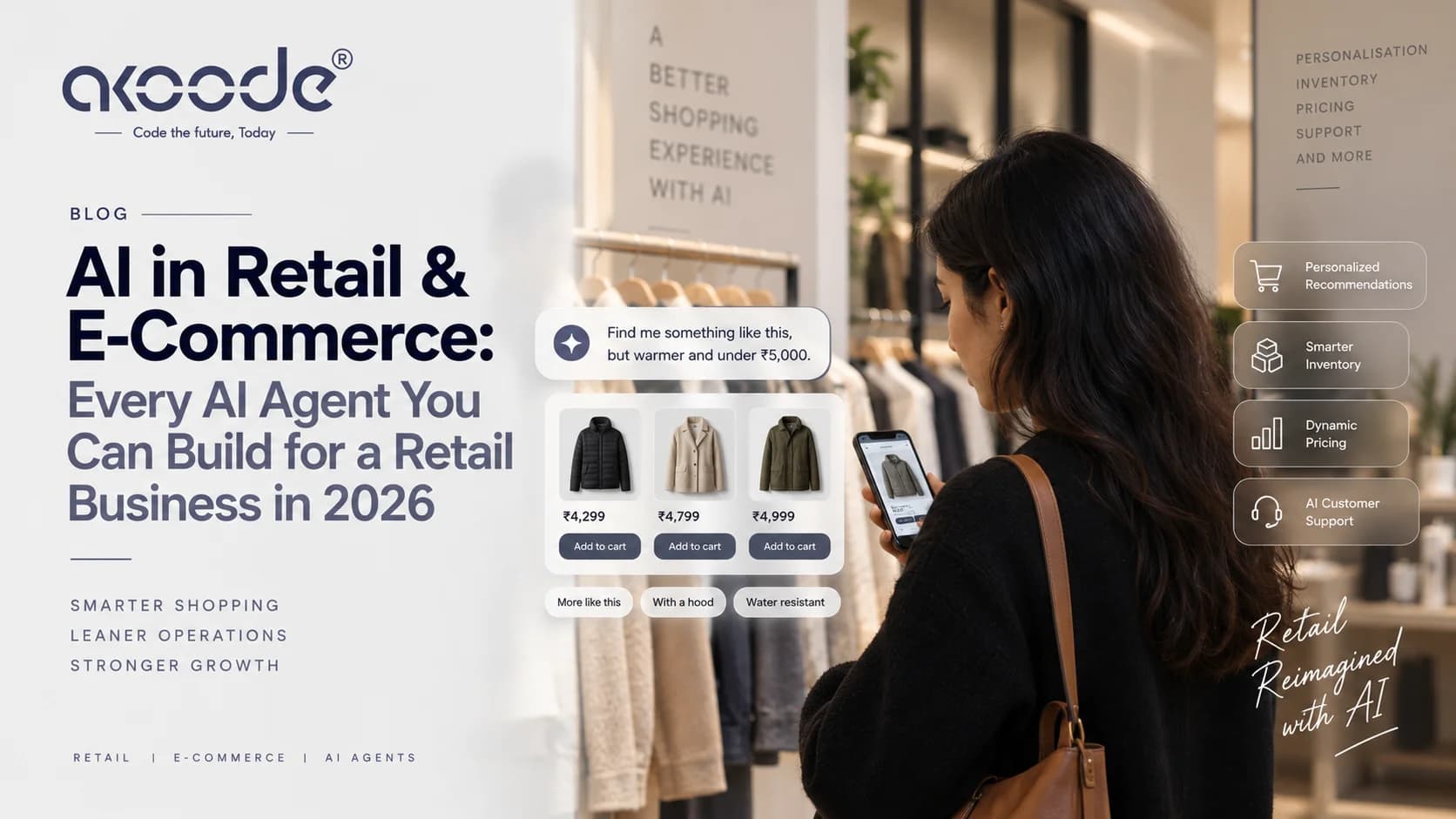
A shopper used to browse a category page, apply four filters, give up, and message customer support asking "do you have this in blue." Now they type "something like the jacket my friend has but warmer, under a certain budget" into a search bar and get three ranked options that actually fit — no filters, no support ticket, no giving up. On the other side of that same transaction, a merchandiser who used to manually reprice a catalogue every weekend now has a system doing it continuously, adjusting for competitor moves and sell-through rate in real time.
Both of those are AI agents doing a job a human used to do manually. Retail and e-commerce is the industry where this shift is happening fastest and furthest — not because retail is more "digital" than other industries, but because it generates exactly the kind of structured, high-volume, repetitive decision-making that AI agents are best at: matching intent to inventory, pricing dynamically, and handling the same handful of support questions thousands of times a day.
This guide covers what AI in retail and e-commerce actually means in 2026, every category of AI agent a retail and e-commerce business — online, offline, or both — can realistically build, how they're engineered, and what's different about building for Gurgaon/NCR, India, and global markets.
Why Retail Is Moving Faster on AI Than Almost Any Other Industry
The scale of investment here is unusual even by AI-industry standards, though the exact numbers depend heavily on what's being measured — a caveat worth stating upfront, because retail AI market sizing is genuinely inconsistent across analyst firms. The broader AI-in-retail market itself sits at roughly $18-19 billion in 2026, up from around $14 billion the year before, with several forecasts pointing toward $80+ billion by 2031. Adoption is already broad rather than experimental: industry surveys from NVIDIA and McKinsey put the share of retail and CPG companies actively testing or deploying AI in the high 80s percent range, though the gap between "testing" and "fully deployed at scale" remains wide — most retailers are still running AI in one or two functions, typically marketing or recommendations, rather than across the business.
The more specific "agentic commerce" category — AI agents that don't just recommend a product but actually complete part or all of a purchase — is where the estimates diverge sharply, and honestly, by design: different firms count fundamentally different things. Narrower measures that count only checkout completed inside an AI platform put 2026 US retail spend in the low tens of billions. Broader measures that include AI-influenced purchases where an agent meaningfully shaped the decision put the global opportunity in the trillions by 2030. What all of them agree on directionally is that AI-referred traffic to retail sites is growing fast — Adobe measured it up roughly 393% year-over-year in the first quarter of 2026 — and that this traffic converts meaningfully better than traditional channels once it lands.
India's retail and e-commerce market is scaling on its own, largely independent trajectory. Estimates for India's e-commerce market in 2026 range from roughly $120 billion to $225 billion depending on methodology, with most forecasts converging on a $300-350 billion market by 2030, driven by UPI payment adoption, ONDC's open commerce network, and quick commerce expansion into tier-2 and tier-3 cities. Mobile already accounts for the large majority of Indian e-commerce transactions, and AI-powered personalization and conversational search are moving from experimental features to standard ones across Indian D2C brands and marketplaces alike.
What "AI in Retail" Actually Means
AI in retail spans two connected worlds that most coverage treats separately but that increasingly need to work together: online retail (search, recommendations, checkout, customer service) and physical retail operations(inventory, in-store experience, workforce, loss prevention). A retail business running both channels — which describes most mid-size and large retailers today — needs AI agents that span both, sharing a single view of inventory, customer, and demand data rather than running as two disconnected systems.
An AI agent, in this context, owns a specific job end-to-end: not just answering a shopper's question, but completing a task — matching a vague request to real inventory, adjusting a price based on live demand signals, or resolving a return without a human touching the ticket. That's the meaningful difference between an AI agent and the recommendation widget or basic chatbot most retail websites already run.
The Complete List: AI Agents You Can Build for a Retail or E-Commerce Business
Discovery and Search Agents
Conversational and natural-language search agent. Lets a shopper describe what they want in plain language instead of navigating filters, and returns ranked, in-stock matches. This is consistently the fastest-adopted generative-AI use case in retail because shopper intent rarely maps cleanly onto a filter form, and the output quality is immediately visible to both the shopper and the business.
Personalized recommendation agent. Learns from browsing history, purchase patterns, and real-time session behavior to surface products a shopper is statistically likely to want, going beyond static "customers also bought" logic toward recommendations that adapt within a single session.
Visual search and styling agent. Lets a shopper upload or describe an image and finds visually similar products in inventory — a category with outsized relevance for fashion, home decor, and apparel retail, where "something like this" is a far more common shopper query than any text search.
Content and Marketing Agents
Product content generation agent. Produces SEO-aware product descriptions, titles, and specifications at catalogue scale from structured data — one of the highest-ROI, lowest-risk AI use cases in retail because the output is easy to review and the time saved compounds across thousands of SKUs.
Personalized lifecycle marketing agent. Runs email, SMS, and push campaigns that adapt content and timing to individual customer behavior — cart abandonment, browse-without-buy, post-purchase upsell — rather than sending the same campaign to an entire list.
Ad creative and catalogue generation agent. Automatically generates product imagery, ad variants, and catalogue content for paid marketing at a scale that would otherwise require a dedicated creative team working full time on nothing else.
Review and sentiment-analysis agent. Processes customer reviews and support tickets at scale to surface recurring product issues, sizing complaints, or shipping problems before they show up as a rating trend a brand manager has to notice manually.
Pricing, Merchandising, and Demand Agents
Dynamic pricing agent. Continuously adjusts pricing based on demand signals, competitor pricing, inventory levels, and sell-through rate, replacing the manual weekly or monthly repricing cycle most retailers still run.
Demand forecasting agent. Predicts SKU-level demand using historical sales, seasonality, promotions, and external signals, feeding directly into inventory and replenishment decisions rather than relying on a fixed reorder calendar.
Assortment and merchandising agent. Recommends what to stock, where, and in what quantity across categories and locations, based on actual regional and channel-level demand patterns rather than a single national assortment plan applied everywhere.
Customer Service and Transaction Agents
24/7 conversational support agent. Handles order status, returns, sizing questions, and general support across chat and voice, resolving the volume of repetitive queries that otherwise consumes the majority of a support team's time, and escalating only the cases that genuinely need a human.
Order and returns processing agent. Manages the return and exchange workflow end-to-end — eligibility check, label generation, refund processing — without a human manually reviewing every request.
Agentic checkout and conversational commerce agent. Enables a shopper to complete a purchase conversationally, inside a chat interface or through an AI shopping assistant, as protocols like the Agentic Commerce Protocol and Universal Commerce Protocol mature and more platforms support checkout initiated outside a traditional storefront.
Fraud and chargeback-detection agent. Flags suspicious order patterns, stolen-card usage, and account takeover attempts in real time — a persistent cost center for any retailer processing high transaction volume, made more urgent as agentic checkout adoption grows and introduces new fraud vectors.
Cart abandonment and win-back agent. Detects abandonment in real time and triggers a personalized, timed intervention — a targeted offer, a reminder, a stock alert — rather than a generic delayed email blast sent to everyone equally.
Operations, Inventory, and Supply Chain Agents
Inventory and replenishment agent. Monitors stock levels across warehouses and stores, automatically triggering reorders based on the demand forecast rather than a fixed threshold that doesn't adapt to seasonality or promotions.
Warehouse and fulfillment optimization agent. Optimizes picking routes, order batching, and carrier selection to reduce fulfillment cost and delivery time — increasingly relevant as quick-commerce delivery windows compress from days to hours.
Supplier and procurement agent. Manages routine supplier communication, purchase order generation, and delivery tracking, particularly valuable for retailers managing large, fragmented supplier bases.
In-Store and Omnichannel Agents
Computer vision inventory and shelf-monitoring agent. Uses in-store cameras to detect stockouts, misplaced items, and planogram compliance in real time, replacing manual shelf walks that happen a few times a day at best.
Self-checkout and loss-prevention agent. Monitors self-checkout lanes and store activity for shrinkage patterns, flagging anomalies for staff review without requiring a person watching every camera feed manually.
Workforce scheduling agent. Predicts staffing needs by store, day, and hour based on historical footfall and demand patterns, replacing manual scheduling that tends to either overstaff during slow periods or understaff during peaks.
Loyalty and Retention Agents
Loyalty personalization agent. Tailors rewards, offers, and communication to individual customer value and behavior rather than running one loyalty program identically for every member.
Churn prediction and win-back agent. Identifies customers showing early signs of disengagement and triggers retention offers before they lapse entirely, rather than after they've already stopped purchasing.
Orchestration: When Multiple Agents Work the Same Customer Journey
The retailers seeing the most value from AI aren't running one assistant in isolation — they're running a handoff chain across the funnel: a discovery agent surfaces a product, a personalization agent times the follow-up, a checkout agent completes the purchase, and a returns agent handles what comes after, all reading from and writing to the same customer and inventory data layer. That connected architecture — rather than five disconnected point solutions — is what separates retailers genuinely capturing AI's ROI from the roughly 88% who are testing AI in at least one function but still running most of the business manually.
How These Agents Are Actually Built
The underlying architecture is consistent across every agent type above, with the data sources and integrations swapped per use case:
A large language model (GPT, Claude, or Gemini class, selected per use case) handles the conversational and reasoning layer — understanding a shopper's loose request, writing product copy, explaining a pricing recommendation.
Retrieval-augmented generation (RAG) grounds every response in real, live catalogue and inventory data, so a search or recommendation agent never suggests a product that's out of stock or describes features it doesn't actually have.
Commerce platform and ERP integrations connect the agent to the systems that hold the real data — Shopify, Magento, or a custom platform for the storefront; an ERP or WMS for inventory and fulfillment; a POS system for in-store data.
Computer vision models, where relevant, handle the in-store and visual-search use cases — shelf monitoring, visual search, self-checkout loss prevention — running as a separate but connected pipeline alongside the language-model-driven agents.
A guardrail and escalation layer defines what an agent can act on autonomously (a routine return, a standard price adjustment within a band) versus what needs human sign-off (a large refund, a pricing change outside normal bounds) — the difference between a system that's trusted in production and one that creates liability the first time it acts on something it shouldn't have.
This is also where the gap between a basic chatbot integration and genuine retail AI engineering shows up. Grounding a search or recommendation agent in real, constantly changing inventory data, connecting cleanly to whatever commerce platform and ERP a business already runs, and building guardrails around pricing and refund decisions is the real engineering work — not the model itself.
Building AI Agents for Retail Businesses in Gurgaon and the NCR
Gurgaon sits at the center of India's D2C and quick-commerce ecosystem, and that shapes what's worth building first here:
Quick commerce and dark-store operations are concentrated heavily in the NCR, which makes inventory and fulfillment-optimization agents — tuned for sub-hour delivery windows rather than the multi-day windows most global retail AI tooling assumes — a higher-priority build than in slower-moving markets.
D2C brand headquarters density in Gurgaon means a large share of the local retail AI opportunity is brand-side (personalization, content generation, retention) rather than large-format retailer-side (in-store computer vision, workforce scheduling).
Hindi-English code-switched customer communication, exactly how NCR shoppers actually message on WhatsApp, needs to be handled natively by any conversational support or checkout agent, not bolted on as a translation layer.
UPI and India-specific payment integration matters for any checkout or fraud-detection agent serving Indian shoppers, since a system built primarily around global card-payment assumptions handles India's dominant payment method poorly out of the box.
Building for the Indian Market Broadly
Beyond Gurgaon's D2C and quick-commerce specifics, three things matter for AI retail agents built for the wider Indian market: ONDC integration is increasingly relevant as India's open commerce network grows, since agents built only around a single marketplace's API miss a meaningful and growing share of the addressable market; regional-language support matters more here than in most global retail markets, given how much of India's next wave of online shoppers are coming from tier-2 and tier-3 cities that are not English-first; and mobile-first design isn't optional — with the large majority of Indian e-commerce transactions happening on mobile, any agent-facing interface needs to be built mobile-native rather than adapted from a desktop-first design.
Building for a Global Market
For retail and e-commerce businesses operating internationally, the same agent categories apply, but the integration and compliance layer shifts: PCI-DSS compliance for payment handling, GDPR and equivalent data-privacy regimes for personalization and recommendation agents that process customer behavioral data, and increasing attention to the emerging agentic commerce protocol stack — the Agentic Commerce Protocol, Universal Commerce Protocol, and Model Context Protocol — as major platforms build native support for AI-driven checkout outside a retailer's own storefront. Retailers operating globally also need pricing and fraud-detection agents that account for jurisdiction-specific consumer protection rules, since what counts as acceptable dynamic pricing varies meaningfully between markets.
What to Actually Prioritize First
Not every retail business needs the full stack above on day one. A practical build sequence for most retailers and D2C brands:
Conversational customer support agent — because it deploys fast, reduces support load immediately, and the risk of getting it wrong is low.
Product content generation — because it's low-risk, high-volume value, and doesn't touch anything customer-facing that could go wrong if the output needs review.
Natural-language search and recommendations — because it directly improves conversion from browse to purchase.
Inventory and demand forecasting — because it removes a genuine operational bottleneck and creates the data foundation dynamic pricing needs to work well.
Dynamic pricing and in-store computer vision — once the earlier agents have generated enough clean behavioral and inventory data to ground pricing and shelf-monitoring decisions accurately.
Proof This Works: What's Already Been Built
A custom Shopify build for Stunner Selfcare shows the storefront-and-catalogue engineering foundation that any discovery, search, or recommendation agent ultimately needs to plug into — a properly structured commerce platform, not a template store, is what makes an AI layer on top of it actually reliable.
An AI-powered advertisement catalogue generator, built for a confidential client, automates product imagery and ad-variant generation at catalogue scale — a working example of the content-generation agent category described above, running as a multi-stage pipeline rather than a single-prompt tool.
A QR-linked apparel platform built for Bacstory, an Indian apparel brand, combined a working storefront with a locked two-step product-claiming flow and an ongoing customer account — proof of the same connected-commerce-and-customer-data architecture that a personalization or loyalty agent depends on.
Choosing a Partner to Build This
A few questions separate a real AI-engineering partner from a generic chatbot vendor wearing a retail label:
Can they explain how their search or recommendation agent stays grounded in live, accurate inventory data, rather than answering from a stale product feed?
Have they actually integrated with commerce platforms and ERPs at scale, not just built a demo against a sample product catalogue?
Do they distinguish between agents that need full autonomy (content generation) and agents that need guardrails and human sign-off (pricing, refunds, fraud flags)?
Do they understand the operational difference between online retail AI and in-store/computer-vision retail AI, which require entirely different engineering?
Can they show a live production example of an AI system running inside a retail or e-commerce business today?
Frequently Asked Questions
What AI agents can a retail or ecommerce business build? Retail and ecommerce businesses can build conversational search agents, personalized recommendation agents, dynamic pricing agents, demand forecasting agents, customer support and returns-processing agents, fraud detection agents, in-store computer vision agents, and loyalty and retention agents, each owning a distinct part of the customer journey.
What is agentic commerce? Agentic commerce refers to AI agents that discover, compare, and complete purchases on a shopper's behalf, often inside a conversational interface rather than a traditional storefront, using emerging standards like the Agentic Commerce Protocol and Universal Commerce Protocol.
Which AI agent should a retail business build first? Most retail and ecommerce businesses see the fastest return from a conversational customer support agent, since it deploys quickly and reduces support volume immediately, followed by product content generation and natural-language search.
What makes AI agent development different for Gurgaon and NCR retail businesses? Gurgaon's retail ecosystem is heavily weighted toward D2C brands and quick commerce, which requires inventory and fulfillment agents tuned for sub-hour delivery windows, Hindi-English WhatsApp-native support agents, and UPI-integrated checkout and fraud detection.
How accurate is AI demand forecasting for retail inventory? AI demand forecasting models trained on historical sales, seasonality, and promotional data generally outperform fixed reorder-threshold approaches, particularly for SKUs with volatile or seasonal demand, though accuracy depends heavily on data quality and history depth.
Where to Start
AI in retail has moved well past the recommendation-widget phase. The retailers and D2C brands pulling ahead in 2026 — in Gurgaon's D2C and quick-commerce corridor, across India's fast-growing e-commerce market, and globally — are the ones connecting search, personalization, pricing, and fulfillment into one system that shares data across every stage, not five disconnected pilots each solving one problem in isolation.
Akoode has delivered AI-powered platforms and e-commerce builds for clients across India, the UK, and the USA, with a 4.9 Google rating from 110+ reviews and a 97% client retention rate. If you're scoping an AI agent — or a full agent portfolio — for a retail or e-commerce business, book time with Akhil Verma, Founder & CEO of Akoode, and bring a short brief on what you're building. The first call is where we map which agents matter most for your business, not a generic list.
If AI use-case ROI specifically is what you're trying to sort out before committing budget, our companion piece on what actually works vs what's hype in AI for e-commerce ranks these same categories by realistic return. For the protocol-level detail behind agentic checkout, see agentic commerce and ecommerce architecture in 2026. And if you're evaluating AI agents across more than one industry, see our companion guides on AI agents for real estate and AI agents for travel and hospitality.
Get In Touch Now
View More Our Blog