


 September 14, 2026
A buyer in Gurgaon used to spend three Sundays in a broker's car, collecting brochures, before deciding on a flat. Today the same buyer filters listings by carpet area and possession date on their phone, watches a drone walkthrough from bed, checks the builder's RERA registration on a government portal, gets a home loan pre-approval digitally, and shortlists three projects before ever speaking to an agent. The broker still closes the deal. But the buyer now shows up already knowing what only the broker used to know.
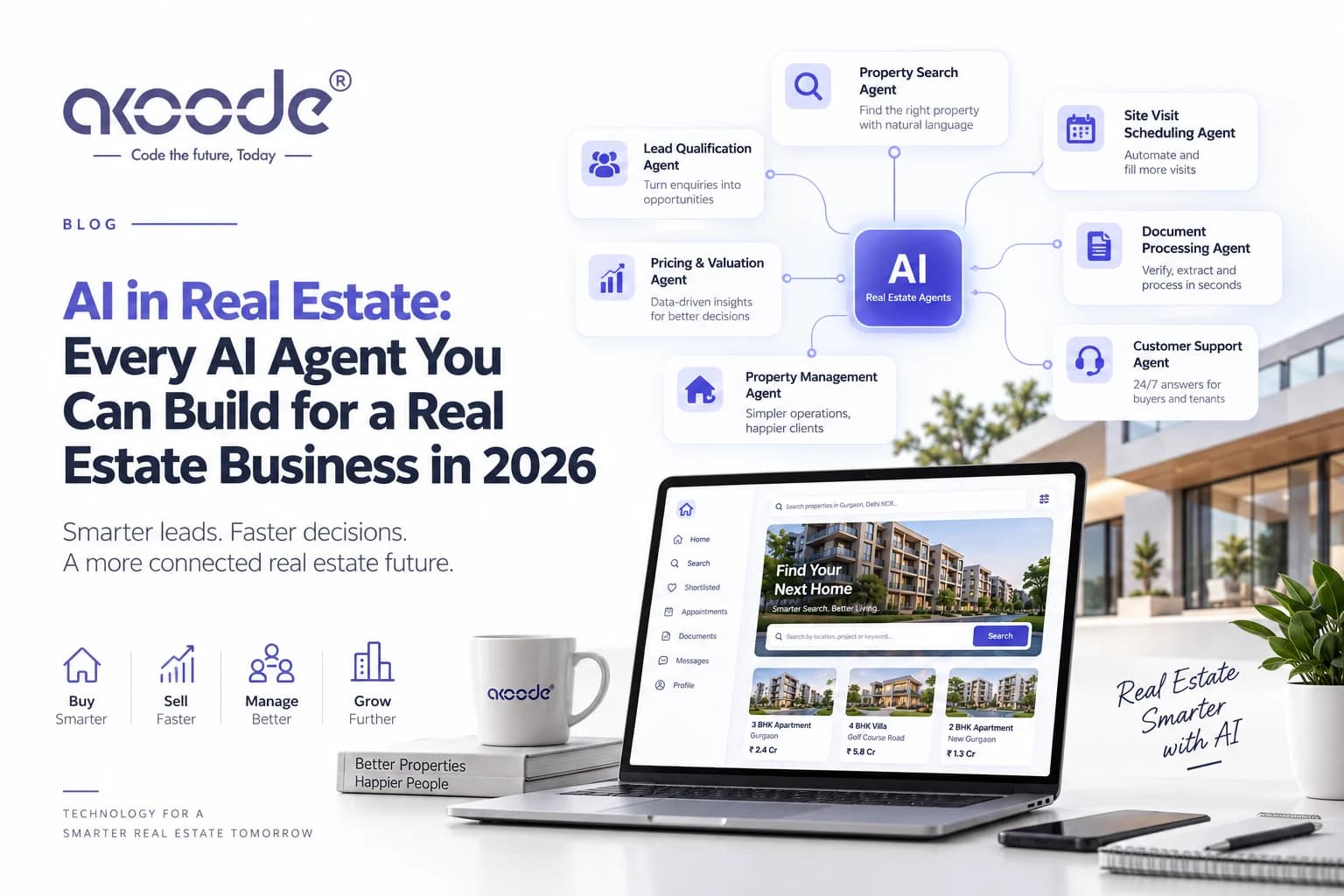
That shift is why real estate businesses — brokerages, developers, property portals, and PropTech platforms — are moving past AI as a single chatbot bolted onto a website, and toward a set of purpose-built AI agents that each own one part of the property lifecycle: finding a lead, qualifying it, showing the property, pricing it, closing the loan, and managing it after handover.
This guide covers what "AI in real estate" actually means in practice, every category of AI agent a real estate business can realistically build in 2026, how the architecture behind them works, and what's different about building for the Gurgaon/NCR and Indian market versus a global one.
Why Real Estate Is Moving on AI Now, Not Later
Real estate has historically been slow to adopt new technology relative to other high-value transaction industries. That's changing fast, and the numbers explain why.
The global AI-in-real-estate market was valued at roughly $300 billion in 2025 and is on track to more than triple by the end of the decade, with growth concentrated in automated valuation, predictive pricing, and virtual property tours. Adoption on the ground is moving even faster than the market-size numbers suggest — industry surveys now put AI usage among top-performing agents well above the halfway mark, with lead nurturing and listing-description generation as the two entry points most agents adopt first, since the return is immediate and the risk is low.
In India specifically, three forces are compounding at once: the residential market is scaling from roughly $480 billion toward a trillion-dollar valuation by 2030, smartphone penetration has crossed 1.1 billion connections, and RERA has formalized over 76,000 projects and 65,000+ registered agents — which means there is now a large, structured, digitally accessible dataset of projects and agents that AI systems can actually work with. Gurgaon and the broader NCR market sit at the center of this shift, alongside Bangalore and Mumbai, as one of the country's most active PropTech and AI-adoption hubs.
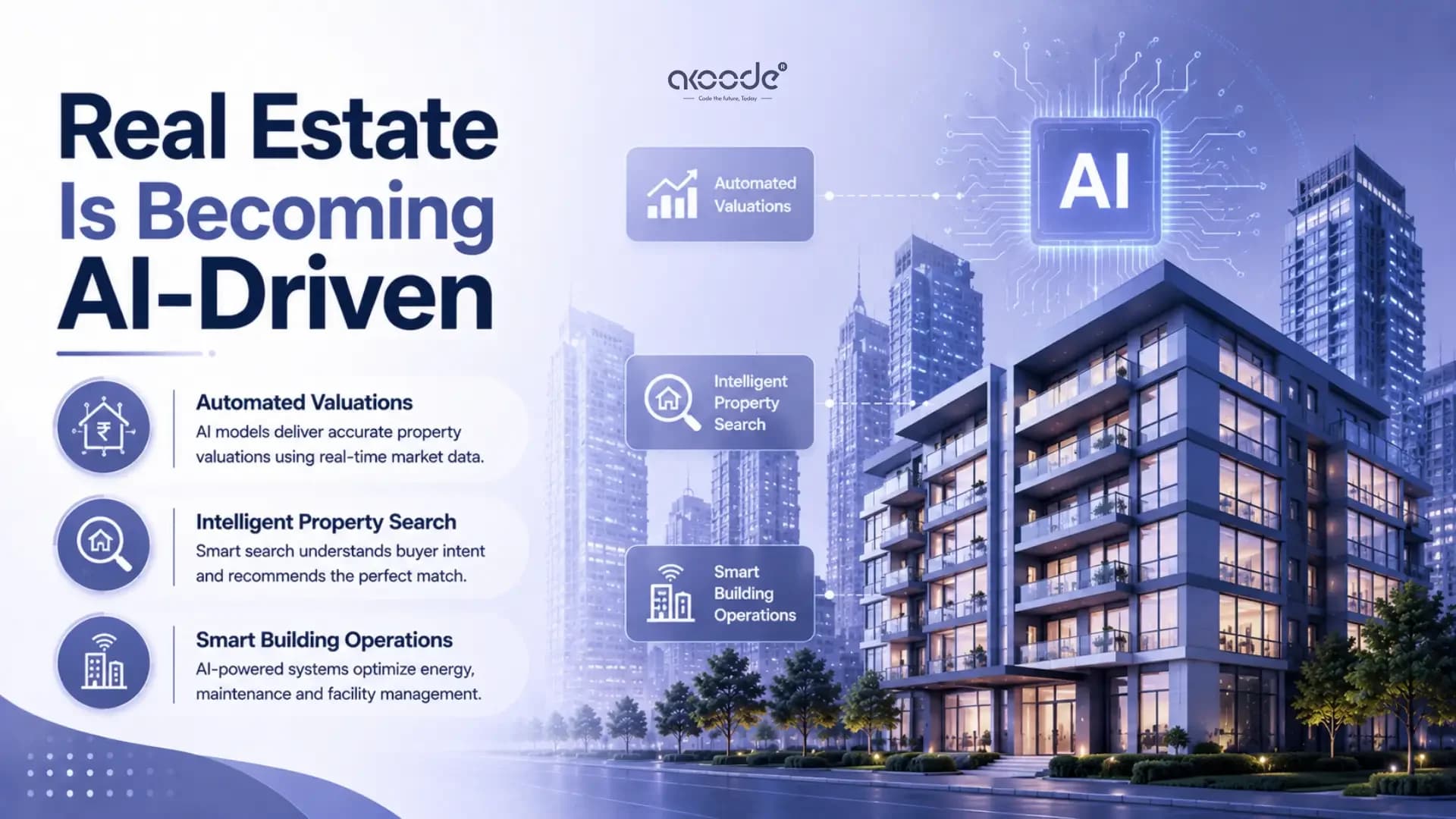
None of this means AI is replacing agents. What it replaces is the manual version of work that used to require a human doing something a system can now do faster, cheaper, and around the clock: answering the fortieth "is this still available" message, scoring a thousand leads by likelihood to convert, or matching a buyer's vague description to the seven listings that actually fit.
What "AI in Real Estate" Actually Means
"AI in real estate" isn't one product. It's a layer of intelligence sitting on top of the systems a real estate business already runs — its CRM, its listing database, its WhatsApp and call channels, its site-visit calendar — doing three things well: understanding unstructured input (a buyer's message, a scanned document, a photo), reasoning over structured data (price history, inventory, loan eligibility rules), and taking action (updating a CRM record, sending a follow-up, scheduling a visit) without a human triggering every step.
An "AI agent," in this context, is a system built to own one of those workflows end-to-end — not just answer a question, but complete a task: qualify a lead and hand it to the right salesperson, generate a valuation and explain the reasoning behind it, or process a rental application from document upload to approval. That's the meaningful difference between an AI agent and the chatbot widgets most real estate websites already have. A chatbot answers. An agent acts.
The Complete List: AI Agents You Can Build for a Real Estate Business
Real estate businesses don't need one AI system. They need several, each scoped to a specific job. Here is the full set worth considering, grouped by where they sit in the property lifecycle.
Lead Generation and Qualification Agents
Conversational lead-qualification agent. Sits on your website, WhatsApp Business, and listing-portal integrations, engages every inbound enquiry instantly, asks the qualifying questions a junior salesperson would ask (budget, timeline, location preference, loan pre-approval status), and routes only sales-ready leads to a human agent. This is the highest-ROI agent for most brokerages because response speed to a fresh lead correlates directly with conversion, and most leads go cold within the first hour of no response.
Lead scoring and prioritization agent. Continuously re-scores every lead in the CRM based on behavioral signals — which listings they've viewed, how many times, how recently, whether they've engaged with a follow-up — so sales teams work the leads most likely to close first instead of working the pipeline in the order it arrived.
Multi-channel follow-up agent. Runs nurture sequences across WhatsApp, SMS, and email for leads that aren't ready to transact yet, with messaging that adjusts based on what the lead has engaged with, so a six-month nurture cycle doesn't require a human to remember to send message four.
Property Discovery and Matching Agents
Natural-language property search and matching agent. Lets a buyer describe what they want in plain language — "3BHK near a metro station in Sector 49 under a certain budget with a park view" — and returns ranked matches from inventory instead of forcing them through a rigid filter form. This is one of the clearest wins from generative AI in real estate because buyer requirements rarely map cleanly onto dropdown filters.
Recommendation and similar-listings agent. Learns from a buyer's browsing and enquiry behavior to surface listings they haven't searched for but are statistically likely to want — the real estate equivalent of "customers who viewed this also viewed."
Virtual tour and AI-narrated walkthrough agent. Powers voice-guided virtual tours and 360° walkthroughs that answer spoken questions about a specific unit in real time — square footage, orientation, what's included — reducing the number of physical site visits needed before a buyer commits to seeing a property in person.
Pricing and Valuation Agents
Automated valuation model (AVM) agent. Generates an instant price estimate for a property based on comparable transactions, locality trends, amenities, and market conditions. Current AVMs are matching human appraisers within a 2-3% margin of error on standard residential properties, which is accurate enough for pricing guidance even though it doesn't replace a formal appraisal for mortgage purposes.
Dynamic pricing agent for developers. Continuously adjusts asking prices across a project's unit inventory based on absorption rate, floor and view premiums, and competing project pricing nearby, replacing the manual price-list revision that usually happens on a fixed monthly or quarterly cycle regardless of how fast units are actually moving.
Investment and rental-yield analysis agent. Models expected rental yield, appreciation trajectory, and holding-period returns for investment buyers, pulling in locality-level infrastructure and demand data so the pitch isn't just "prices are rising here" but a defensible number.
Transaction, Compliance, and Legal Agents
Document processing and verification agent. Extracts and validates data from KYC documents, income proofs, title deeds, and sale agreements, flagging inconsistencies or missing fields before they become a closing delay. This is one of the most immediately valuable back-office agents because document handling is typically the slowest, most manual stage of an Indian real estate transaction.
RERA compliance agent. Tracks a developer's quarterly reporting obligations, project update disclosures, and agent registration renewals, and automates the document management and form-filling work that RERA compliance otherwise requires on a recurring basis — increasingly relevant as regulatory scrutiny on construction-finance disbursement and project-progress reporting tightens.
Fraud and title-risk detection agent. Cross-references listing data, seller identity, and property records to flag likely fraudulent listings, duplicate postings, or encumbered titles before a buyer wires earnest money — a real and recurring risk in markets where property portals aggregate listings from thousands of unverified sources.
Mortgage and loan pre-qualification agent. Collects income and credit information conversationally and gives a buyer an instant pre-qualification estimate against multiple lender criteria, shortening the gap between "interested" and "loan-ready" that otherwise costs deals momentum.
Marketing and Content Agents
Listing description and content generation agent. Produces professional, SEO-aware listing copy from structured inputs (square footage, features, locality, price) in seconds. This is consistently the single most widely adopted AI use case in real estate, because the output quality is immediately visible and the risk of getting it wrong is low.
AI virtual staging agent. Digitally furnishes and stages empty units in listing photos, at a fraction of the cost of physical staging, which matters most for developer inventory and vacant resale units where empty rooms otherwise undersell a property's potential.
Hyperlocal market-intelligence agent. Synthesizes locality-level data — upcoming infrastructure, school catchments, transit connectivity, price trends — into content and sales collateral that a brokerage can use in pitches without a research team compiling it manually each time.
Post-Sale and Operations Agents
Property management and maintenance agent. Handles tenant and resident maintenance requests conversationally, routes them to the right vendor, and tracks resolution — the same category of AI now running large co-living and managed-housing operators, which are scaling fast in India.
Site-visit scheduling and coordination agent. Manages the back-and-forth of coordinating site visits across multiple prospects, sales staff, and project locations, including automated reminders and rescheduling, without a coordinator manually managing every calendar.
Churn and retention agent for property managers and brokerages. Flags tenants or clients showing signs of disengagement — a landlord not renewing, a buyer going cold mid-funnel — early enough for a human to intervene.
Orchestration: When You Need More Than One Agent Talking to Each Other
Most real estate businesses eventually need two or three of these agents working together rather than in isolation — a lead-qualification agent handing a qualified buyer to a property-matching agent, which hands a shortlisted property to a valuation agent, all logging back into the same CRM. This is what a genuinely AI-native real estate platform looks like: not one chatbot, but a set of specialist agents orchestrated around a shared data layer, each one doing a narrow job well.
That orchestration pattern is exactly what an AI-driven real estate platform Akoode built looks like in production — a system nicknamed "BigCatGPT" for the client, BigCat Realty, that combines property search, AI-assisted recommendations, and conversational discovery inside one platform rather than as separate bolt-on tools. See how these patterns generalize beyond real estate in what agentic AI actually is and how enterprise-grade agent architectureis built to stay reliable at scale.
How These Agents Are Actually Built
Every agent on this list is built on the same underlying architecture, with the specific data sources and tools swapped per use case:
A large language model (GPT, Claude, or Gemini class, chosen per use case rather than by default brand preference) handles language understanding and generation — reading a buyer's message, writing a listing description, explaining a valuation.
Retrieval-augmented generation (RAG) grounds the model's responses in your actual inventory, pricing history, and compliance documents, rather than letting it guess or hallucinate details about a property that doesn't exist.
Tool and API integrations connect the agent to your CRM, listing database, WhatsApp Business API, payment gateway, and RERA data sources, so the agent can act — update a record, send a message, generate a document — not just answer.
A business-logic and guardrail layer enforces what the agent is and isn't allowed to do: a valuation agent shouldn't quote a legally binding price, a document agent shouldn't approve a loan on its own, and every agent should hand off to a human at defined trust boundaries.
This is also why a generic chatbot vendor and a company that engineers full AI platforms produce very different outcomes from the same brief. The agent architecture is the easy 20%. The RAG grounding against your real inventory, the CRM and RERA integration work, and the guardrails that keep an agent from making a commitment it shouldn't are the 80% that determines whether the system actually gets used six months after launch.
Building AI Agents for Real Estate in Gurgaon and the NCR
Gurgaon sits inside one of the most AI-active real estate corridors in India, alongside Bangalore and Mumbai, and a few things are specific to building here rather than for a generic Indian or global deployment. The underlying agent-development approach follows the same playbook covered in our guide to custom AI agent development in Gurgaon, applied specifically to property workflows:
RERA Haryana compliance needs to be built into any agent handling project disclosures, agent registration, or buyer-facing project data — not retrofitted after launch, since disclosure formatting and reporting cadence are specific to the state authority.
Bilingual and code-switched conversation handling (Hindi-English mixed input, exactly how NCR buyers actually message on WhatsApp) needs to be trained into a conversational agent from day one, not treated as a translation layer added later.
Local comparable data — Gurgaon's sector-wise pricing variance, metro connectivity premiums, and builder-specific reputation signals — needs to feed valuation and recommendation agents directly, since national-average pricing models produce estimates that are wrong by a wide margin at the sector level.
WhatsApp as the primary channel, not email or web chat, is where NCR real estate leads actually respond, which changes which integrations matter most for a lead-qualification or follow-up agent.
Building for the Indian Market Broadly
Beyond Gurgaon-specific detail, three things matter for any AI real estate agent built for the Indian market: RERA compliance logic needs to account for state-level variation (Haryana's requirements differ from Maharashtra's or Karnataka's), documentation workflows need to handle the specific KYC and income-proof formats Indian lenders and developers actually use, and multilingual support needs to extend beyond Hindi-English to the regional languages relevant to a platform's target cities.
Building for a Global Market
For real estate businesses operating in the US, UK, or other global markets, the same agent categories apply, but the integration layer changes: MLS data feeds and IDX integration in the US, Rightmove and Zoopla feeds in the UK, and jurisdiction-specific disclosure and fair-housing compliance logic baked into any agent that touches pricing, recommendations, or buyer communication — since fair-housing rules in the US, for example, place real constraints on how an AI system can be allowed to filter or recommend listings to avoid discriminatory outcomes, even unintentional ones.
What to Actually Prioritize First
Not every real estate business needs all fourteen of these agents on day one. A practical build sequence looks like this for most brokerages and developers:
Lead qualification and follow-up — because response speed to a fresh lead is the single highest-leverage fix available, and the ROI is visible within weeks.
Listing description and content generation — because it's low-risk, immediately useful, and frees agent time without touching anything customer-facing that could go wrong.
Property search and matching — because it directly improves conversion from browse to enquiry.
Document processing and RERA compliance — because it removes the slowest manual bottleneck in the transaction pipeline.
Valuation and investment analysis — once the data foundation from the earlier stages is solid enough to ground pricing outputs accurately.
Building in this order also means each agent has real usage data to learn from by the time the next one launches, instead of five disconnected pilots running on incomplete data simultaneously.
Proof This Works: What's Already Been Built
A working example beats a hypothetical one. Akoode has already delivered production AI systems inside real estate businesses:
BigCat Realty's AI-powered platform ("BigCatGPT") combines AI-assisted property search, conversational discovery, and recommendation logic inside one platform rather than a separate chatbot layered on top of a static listings site — the orchestration pattern described above, in production.
A real estate CRM built for WeGrow InfraVentures, spanning both software development and a companion mobile app for field agents, replaced an entire brokerage's spreadsheet-based operation with a system covering 16 feature modules across four property categories, a web dashboard, and subscription billing — the operational backbone that any lead-qualification or matching agent ultimately needs to plug into. As Ankit Goyal, Founder & CEO of WeGrow InfraVentures, put it: the platform's deep research and data integration across different countries and cities added real value, with a design that came through as modern and genuinely usable.
Both projects point to the same conclusion: the AI layer only works as well as the operational system underneath it. An agent that qualifies leads brilliantly but writes them into a CRM nobody actually uses hasn't solved anything.
Choosing a Partner to Build This
A few questions separate a real AI-engineering partner from a chatbot reseller:
Can they explain how their agent grounds its answers in your actual inventory data (RAG), rather than relying on the model's general training?
Do they have a real answer for RERA compliance logic, or does "compliance" mean a disclaimer in the terms of service?
Have they built multi-agent systems that hand off between each other, or only single-purpose chatbots?
Can they show a live, production example of an AI system running inside a real estate business today — not a demo, an actual client?
Do they understand the difference between Gurgaon/NCR buyer behavior and a generic national playbook?
Where to Start
AI in real estate isn't a single tool decision anymore — it's a portfolio of agents, each solving one part of a much longer transaction, working off a shared data layer that gets smarter the more of the property lifecycle it touches. The businesses winning with this in Gurgaon, across India, and globally aren't the ones that bought a chatbot. They're the ones that built lead qualification, property matching, valuation, and compliance as connected systems from the start.
Akoode has delivered AI-powered platforms and real estate systems for clients across India, the UK, and the USA, with a 4.9 Google rating from 110+ reviews and a 97% client retention rate. If you're scoping an AI agent — or a full agent portfolio — for a brokerage, developer, or property platform, book time with Akhil Verma, Founder & CEO of Akoode, and bring a short brief on what you're building. The first call is where we map which agents matter most for your business, not a generic list.
Get In Touch Now
View More Our Blog