



 May 28, 2026
Property has always rewarded people who knew things others did not.
Which neighbourhood would appreciate next. Which project was underpriced. Which buyer was serious and which was browsing. That edge came from experience, contacts, and instinct built over years.
AI does not replace that. It amplifies it. And for businesses that have started using it, the gap between them and those that have not is growing every quarter.
This guide covers how artificial intelligence is being used across the real estate industry in 2026. What is working, where India sits in this shift, and what it actually means for developers, brokers, investors, and property technology businesses.
How Fast Is AI Adoption Moving in Real Estate?
The numbers tell a clear story. The PropTech market sits at $53 billion globally in 2026. AI components appear in roughly 70 percent of all new PropTech investments. That share has roughly doubled in two years.
India is moving faster than most markets expect. Luxury developers in Bengaluru, Hyderabad, and NCR are integrating AI into residential projects to attract buyers from the startup and digital economy generation. Mid-market builders are using AI for pricing, lead management, and construction monitoring. Property management platforms are replacing manual processes with automated workflows.
The driver is not just ambition. It is competitive pressure. When a competitor's platform gives buyers instant valuations, personalised recommendations, and 24-hour chat support, a manual alternative starts to feel like a step backward.
How Is AI Changing Property Valuation?
Traditional property valuation is slow, expensive, and inconsistent. Two appraisers can assess the same flat and come back with numbers that are lakhs apart. The process takes days. The output reflects one person's judgement on one day.
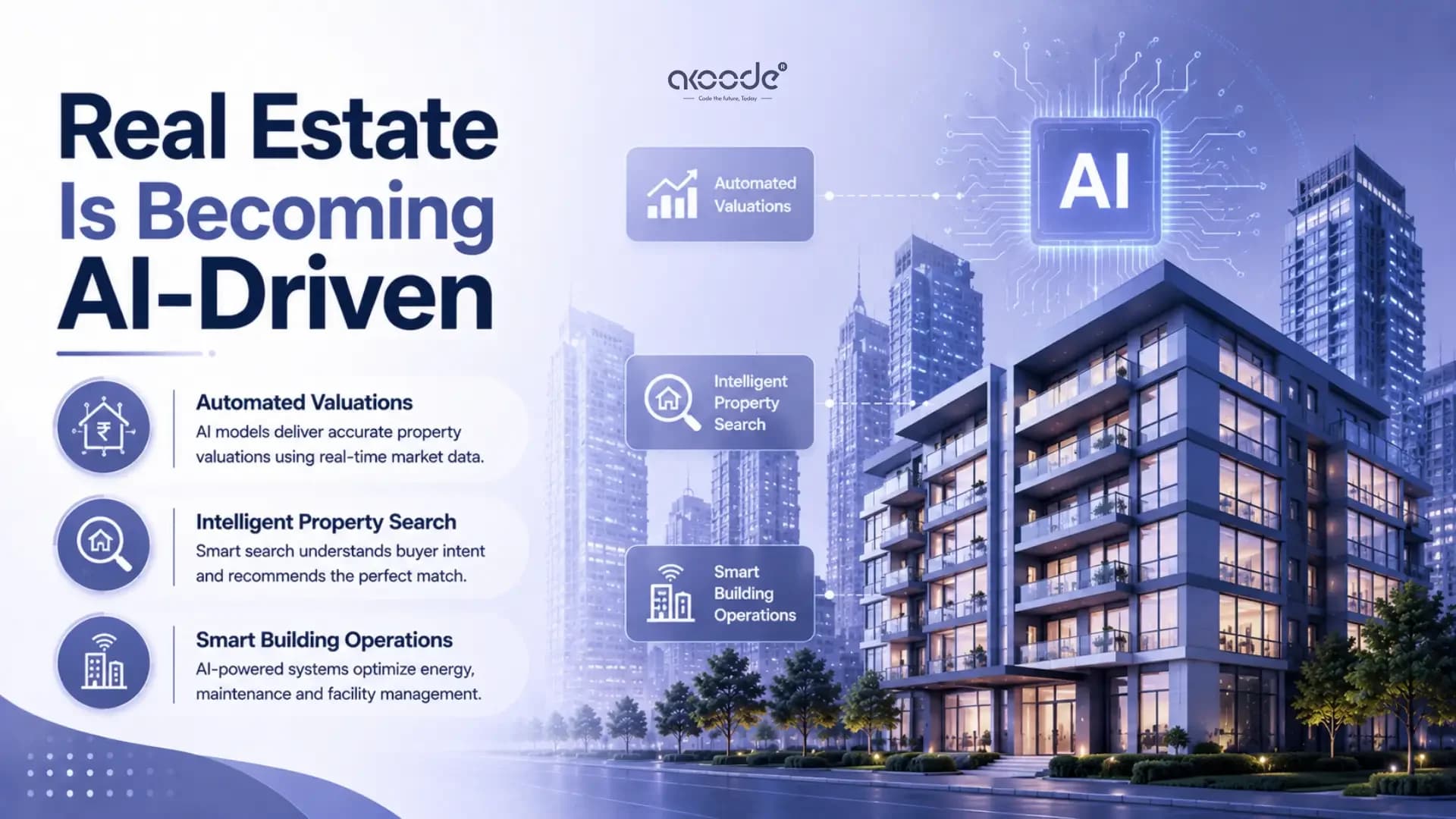
Automated Valuation Models work differently. They process hundreds of data points simultaneously. Historical transaction data. Comparable sales. Location signals. Infrastructure developments. Economic indicators. The result is an instant estimate that updates as market conditions change.
In India, this is particularly valuable. A 1,200 square foot apartment in Whitefield and one in Marathahalli four kilometres away have completely different price stories. Models trained on RERA filings, registration data, and neighbourhood development patterns understand those micro-market differences in ways that broad averages never could.
For investment firms evaluating portfolios, AI valuation tools also run scenario modelling. What does this asset look like if the metro extension completes in 2027? What happens to yield if office absorption in this micro-market drops 15 percent? These are questions that used to require weeks of analyst time. AI answers them in minutes.
How Does AI Transform Property Search for Buyers?
Most property search in 2020 was a database filter. Enter criteria. Get matching results. The intelligence was in the database structure, not the system.
Search in 2026 works differently. Natural language processing lets buyers describe what they want in plain terms. Not just "3BHK Noida under 90 lakhs" but "good light in the mornings, a separate study, quiet neighbourhood, close to schools." The AI reads intent, not just keywords.
Personalisation adds another layer. Every interaction tells the system something. Which listings a user views longer. Which types they save. Which ones they return to. After a few sessions, the platform is surfacing listings that match what the buyer actually wants, not just what they typed in the search bar.
Platforms that have deployed this consistently report longer sessions, better lead quality, and higher conversion from enquiry to site visit. The improvement is not marginal.
What Role Does AI Play in Lead Management?
Agents spend a large part of their day on tasks that do not need their expertise. Responding to basic enquiries. Chasing follow-ups. Qualifying whether a buyer is serious. Scheduling viewings.
AI handles all of this. Chatbots respond to enquiries immediately, at any hour, in multiple languages. They answer standard questions, collect buyer information, and escalate to an agent when the conversation reaches a point that needs human judgment.
Lead scoring models rank incoming enquiries by purchase probability before an agent touches them. The signals are subtle. How quickly someone responds. Whether they ask specific questions about floor plans or just ask for a brochure. Whether their browsing history shows they have been looking at this price range for six weeks or six hours.
For Indian property platforms that receive thousands of enquiries daily across Tier 1 cities, this is not a nice-to-have. Scaling without AI-powered lead management means scaling the agent headcount at the same rate as enquiry volume. That equation breaks quickly.
How Is AI Being Used in Property Management?
Manual property management has a ceiling. One manager handling thirty units can provide decent service. That same manager handling three hundred cannot.
AI lifts that ceiling. Maintenance requests submitted through a tenant app are automatically categorised by priority, assigned to the right contractor, and tracked to resolution. The property manager sees a dashboard rather than an inbox. They focus on exceptions, not routine processing.
Predictive maintenance takes this further. IoT sensors in building systems generate continuous data. HVAC units. Elevators. Water infrastructure. Electrical panels. AI models analyse this data for early warning patterns. A bearing running warmer than its baseline for three consecutive days is a signal. The system flags it, schedules a service visit, and resolves the problem before the tenant experiences anything wrong.
In India's commercial real estate market, this capability is moving from premium feature to standard expectation. Grade A office buildings are specifying AI-enabled facility management as part of lease terms.
What Are Virtual Tours and AI Doing to the Buyer Journey?
Properties with virtual tour capability consistently attract more enquiries than photo-only listings. Buyers who complete a virtual tour before a physical visit are more informed, more committed, and further along in their decision. The conversion rate from these enquiries is measurably higher.
AI adds two layers to this. Personalisation during the tour itself. A system that knows a buyer prioritises a home office and natural light highlights those features as they navigate the property. They see what matters to them first, not a default walkthrough designed for a hypothetical average buyer.
Generative design is the second layer. A buyer evaluating a bare-shell apartment can see it rendered with their preferred kitchen, flooring, and furniture configuration in real time. Developers using these tools report faster decision timelines and fewer post-purchase changes.
How Is AI Reshaping Real Estate Investment Decisions?
Investment in real estate has always blended data and instinct. AI is shifting that balance toward data without removing the judgment that experienced investors bring.
Predictive analytics platforms now analyse thousands of data points across a target market and produce investment signals based on historical patterns. Neighbourhood appreciation trajectories. Rental yield forecasting. Development pipeline analysis. Supply and demand correlation with employment data.
These analyses used to take a research team weeks. They were always at risk of being outdated by the time they reached the investor. AI produces them continuously and updates them as new signals arrive.
For investors evaluating markets in India, this is particularly relevant. Secondary cities like Kochi, Coimbatore, and Indore are generating yield opportunities that national-level analysis consistently underweights. AI tools that analyse granular local data surface these opportunities before the broader market has priced them in.
Understanding the latest shifts in AI software development is worth tracking for anyone building investment platforms, since the pace of capability change in AI directly affects what is now buildable within a realistic budget.
How Is AI Improving Construction and Development in India?
AI in Indian real estate is not limited to the transaction and management layers. The construction process itself is changing.
Project management tools analyse construction schedules and flag delays before they become crises. A material delivery that will arrive late on a critical path item represents a cash flow problem and a RERA compliance risk if caught three days before it happens. Caught three months before it happens, it is a scheduling problem with options.
Computer vision on construction sites compares drone footage against the building information model. Deviations are flagged automatically. Quality control work that previously required senior engineers to physically inspect every section is partially automated, freeing expert time for decisions that actually need it.
Generative design tools let architects evaluate thirty building configurations in the time it used to take to produce three. Each variant is assessed against cost, natural light, sustainability performance, and regulatory compliance simultaneously.
What Challenges Does AI Face in Indian Real Estate?
AI adoption in Indian real estate is accelerating. It is also hitting real constraints that businesses need to plan for honestly.
Data quality is the biggest one. AI models need clean, consistent, well-labelled data to produce useful outputs. Indian property data is fragmented across state registration systems, municipal records, RERA filings, and private databases that do not share a common structure. Building the data layer required for a useful model often costs more and takes longer than the model development itself.
Regulatory uncertainty around AI-generated valuations and AI-facilitated transactions is another active challenge. The legal framework is still developing. Businesses deploying AI in regulated parts of the property transaction process are operating in an environment where the rules are being written as the technology is being deployed.
Change management within traditional brokerage networks is consistently underestimated. Experienced agents who have built careers on local market knowledge can be resistant to tools that appear to reduce the value of what they know. The most effective deployments frame AI as amplifying agent capability rather than replacing it. That framing is not just messaging. It is accurate.
Before starting any AI deployment, understanding what AI development actually costs end to end, including data preparation and change management, prevents the budget surprises that cause real estate AI projects to stall after the pilot phase.
How Should Real Estate Businesses Start With AI?
The most common mistake is trying to do everything at once. A developer that attempts to deploy AI across valuation, lead management, construction monitoring, and virtual tours simultaneously typically sees none of them reach the quality threshold that creates real value.
Pick one workflow. Identify the single application where AI would produce the clearest, most measurable outcome in the next 90 days. For a developer, that might be AI-powered lead qualification for incoming enquiries from their portal. For a property manager, it might be automated maintenance request routing for their largest building. For an investment firm, it might be a market analytics dashboard for one target city.
Start there. Measure the outcome. Build on what works. The businesses seeing the best returns from AI in Indian real estate are the ones that started narrow, proved the value quickly, and expanded deliberately.
For real estate businesses thinking about where AI applies beyond property, how AI is used across different business functions gives a broader picture of where the technology creates consistent, repeatable value.
Conclusion
Every part of the real estate business is changing. Search. Valuation. Lead management. Construction. Investment. Property management. AI is not disrupting one workflow. It is running through all of them.
The firms that will lead India's property market through the next decade are the ones making deliberate AI investments now. Not broad deployments without clear metrics. Targeted implementations in workflows where data quality is manageable and outcomes are measurable.
The technology partner you choose matters as much as the use case you start with. Real estate AI projects fail most often not because the technology is wrong but because the team implementing it does not understand the domain it is being deployed into.
Akoode Technologies is a leading AI and software development company headquartered in Gurugram, India, with a US office in Oklahoma. From AI-powered real estate platforms and real estate application development to custom property software and SaaS products, Akoode builds technology for PropTech startups, developers, and enterprise property businesses across 15+ industries globally. If you are planning an AI project for your real estate business and want a partner who understands both the technology and the market it is being deployed into, that conversation starts here.
Frequently Asked Questions
1. How is AI being used in real estate in 2026?
AI in real estate covers automated property valuation, personalised search, AI-powered lead qualification, predictive maintenance for building systems, construction project monitoring, investment analytics, virtual tour personalisation, and full tenant lifecycle automation. In India, adoption is accelerating across luxury residential, commercial property management, and digital transaction platforms.
2. How is AI used in Indian real estate specifically?
Indian developers are using AI for pricing models trained on RERA and registration data, chatbot-based lead qualification, smart building systems in Grade A commercial properties, and investment analytics for domestic and NRI buyers. AI is also being applied to construction monitoring and regulatory compliance tracking for RERA delivery commitments.
3. Can AI replace real estate agents?
Not in 2026 and not in the foreseeable future. AI handles the automatable parts of an agent's work: lead qualification, enquiry responses, scheduling, and market data retrieval. Negotiation, relationship management, complex deal structuring, and managing client confidence through a major financial decision remain human functions. The best agents in 2026 use AI to free their time for this higher-value work.
4. What are the main challenges of AI in Indian real estate?
Data quality and fragmentation across state systems is the biggest challenge. Regulatory uncertainty around AI-generated valuations is a second. Change management within traditional brokerage networks is consistently underestimated. Data preparation costs are often higher than the model development costs themselves.
5. How much does AI implementation cost for a real estate business?
A chatbot-based lead qualification system costs $15,000 to $50,000. A custom automated valuation model costs $60,000 to $150,000. A full predictive analytics platform costs $150,000 to $400,000 or more. Data preparation typically adds 20 to 40 percent to the model cost and is the most commonly underestimated budget line.
6. What is the best way to start using AI in a real estate business?
Start with one workflow where the outcome is clearly measurable within 90 days. Lead qualification, maintenance request automation, or a market analytics tool for one target geography are all practical starting points. Prove the value at small scale before expanding. Businesses that try to deploy AI across multiple workflows simultaneously typically see none of them reach the quality threshold that creates real operational value.
Get In Touch Now
View More Our Blog