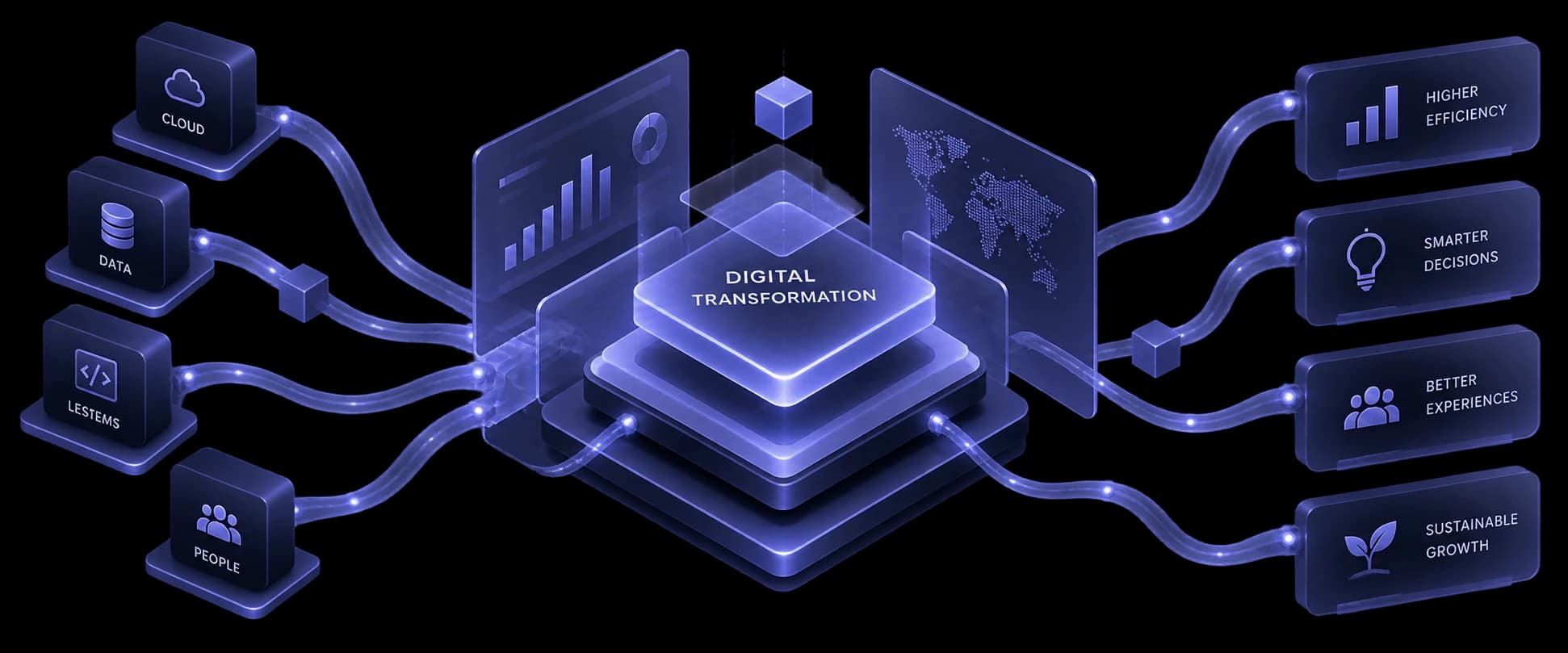
Digital Transformation Company in India
Akoode is a digital transformation company in India helping enterprises and growing businesses modernize legacy systems, automate operations, integrate enterprise applications, and build AI-ready digital platforms
The Tools Aren't the Problem, the Systems Underneath Them Never Talked to Each Other
A business can buy the best CRM, the best analytics platform, and the best automation tool on the market, and still be running on disconnected systems that nobody designed to work together.

Our Positioning
Akoode is not a software vendor selling you a platform and walking away.
We are a digital transformation company that redesigns the operating model first, then builds the technology to support it, so the tools actually get used the way they were supposed to.
CONNECTED System Real Outcomes
The Reality
Here's the pattern behind most transformation engagements we take on.
A business has grown past the systems it started with, a CRM that doesn't talk to the ERP, a reporting process that's really three people manually exporting spreadsheets every Friday, an approval workflow that lives in someone's email inbox because nobody ever automated it. None of this looks urgent day to day. It just quietly costs hours, then headcount, then eventually a competitive disadvantage nobody can point to a single cause for.
Why Now
By the time a business calls a digital transformation company, the cost of staying disconnected usually isn't theoretical anymore.
It shows up as decisions made on data that's two weeks stale, as customer experience that breaks the moment a request touches more than one system, and as an engineering team spending more time patching integrations than building anything new. In 2026, with AI-driven automation genuinely capable of removing entire categories of manual work, the businesses still running on disconnected systems aren't just inefficient, they're the ones a faster-moving competitor is quietly pulling ahead of.
Our Digital Transformation Services
Every engagement gets scoped against a measurable outcome: fewer manual hours, faster decisions, lower operating cost, or a customer experience that finally holds together across channels.
 Talk to Our Team
MODERNIZE
Enterprise Application Modernization
Modernize legacy systems into scalable, cloud-native applications while reducing technical debt, improving maintainability, and creating a flexible technology foundation that supports new features, integrations, and future business growth.

MIGRATE
Cloud Migration & Optimization
Migrate and optimize your infrastructure across AWS, Azure, or GCP with the right architecture for your workload, improving scalability, reliability, performance, and cloud cost efficiency while minimizing operational disruption.
INSIGHTS
Data Analytics & AI Integration
Connect fragmented data sources and build reliable data pipelines, analytics, and AI-driven systems that turn operational information into real-time insights, faster decisions, predictive capabilities, and measurable business outcomes.
AUTOMATE
Robotic Process Automation
Automate repetitive, rules-based workflows such as finance reconciliation, data entry, approvals, and reporting to reduce manual effort, minimize errors, improve operational efficiency, and give teams more time for higher-value work.
CONNECT
Customer Experience Transformation
Connect web, mobile, support, and backend systems to create seamless customer journeys across channels, improving consistency, personalization, and operational visibility while ensuring every customer interaction is supported by connected technology.
PROTECT
Cybersecurity & Risk Management
Build security into transformation initiatives from the beginning with risk assessments, access controls, compliance practices, monitoring, and secure architecture that protect business systems while supporting modernization, scalability, and operational continuity.
Capabilities Most Transformation Vendors Treat as an Afterthought
Modernizing one system is straightforward. The capabilities below are what decide whether the whole transformation actually holds together a year later.
Enterprise System Integration
CRMs, ERPs, and internal tools connected into one coherent system instead of a collection of platforms that each do their job in isolation. This is where most "transformation" projects quietly fail, and where we spend real engineering time.
Change Management and Adoption
New systems that nobody actually uses aren't a transformation, they're an expensive shelf item. We build training and adoption plans alongside the technical rollout, not as an afterthought once the system's already live.
Process Redesign, Not Just Digitization
Automating a broken process just makes the broken process faster. We redesign the workflow itself before automating it, so the outcome is actually better, not just quicker at being the same.
Data Governance and Quality
AI and analytics are only as good as the data underneath them. We build data quality and governance into the pipeline from the start, so "garbage in, garbage out" isn't the quiet failure mode nobody catches until the dashboard's already wrong.
Phased Rollout Strategy
Transformation doesn't have to mean a risky big-bang cutover. We stage rollouts so the business keeps running while systems change underneath it, with rollback points built in at each stage.
Post-Launch Optimization
The system that goes live on day one isn't the system that should still be running unchanged a year later. We stay engaged to tune, adjust, and improve based on how the transformation actually performs once real usage hits it.
Which Digital Transformation Approach Fits Your Business?
Not every business needs a full transformation. Choose the right scope based on the systems involved, the problem you're solving, and how much change your organization actually needs.
Multiple disconnected systems or a broader operational change
Several months to a year+
Scope creep and slow early results
One legacy system creating a clear bottleneck
Weeks to a few months
Fixes one system while surrounding issues remain
One repetitive process consuming significant time
2–6 weeks
Solves one task while a larger systems problem remains
If the real problem is one legacy system nobody's touched in years, a full transformation engagement is more than the problem needs, and we'll say so. If the disconnection runs across finance, operations, and customer-facing systems all at once, starting with a single automation project just delays the work that actually needs doing.
Not Every Problem Needs a Transformation
If one legacy system is the bottleneck, a focused modernization may be enough. If multiple departments and systems are disconnected, a broader transformation can address the underlying operational problem.
What Digital Transformation Actually Costs and How Long It Takes
On the page directly, rather than left for a sales call, because cost and timeline are usually the two questions that decide whether a shortlist conversation even starts.
What Drives the Cost

Number of Systems
More systems mean more integration, migration, testing, and coordination work.
Data Complexity
Clean, structured data requires less effort than fragmented data across spreadsheets, databases, and legacy systems.
Change Management
Transformations spanning multiple departments require more training, adoption planning, and organizational support.
Compliance Requirements
Regulated industries require additional security, governance, documentation, testing, and audit preparation.
HOW LONG IT ACTUALLY TAKES
Single System Modernization
A focused legacy-system upgrade with defined scope and limited dependencies.
6–12
WEEKS
Full Digital Transformation
Multiple systems, process redesign, integration, technology modernization, and organizational change.
4–9
MONTHS
Point Automation
A focused automation project targeting one repetitive, rules-based business process.
2–6
WEEKS

A number quoted before we understand your systems is a guess dressed up as a quote.
We provide a fixed estimate after assessing your systems, workflows, data, and requirements - so you're comparing a real project scope, not a marketing range.
Where Digital Transformation Stands in 2026
None of this is a forecast. These are the conditions already shaping transformation budgets and priorities this year.

Five Trends
Shaping
Transformation
in 2026
Is AI now the starting point for digital transformation, or still an add-on?
For most businesses starting a transformation initiative in 2026, AI integration is designed in from the beginning rather than bolted on once the "real" transformation is finished. The businesses treating AI as a separate, later phase are increasingly the ones rebuilding parts of their architecture a second time to accommodate it properly.
Why has process redesign overtaken pure digitization as the priority?
Digitizing a broken process just makes the broken process faster, and enough businesses learned that lesson the expensive way that process redesign now comes before automation in most serious transformation scopes, not after. The conversation has shifted from "how do we automate this" to "should this process even exist in its current form."
How is change management changing as transformation projects get faster?
Faster implementation timelines have made change management the actual bottleneck in more transformation projects than the technology itself. A system that ships in six weeks but takes six months for the organization to actually adopt hasn't saved anyone time, and businesses are increasingly budgeting for adoption as seriously as they budget for development.
Why are businesses choosing phased modernization over full-scale rebuilds?
Big-bang legacy rebuilds carry a failure risk most businesses have grown unwilling to accept, especially once a few high-profile failed rebuilds became industry cautionary tales. Phased modernization, replacing and validating one component at a time, has become the default approach precisely because it keeps the business running throughout instead of betting everything on a single cutover date.
How is data governance shaping AI adoption in transformation projects?
As more transformation initiatives lean on AI-driven decision systems, the businesses getting real value are the ones that treated data quality and governance as foundational work, not cleanup done after the fact. The gap between businesses with genuinely trustworthy data and those without it has become one of the clearest predictors of whether an AI initiative actually delivers.
Digital Transformation Across 15+ Industries
Every industry has different systems, processes, and challenges. We build transformation strategies around the operational realities of your business-not a one-size-fits-all approach.
Explore Industries
01 —
Real Estate
- Unified Property Management
- Connected Customer Engagement
- Real-Time Leasing Data
Property management often relies on disconnected spreadsheets, platforms, and communication channels. We build digital platforms that unify property management, customer engagement, and leasing data, helping teams make faster decisions using current occupancy, demand, and operational information.
Property Data ↑
Unified
Leasing ↑
Connected

Our Digital Transformation Process
Six stages, and skipping the first one is the single most common reason a transformation initiative ends up solving the wrong problem well.
Digital Transformation Technology Stack
Our digital transformation technology stack is designed around your existing architecture, business requirements, scalability goals, security requirements, and modernization roadmap. We select the right combination of cloud, application, AI, data, automation, and DevOps technologies rather than forcing every business into the same technology stack.
 Google Cloud
 Microsoft Azure
 AWS
AWSFlexible Engagement Models for Digital Transformation
Every transformation initiative has a different shape, so there are three ways to work with us. Pick whichever fits how defined your scope is right now, and how long you need strategic ownership to continue.
Fixed Cost
Best for: a defined modernization or automation project with clear boundaries
- Price, timeline and scope agreed before a line of code gets written, and they stay agreed
- Milestones with acceptance criteria you personally sign off, one by one
- The low-risk route for a single system modernization or point automation project
- If mid-project surprises are what worry you, this model exists to prevent them
Dedicated Team
Best for: a full transformation initiative that spans multiple systems and departments
- Consultants and engineers who work as part of your team, not around it
- You set priorities. We execute against the roadmap. That simple
- Grow or shrink the engagement as the transformation's scope evolves
- Plugs into whatever tools and workflows your team already runs
- You talk to the people doing the actual work. Never through an account manager
Staff Augmentation
Best for: a specific transformation skill gap today, or capacity for a defined phase
- Specialists who slot into your existing team and initiative from day one
- Senior transformation, data, or automation skills without a full-time hire
- Add capacity when a phase tightens the timeline, release it when it's done
- Onboarded and contributing within days. Not months. Days
Work That Speaks for Itself
Real challenges. Practical transformation. Measurable outcomes. Explore how we help businesses modernize systems, connect operations, and build for what comes next.
Website Development and Digital Transformation
Key Outcomes
4+
Service Categories Structured
8+
Industries Represented
Challenge
What We Built
Website Redesign and Digital Transformation
AI-Powered Hair Analysis
Key Outcomes
Seconds
Scalp Analysis Speed
Real-Time
3D Simulation Output
Challenge
What We Built
Why Choose Akoode as Your Digital Transformation Company
Plenty of vendors can sell you a platform. Choosing a transformation partner is really a decision about who's accountable for whether the systems underneath that platform actually work together once it's live.

Talk Directly with Our Founder
Discuss your software vision, AI roadmap, and delivery strategy with the team leading product engineering at Akoode.
Digital Transformation FAQs
Straight answers on timelines, team shape, security, and how we plug into your existing delivery process.
A digital transformation company helps businesses redesign how they operate, not just adopt new software. That means auditing current systems and workflows, building a roadmap tied to actual business goals, and then implementing the technology, cloud, AI, automation, integration, that supports the redesigned operation, not the other way around.
New software solves one problem in isolation. Digital transformation looks at how systems, processes, and data connect across the whole business, so the new tool actually integrates with everything around it instead of becoming one more disconnected system to manage.
It depends on how many systems are involved, how complex your existing data is, and how much organizational change management the initiative needs. A single system modernization and a full multi-department transformation sit in genuinely different cost brackets. We give a fixed estimate after an actual assessment of your systems and workflows.
A single system modernization typically runs six to twelve weeks. A full transformation spanning multiple systems and departments usually takes four to nine months, sometimes longer for large organizations. Point automation projects are often the fastest, typically two to six weeks.
Not always a full transformation, and we'll tell you that in the first conversation if it's true. If the real problem is one legacy system, that's a smaller, faster engagement, not a strategic transformation initiative dressed up as bigger than it needs to be.
No. The scope changes, not the underlying need. Small and mid-sized businesses often see faster, more visible returns precisely because there are fewer systems to untangle and adoption happens faster across a smaller team.
This is exactly why change management runs alongside the technical rollout, not after it. Training, clear communication, and phased adoption plans are built into the engagement from the start, because a system nobody uses isn't a completed transformation, whatever the deployment dashboard says.
Yes, healthcare, finance, and insurance transformations all carry real regulatory weight, and compliance gets designed into the architecture from day one rather than audited in afterward. Data governance and audit trails are treated as core requirements, not paperwork bolted on at the end.
Often, yes. Enterprise system integration is one of our core capabilities specifically because replacing a working system outright is rarely the right call. We connect what's already working and modernize what genuinely needs to change.
Yes, a significant share of our digital transformation work comes from clients in the US, UK and UAE. Communication runs through whatever tools your team already uses, and several of our longest-running transformation engagements have been fully remote from the first strategy conversation.
Ready to Build a Smarter Digital Future? Before It Costs You a Year
Stay Informed With Thoughtful Innovation
Subscribe To The Akoode Newsletter For Carefully Curated Insights On AI, Digital Intelligence, And Real-World Innovation.