


 May 28, 2026
Over 70 percent of property searches now start on a mobile device. Buyers browse listings on their commute. Agents manage portfolios from their phones. Investors run neighbourhood analytics from dashboards built for mobile-first workflows.
For real estate businesses and PropTech founders, the question is no longer whether to build an app. It is what a serious one actually costs to build and maintain.
This guide gives you production-grade pricing, not the lowest possible quote. The numbers reflect what it takes to build a real estate app that competes with the platforms users already compare yours against.
What Drives Real Estate App Development Cost More Than Anything Else?
Two variables dominate every real estate app budget. Feature complexity and data integration depth.
Feature complexity is straightforward. A property listing app with search filters costs a fraction of a full marketplace platform with agent tools, mortgage calculators, and AI-powered valuations. Every feature added has a cost attached to the build, the testing, and the ongoing maintenance.
Data integration is where most real estate apps run into unexpected cost. MLS and IDX integrations in US markets require licensing approvals, custom data mapping, and ongoing compliance with listing display rules. Connecting a property app to live price feeds, government land records, or valuation APIs requires backend architecture that grows significantly in complexity compared to a standard content-driven app.
Third-party integrations, map and geolocation, payment processing, identity verification, CRM connectivity, and virtual tour tools, each add between $8,000 and $35,000 to the total development scope depending on complexity.
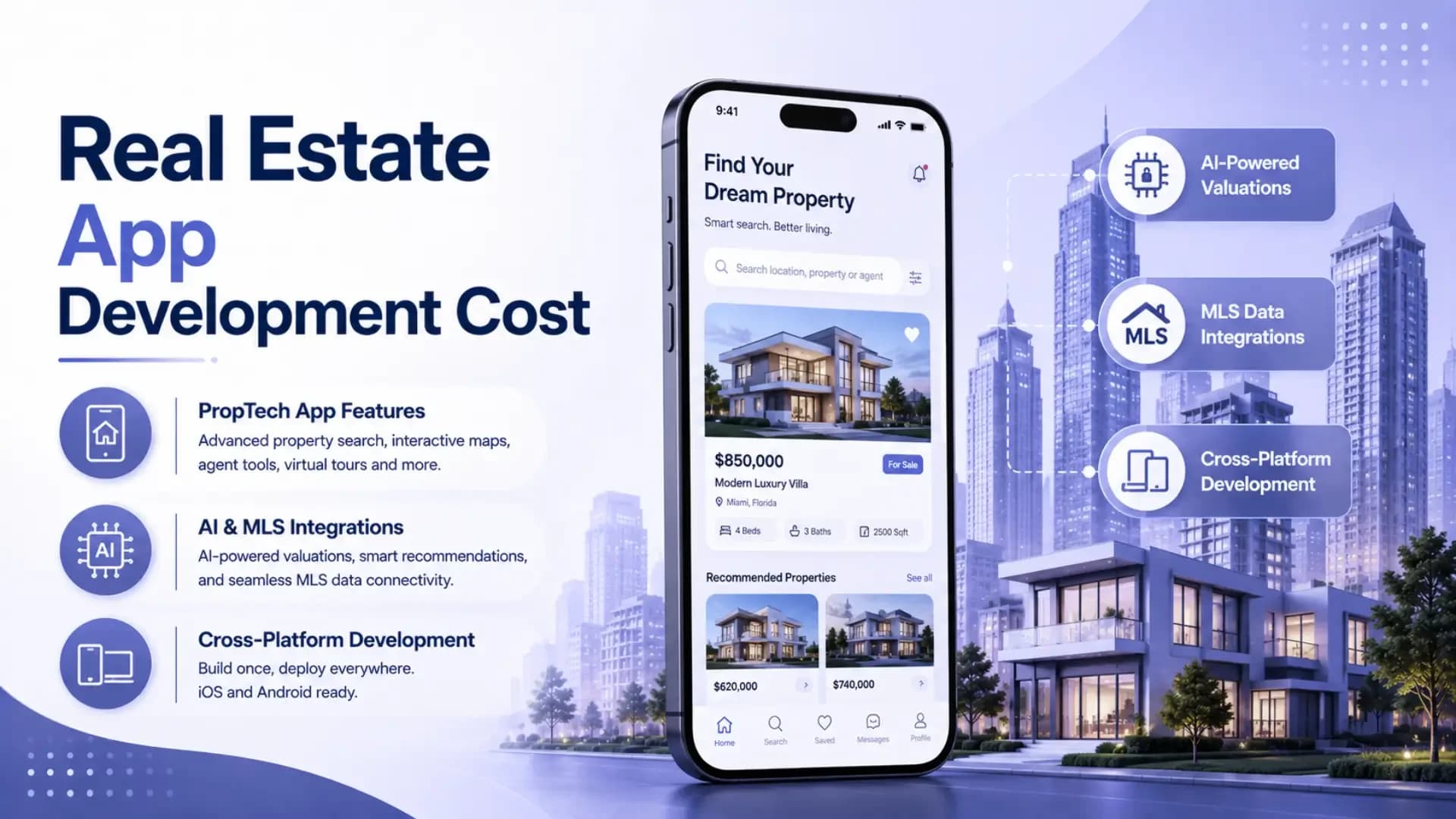
Platform strategy is the third significant variable. A React Native app covering both iOS and Android from one codebase costs 40 to 50 percent less than two separate native builds delivering the same features. For most real estate platforms launching in 2026, cross-platform development offers the best balance of cost efficiency and performance. Native development makes sense when the app depends heavily on device-specific features like augmented reality property overlays or high-performance 3D rendering.
How Much Does a Real Estate App Cost by Project Tier?
Project Tier | Cost Range | Timeline | What It Includes |
|---|---|---|---|
MVP / Validation Build | $80,000 to $180,000 | 8 to 14 weeks | Property listings, search filters, map integration, user accounts, agent contact |
Version 1 Production App | $180,000 to $450,000 | 16 to 28 weeks | Full marketplace features, agent portal, CRM integration, notifications, analytics |
Advanced Platform (V2+) | $450,000 to $900,000+ | 28 to 52 weeks | AI valuations, predictive analytics, virtual tours, multi-role workflows, enterprise backend |
These figures reflect production-grade development with proper architecture, security, QA across devices, and admin panel included. They are not prototype costs. A prototype gets you a demo. These ranges get you a product you can acquire users with and scale.
US-based development teams price at $100 to $180 per hour for senior engineers. India-based teams with equivalent seniority and real estate domain experience price at $35 to $75 per hour. The same $300,000 V1 build with a US team costs $80,000 to $120,000 with a quality India-based partner. The output, when the right team is selected, is architecturally equivalent.
What Does Real Estate App Development Cost by Feature?
Individual features have their own cost range depending on complexity. Here is what the most common real estate app features cost to build in 2026.
Feature | Development Cost Range |
|---|---|
Property search and listings with filters | $15,000 to $35,000 |
Map and geolocation integration | $8,000 to $20,000 |
MLS / IDX data integration | $20,000 to $50,000 |
User registration and profile management | $8,000 to $15,000 |
Agent portal and CRM integration | $20,000 to $50,000 |
Mortgage calculator and comparison tools | $8,000 to $20,000 |
In-app messaging and lead routing | $15,000 to $30,000 |
Push notifications | $5,000 to $12,000 |
Virtual tour integration | $15,000 to $35,000 |
AI property valuation engine | $35,000 to $80,000 |
Predictive investment analytics | $40,000 to $90,000 |
Blockchain property records | $50,000 to $120,000 |
Admin panel and back-office tools | $20,000 to $50,000 |
The feature cost table reveals something important. A real estate app that includes MLS integration, an agent portal, in-app messaging, virtual tour support, and a basic AI valuation tool will cost $125,000 to $265,000 in features alone before accounting for backend architecture, QA, and deployment.
That is exactly why V1 production apps land in the $180,000 to $450,000 range. The scope required to build something competitive is larger than most initial briefs account for.
What Types of Real Estate Apps Have Different Cost Profiles?
Not all real estate apps are the same product. The type of app you are building determines which features are essential and which cost lines dominate the budget.
Property listing and search apps are the most common entry point. The core requirement is a fast, filterable search experience connected to a live property database. Map integration, property detail pages, high-quality image handling, and agent contact flows are the baseline. These apps cost $80,000 to $180,000 for a serious V1.
Real estate marketplace platforms connect buyers, sellers, renters, landlords, and agents on one platform. They require multi-role user systems, bidding or offer management workflows, review systems, identity verification, and payment processing. The complexity is substantially higher. Budget $200,000 to $500,000 for a marketplace with real market depth.
Property management apps serve landlords and property managers rather than buyers and renters. Core features include tenant onboarding, digital lease signing, rent payment processing, maintenance request management, and financial reporting. A full-featured property management app costs $150,000 to $350,000.
Real estate investment platforms serve investors who need yield analysis, market trend data, portfolio tracking, and predictive analytics. These are data-intensive products. AI and analytics features dominate the cost. Budget $200,000 to $500,000 for a platform that delivers real analytical depth.
Agent and broker tools help real estate professionals manage leads, listings, client communications, and performance metrics. CRM integration, lead routing, and reporting are the primary cost drivers. These range from $80,000 to $250,000 depending on the depth of workflow automation.
For real estate technology businesses evaluating which app type to build first, starting with a clearly defined user segment and validating one core workflow before expanding is consistently the approach that gets to market fastest without overbuilding.
How Does Platform Choice Affect the Total Cost?
Every real estate app development budget is directly shaped by the platform decision made early in the project.
Native iOS development builds specifically for Apple devices using Swift. It delivers the best performance for feature-heavy apps and the most direct access to iOS-specific capabilities. iOS app development is the right choice when the primary user base is on iPhone and the app relies on demanding features like AR property overlays or intensive map rendering. It costs more and takes longer than cross-platform.
Native Android development mirrors this logic for Android users. In India and many emerging markets, Android holds a dominant share. A platform targeting these markets benefits from Android app development as the primary build. Building separate native apps for both platforms adds 40 to 60 percent to the total development budget compared to a cross-platform approach.
Cross-platform development using Flutter or React Native produces one codebase that runs on both iOS and Android. For most real estate apps in 2026, the performance difference between cross-platform and native is not visible to users. The cost saving is real. Cross-platform development typically costs 35 to 50 percent less than two separate native builds for equivalent features. Flutter app development is particularly strong for design-heavy real estate apps where visual consistency across devices matters. Hybrid app development suits teams that need web and mobile delivery from a single codebase.
The platform decision should be driven by your primary user's device preference, your feature requirements, and your budget. For most PropTech startups building in 2026, a cross-platform V1 followed by native investment where specific features demand it is the most economically sound approach.
How Do AI Features Add to Real Estate App Development Cost?
AI has moved from a differentiator to a competitive baseline in real estate apps. The question is no longer whether to include AI but which capabilities are worth the investment at your current stage.
Automated valuation models use machine learning trained on historical sales data, property attributes, and local market signals to generate instant property price estimates. Building a proprietary AVM adds $35,000 to $80,000 to the development scope. Using a third-party valuation API like Zestimate or HouseCanary costs far less but produces generic results not tuned to your specific market.
AI-powered property recommendations analyse user behaviour to surface relevant listings ahead of manual search. Implementing a recommendation engine adds $25,000 to $60,000. The impact on user engagement is measurable. Personalised recommendations consistently improve session depth and lead generation rates.
Virtual tour integration using platforms like Matterport or Cupix adds $15,000 to $35,000 to the build budget. Properties with virtual tours receive significantly more enquiries than photo-only listings. For platforms targeting premium property segments, this investment directly impacts the core conversion metric.
Predictive investment analytics covering neighbourhood appreciation, yield forecasting, and comparative market analysis are the most expensive AI feature category. Building this capability properly costs $40,000 to $90,000 and requires access to reliable historical and real-time market data as inputs.
The broader context for where AI sits in the PropTech market right now is covered in detail in the PropTech trends guide, which covers how AI is reshaping the entire real estate technology stack in 2026.
What Are the Hidden Costs of Real Estate App Development?
The development invoice is the visible cost. Several significant costs sit outside it.
MLS and IDX licensing. Access to live MLS data in US markets requires licensing agreements with regional MLS boards. Approval timelines range from two to eight weeks. Licensing fees vary by market. This process affects both budget and timeline but rarely appears in initial project quotes.
Ongoing infrastructure costs. A production real estate app running live property data, high-resolution images, map tiles, and user sessions requires meaningful cloud infrastructure. AWS, Google Cloud, or Azure costs for a mid-scale real estate platform run $2,000 to $8,000 per month. This figure grows with user scale and media storage volume.
App Store fees and compliance. Apple charges $99 per year for developer account membership. App Store review requirements for real estate apps that handle financial transactions or user data are strict. Google Play carries a $25 one-time registration fee. Both platforms require compliance with privacy and data handling standards that need engineering time to implement correctly.
Post-launch maintenance. Platform updates, OS compatibility patches, third-party API deprecations, and performance improvements are ongoing costs. Plan for 20 to 25 percent of the original build cost annually for maintenance and iteration. A $200,000 app requires $40,000 to $50,000 per year to keep production-ready.
Security and compliance audits. Real estate apps handling personal data, financial transactions, or identity verification require periodic security audits. A professional penetration test and security audit costs $8,000 to $25,000. Regulated markets require these as a standard part of the deployment process.
How Should You Structure the Budget for a Real Estate App Build?
Budget allocation determines whether a real estate app launches with real market potential or as a technically functional product with no users.
A practical allocation for a $200,000 real estate app build looks like this. Forty to fifty percent goes to development across frontend, backend, and API integration. Fifteen to twenty percent goes to UI/UX design. Ten to fifteen percent goes to QA and testing. Ten percent goes to deployment infrastructure and DevOps setup. The remaining fifteen to twenty percent should be reserved for post-launch iteration based on early user behaviour.
The post-launch reserve is the budget line most teams cut first. It is consistently the one that determines whether the product improves past its launch state. User behaviour in a production environment always reveals something the brief did not anticipate. Having budget to respond to that signal is the difference between a product that compounds and one that stagnates.
For teams evaluating the full mobile app development investment across platforms and project types, understanding the end-to-end cost structure before briefing a development partner prevents the most common and expensive budget surprises.
Conclusion
A real estate app that competes in 2026 is not a simple listing tool. It is a data-intensive, AI-capable, multi-platform product that handles live property data, complex user workflows, and high user expectations shaped by the best consumer apps on the market.
The cost reflects that complexity. A production-ready V1 real estate platform costs $180,000 to $450,000. An advanced platform with AI, predictive analytics, and marketplace infrastructure costs $450,000 to $900,000 or more. These are not overestimates. They are what serious PropTech products cost to build properly in 2026.
The businesses that build successfully at these budgets share one habit. They scope precisely, choose the right platform strategy for their user base, invest in architecture that does not need to be rebuilt at the next funding stage, and plan for post-launch costs from day one.
Akoode Technologies is a leading AI and software development company headquartered in Gurugram, India, with a US office in Oklahoma. From mobile app development and AI-powered real estate platforms to full stack development and SaaS products, Akoode builds PropTech products for startups, SMEs, and enterprises across 15+ industries globally. If you are planning a real estate app and want production-grade development at a cost structure that makes the investment viable, that conversation starts here.
Frequently Asked Questions
1. How much does real estate app development cost in 2026?
A production-ready real estate app MVP costs $80,000 to $180,000. A full V1 platform with marketplace features, agent tools, and analytics costs $180,000 to $450,000. Advanced platforms with AI valuations, predictive analytics, and enterprise backend infrastructure cost $450,000 to $900,000 or more.
2. What features drive real estate app development cost the highest?
MLS and IDX data integration, AI-powered valuation models, predictive investment analytics, virtual tour infrastructure, and agent CRM integration are the highest-cost features. Each adds $20,000 to $90,000 to the total scope depending on implementation depth.
3. Is cross-platform or native development better for a real estate app?
Cross-platform development using React Native or Flutter costs 35 to 50 percent less than separate native builds and delivers equivalent performance for most real estate app requirements. Native development is justified when the app relies on demanding device-specific features like AR property overlays or intensive real-time 3D rendering.
4. What are the hidden costs of real estate app development?
MLS and IDX licensing fees, cloud infrastructure at $2,000 to $8,000 per month, App Store fees, annual security audits at $8,000 to $25,000, and post-launch maintenance at 20 to 25 percent of the original build cost annually are the most significant costs that do not appear in initial development quotes.
5. How do AI features affect the real estate app development budget?
AI property valuation models add $35,000 to $80,000. Recommendation engines add $25,000 to $60,000. Virtual tour integration adds $15,000 to $35,000. Predictive investment analytics add $40,000 to $90,000. Together, a full AI feature set adds $100,000 to $250,000 to a standard real estate app build.
6. How much does real estate app development cost with an India-based team?
Senior real estate app developers in India charge $35 to $75 per hour. A V1 real estate platform that costs $300,000 with a US-based team can be delivered for $80,000 to $120,000 with an experienced India-based development partner. The architecture, security, and output quality are equivalent when the right partner is selected.
Get In Touch Now
View More Our Blog