


 September 8, 2026
Agentic AI describes AI systems that can pursue a goal with limited supervision — planning a sequence of steps, calling tools or APIs to carry them out, evaluating the results, and adjusting the plan, rather than producing a single response to a single prompt. The defining property is not intelligence, it is autonomy over multiple steps: an agentic system decides what to do next based on what just happened, without a person approving each step in between.
This article defines the term precisely, distinguishes it from generative AI, chatbots, and traditional automation, sets out a five-level scale for how much autonomy a given system actually has, and clears up the misconceptions that make "agentic" one of the most overused words in enterprise technology right now.
1. A precise definition
Agentic AI is AI that operates in a loop: perceive the current state, decide the next action, act, observe the result, decide again — continuing until the goal is met or the system determines it cannot proceed and escalates. That loop is what "agentic" refers to. A system that runs it once, for one step, is not agentic even if it uses the same underlying model. A system that runs it repeatedly, adjusting its own plan based on intermediate results, is.
This is a specific technical claim, not a marketing category, and it is worth being strict about it, because the word is currently applied to almost anything that calls an API.
2. Agentic AI vs generative AI vs automation
These three get conflated constantly, and the conflation causes real buying mistakes — teams pay for agentic capability they don't need, or accept automation dressed up as agentic AI.
Generative AI | Traditional automation | Agentic AI | |
|---|---|---|---|
What it does | Produces content — text, images, code — from a prompt | Executes a fixed, pre-defined sequence of steps | Plans and executes a variable sequence of steps toward a goal |
Decision-making | None beyond the single response | None — the path is fixed at build time | Decides the next step based on the outcome of the last one |
Adapts mid-task | No | No | Yes, within its defined scope |
Needs a human per step | Yes — one prompt, one response | No, but only handles the cases it was built for | No, within its autonomy level (see section 7) |
Typical failure mode | A single wrong or unhelpful output | Breaks visibly when reality falls outside the built-in cases | Can complete several wrong or unnecessary steps before anyone notices |
Example | Drafting an email from a prompt | A fixed workflow that files an invoice into a folder by vendor name | A system that reads an invoice, checks it against a purchase order, flags a discrepancy, and drafts the follow-up email — deciding that sequence itself |
The distinction that matters commercially: generative AI produces an output; agentic AI produces an outcome. A generative system that drafts a reply is finished once the draft exists. An agentic system that handles a support ticket is not finished until the ticket is resolved — which might require checking an order status, applying a policy, and updating a record, in whatever order the specific ticket requires.
Most of what is marketed today as "AI agents" is closer to generative AI with a tool attached — a single model call that happens to invoke an API — than to the loop described in section 1. Section 5 covers how to tell the difference.
3. The four properties that make a system agentic
A system needs all four to be meaningfully agentic. Missing any one of them, it is something else — usually a well-built assistant, which is a legitimate thing to build and not a lesser version of an agent, just a different category. See AI agent vs AI assistant vs copilot for the full distinction.
Planning. The system decomposes a goal into steps itself, rather than following a sequence a developer hard-coded. Given "resolve this customer's billing complaint," it determines which checks are needed for this specific complaint, rather than running the same fixed script for every complaint.
Tool use. It acts on the world through defined tools and APIs — querying a database, calling a service, writing to a system of record — rather than only generating text. Tool use is what turns a language model's output into an action with a real effect.
Memory. It retains relevant context across the steps of a task — what it has already tried, what it has learned, what the current state is — rather than treating each step as independent of the last.
Iteration and self-correction. It evaluates whether an action succeeded and adjusts course if it didn't, rather than proceeding blindly through a fixed sequence regardless of outcome.
A chatbot with a plugin has tool use but usually no planning or iteration — one tool call per message, decided by the person, not the system. A traditional workflow engine has planning in the sense that a sequence exists, but the sequence was decided by a developer at build time, not by the system at run time. Agentic AI is specifically the combination of all four properties operating together, in a loop, with the system itself deciding what happens next.
4. A concrete before-and-after example
Non-agentic: a support tool that, when asked, drafts a reply to a customer email based on the email's content. A person reads the draft, checks the customer's account manually, edits the reply, and sends it. The AI produced one output; every other step was human-driven.
Agentic: a system that receives the same email, checks the customer's account and order history itself, determines whether the complaint is valid against a stated policy, drafts a response reflecting what it found, and — if its confidence is high and the action is reversible — sends it directly, escalating to a person only when confidence is low or the action would be costly to undo (a refund above a threshold, for example).
The model doing the drafting can be identical in both cases. What makes the second one agentic is that the system decided to check the account, decided whether the complaint was valid, and decided whether to act or escalate — three decisions a person made in the first version and the system makes in the second.
For a sense of what production-grade discipline actually looks like once a system crosses into agentic territory — tool scoping, approval gates, execution tracing — see the production evidence from our own builds and the deeper architectural walkthrough in agentic AI orchestration.
5. Why "agentic" gets applied to things that aren't
Three quick tests separate genuinely agentic systems from relabelled generative AI or automation.
Test one: does it decide, or does it execute a decision someone else already made? A tool that always performs the same three steps in the same order for every input is automation with an AI-generated component, not an agentic system, regardless of what the vendor calls it.
Test two: can it fail partway through and recover, or does it just stop? Genuine iteration means the system notices a step didn't work and tries something else — a different query, a different tool, an escalation. A system that halts on the first error was never running the perceive-decide-act loop in the first place.
Test three: does removing one possible path change what the system can do, or just how it phrases things? If a system's only variability is in wording, and the sequence of actions is identical regardless of input, the agentic label is describing the language model underneath it, not the system's behaviour.
None of this makes non-agentic tools less valuable. A well-built assistant that drafts, summarises, or extracts with a human reviewing every step is often the right amount of autonomy for a task where errors are costly. The problem is not that non-agentic tools exist — it is that mislabelling them sets a buyer's expectations for a level of autonomy the system was never built to have.
6. Why this is happening now
Interest in agentic AI has moved from research conversation to enterprise roadmap item extremely quickly. Gartner's August 2025 forecast projected that 40% of enterprise applications would embed task-specific AI agents by the end of 2026, up from under 5% in 2025 — an eightfold jump in a single year.
Adoption is running ahead of production maturity, though. Teradata and Wakefield Research's 2026 survey found that 78% of enterprises have at least one agent pilot running, but only 14% have scaled one to organisation-wide use. Gartner separately expects more than 40% of agentic AI projects to be cancelled by 2027. Read together, these numbers describe a technology being adopted faster than most organisations can yet operate reliably — which is exactly why the properties in section 3, and the autonomy scale in section 7, matter more than the marketing term itself.
7. Five levels of agentic autonomy
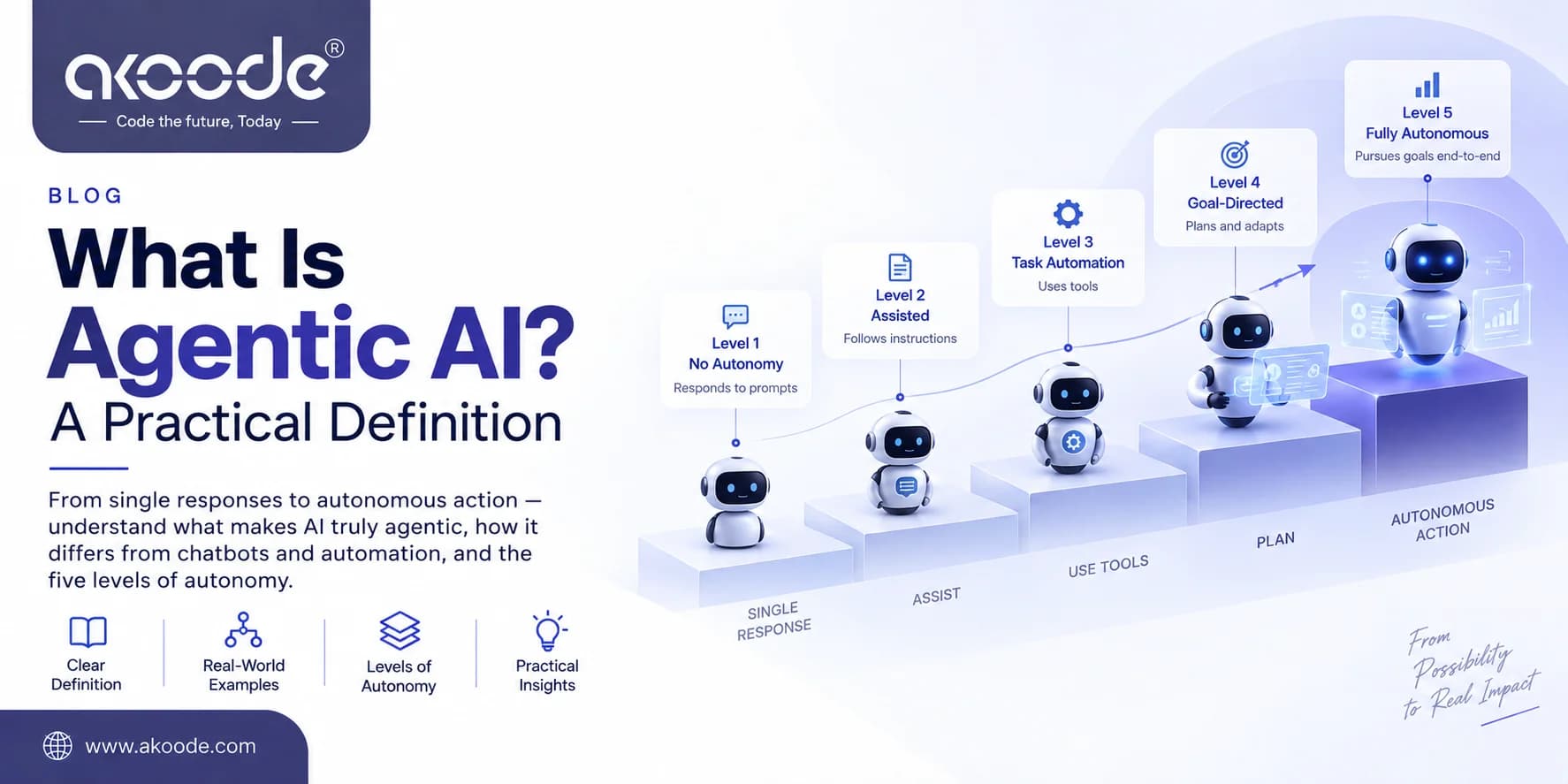
Not every agentic system carries the same amount of risk or requires the same governance. This scale — deliberately modelled on how autonomous driving is graded, because the underlying question is the same: how much is the system deciding without a human in the loop — gives a common vocabulary for describing where a specific system sits.
Level | Name | What the system does | What a human does | Example |
|---|---|---|---|---|
0 | No autonomy | Produces one output per prompt | Initiates and reviews every step | Drafting a single email on request |
1 | Tool-assisted | Calls one tool per request, at the person's direction | Decides which tool and when | A chatbot that looks up an order when explicitly asked to |
2 | Bounded task agent | Plans and executes a short, well-defined sequence within a narrow scope | Reviews the outcome, not each step | An agent that triages and categorises a support ticket end to end |
3 | Supervised autonomous agent | Plans and executes multi-step tasks across a broader scope, with defined escalation rules | Approves specific high-consequence actions only | An agent that resolves a billing dispute and issues a refund below a set threshold, escalating above it |
4 | Coordinated multi-agent system | Multiple specialist agents plan and execute across a complex task, coordinated by an orchestration layer | Sets policy and reviews exceptions, not individual tasks | A multi-agent system handling end-to-end claims processing across intake, verification and settlement |
How to use this scale in practice: most organisations should not aim for level 4 as a starting point, regardless of how the technology is being marketed. The evidence in section 6 — 14% scaled versus 78% piloting — is largely a story of organisations attempting level 3 or 4 systems without first proving level 2 reliably. Enterprise AI agent architecture covers what reliability, security and scalability require once you're operating at level 2 or 3, and agentic AI orchestration covers level 4 specifically — the coordination patterns, protocols and failure modes unique to multiple agents working together.
8. Common misconceptions
"Agentic AI means the system has no human oversight." Every well-built agentic system at any level above 1 has defined escalation points. Autonomy is about who decides the next step during normal operation, not about the absence of a person entirely.
"A bigger or newer model makes a system more agentic." Model capability affects how well each step is reasoned, not whether the system plans, uses tools, remembers context and iterates. A system built on a smaller model with genuine tool use, memory and iteration is more agentic than a system built on the largest available model that only produces a single response per prompt.
"Agentic AI and multi-agent AI are the same thing." A single agent operating the loop in section 1 is fully agentic on its own. Multi-agent systems — level 4 on the scale above — are a further step of coordinating several agentic systems together, covered in depth in agentic AI orchestration. Most organisations need level 2 or 3, not level 4, and conflating the terms leads directly to the over-engineering the field is currently producing.
"If it uses tools, it's agentic." Tool use is one of four required properties, not the whole definition. A system that calls a tool once per human-initiated request, with no planning or iteration, sits at level 1 — genuinely useful, but not what most people mean when they say "agentic."
9. Where agentic AI fits into a build decision
Agentic AI is the right tool for a specific shape of problem: a task whose steps vary case by case, where the variation is too broad for a fixed rule set to cover economically, and where the cost of an occasional wrong step is recoverable. It is the wrong tool when the steps are stable and known in advance — that is a case for conventional automation, covered in our companion piece on when an AI agent is unnecessary — or when a single well-scoped generative AI feature already solves the problem without needing autonomy over multiple steps at all.
Before committing to an agentic build, it is also worth running the same custom AI vs off-the-shelf AI evaluation you would run for any AI investment, and understanding what an agentic system actually costs to build and run — autonomy is not free, and the cost structure of a system that plans and acts across several steps is meaningfully different from a single-response feature.
FAQs
Is agentic AI the same as an AI agent? Close, but not identical in how the terms are typically used. "AI agent" usually refers to one system built around the perceive-decide-act loop. "Agentic AI" refers to the broader category of AI exhibiting that property, and is often used when discussing the field or approach rather than one specific system.
Is ChatGPT or a chatbot agentic AI? Not by default. A chatbot that responds to messages one at a time, with a person deciding what to ask next, sits at level 0 or 1 on the scale in section 7. The same underlying model becomes part of an agentic system once it is wrapped in a loop that plans multi-step actions and decides when to continue or stop without a person driving each step.
What is the difference between agentic AI and RPA (robotic process automation)? RPA executes a fixed, pre-programmed sequence of steps and breaks when reality falls outside those steps. Agentic AI decides the sequence itself based on the specific case, and can adjust when something unexpected happens. RPA is more reliable and cheaper for stable, well-defined processes; agentic AI is better suited to processes with real case-by-case variation.
Do I need multi-agent orchestration to be "doing agentic AI"? No. A single well-built agent operating at level 2 or 3 on the autonomy scale is fully agentic. Multi-agent orchestration is a further architectural choice for tasks that genuinely require multiple specialists coordinating, not a requirement for a system to count as agentic. See agentic AI orchestration for when that additional complexity is actually justified.
What is the biggest risk in adopting agentic AI? Attempting a higher autonomy level than the organisation can yet operate reliably. The gap between 78% of enterprises running a pilot and only 14% having scaled one, cited in section 6, is largely explained by this — teams build for level 3 or 4 before proving level 2 works consistently in production.
How much autonomy should a first agentic AI project have? Level 2 — a bounded task agent with a narrow, well-defined scope and human review of outcomes rather than individual steps. It is enough to prove the approach works and generate real evidence before extending autonomy further.
Conclusion
Agentic AI is a specific technical property — a system that plans, acts through tools, remembers context and iterates toward a goal with limited step-by-step supervision — not a marketing category applied to anything with an API call. Distinguishing genuine agentic behaviour from relabelled automation or generative AI, and being precise about which autonomy level a given system actually needs, is the difference between a project that reaches the 14% who scale and one that joins the 86% still stuck in pilot.
If you're evaluating what level of autonomy your own use case actually requires, and what building it properly involves, explore Akoode's AI development capabilities.
Talk to an AI Engineer A working session on your specific task: what level of autonomy it actually needs, and whether an assistant, a single agent, or a coordinated system is the right shape for it.
Talk to an AI engineer · Book a call: calendly.com/akhil-akoode/ak
Get In Touch Now
View More Our Blog