 October 19, 2026
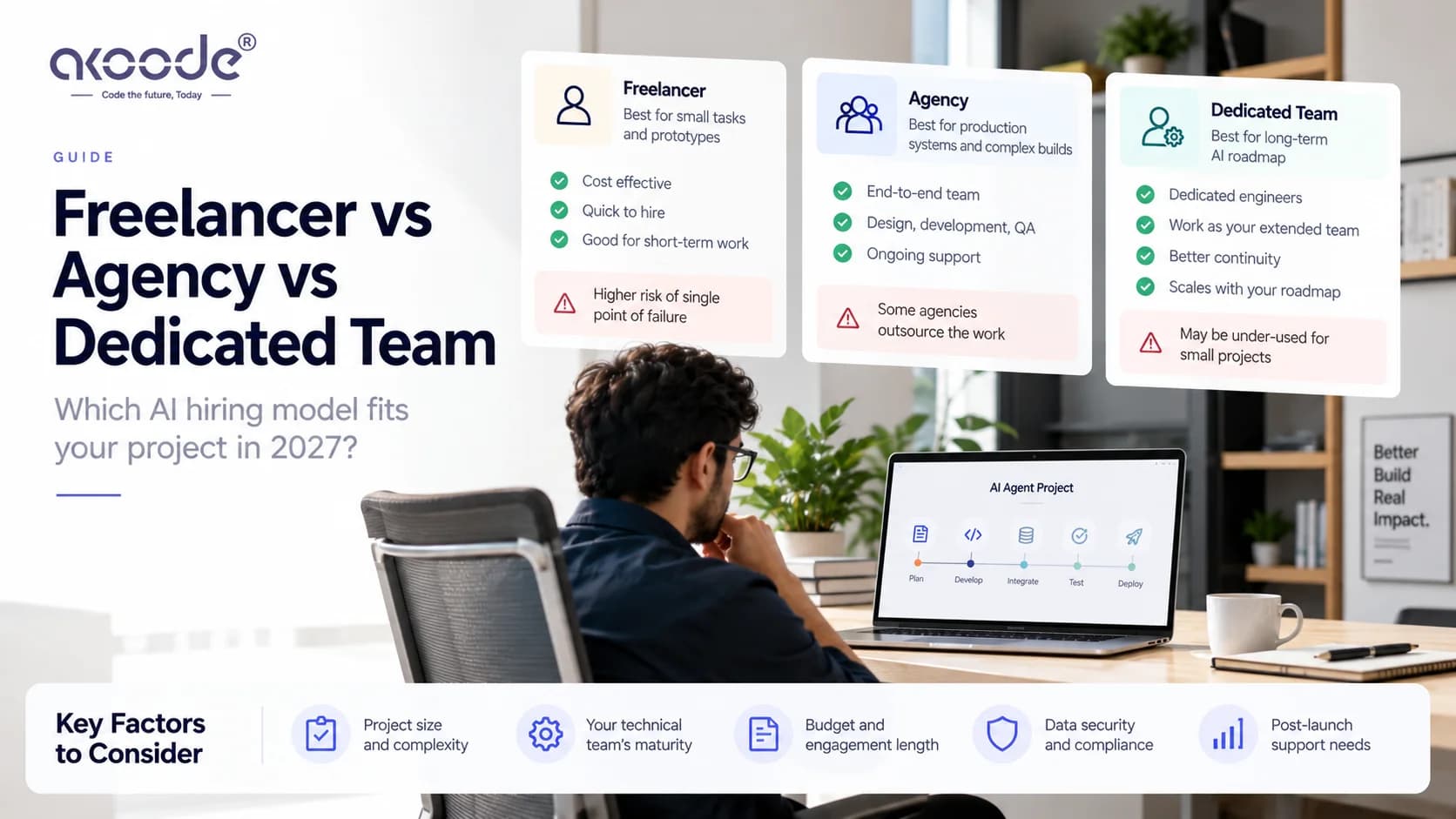
Before you choose an AI developer, you have to choose how you will work with one. That decision shapes your results more than the model, the framework or the vendor's logo list. A freelancer, an agency and a dedicated team are three different ways of buying the same skill, and each one fails in its own predictable way when it is used for the wrong job.
This guide compares the hiring models for AI agent projects in 2027: freelance, agency, dedicated team, part-time, consultation-only and results-based. It also covers contract length, remote delivery, offshore versus domestic hiring, and the build-or-outsource decision. It comes from Akoode Technologies, founded in 2023 by a leadership team with more than a decade of experience in AI consulting and technology development. Our developers are in house, qualified and certified, and everything we build is designed and tested inside the company.
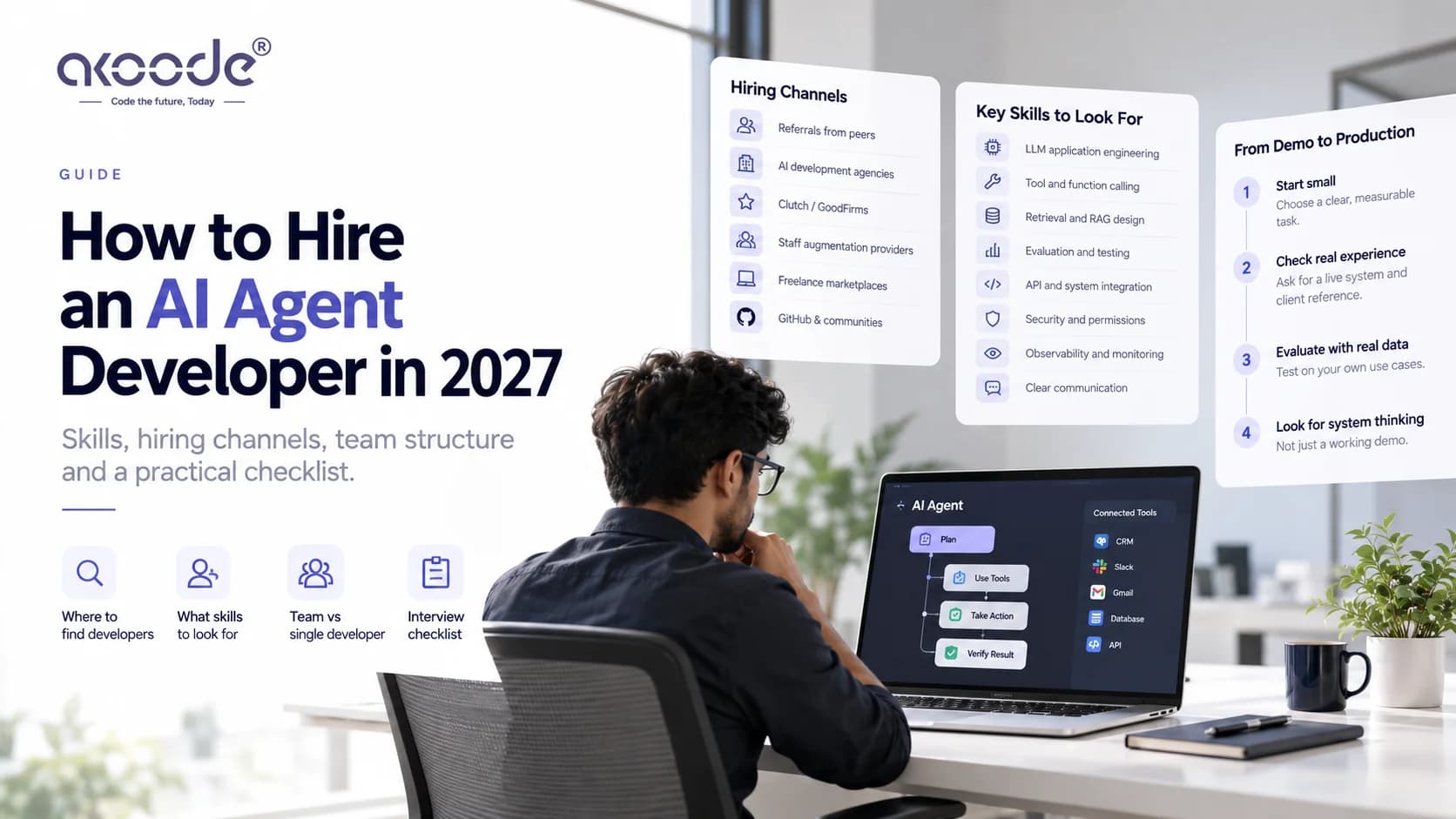
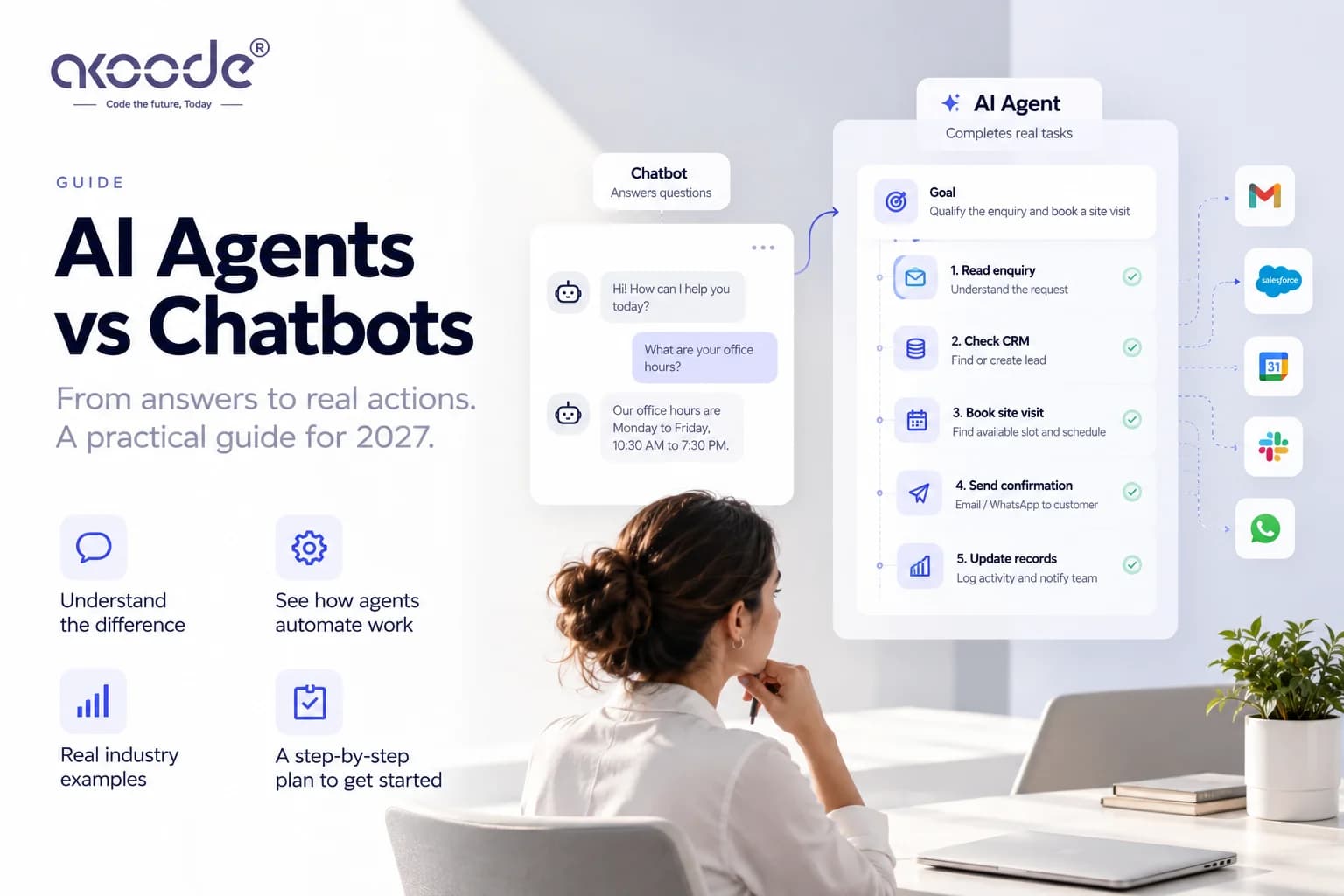
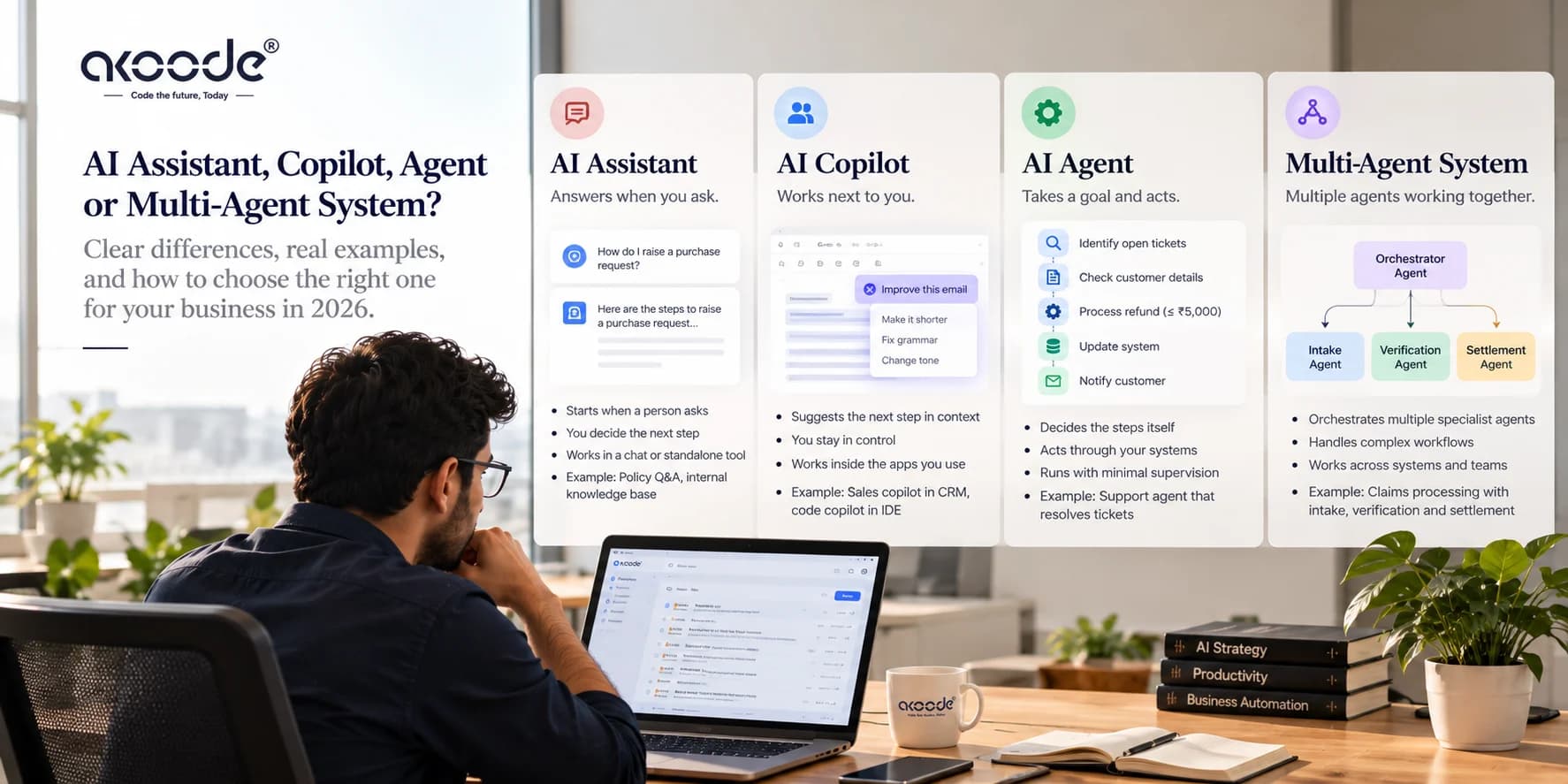
If you have not yet decided whether you need an agent at all, start with our complete guide to AI agent development. If you are ready to find the person or team, our guide on how to hire an AI agent developer covers vetting. This article covers the structure of the engagement itself.
Should You Hire a Freelance AI Developer or an Agency?
Quick answer: Hire a freelancer for a small, well-defined task or prototype that you can manage yourself. Choose an agency when the agent touches several systems, handles sensitive data or needs support after launch, because you will need a team, testing and continuity. A dedicated team fits ongoing AI work where you want engineers inside your workflow.
Factor | Freelancer | Agency | Dedicated team |
|---|---|---|---|
Best for | Prototypes, short experiments, one-off tasks | Production agents and multi-system builds | Ongoing roadmap of AI work |
Who manages the work | You | The agency, with your input | Shared, usually with your product owner leading |
Skills in one engagement | One person's range | AI, integration, QA, design | Chosen to match your roadmap |
Continuity if someone leaves | Low | Higher, the team covers the gap | Higher, with replacement handled by the provider |
Support after launch | Depends on availability | Usually part of the engagement | Built in, since the team stays |
Main risk | Single point of failure | Weak vendors that subcontract the work | Under-using the team between projects |
Freelancers can be excellent. The best ones are often more current than any agency on a specific technique. The risk is structural: one person is the developer, the tester, the architect and the support desk. If they get ill, move on or take on a bigger client, your agent is orphaned.
Agencies fix the structural risk and add their own. A weak agency resells work to subcontractors, so the person you met in the sales call is not the person writing your code. The fix is a single question: who will actually build this, and are they employees? Our guide to AI development companies in India lists the other checks worth running on any vendor.
Which AI Hiring Model Fits Your Project?
The right model depends on two things: how risky the project is, and how mature your own team is. We call this the Akoode Hiring Fit Matrix. Find your row, then read across.
Your situation | Project risk | Best-fit model |
|---|---|---|
No technical team, first AI project, one workflow | Medium | Consultation first, then an agency to build |
No technical team, regulated data or customer-facing agent | High | Agency with in-house developers and a security review |
Small tech team, needs specific AI skills for a defined period | Medium | Staff augmentation or a part-time specialist |
Strong tech team, wants speed on a known design | Low to medium | Dedicated team working under your technical lead |
Experimenting with a model or approach, low stakes | Low | Freelancer on a short paid task |
Long roadmap of AI features across the product | Medium to high | Dedicated team, with a plan to build internal capability |
Two rules sit behind the table. The higher the risk, the less you should rely on a single person. The less technical your own team, the more delivery responsibility should sit with the provider and not with you.
What Is a Dedicated AI Team and When Does It Make Sense?
Quick answer: A dedicated AI team is a group of engineers assigned to your work for an agreed period, working as an extension of your own team. It makes sense when you have continuing AI work, a product owner who can direct it, and a roadmap longer than a single project.
The difference from an agency project is ownership of direction. In an agency project the provider carries delivery. In a dedicated team you set priorities week to week, and the provider supplies the engineers, the continuity and the management of their people.
Akoode offers both structures. For teams that want to add engineers to a group they already run, staff augmentation typically provides profiled engineers within 48 to 72 hours, with ramp-up usually within 5 to 7 days. For dedicated team and fixed-scope engagements, kick-off typically happens one to two weeks after signing. If you are comparing structures more broadly, see staff augmentation versus outsourcing and our overview of software development engagement models.
Can You Hire an AI Developer Part-Time or Full-Time?
Quick answer: Yes. Part-time suits pilots, audits, reviews and light maintenance. Full-time suits active builds and complex integrations where context switching would slow progress. Many projects start part-time during scoping, go full-time during the build, then return to a smaller allocation for support after launch.
Match the allocation to the phase of work, not to a fixed preference:
Scoping and discovery: part-time senior time is usually enough. You need judgement more than hours.
Prototype: part-time to full-time, depending on how fast you want a result.
Build and integration: full-time. Agent work involves a lot of testing and debugging across systems, and that suffers from fragmented attention.
Testing and rollout: full-time for a short period, with the people who built it.
Support and tuning: part-time, with a defined response process.
A common mistake is to keep full-time capacity running after launch because it feels safer. A smaller support allocation with clear response commitments is usually enough, and it frees budget for the next workflow.
What Is the Typical Contract Length for an AI Developer?
Quick answer: Tie the contract to phases, not the calendar. Start with a short scoping or pilot commitment, extend into the build once the pilot proves value, and move to a rolling support agreement after launch. Avoid long fixed commitments before anyone has seen your data or tested your workflow.
AI projects carry more uncertainty than most software work, because results depend on your data and your exceptions, and neither is fully known on day one. That is an argument for staged commitment:
Discovery. A short, defined piece of work with a clear deliverable and an exit point.
Pilot. One workflow, real data, agreed success criteria. You decide at the end whether to continue.
Build. A longer commitment, justified by what the pilot showed.
Run. A rolling support agreement with a notice period both sides can live with.
Whatever the length, check three clauses: who owns the code and prompts, what happens to your data at the end, and how knowledge is handed over if you part ways. Those matter more than the duration.
Can You Hire an AI Developer Only for Consultation?
Quick answer: Yes. A consultation or discovery engagement should end with a mapped process, a recommended architecture, a risk list, a build or do-not-build recommendation, and an estimate you can take to any vendor. It lowers risk before a larger commitment and is useful even if you build in house.
A consultation is worth paying for when it produces something you can use without the consultant. Insist on these deliverables:
A step-by-step map of the current process, including the exceptions.
A list of systems, data sources and the access each would need.
A recommended approach with the alternatives that were rejected and why.
A risk list covering data, security, accuracy and change management.
A clear statement of whether to build, buy or wait.
A scoped estimate with assumptions stated.
A good consultant will sometimes tell you not to build. That is a sign the advice is honest. Our artificial intelligence services include consultation, and we estimate project work after a scoping call, since figures given before understanding your systems are guesses.
Can You Hire an AI Developer on a Results-Based Contract?
Quick answer: Partly. Outcomes such as accuracy or time saved depend on your data and processes as well as the developer's work, so pure results-based pricing often leads to disputes. A hybrid works better: milestone payments for delivery, plus a measured pilot with success criteria that both sides agree before the build starts.
The appeal is obvious: you pay only if it works. The trouble is that "works" is rarely under the developer's control alone. Poor data, changing processes and unclear success measures can sink a technically sound agent, and neither side wins the argument that follows. Pure results-based deals also push vendors toward easy metrics and away from the harder, more valuable ones.
A hybrid structure gives you most of the protection without the downsides:
Define the success measure first. One or two numbers, measured the same way before and after.
Baseline the current process. You cannot prove improvement against a guess.
Pay on milestones. Each payment tied to working software you have seen.
Run a measured pilot. Agree the pass criteria in writing before it starts.
Link part of the engagement to the pilot result. For example, the decision and scope of the next phase.
Our post on AI agent development cost explains what drives the price underneath any of these structures.
How Do Remote AI Developers Communicate and Deliver?
Quick answer: Good remote teams set a fixed rhythm: a kickoff, regular working sessions, weekly demos of working software, written updates, shared access to the code repository and evaluation reports you can read. Agree overlap hours and one decision maker on your side. Time zones matter less than cadence and documentation.
Most AI work is done remotely now, and the failures are almost never about distance. They come from missing rhythm. This is the delivery pattern we recommend you insist on from any provider:
Kickoff: goals, success measures, systems, access, risks and who decides what.
Weekly demo: working software on real or realistic data, not slides.
Written weekly update: what was done, what is blocked, what is next, what changed in scope.
Shared repository from day one: you can see the code and its history.
Evaluation reports: test results you can read, showing accuracy before and after each change.
One named decision maker on each side: fast answers prevent most delays.
Agreed overlap hours: a few hours of shared working time is usually enough.
Akoode works with clients across India, the UK and the USA, so agreeing overlap hours is something to settle at the start of any engagement.
What Is the Difference Between AI Agent Development Companies?
Quick answer: Some are platform vendors, some are large consultancies, some are specialist AI firms, and some are general software shops adding AI to their service list. They differ in who writes the code, how they test agents, whether they support systems after launch, and how closely their team works with yours.
Type | Strength | Watch for |
|---|---|---|
Platform or product vendor | Fast start with a ready tool | Lock-in and limited customisation |
Large consultancy | Scale, governance, broad programmes | Layers of management between you and the engineers |
Specialist AI firm | Depth in agents, evaluation and integration | Narrow range outside AI |
General software shop adding AI | Strong engineering and delivery habits | Thin AI experience in production |
Staffing firm | Speed in adding people | You carry architecture and management |
Beyond type, compare vendors on four practical points: who writes the code and whether they are employees, how agents are tested before launch, what happens after go-live, and how long people stay on your project. Case studies you can verify beat any capability slide. Akoode holds a 4.9 rating on Google from 126 reviews and a 5.0 out of 5 on GoodFirms, which are worth checking independently, as you should for any company you consider.
Should You Hire Offshore or Domestic AI Developers?
The honest answer is that location matters less than structure. What you are really choosing between is time zone overlap, compliance requirements, communication habits and budget, and each can be managed.
Overlap. Domestic teams share your working day. Offshore teams need a deliberate overlap window, and many provide one.
Compliance and data residency. Some sectors and contracts require data to stay in a region or be handled by named staff. Check this before you choose, not after.
Communication. Clear written communication and a named lead matter more than a shared postcode.
Capacity and depth. Offshore providers often offer a wider pool of specialists for the same engagement.
Cost. Differences exist, but compare total cost of ownership, including rework and support, not day rates.
A hybrid often works best: a local product owner and an offshore delivery team with agreed overlap. Akoode is headquartered in Gurugram, India, with a presence in Jenks, Oklahoma, so US clients can work with a team that has people on both sides of that overlap. This shape suits steady, process-driven work, which is common in retail and e-commerce, logistics and manufacturing. See our pages for retail and e-commerce, logistics and manufacturing.
Should You Build an Internal AI Team or Outsource?
Most businesses should not choose one or the other. They should sequence them.
Outsource first when you have no AI engineers, need a result in a few months, or want to test value before investing in hiring.
Build internally when AI is central to your product, your data is highly sensitive, or you expect a long, continuous roadmap.
Use a hybrid when you want delivery speed now and capability later. Have the provider document everything, pair their engineers with yours, and plan a handover.
If you intend to bring work in house later, say so at the start. A good partner will structure the engagement for knowledge transfer: documented architecture, readable evaluation sets and a repository your team can take over. For a view of what that architecture looks like, read our enterprise AI agent architecture guide.
Why Does It Matter That Your Provider Builds In House?
Every model in this article depends on one fact: the people you evaluate are the people who build. At Akoode, our developers are qualified, certified and employed in house, and all design, development and testing happen inside the company. There is no subcontracting chain between your requirement and the code, so continuity, quality and accountability sit with one team.
If you want us to own delivery, see our AI agent development services. If you want engineers added to your team, see staff augmentation. If you are not sure which structure fits, that is exactly what a scoping call is for.
What Should You Read Next?
AI agent development in 2027: the complete business guide: what agents are and whether you need one.
How to hire an AI agent developer in 2027: skills, questions and the vetting scorecard.
AI agent development cost: what drives the price.
How to hire a dedicated AI developer in India: roles, steps and trial structure.
Frequently Asked Questions
Should I hire a freelance AI developer or an agency?
Hire a freelancer for a small, well-defined task or prototype that you can manage yourself. Choose an agency when the agent touches several systems, handles sensitive data or must be supported after launch, because you need a team, testing and continuity. A dedicated team fits when you have ongoing AI work and want engineers inside your workflow.
Can I hire an AI developer part-time?
Yes. Part-time works for pilots, audits, reviews and light maintenance. Full-time suits active builds and complex integrations where context switching would slow progress. Many projects start part-time during scoping, move to full-time during the build, then drop back to a smaller support allocation after launch.
How long should an AI developer contract be?
Tie the contract to phases, not the calendar. Start with a short scoping or pilot commitment, extend into the build once the pilot proves value, and move to a rolling support agreement after launch. Avoid long fixed commitments before anyone has seen your data or tested the workflow.
Can I hire an AI developer only for consultation?
Yes. A consultation or discovery engagement should end with a mapped process, a recommended architecture, a risk list, a build or do-not-build recommendation and an estimate you can take to any vendor. It lowers risk before a larger commitment and is useful even if you build in house.
Can I hire an AI developer on a results-based contract?
Partly. Outcomes such as accuracy or time saved depend on your data and processes as well as the developer's work, so pure results-based pricing often creates disputes. A hybrid works better: milestone payments for delivery, plus a measured pilot with success criteria that both sides agree before the build starts.
How do remote AI developers communicate and deliver?
Good remote teams set a fixed rhythm: a kickoff, regular working sessions, weekly demos of working software, written updates, shared access to the code repository and evaluation reports you can read. Agree overlap hours and a single decision maker on your side. Time zone differences matter less than cadence and documentation.
What is the difference between AI agent development companies?
Some are platform vendors, some are large consultancies, some are specialist AI firms, and some are general software shops adding AI to their list. They differ in who writes the code, how they test agents, whether they support systems after launch and how closely their team works with yours. Ask for production examples and named people.
Talk to the Team Before You Choose a Model
Tell us what you want to build, who is on your side and how involved you want to be. We will recommend a structure honestly, including when a freelancer or a consultation is the better first step.
Book a call with Akhil Verma, Founder and CEO of Akoode Technologies, or explore our AI agent development services.
Written by the Akoode Technologies team. Akoode is headquartered in Gurugram, India, with a presence in Jenks, Oklahoma, and serves clients across India, the UK and the USA.
Get In Touch Now
View More Our Blog