


 May 20, 2026
Every growing technology team eventually faces the same pressure. The workload has grown faster than the headcount. Deadlines are slipping. Permanent hiring is too slow. And the product cannot wait.
Two models dominate the conversation. IT staff augmentation and outsourcing. Both solve the talent problem. Both bring in external expertise without permanent commitment. But they operate in fundamentally different ways and choosing the wrong one at the wrong stage costs more than it saves.
This guide cuts through the surface comparison and ties the decision to where your business actually is right now.
What Is the Core Difference Between Staff Augmentation and Outsourcing?
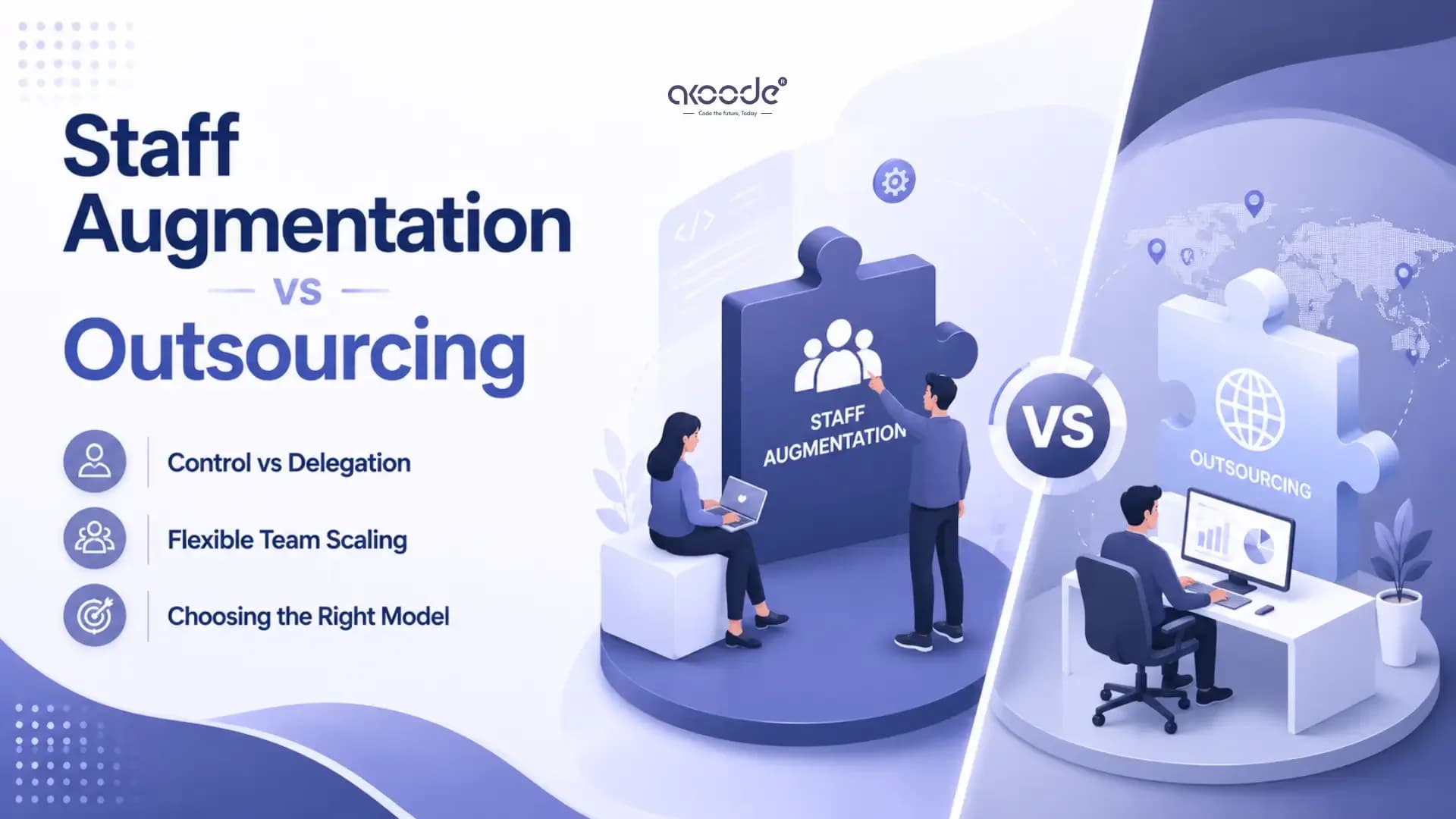
The easiest way to separate the two models is one question: who runs the work every day?
In staff augmentation, you do. External professionals join your team. They follow your processes, use your tools, attend your standups, and report to your managers. You set the priorities. You own the output. The augmented staff bring the skills or the bandwidth. The direction stays with you.
In outsourcing, the vendor does. You define the outcome you need. The external company manages the team, the timeline, the process, and the delivery. You review the output. You do not run the day-to-day.
That distinction is not about geography or cost. It is about where delivery ownership sits. Everything else in this comparison flows from that single difference.
How Does IT Staff Augmentation Work?
Staff augmentation is a flexible hiring model. You bring external engineers, designers, QA specialists, or DevOps professionals directly into your team for a defined period. They work inside your delivery system.
The global IT staffing market is projected to reach over $82 billion by 2027. The growth reflects how consistently businesses need skills quickly without the cost and timeline of permanent hiring.
The model works best when the internal team has the management capacity to direct and integrate external professionals. When onboarding is disciplined, augmented staff contribute within the first week. When it is vague, they become expensive observers. That difference is entirely within the client's control.
The advantages are meaningful. You keep full visibility over what gets built and how. You retain institutional knowledge inside the team. You scale headcount to match project phases without permanent commitment. And when the requirement changes, the engagement adjusts without a contract renegotiation.
The limitations are equally real. You carry the management overhead. If your team is already stretched too thin to onboard and direct external contributors, augmentation creates coordination debt rather than solving a capacity problem.
How Does IT Outsourcing Work?
Outsourcing means delegating a defined project or function to an external vendor who takes ownership of delivery. They hire the team, manage the process, and deliver an agreed outcome.
The global outsourcing market is projected to exceed $900 billion by 2027. It spans everything from full product builds and platform migrations to ongoing support functions and QA operations.
The model works best when the scope is clear, the requirements are stable, and your internal team does not have the bandwidth to manage delivery. The vendor handles execution. You review milestones and outputs.
The advantages are significant for the right project. Lower management overhead on your side. Access to a complete team with built-in project management. Faster time to start for well-defined scopes. And for non-core functions, outsourcing lets your internal team focus on the work only they can do.
The limitations surface quickly when scope changes. Every change request goes through a commercial process. Outsourcing is cheaper than augmentation when scope stays within roughly 25 percent of the original agreement. When scope drifts beyond that, which happens in most non-trivial software projects, the change-request cycle erodes both budget and timeline faster than augmentation would have.
IT Staff Augmentation vs Outsourcing: Side-by-Side Comparison
Factor | Staff Augmentation | Outsourcing |
|---|---|---|
Who manages daily work | You | The vendor |
Control over process | Full | Limited |
Flexibility to change scope | High | Low to medium |
Management overhead | Higher | Lower |
Knowledge retention | Stays with your team | Stays with the vendor |
Best for | Evolving requirements, active products | Fixed scope, defined deliverables |
Onboarding speed | Days to weeks | Weeks to months |
Cost when scope is stable | Higher than outsourcing | Lower |
Cost when scope drifts | Lower than outsourcing | Higher |
Team integration | Deep | Minimal |
IP and code ownership | Clear, stays with you | Needs explicit contractual definition |
Risk of vendor dependency | Low | Higher |
Which Model Fits Your Growth Stage?
This is the question most comparison guides skip. The right model is not universal. It depends on where your business is and what you are trying to achieve.
Early-stage startup: Bias toward outsourcing for defined builds, augmentation for product iteration
At the earliest stage, speed and cost efficiency matter most. If you need a defined MVP built quickly and you do not yet have an internal engineering team, outsourcing that build to an experienced software development partner is practical. The scope is clear. You want an output. You do not yet have the infrastructure to manage an augmented team.
Once the MVP is live and the product is iterating based on user feedback, the requirements change every sprint. At that point, outsourcing generates constant change-request friction. Augmentation gives you the flexibility to redirect the team as the product evolves.
Growth-stage company scaling a product: Staff augmentation is almost always the better fit
For companies in active product development, building features, fixing technical debt, and scaling infrastructure, augmentation consistently outperforms outsourcing. You need engineers who understand the codebase deeply, work within your sprint cycle, and contribute to architectural decisions as they arise.
Delegating this to an outsourced vendor means slower communication, misaligned context, and a delivery process that lags your product pace. Augmenting with senior engineers who integrate into the existing team moves at product speed.
Enterprise running a non-core function: Outsourcing is often more efficient
For large organisations running stable, defined functions, such as data migration, legacy system maintenance, QA operations, or specific compliance-driven builds, outsourcing makes economic and operational sense. The requirements are stable. The function is not strategic. The internal team should not be spending time managing it.
Team with no internal management capacity: Outsourcing reduces friction
Staff augmentation requires someone internally to direct and review the work. If no one has that capacity, augmentation does not solve the problem. It moves the constraint. When the internal team is fully stretched and cannot meaningfully manage additional contributors, a fully managed outsourcing engagement is the more practical choice.
What Are the Hidden Costs of Each Model?
Every comparison based on headline rates misses the costs that actually determine which model is cheaper for a specific project.
Staff augmentation hidden costs: Onboarding time before contribution begins. Management overhead from your senior engineers. Coordination cost when augmented staff and permanent staff work on the same codebase. These are real but contained when the engagement is set up properly.
Outsourcing hidden costs: Change request cycles when requirements evolve. The time cost of detailed specification writing before the vendor can begin. The re-onboarding cost when the vendor team turns over between project phases. And the longer-term cost of knowledge living outside your organisation when the engagement ends.
The scope drift number is the clearest decision point. When scope stays within 25 percent of the original agreement, outsourcing is typically cheaper. When scope drifts beyond that, which it does in most active product builds, augmentation costs less over the full project duration.
When Does Using Both Models Make Sense?
The choice between staff augmentation and outsourcing is not always binary. Many growing businesses use both simultaneously for different functions.
A common model that works well in practice: the core product team uses staff augmentation to extend engineering capacity during high-demand phases. Non-core or clearly scoped work, such as a specific integration build, a one-time data pipeline, or ongoing infrastructure monitoring, is outsourced to a vendor with defined deliverables.
This approach keeps product development fast and internally controlled while removing lower-priority work from the internal team's plate. It requires clear boundaries between what is managed internally and what is delegated. When those boundaries are clear, the combined model captures the benefits of both without the drawbacks of either.
As AI-assisted development continues to reshape how teams work, the decision between augmentation and outsourcing is also influenced by how quickly teams can leverage modern tooling. For context on the tools and trends shaping software delivery in 2026, the AI software development trends guide is worth reading before making resourcing decisions.
What Should You Ask Before Choosing a Partner for Either Model?
Whether you are evaluating an IT staff augmentation provider or an outsourcing vendor, the same questions determine whether the engagement will deliver.
For staff augmentation: How quickly can you onboard engineers for our specific stack? What is your replacement process if a professional is not the right fit? What does your vetting process look like beyond CV review? Do you have engineers with experience in our industry or product type?
For outsourcing: How do you handle requirement changes mid-project? What does your change request process look like? Who owns the code and IP at the end of the engagement? What happens to project knowledge when the engagement closes?
A provider who cannot answer these questions clearly before work begins will not answer them clearly when the situation is under pressure.
Conclusion
Staff augmentation and outsourcing both solve real problems. Neither is universally better. The right choice depends on who needs to own delivery, how stable your requirements are, and whether your internal team has the capacity to direct external contributors.
For active product development where requirements evolve every sprint, staff augmentation gives you the control and flexibility to move at the pace your product requires. For defined, stable scopes where management bandwidth is limited, outsourcing delivers the outcome without the overhead.
The expensive mistake is applying the wrong model to the wrong situation. A product team that outsources active development loses control of its roadmap. A stretched internal team that augments without management capacity wastes the investment.
Akoode Technologies is a leading AI and software development company headquartered in Gurugram, India, with a US office in Oklahoma. Whether your team needs IT staff augmentation services to extend engineering capacity or end-to-end software development for a defined product build, Akoode works with startups, SMEs, and enterprises across 15+ industries globally to match the right model to the right stage of growth. If you are weighing both options and want a clear recommendation for your specific situation, that conversation starts here.
Frequently Asked Questions
1. What is the main difference between IT staff augmentation and outsourcing?
In staff augmentation, you manage the external professionals directly. They work inside your team, follow your processes, and you own the direction. In outsourcing, the vendor manages delivery. You define the outcome and review the output. The key distinction is where delivery ownership sits.
2. Which is cheaper: staff augmentation or outsourcing?
It depends on scope stability. Outsourcing is typically cheaper when project scope stays within 25 percent of the original agreement. Staff augmentation is cheaper when scope drifts beyond that, which happens in most active product builds. Change request cycles in outsourcing erode budget faster than the coordination overhead of augmentation.
3. When should a company choose IT staff augmentation?
Choose staff augmentation when requirements evolve frequently, when you need engineers integrated into an active sprint cycle, when knowledge retention matters, or when you have the internal management capacity to direct external contributors. It is the stronger model for growth-stage companies in active product development.
4. When does outsourcing make more sense than staff augmentation?
Outsourcing works better for clearly defined, stable scopes where the outcome matters more than the process. Non-core functions, one-time builds, legacy system work, and situations where your internal team has no bandwidth to manage contributors are all scenarios where a fully managed outsourcing engagement delivers better results.
5. Can a company use both staff augmentation and outsourcing at the same time?
Yes. Many growing businesses use augmentation for core product development and outsource specific non-core functions with defined deliverables. The model works well when boundaries are clear between what is managed internally and what is delegated to a vendor.
6. What are the hidden costs of IT staff augmentation versus outsourcing?
Staff augmentation carries onboarding time, management overhead, and coordination cost. Outsourcing carries change request friction, specification writing overhead, vendor team turnover between phases, and the long-term cost of knowledge leaving the organisation when the engagement ends. Both models have real hidden costs that headline rates do not reflect.
Get In Touch Now
View More Our Blog