


 April 30, 2026
Deadlines do not wait for hiring cycles.
Most businesses hit this wall at some point. There is real work to do. The team does not have enough people or the right skills. Hiring full-time takes months. Outsourcing the whole project means losing control. Doing nothing means falling behind.
Staff augmentation services exist to solve this exact problem.
This guide explains what staff augmentation services mean, how the model works, what types are available, and how to choose the right partner in 2026.
What Is Staff Augmentation, and Why Does It Matter?
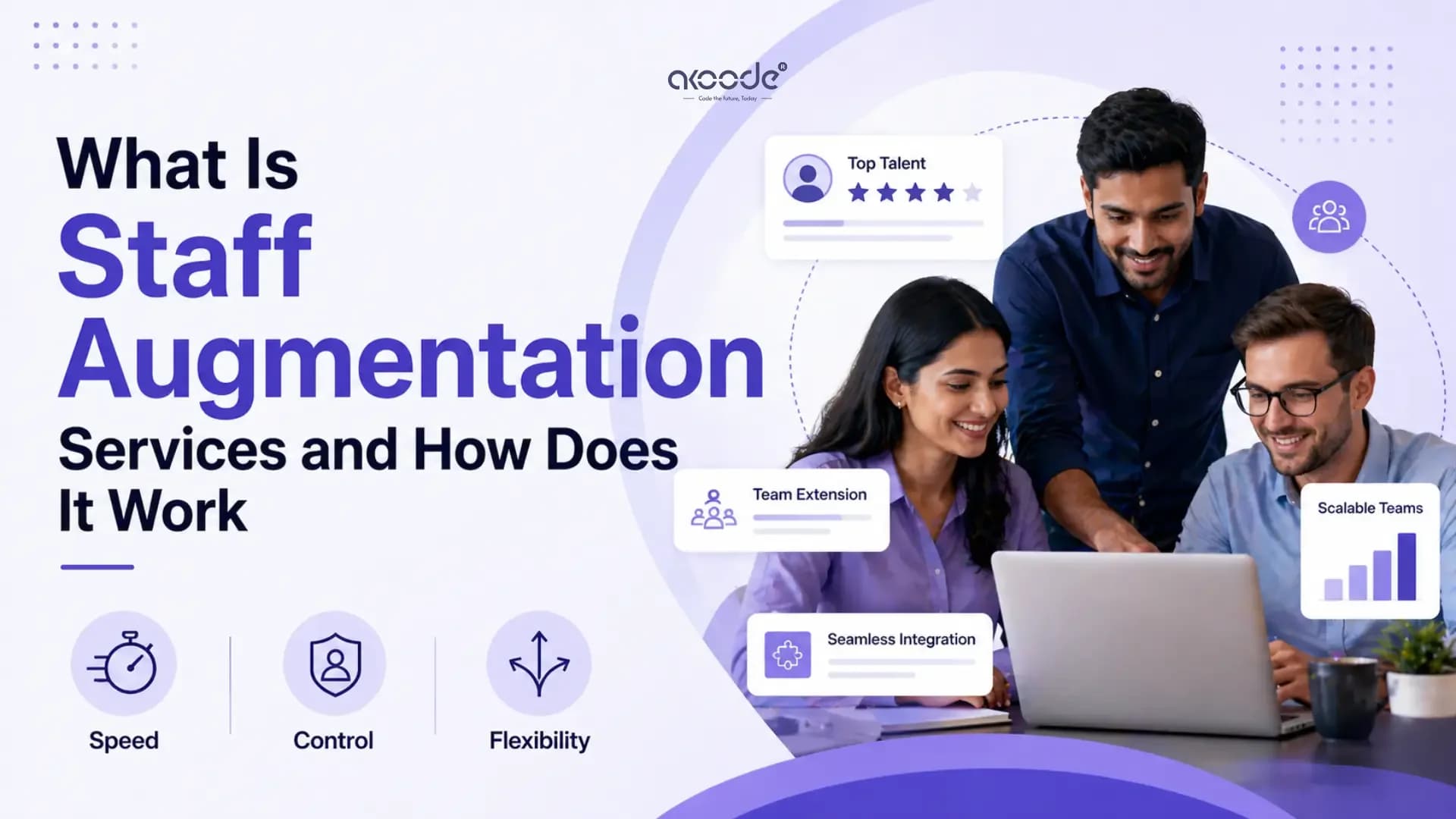
Staff augmentation is a hiring model. A business brings in external professionals to work inside its team for a set period.
These professionals come from a staff augmentation company. But they work under your direction. They follow your processes, use your tools, and answer to your managers. You keep full control.
This is what makes it different from outsourcing. In outsourcing, a vendor runs the project. In staff augmentation, you run the project. The external team just adds capacity and skill.
The model has been around for decades. But in 2026, it has become far more common. Technology skills are harder to find. Project scopes shift quickly. Permanent hiring is slow and expensive. Staff augmentation fills the gap without the long-term commitment.
What Does Staff Augmentation Mean in Practice?
Staff augmentation meaning is simple. Your core team has a certain skill set and a certain capacity. A project comes in that needs more than you currently have. You bring in the extra skills or headcount. The project moves forward.
The augmented professionals do not replace your team. They extend it. Your internal engineers keep ownership of the architecture and long-term decisions. The external staff handle the extra work, the specialist tasks, or both.
Resource augmentation means the same thing. Both terms describe the same model. You are adding to your technical resource pool temporarily, not permanently restructuring your organization.
What Are the Different Types of Staff Augmentation Services?
The model comes in several forms. The right type depends on your project timeline, your skill gap, and your location preferences.
Short-term project-based augmentation. A business brings professionals in for one project. When the project ends, the engagement closes. This works well for product launches, system migrations, and development sprints with a fixed end date.
Long-term dedicated team augmentation. Some businesses need consistent support over many months. A dedicated augmented team integrates deeply into the existing operation. They learn the codebase, the product, and the culture over time. This model suits ongoing product development or long digital transformation programs.
Skill-based augmentation. A specific skill is missing from the internal team. The business brings in a specialist to fill that exact gap. AI engineers, cloud architects, DevOps specialists, and cybersecurity experts are commonly augmented this way. Hiring permanently for a role needed only for one phase makes no financial sense.
Offshore augmentation. External professionals join remotely from another country. US and European companies regularly use this model with teams from India, Eastern Europe, and Latin America. The cost advantage is real. Modern collaboration tools have made time zone differences manageable for most workflows.
Nearshore staff augmentation. Nearshore staff augmentation is a version of offshore with less time zone friction. A US company might work with a team in Mexico or Colombia. A UK company might use engineers from Poland or Romania. The nearshore model offers cost efficiency with overlap in working hours. Real-time collaboration is easier.
Hybrid augmentation. Some businesses layer multiple models together. Internal teams own architecture and core decisions. Augmented professionals drive execution. A managed service provider handles specific operational functions like testing or deployment. Each layer has a defined role.
How Does the Staff Augmentation Process Work Step by Step?
The process is straightforward. Most engagements follow the same sequence.
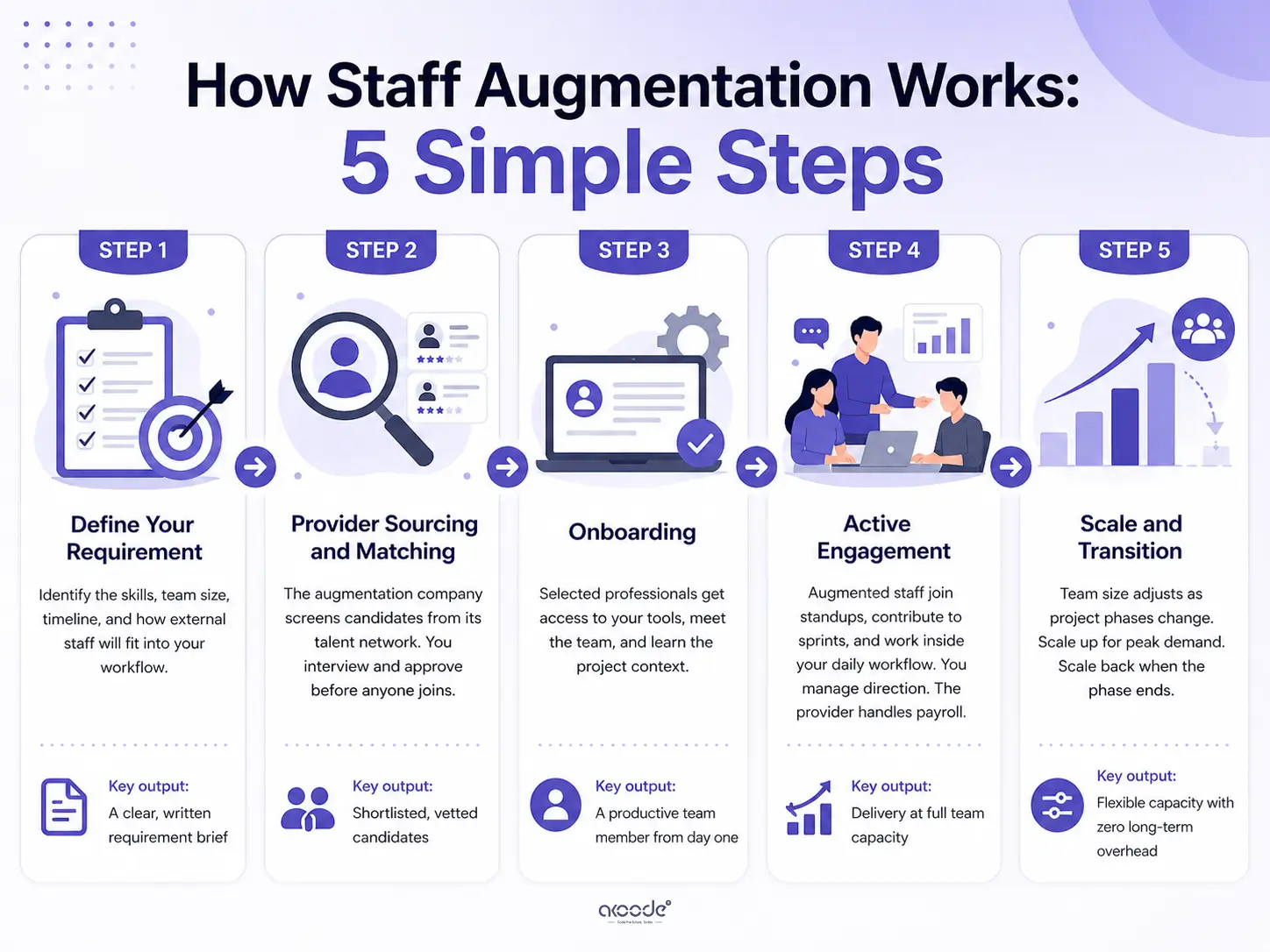
Step one: Define the requirement. The business identifies the skills needed, how many people, how long, and how they will work within the team. A precise definition leads to faster and more accurate matching.
Step two: Provider sourcing. The staff augmentation company draws from its talent network. They assess candidates against the client's requirements. The client interviews shortlisted candidates before committing.
Step three: Onboarding. Selected professionals are introduced to the team, given access to tools, and briefed on the project context. Good onboarding cuts the ramp-up time significantly. Professionals who are onboarded properly start contributing faster.
Step four: Active engagement. The augmented staff work as part of the team. They join standups, contribute to sprints, and communicate through the same channels as permanent employees. The client sets priorities. The augmentation provider handles payroll and administrative compliance.
Step five: Scaling and transitions. As the project moves through phases, the engagement adjusts. More professionals come in during high-demand stages. The team scales back when a phase completes. This flexibility is one of the core advantages of the model.
How Does Staff Augmentation Compare with Outsourcing and Managed Services?
Businesses often weigh these three models against each other. Each one serves a different purpose.
Factor | Staff Augmentation | Outsourcing | Managed Services |
|---|---|---|---|
Who manages the team | You | The vendor | The vendor |
Who owns the output | You | The vendor | Shared |
Flexibility | High | Low to medium | Medium |
Control over daily work | Full | Limited | Limited |
Best for | Extending team capacity | Delegating a defined project | Ongoing operational functions |
Risk of knowledge loss | Low | Higher | Medium |
Time to start | Days to weeks | Weeks | Weeks to months |
Staff augmentation is right when you want outside skills but need to keep control. Outsourcing works when a project scope is clearly defined and the outcome matters more than the process. Managed services fit stable, repeatable functions like support, monitoring, or testing.
What Are the Real Benefits of IT Staff Augmentation Services?
Speed. Traditional hiring for a senior engineer can take three to six months. IT staff augmentation services compress that to days or weeks. The work does not pause while you recruit.
Cost control. A permanent hire carries salary, benefits, payroll taxes, and recruitment fees. Augmented professionals come at a transparent rate for the time they contribute. For project-based work, this is consistently more economical.
Access to specialist skills. Some roles are only needed for one phase. An AI specialist for a six-month model build, a cloud architect for a migration, or a mobile developer for a single platform release. Hiring permanently for these roles wastes money. Augmenting them makes far more sense.
Lower hiring risk. A bad permanent hire is expensive and slow to fix. An augmented professional who is not working out can be replaced without the same consequences. This is especially valuable when hiring decisions are made quickly under project pressure.
Stable core team. Permanent teams that grow and shrink to match project volume become unstable. Staff augmentation keeps the core team consistent. External capacity adjusts around it.
When Does Staff Augmentation Work Best, and When Does It Not?
It works well when your team has a clear direction but not enough capacity. It works when a project needs a skill your permanent team does not have and will not need permanently. It works when a deadline is fixed and full-time hiring would take longer than the window available.
It is less suited when the project scope is unclear. If nobody can define the expected outcome, outcome-based outsourcing is a better fit. It also does not work well when augmented professionals would need months of ramp-up before contributing. That usually means the requirement was not defined precisely enough in the first place.
For teams building custom web development projects, full stack development platforms, or AI-powered web applications, augmentation is a natural fit. These projects move through phases with concentrated skill needs. Permanent hiring for every phase is impractical. Full outsourcing gives up too much control.
What Should You Ask Before Choosing an IT Staff Augmentation Partner?
How do you assess technical candidates?
The answer should describe structured screening. Technical tests, portfolio reviews, and interviews. Not just CV shortlisting.
How quickly can you onboard for our required skills?
For common roles, five to fifteen days is a reasonable benchmark. A serious provider is honest when a niche requirement will take longer.
How do you handle a poor fit mid-engagement?
Every engagement carries this risk. A reliable provider has a clear replacement process that protects the client's project continuity.
Do you have experience in our domain?
Augmenting for a fintech platform requires different skills than augmenting for a healthcare product or an e-commerce web application. Domain familiarity in the talent pool matters.
Conclusion
The gap between what your team can deliver and what your business needs does not have to stop your project.
Staff augmentation services give you the ability to move at the pace modern markets require. You get skilled professionals inside your team when you need them. You keep full control. And you do not carry the overhead once the work is done.
The model works best when the requirement is clearly defined and the provider has the talent depth to match it fast.
Akoode Technologies is a leading AI and software development company headquartered in Gurugram, India, with a US office in Oklahoma. From IT staff augmentation services and dedicated development teams to custom web development, full stack development, and AI-powered web applications, Akoode serves startups, SMEs, and enterprises across 15+ industries globally. If your team has a gap that is slowing your product down, you already know what the next step is.
Frequently Asked Questions
1. What is staff augmentation in simple terms?
\It is a model where external professionals join your team for a set period. They work under your management, follow your processes, and contribute to your project. You keep full control of direction and output.
2. What is the difference between staff augmentation and outsourcing?
In staff augmentation, you manage the team directly. You own the direction and decisions. In outsourcing, the vendor manages delivery and reports results. Staff augmentation gives you more control. Outsourcing gives the vendor more autonomy over the process.
3. What is nearshore staff augmentation?
It means bringing in external professionals from a nearby country with a similar or overlapping time zone. A US company might use talent from Mexico or Colombia. It combines cost efficiency with easier real-time collaboration compared to fully offshore arrangements.
4. What does resource augmentation mean?
Resource augmentation means the same thing as staff augmentation. You are adding external professionals to your team temporarily to extend your technical capacity and capability.
5. What roles work best with IT staff augmentation services?
Software developers, full stack engineers, mobile developers, cloud architects, DevOps engineers, AI specialists, QA engineers, UI/UX designers, and cybersecurity professionals. It works especially well for specialist roles needed for a defined phase rather than permanently.
6. How long does onboarding take for augmented professionals?
For common technical roles with a capable provider, five to fifteen business days is typical. Niche or highly specialized roles may take longer. A good provider tells you the honest timeline upfront, not what you want to hear.
Get In Touch Now
View More Our Blog