


 May 25, 2026
Plenty of startups have strong ideas and weak execution. The gap between the two is almost always the team. When you cannot hire ten engineers in-house, you need another way to build. That is where a dedicated development team comes in.
This model has become a go-to choice for founders who want serious engineering output without building an internal department. But the wrong hire costs more than the right one saves. Getting this decision right matters.
What Does a Dedicated Development Team Actually Mean?
A dedicated development team is a group of engineers hired to work solely on your product. They are not rotating between clients. They are not freelancers picking up side projects. They show up every day for your roadmap and your deadlines.
The model sits between in-house hiring and project outsourcing. You get the commitment of a full-time team. You skip the overhead of employment contracts, office space, and HR systems. The partner firm handles admin. You handle product direction.
This often gets confused with staff augmentation. They are not the same thing. Staff augmentation adds specific people to a team you already have. A dedicated team for software development replaces the need for that in-house team entirely. Founders with no existing engineers almost always need the dedicated model, not augmentation. Knowing how staff augmentation actually works before comparing options helps you pick the right fit from the start.
How Does a Dedicated Team Compare with Freelancers and Fixed-Price Outsourcing?
Three options dominate external development: freelancers, fixed-price contracts, and a dedicated application development team. Each one suits a different situation.
Freelancers work for small, isolated tasks. A quick UI fix. A single API connection. Simple, fast, done. But try building a full product with five freelancers spread across different time zones. The coordination alone becomes a job. Communication breaks down. No one owns the full picture.
Fixed-price outsourcing feels structured at first. You lock in a scope and a budget. But products change. Priorities shift mid-build. Vendors on fixed contracts stick to the original spec even when everyone knows it is wrong. Every change request turns into a negotiation.
A dedicated team handles product evolution naturally. They build context over time. Each sprint they understand your system better. Velocity grows. Communication tightens. You are not re-explaining the product to a new team every few months.
Factor | Freelancers | Fixed-Price Outsourcing | Dedicated Team |
|---|---|---|---|
Commitment | Low | Medium | High |
Flexibility | Low | Very Low | High |
Team Continuity | None | Project-based | Long-term |
Cost Predictability | Variable | Fixed but rigid | Monthly, predictable |
Best For | Small tasks | Defined projects | Evolving products |
Management Overhead | High | Low initially | Low after onboarding |
For a startup building something that will grow and change, the dedicated model almost always wins.
Who Should Be on Your Dedicated Development Team?
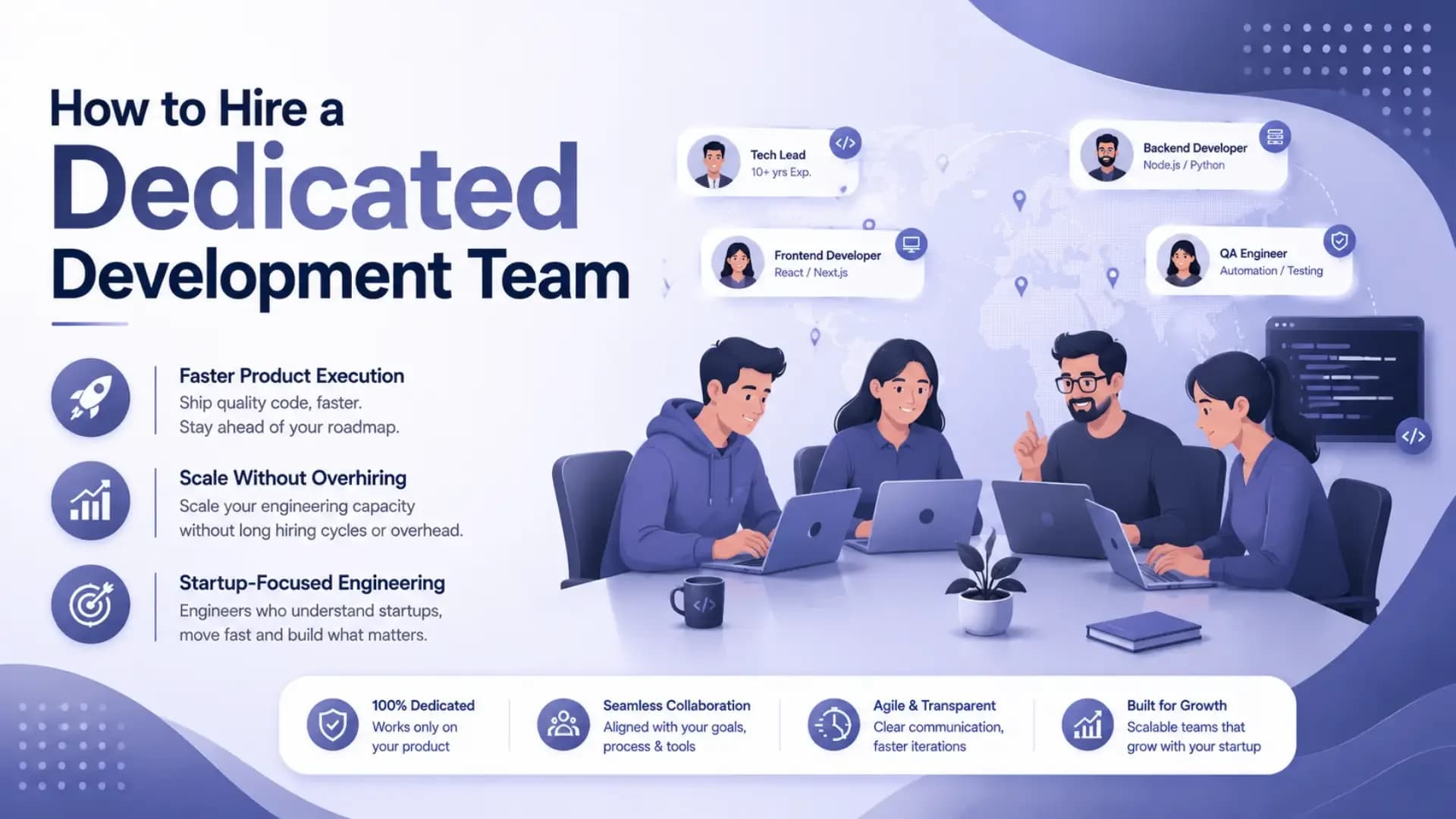
Team composition depends on your product. But most early-stage builds follow a recognisable structure. Getting roles right from day one prevents expensive gaps later.
A tech lead or project manager is the role founders most often undervalue. Someone must own technical decisions. Someone must translate product requirements into sprint tasks. Without this person, the founder fills the gap. That is rarely a good use of their time.
Frontend and backend developers form the core. A web product typically needs at least one strong engineer on each side during the early phase. Full-stack developers can cover both, but their depth on either side tends to be thinner. Mobile products need dedicated iOS or Android engineers depending on target platforms.
A QA engineer is not optional. Startups cut QA to move faster. They then spend the next three months fixing bugs that one QA resource would have caught in a week. Quality also shapes how early users and investors experience the product. That first impression is hard to recover from.
A UI/UX designer should be working alongside the development team, not after it. Consumer-facing products especially need design embedded in the sprint process. When design comes in only at the end, rework is almost guaranteed.
Custom software development dedicated teams can be assembled around your specific technical stack. A logistics platform has different engineering needs than a healthcare SaaS product. Build your team around your actual requirements.
What Are the Real Benefits of Hiring a Dedicated Development Team?
Most founders focus on cost first. Cost matters, but it is not the whole picture. The benefits of hiring a dedicated development team go further than the monthly rate comparison.
Scaling speed stands out immediately. You can double your engineering team in weeks. No job posts. No notice periods. No months-long hiring cycles. Your partner handles resourcing. For a startup in momentum, this is a serious operational advantage.
Product knowledge compounds. A team that has worked on your product for six months knows things no new hire can replicate quickly. They know where the technical debt lives. They remember why certain decisions were made. They write better code because they understand the full system.
Cost efficiency is real but requires honest accounting. Development costs in India run well below US or UK equivalents at comparable quality levels. But founders regularly underestimate the full cost of building software, particularly the post-launch maintenance and iteration that sits outside the initial build quote.
Timezone alignment is manageable. Indian teams working with US or UK founders structure their days around shared overlap hours. Many founders are surprised by how natural this collaboration becomes when the engagement model is designed properly from the start.
How Do You Hire a Dedicated Development Team Step by Step?
This is where most guides give vague advice. The actual process is sequential. Each step has a specific purpose.
Step one: Write a product brief before you talk to anyone. Describe the problem you are solving, your technology direction if you have one, and the timeline you are working toward. Vendors who ask sharp questions after reading it are better partners than those who send proposals within the hour.
Step two: Identify your minimum viable team for the first three months. Not every role needs to be filled at launch. Start with what the first sprint cycle genuinely requires. You can scale from there once the engagement is proven.
Step three: Shortlist vendors with relevant domain experience. A team that has built SaaS products before will move faster on your SaaS product. Look for case studies that match your problem category. Top software companies in India with genuine domain depth show it in their portfolio work, not just in their sales pitch.
Step four: Evaluate technical depth through a direct conversation. Get the engineers on a call. Ask them to walk through a past project. Ask where they made technical decisions and why they made them that way. How they explain past work tells you more than any proposal document.
Step five: Run a paid trial sprint. Two weeks on a defined module will show you their communication quality, code standards, and how they handle unclear requirements. A firm worth hiring will welcome this. One that resists it is signalling something worth noting.
Step six: Lock down IP and working agreements before you start. Code ownership, IP assignment, sprint cadence, communication protocols, and review cycles. These prevent disputes later. Confirm in writing that all source code transfers fully to you. This is non-negotiable.
How Does Location Affect Which Team You Should Choose?
Geography shapes cost, communication rhythms, and technical context. There is no single right answer, but better fits exist depending on your situation.
India consistently leads for product companies that want strong engineering at a fraction of US or European costs. Gurugram, Bengaluru, Hyderabad, and Pune all have deep pools of talent across modern stacks. The IT ecosystem in Gurugram reflects two decades of serious engineering investment in that region.
UK-based founders find Indian teams easier to work with than expected. Timezone overlap is workable. English communication at the senior level is strong. Founders exploring this often discover that partnering with Indian development teams from the UK is smoother in practice than it sounds on paper, particularly when the vendor already manages UK-India engagements regularly.
US-based startups split largely between India and Latin America. Indian teams tend to win on depth, especially for AI, data engineering, and complex backend architecture.
What Should You Watch Out for After You Hire?
Vague IP clauses are the most dangerous contract issue. Some vendors retain rights to specific components or reusable frameworks they built for you. Read IP sections carefully. If anything is ambiguous, resolve it before the contract is signed.
Early communication gaps compound. A team that responds slowly in week one rarely improves in week six without direct intervention. Slow updates, vague blockers, and missing stand-ups are patterns to address immediately, not wait out.
Hidden costs appear in loosely written contracts. Clarify what the monthly rate includes. Ask what triggers additional charges. Understanding how custom software development projects are typically scoped helps you ask the right questions before anything is agreed.
Team rotation breaks the dedicated model. Ask your vendor what their average engineer tenure looks like. Ask whether the people assigned to your project will stay consistent or move based on internal demand. Continuity is the whole point. If a vendor cannot commit to it, the model is no longer dedicated in any meaningful sense.
How Do You Know the Engagement Is Working After Onboarding?
Track these signals across the first ninety days. They tell you more than any status call will.
Sprint delivery rate shows whether the team can commit and execute. A team that consistently misses sprint targets is either under-resourced, poorly managed, or receiving unclear requirements. Find which one and fix it fast.
Code review quality reveals actual technical standards. If a trusted reviewer finds basic errors in every pull request, the quality bar is too low. Address it early before poor habits become structural.
Velocity should climb, not flatten. A team still working at onboarding speed three months in is likely dealing with early codebase decisions that were not well made. Catch this before it becomes a refactoring project.
Communication cadence matters as much as quality. Weekly updates, shared sprint boards, and documented decisions create transparency. You should be informed without having to chase for information.
Also Check: SaaS vs Custom Software: Which Should Your Startup Build First?
Conclusion
Hiring a dedicated development team is not just a cost decision. It is a structural one. The team you build around your product in the first six to twelve months shapes how fast you move, how well you build, and how much you spend fixing avoidable mistakes later.
Akoode Technologies is a leading AI and software development company headquartered in Gurugram, India, with a US office in Oklahoma. From custom software development and full-stack engineering to AI integration, MVP development, and dedicated application development teams, Akoode serves startups, SMEs, and enterprises across 15+ industries globally. If you are ready to hire a dedicated development team that operates like an extension of your founding team, speak with Akoode and get a clear picture of what the right structure looks like for your product stage.
The model works when you choose the right partner, define the right roles early, and treat the engagement as a long-term relationship rather than a vendor transaction. Founders who get this right ship faster. They spend less time managing chaos and more time building product. Get the structure right first, and the vendor decision becomes much easier.
Frequently Asked Questions
1. What is the typical cost of hiring a dedicated development team in India?
A mid-level full-stack developer in India generally runs between $25 and $50 per hour depending on seniority and stack. A team of five to seven people costs significantly less than the equivalent in-house group in the US or UK. Actual figures shift based on role mix and engagement structure.
2. How long does onboarding take before a dedicated team is fully productive?
Most well-structured teams reach productive sprint output within two to four weeks. Week one covers tooling, codebase review, and architecture alignment. By week three, delivery should be consistent. Products with heavier legacy systems may take a few weeks longer.
3. Should a non-technical founder hire a dedicated team or a CTO first?
At early stages, a dedicated team with a capable tech lead can substitute for a full-time CTO. At Series A and beyond, a technical co-founder or in-house CTO adds strategic value. Many founders start with a dedicated team and bring in a CTO once the product has proven traction.
4. What is the difference between a dedicated team and a managed development service?
With a dedicated team, you set priorities and own product decisions. With a managed service, the vendor controls delivery and makes many decisions on your behalf. Dedicated gives you more control. Managed reduces your management overhead. Most growth-stage startups prefer the dedicated structure.
5. Can a dedicated development team take over an existing codebase?
Yes, experienced teams do this regularly. Strong onboarding practices allow them to assess and adapt to existing systems efficiently. Ask any vendor you are evaluating how they handle codebase audits and legacy system transitions. It is a fair question and a serious vendor will have a clear answer.
6. When does the dedicated team model stop making sense?
The model works best when development needs continue for at least six months. For a narrow, one-time project with fixed requirements, a fixed-price engagement may suit better. If the product has reached a stable maintenance phase, a full dedicated team can be scaled down rather than replaced entirely.
Get In Touch Now
View More Our Blog