


 October 8, 2026
Short answer
The right IT staffing company in India depends on what you are buying. Large firms such as TeamLease Digital, Quess and Randstad suit volume hiring and payroll compliance. Specialist firms such as Xpheno suit GCC and engineering-heavy builds. Engineering-led firms such as Akoode, ValueCoders and Capital Numbers suit teams that want working engineers inside their own sprints. This guide compares ten providers on exactly that basis, then shows how to hire the eight AI roles that are hardest to fill right now.
If you have ever sent one job brief to six vendors, you know how it goes. Three come back with the same dozen resumes. One asks whether "AI engineer" means someone who calls an API or someone who trains models. One goes quiet. One sends a rate card before asking a single question about your stack.
That mismatch is the real problem with choosing among IT staffing companies in India. The label on the door is the same. The product behind it is not. A recruitment agency that places a permanent hire, a staffing firm that carries a contractor on its payroll, and a delivery company that embeds engineers in your team are three different businesses, and most buyers only find out which one they hired after the first invoice.
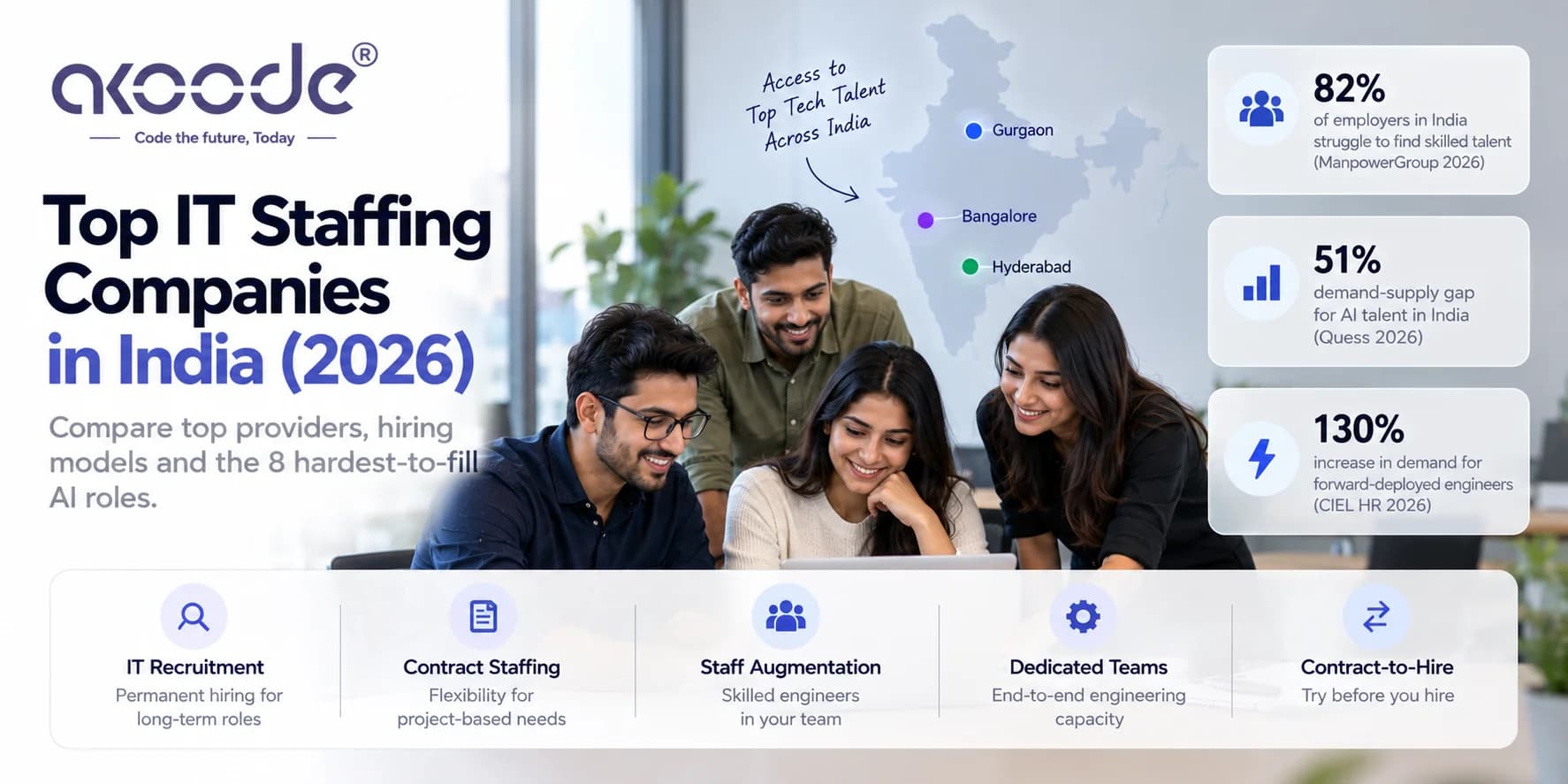
The pressure to get this right is not abstract. ManpowerGroup's 2026 Talent Shortage Survey found that 82% of employers in India are struggling to find skilled people, against 72% globally, and it puts AI and engineering at the top of the technical skills employers say they cannot find. When the market is that tight, a weak staffing choice costs you quarters, not weeks.
A note on who is writing this. Akoode is on the list, because we do this work. We have tried to treat ourselves the way we treat everyone else: one profile, the same headings, and a plain statement of where we are not the right fit. Every other company here is described from its own published material and independent sources, and any figure a company reports about itself is labelled as self-reported.
IT staffing, IT recruitment and IT staff augmentation: what you are actually buying
These terms get used as if they mean the same thing. They do not, and the difference decides who carries the legal and management load once the person starts. Here is the practical split.
Model | Who employs the person | Who directs the daily work | Typical fit |
|---|---|---|---|
IT recruitment services (permanent placement) | You, from day one | You | A long-term role you are ready to carry on your own payroll |
Contract IT staffing | The staffing firm, on its payroll, or you as a fixed-term employee | You | A defined project or a seasonal peak where headcount should end with the work |
IT staff augmentation | The delivery company | You, inside your sprint process | A specific skill gap on a team that already has technical leadership |
Dedicated team extension | The delivery company | Shared, against your roadmap | A roadmap bigger than your current headcount |
Contract-to-hire | The provider first, then you if both sides convert | You | Roles where an interview loop cannot tell you how someone really works |
An IT recruitment agency earns its fee by finding and presenting candidates. Once the offer is accepted, the relationship with the hire is yours. A technology staffing company or IT staffing agency goes further and becomes the employer of record for contract workers, which means payroll, statutory contributions and attendance sit with it. IT staff augmentation services sit on the delivery side of the line: the engineer comes from a company that builds software for a living, has been screened against your stack, and works under your direction.
If you are still deciding between augmentation and handing a project to a vendor entirely, our guide on staff augmentation vs outsourcing covers the control and risk trade-offs, and what staff augmentation services are and how they work covers the mechanics. For the wider choice between fixed price, dedicated team and augmentation, see how to choose a software engagement model.
Why hiring technology talent in India got harder in 2026
Four pieces of recent data explain why buyers are leaning on outside partners more than they were two years ago.
AI demand is outrunning supply. Quess Corp's report on India's AI talent counted about 416,000 AI professionals in India and a demand-supply gap of 51%. It also measured demand for AI and data talent rising by roughly 45% between March 2024 and March 2025.
Demand is not only a metro story. The same report attributes about 23% of AI hiring to global capability centres, and 14 to 16% of AI demand to tier-2 cities, led by Kochi, Ahmedabad and Coimbatore.
The new scarce title is the person who deploys AI. A CIEL HR analysis released in August 2026 found demand for forward-deployed engineers up 130% over the year to July 2026, with 52 organisations recruiting for the role.
Hiring has not slowed on the AI side even where IT hiring has. Naukri data reported by Reuters showed AI-related hiring in India's IT sector up 16% year on year in June 2026.
Put those together and the pattern is clear. Companies are not short of applicants. They are short of people who have shipped AI into a real system, and the normal permanent hiring cycle is too slow to find them before the roadmap moves on. That is the gap staffing and augmentation partners are being hired to close.
How we chose these ten companies
We looked for providers an Indian or overseas buyer could realistically engage for technology hiring, then checked each one against the same four questions.
Is the business verifiable? A working website, a registered entity and a findable history.
Is technology hiring a real part of the offer? Not a line on a generic HR services page.
Can we describe it from its own publications and independent sources?Headquarters, founding year and service lines were cross-checked. Where sources disagreed, we say so.
Does it serve a distinct buyer? The list is grouped by what each company is built for, not ranked from best to worst, because a payroll-heavy staffing firm and a five-person augmentation pod are not competing for the same brief.
Nobody paid to be included. Employee counts, client counts and placement totals are quoted only when the company publishes them, and they are marked as self-reported. Where we could not verify a founding year or headquarters from independent sources, we left it out rather than guess.
Quick comparison: IT staffing and augmentation companies in India
Company | Headquarters | Built for | Strongest when you need |
|---|---|---|---|
TeamLease Digital | Bengaluru | Specialised staffing at scale | Volume tech hiring with statutory compliance handled |
Quess Corp (Quess IT Staffing) | Bengaluru | Staffing, recruitment and RPO | Large, multi-city hiring programmes |
Randstad India | Chennai (registered office) | Professional staffing and permanent hiring | Mid-to-senior tech roles with global-standard process |
ManpowerGroup India (Experis) | India-wide network | IT resourcing inside a global group | Multinational buyers wanting one staffing partner across regions |
CIEL HR | Bengaluru | Permanent and flexible staffing plus HR services | Broad hiring support with market-data insight |
Xpheno | Bengaluru | Specialist and GCC staffing | Standing up or scaling a capability centre |
Akoode Technologies | Gurugram, with a US office in Jenks, Oklahoma | Engineering-led augmentation, AI-first | Vetted engineers inside your sprints, including AI and ML roles |
ValueCoders | Gurugram (Delhi NCR) | Dedicated teams and team extension | A standing offshore pod for a long roadmap |
Capital Numbers | Kolkata | On-demand specialist hiring | Adding one or two named skills to an existing team |
Squareboat (Crewmate) | India | Design-led builds plus remote developer placement | Hiring pre-vetted full-time remote developers |
1. TeamLease Digital
Headquarters: Bengaluru
Type: Specialised staffing arm of TeamLease Services
Services: IT, ITeS, telecom, engineering, edtech, healthtech, finance and accounting, and gaming staffing
Best fit: Enterprises and capability centres hiring technology talent at volume
Check before you sign: How much of the bench is genuinely senior and AI-capable versus general IT
TeamLease Digital is the specialised-staffing subsidiary of TeamLease Services, one of India's best-known listed staffing groups. By its own account it has hired more than 80,000 professionals since inception, currently has over 10,000 consultants deployed, and works with more than 200 clients. Those are company figures, not audited ones, but they describe a business built around repeatable process and compliance rather than boutique matching. Its CEO has also been quoted in the trade press on AI talent demand, which suggests the firm is watching where hiring is moving.
2. Quess Corp (Quess IT Staffing)
Headquarters: Bengaluru, established 2007
Type: Staffing and workforce solutions group with a dedicated IT staffing business
Services: Recruitment, RPO, executive search and IT staffing across BFSI, retail, telecom and manufacturing
Best fit: Large employers running multi-location hiring programmes
Check before you sign: Who specifically will own your requirement inside such a large organisation
Quess describes itself as India's largest staffing and workforce solutions company, with a workforce of well over 450,000 across eight countries. That is a self-reported claim, so treat it as the company's positioning rather than a ranking. What is easier to verify is its research output: the AI talent report cited above came from Quess and is one of the more widely quoted sources on India's AI supply gap, with comment from Kapil Joshi, CEO of Quess IT Staffing.
3. Randstad India
Headquarters: Registered office in Chennai; part of Randstad N.V. of the Netherlands
Type: Staffing, permanent hiring, executive search and RPO
History: Began in 1992 as Ma Foi Management Consultants; the Randstad India name replaced Ma Foi Randstad in April 2012
Best fit: Mid-to-senior technology and engineering hiring where a structured, globally consistent process matters
Check before you sign: Whether your role sits in its professional-staffing practice or its general-staffing one, since the teams differ
Randstad's Indian business was assembled from acquisitions, including the Chennai HR firm Ma Foi and the recruitment companies EmmayHR and Teams4U. Industry commentary often points to its fit for multinationals that want a hiring process matching what they run elsewhere. If your brief is a mid-career data or platform engineer for an India office of a foreign company, it belongs on your shortlist.
4. ManpowerGroup India (Experis)
Presence: India operation of ManpowerGroup, with Manpower Services India established in 1999
Type: Staffing and permanent recruitment, with IT resourcing under the Experis brand
Best fit: Multinational buyers who want the same staffing partner in several countries
Check before you sign: Whether the Experis team handling your search has hired your specific stack before
ManpowerGroup built its Indian IT staffing business partly through the acquisition of a majority stake in Web Development Company Limited, then moved IT professional resourcing under the Experis name. The group's annual Talent Shortage Survey is also one of the better recurring datasets on hiring difficulty, which is why it appears in the market section above.
5. CIEL HR
Headquarters: Bengaluru, established 2015
Type: HR services group
Services: Permanent staffing, flexible staffing, talent assessment, HR advisory and HR platforms
Best fit: Employers who want a single provider for hiring, assessment and workforce data
Check before you sign: How deep its engineering bench goes compared with its generalist HR offer
CIEL was founded by leaders who earlier built Ma Foi, so the business is new but the people are not. It was also the source of the forward-deployed engineer analysis quoted earlier, and Brand Finance included it in its India 100 brand ranking in 2024, which CIEL says made it the only HR services company on that list. It is a sensible option when you want hiring plus market intelligence from the same partner.
6. Xpheno
Headquarters: Bengaluru, with offices in the NCR, Mumbai, Pune, Chennai, Hyderabad, Udupi and the United States
Founded: Late 2010s (sources give 2016 or 2017), by Kamal Karanth and Anil Ethanur
Services: IT staffing and staff augmentation, engineering services, sales staffing, direct hire, RPO and executive search
Best fit: Companies building or scaling a global capability centre in India
Check before you sign: Whether your requirement fits its specialist model or needs a broader generalist partner
Xpheno positions itself as a specialist rather than a volume player, and says it was purpose-built to staff greenfield GCCs. Its founders previously served as managing directors at established staffing companies, which shows in how it talks about the work. For a company opening its first India engineering centre, that focus can matter more than raw size.
7. Akoode Technologies
Headquarters: Spaze iTech Park, Sector 49, Gurugram; US office in Jenks, Oklahoma
Founded: 2023
Type: Software and AI engineering company that places engineers into client teams
Services: Single-engineer augmentation, dedicated team extension, short-term and project-based augmentation, specialised AI and DevOps skills, offshore augmentation, contract-to-hire and managed augmentation
Best fit: Teams that already have technical leadership and need vetted engineers, including AI and ML specialists, working inside their sprints
Not the best fit: High-volume non-technical hiring, payroll outsourcing, or a pure recruitment and RPO mandate
Akoode is the newest company on this list, and one of four here (with ValueCoders, Capital Numbers and Squareboat) that are software engineering firms first and staffing providers second. It holds a 4.9 rating from 126 Google reviews and a 5.0 on GoodFirms, and has delivered 180+ projects across more than 15 industries. We are also the first to say that it is not a recruitment agency. The engineers who join your team come from the same bench that builds client products, which is why the vetting is stack-specific and why AI placements are matched on production experience, not adjacent experience.
That bench includes people who have shipped systems such as an AI medical diagnostic platform and an AI player performance tracking system, and the same team builds under our AI development and custom software development practices. By our own published timelines, a single-engineer placement typically goes from requirement to start date in two to three weeks, and scarce AI skills can take longer. The full model list, process and engagement terms are on our staff augmentation page.
8. ValueCoders
Headquarters: Gurugram, Delhi NCR; founded 2004
Type: Software engineering company offering team-based delivery
Services: Product and MVP development, web and mobile apps, AI and machine learning, data engineering, cloud and DevOps, delivered through delivery pods, team extension and development centre models
Best fit: Companies that want a standing offshore pod for a long roadmap
Check before you sign: Whether you are getting a named team or a pooled one, and what happens when a pod member leaves
ValueCoders has been operating for over two decades and reports clients in more than 40 countries, a self-reported figure. Its structure is closer to a managed team than to an individual contractor placement, which suits long builds where continuity matters more than flexibility.
9. Capital Numbers
Headquarters: Kolkata; founded 2012
Type: Digital engineering company with an on-demand hiring model
Services: Web and mobile development, DevOps, AI and ML, and UI/UX talent, plus custom software and digital transformation
Best fit: Companies adding one or two named skills to an existing team
Check before you sign: Seniority mix on the specific profile you are shown, not the firm's average
Capital Numbers markets its model as in-demand skills, on demand, and states that it holds ISO 9001 and 27001 certification. It also reports work for well-known media and software brands. That makes it a reasonable fit for agencies, SaaS firms and product teams that know exactly which role is missing.
10. Squareboat (Crewmate)
Headquarters: India, with a growing US presence; founded 2013
Type: Design-first software company with a separate talent resourcing division
Services: Web and mobile product development, cloud solutions, and, through Crewmate, placement of pre-vetted full-time remote developers
Best fit: Startups that want to hire remote developers directly rather than commission a whole project
Check before you sign: Whether the developers you meet through Crewmate are the ones who will actually join
Squareboat calls itself a design-first company, and Crewmate is its answer to founders who want full-time developers without running a local hiring process. The split between its product studio and its talent arm is useful to understand before you approach either.
Which type of provider fits which hiring need
Most buyers do not need the biggest name. They need the provider whose model matches the shape of the problem.
Your situation | Provider type to start with | Why |
|---|---|---|
Hiring dozens of developers across several cities | Large staffing firm | Volume sourcing, payroll and statutory compliance are the core product |
Opening an India capability centre | Specialist or GCC-focused firm | Leadership hiring, ramp planning and team build-out come as a set |
One missing skill on a team that already has leadership | Engineering-led augmentation | You get a screened engineer, not a stack of resumes |
A long roadmap and no spare headcount | Dedicated team extension | Continuity of the same engineers matters more than flexibility |
A permanent role you want on your own payroll | IT recruitment agency or direct hiring | You pay for the search, then carry the employee |
A role where you are unsure of fit | Contract-to-hire | Months of real work replace a handful of interviews |
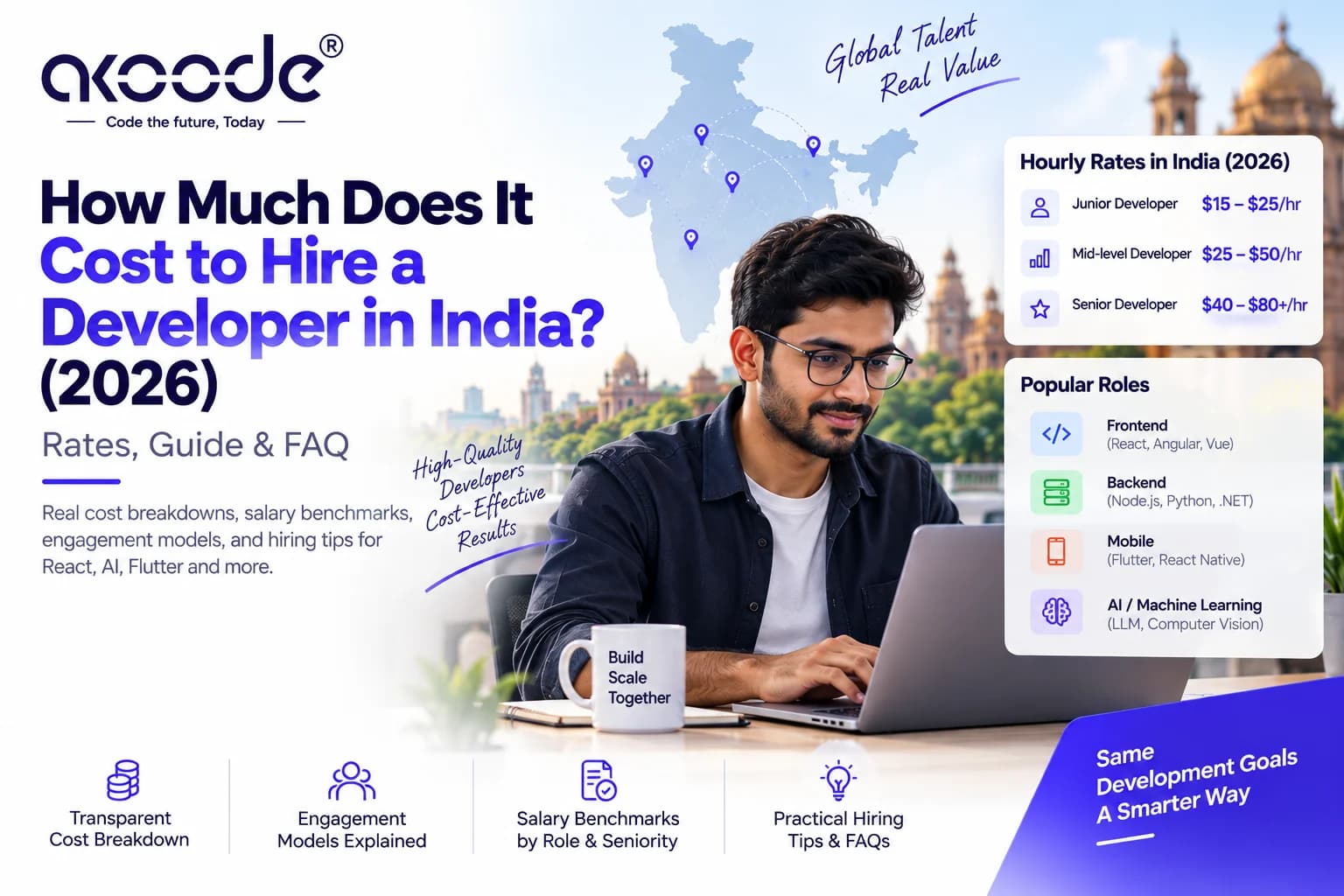
If your search is specifically for developers, how to hire developers in India walks through the full process, and what it costs to hire a developer in India covers the budget side. To compare delivery companies rather than staffing firms, see our lists of the top software development companies in India and the top AI development companies in India.
AI engineer: the most requested title, and the eight roles hiding inside it
"AI engineer" is now the most common title in technology hiring briefs, and it is the vaguest. Three different employers can use it to mean someone who wires up a language model API, someone who trains and evaluates models, and someone who keeps a model alive in production. If a staffing partner accepts "AI engineer" as a complete requirement, you will receive a pile of mismatched profiles.
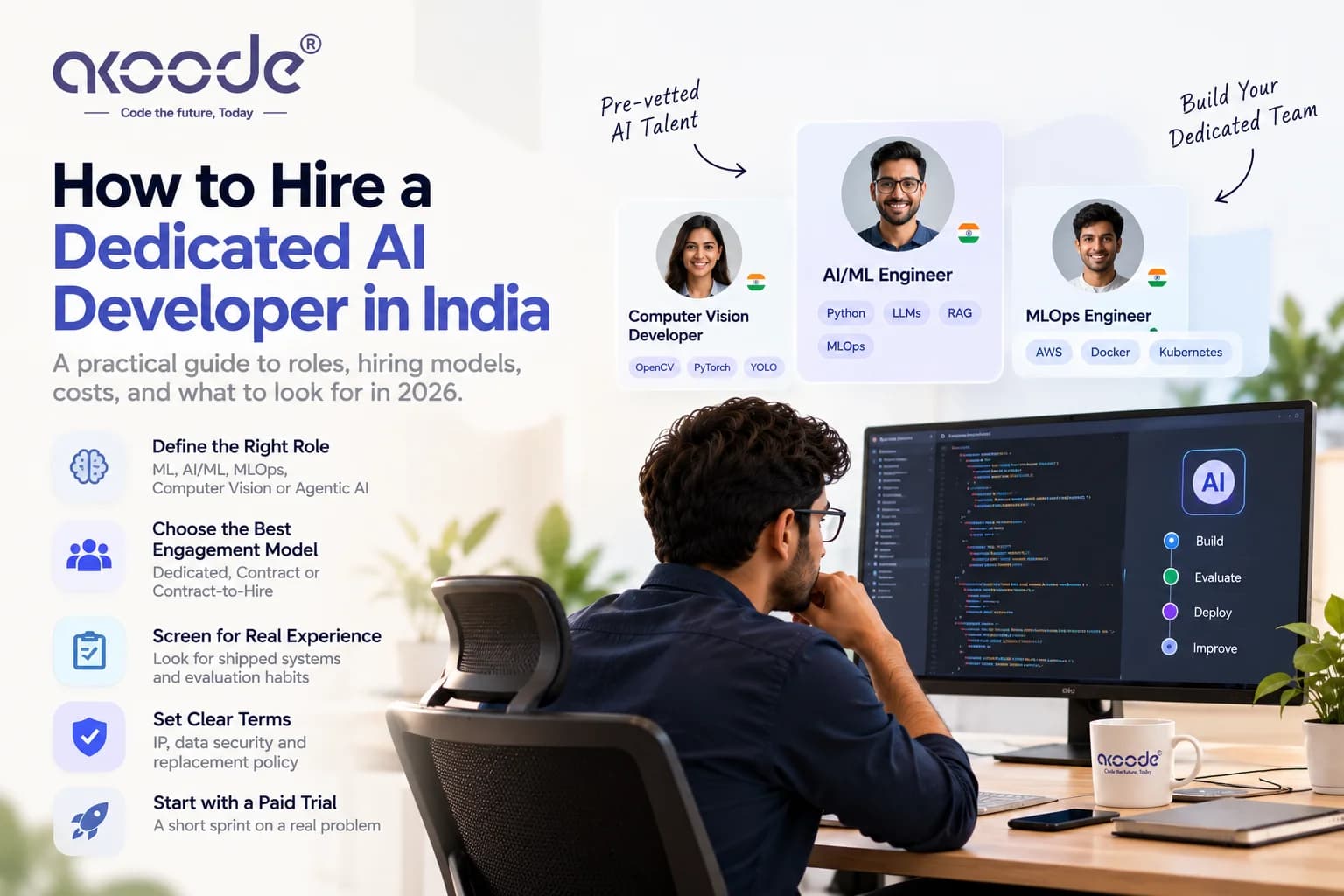
The fix is to name the role before you brief anyone. These are the eight that matter, what each one actually does, and what to test for. For a deeper look at hiring this talent on a dedicated basis, see our guide to hiring a dedicated AI developer in India
Role 1: Machine Learning Engineer
A machine learning engineer trains, evaluates and ships models, and owns what happens to them afterward. The core skills are Python, a deep learning framework, feature and data pipelines, and honest evaluation. This is the role most people picture when they say "AI engineer", and the one most often confused with data science.
Screen for: a model that degraded after launch and what the candidate did about it. People who have only run notebooks have no such story. Best engagement:augmentation works well when you have an ML lead to direct the work. Our AI development services staff this profile regularly.
Role 2: Forward-Deployed Engineer
A forward-deployed engineer sits close to the customer and makes AI work inside that customer's real systems: integrating with their data, adapting a product to their workflow, and translating between engineers and operators. It is the fastest-growing title on this list, and the CIEL HR study showed demand rising 130% in a year. It is also the hardest to hire because it needs engineering depth, AI fluency and customer-facing judgement in one person.
Screen for: a project where requirements were unclear and the candidate scoped it anyway, plus how they explain a technical limit to a non-technical buyer. Watch for support engineers who have been retitled. Best engagement: usually a long-term hire or a dedicated placement. Read what agentic AI is and our AI agent developmentwork to see the kind of deployment this role handles.
Role 3: Data Scientist
A data scientist frames business questions as statistical or modelling problems, runs experiments and explains what the numbers mean. The role has not disappeared with the rise of language models. It has narrowed toward judgement: which question is worth asking, and whether the answer can be trusted.
Screen for: problem framing and statistical sense, not tool lists. A good data scientist will push back on a vague brief. Common mistake: expecting them to productionise models, which is a different job. Best engagement: contract or augmentation for defined analysis work. Our big data and analytics team covers the surrounding data engineering.
Role 4: AI/ML Software Engineer
This is the engineer who builds the product around the model: the APIs, retrieval pipelines, agents, integrations, evaluation harness and user interface that make a model useful. It is the most hireable bridge role, because strong software engineers can grow into it, and it is where a large share of real AI delivery work sits.
Screen for: system design with language model calls, including latency, fallback behaviour, cost control and how they test non-deterministic output. Best engagement:a natural fit for augmentation. Our guides on how to build an AI app and our RAG application development practice show what this work looks like end to end.
Role 5: AI Product Manager
An AI product manager owns the problem, decides what "good enough" means for an output that is probabilistic, and plans how a feature rolls out when it can be wrong. Quess's report notes growing demand for AI product managers and business analysts who can turn model capability into business results.
Screen for: how they define acceptance criteria for a model, and how they handle a feature that is right 90% of the time. Best engagement: almost always a permanent hire, since the role is tied to your strategy. A recruitment agency suits this better than an augmentation partner.
Role 6: AI Research Scientist
A research scientist develops new methods, reads and reproduces the literature, and pushes what a model can do. Most companies asking for this role actually need applied engineering, which is cheaper to find and faster to deliver. Genuine research hiring is a long-term investment, usually in someone with a doctoral background or a strong publication record.
Screen for: reproducibility of past work and the ability to explain a result's limits. Common mistake: hiring research when the real need is an engineer who can adapt an existing model. Best engagement: direct hire or a long research partnership, rarely a short contract. Our computer vision architecture and optimisation guide gives a feel for the technical depth involved.
Role 7: MLOps / AI Infrastructure Engineer
An MLOps engineer builds the pipelines, deployment, monitoring and GPU capacity that keep models running. The work is unglamorous and decides whether an AI feature survives its first month in production: drift monitoring, rollbacks, cost per inference, and what happens when a dependency changes.
Screen for: a rollback story, how they monitor drift, and how they would cut compute cost without hurting quality. Best engagement: a strong fit for specialist augmentation, since the need is often a defined stretch of platform work. See our cloud and DevOps solutions and the guide to enterprise AI agent architecture.
Role 8: Computer Vision Engineer
A computer vision engineer builds systems that understand images and video: detection, segmentation, tracking, and increasingly deployment on edge devices. The hard part is rarely the model. It is data curation, labelling quality and keeping latency acceptable on real hardware.
Screen for: how they built and cleaned a dataset, and what they did when a model worked in testing but failed on live footage. Best engagement: well suited to project-based augmentation. Our work on an AI player performance tracking system is a good illustration, and the guides to computer vision use cases and choosing a computer vision development company go deeper.
Which engagement model fits each AI role
Role | Usually best as | Reason |
|---|---|---|
Machine Learning Engineer | Augmentation or dedicated hire | Works well when an ML lead already sets direction |
Forward-Deployed Engineer | Long-term hire or dedicated placement | Needs sustained customer context |
Data Scientist | Contract or augmentation | Analysis work often has a defined end |
AI/ML Software Engineer | Augmentation | Slots directly into a product sprint |
AI Product Manager | Permanent hire via recruitment | Tied closely to your strategy |
AI Research Scientist | Direct hire or research partnership | Long horizon, rarely a short contract |
MLOps / AI Infrastructure Engineer | Specialist augmentation | Often a defined stretch of platform work |
Computer Vision Engineer | Project-based augmentation | Clear start and end per vision project |
How to vet an AI hire when someone else does the screening
Handing the first screen to a staffing partner saves time only if you know what a good screen looks like. These checks work whoever runs them.
Ask for something shipped. A production system, not a prototype, and what business number it moved.
Ask how they evaluated it. Anyone can describe training. Fewer can describe how they knew the output was good.
Ask for a failure. What broke, how they found out, and what they changed. Real experience has scars.
Use a live problem from your own stack. Generic puzzles reveal puzzle skill. A problem from your codebase reveals fit.
Sit in on the technical round. A reputable provider will let you. If it will not, ask why.
Check data handling. Who sees your data, where models run, and what the contract says about it.
Contract IT staffing in India after the labour codes
Anyone buying contract IT staffing in India should know the labour rules changed recently. India's four Labour Codes took effect on 21 November 2025, consolidating 29 earlier laws. According to published summaries from payroll and legal firms, fixed-term employment is now a recognised category, and fixed-term employees become eligible for pro-rata gratuity after one year of service rather than five.
The practical point is a distinction worth asking about. A fixed-term employee is on a company's own rolls. A contract worker supplied through a contractor is a different arrangement. If a provider offers you "contract staffing", ask which of the two it means, who the employer of record is, and how the new rules change its pricing structure. Implementation is still bedding in, so treat this as a question for your counsel, not a settled answer from a blog post.
Ten questions to ask any IT staffing company before you sign
Who is the employer of record, and who carries statutory compliance?
Can I interview the exact person you are proposing, not a representative profile?
What is the replacement process if the fit is wrong, and how fast does it happen?
Who owns the work product and the code from day one?
Can the engineer convert to my payroll, and on what terms?
How do you vet for my stack specifically, not for general seniority?
What happens if the person resigns mid-project?
How do you handle security, NDAs and access provisioning before day one?
Which of your past placements resemble mine, and may I speak to those clients?
What overlap hours will the team keep with mine, agreed in writing?
A provider that answers these plainly and quickly is usually one you can work with. Vagueness on the first three tells you most of what you need to know. For a wider checklist covering delivery companies rather than staffing firms, see how to choose a software development company, and for proof of what augmentation looks like in practice, read our staff augmentation case studies.
Frequently asked questions
What is the difference between an IT staffing company and an IT recruitment agency?
An IT recruitment agency finds candidates and charges a fee, after which the hire joins your payroll. An IT staffing company usually employs the contract worker on its own payroll and supplies them to you for a period. Recruitment suits permanent roles, staffing suits temporary or project-based ones.
What is IT staff augmentation, and how is it different from contract staffing?
IT staff augmentation adds engineers from a technology delivery company into your team, working under your direction and inside your sprint process. Contract staffing supplies a worker on a staffing firm's payroll, often for general IT roles. Augmentation is skill-led and engineering-vetted, while contract staffing is more about headcount and compliance.
Which is the best IT staffing company in India?
There is no single best one, because the providers are built for different buyers. Large firms like TeamLease Digital and Quess suit volume hiring, specialists like Xpheno suit capability centres, and engineering-led firms like Akoode, ValueCoders and Capital Numbers suit teams needing engineers inside their sprints.
How long does it take to hire an AI engineer through a staffing partner in India?
It varies with the role and how scarce the skill is. By Akoode's own published timelines, a single-engineer placement typically takes two to three weeks, while a multi-person team takes longer. Specialised AI roles can take more time because the qualified pool is small.
Can I hire software developers in India on a contract basis?
Yes. You can use contract staffing, fixed-term employment, staff augmentation or contract-to-hire. India's Labour Codes took effect on 21 November 2025 and changed some fixed-term rules, including gratuity after one year, so confirm the employment structure with legal counsel before signing.
Do I need a staffing agency to hire AI engineers, or can I hire directly?
You can hire directly if you have time and an internal team able to screen AI skills. A partner helps when the role is scarce, the roadmap cannot wait for a three-to-four-month hiring cycle, or you lack an internal expert to run the technical screen.
How much does IT staffing cost in India?
It depends on seniority, skill scarcity, engagement length and whether you buy permanent placement, contract staffing or augmentation. A figure quoted without those details is rarely reliable. Ask any provider for a fully loaded quote against your specific role, and compare what each quote includes.
What should a contract with an IT staffing provider include?
It should state the employer of record, replacement terms and timing, intellectual property ownership, conversion rights to permanent hire, notice periods, confidentiality and security obligations, and the working-hours overlap with your team. If any of these is missing, ask for it before you sign.
Where to go from here
Start by naming the role precisely, then match the provider type to the shape of your problem, then verify the claims with a technical interview you attend yourself. That order saves more time than any comparison table, including the ones above.
If you are weighing augmentation for an AI or engineering role and want a plain answer on whether it fits, or a referral if it does not, you can book a slot with our founder. No pitch deck, just a conversation about the gap you are trying to close.
Get In Touch Now
View More Our Blog