


 June 22, 2026
In 2026, software is no longer a back-office utility — it is the engine of competitive differentiation. From AI-powered customer experiences to cloud-native supply chains, businesses of every size are racing to build or upgrade their digital capabilities. Yet the decision that determines success or failure is rarely which technology to use. It is which software development company to partner with.
Global IT spending is projected to exceed $5.1 trillion in 2026, with custom software accounting for a growing share. Simultaneously, the global shortage of skilled developers — estimated at more than 4 million unfilled positions — has made access to quality engineering talent the single greatest bottleneck for product and technology leaders worldwide.
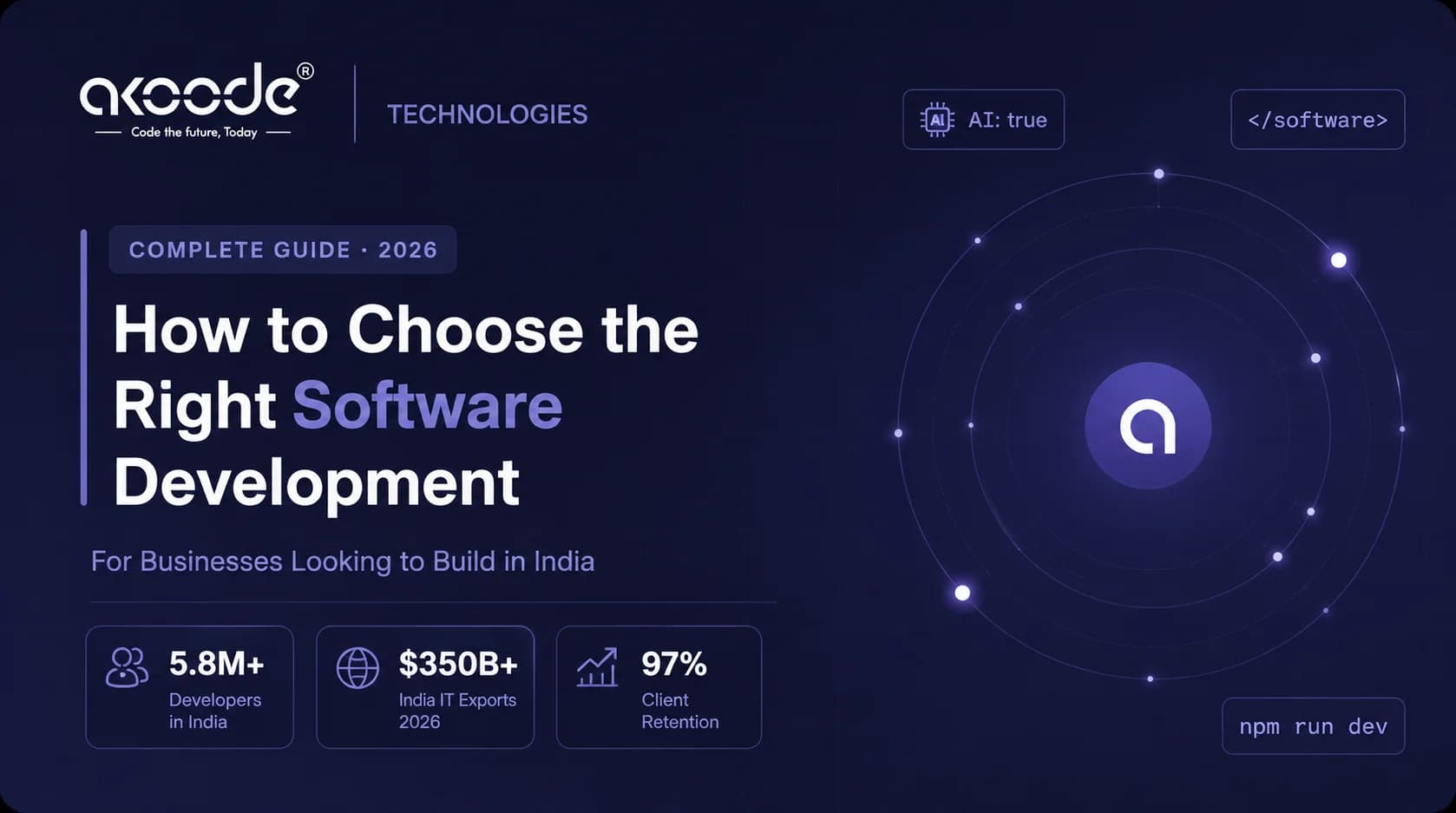
India has emerged as the undisputed epicentre of this global talent supply. With over 5.8 million software developers and a rapidly maturing technology ecosystem, India-based software development companies now build mission-critical systems for Fortune 500 enterprises, VC-backed startups, and government agencies across six continents.
Yet with tens of thousands of companies claiming to offer software development services, choosing the right partner is harder than ever. This comprehensive guide gives you the frameworks, questions, and criteria you need to make that decision with confidence — whether you are a startup founder, a CTO, or an enterprise procurement leader.
1. What Is a Software Development Company?
Definition
A software development company is a professional services organisation that designs, builds, deploys, and maintains digital products and technology systems on behalf of client businesses. Unlike in-house development teams embedded within a single organisation, a software development company brings together diverse engineering, design, and project management talent to serve multiple clients — often across industries, geographies, and technology stacks.
Core Services Offered
A full-service software development company typically provides:
Custom software development tailored to unique business workflows
Mobile app development for iOS, Android, and cross-platform environments
Web application development — portals, dashboards, and e-commerce platforms
Enterprise software development including ERP, CRM, and HRMS systems
SaaS product development and multi-tenant architecture
AI and machine learning solution development
Cloud migration, cloud-native architecture, and DevOps engineering
API design, third-party integrations, and microservices
QA, testing, and quality engineering
Ongoing maintenance, support, and product evolution
Types of Software Projects
Projects span the full spectrum — from rapid MVPs delivered in weeks to multi-year enterprise transformation programmes. Browse our software project case studies to see examples across industries. Common categories include:
Consumer-facing mobile and web applications
Internal business automation and workflow tools
Data platforms, analytics dashboards, and reporting systems
E-commerce platforms and digital marketplaces
Healthcare, fintech, and regtech compliance systems
AI-powered engines for recommendation, prediction, and decision support
IoT and embedded systems integration
2. Why Businesses Choose a Software Development Company in India
India's dominance in global software delivery is not accidental. It is the product of decades of strategic investment in STEM education, a maturing startup ecosystem, and a deeply competitive service economy. Here is why businesses from the USA, UK, Europe, and beyond consistently choose a software development company in India.
Cost Advantages Without Quality Compromise
Hourly engineering rates in India typically range from $18 to $65 depending on seniority and specialisation, compared to $80–$250 in the USA and $70–$180 in Western Europe. For a team of five mid-level developers, this difference can represent annual savings of $300,000 or more — capital that can be reinvested into product marketing, sales, or R&D.
Critically, this cost advantage does not reflect a quality differential. India produces over 1.5 million engineering graduates annually, and its top-tier software development companies compete directly with global peers on code quality, delivery velocity, and architectural sophistication.
Deep and Diverse Technical Expertise
India's developer community has accumulated expertise across virtually every technology domain — from legacy Java and .NET enterprise systems to cutting-edge Rust, Go, and WebAssembly implementations. India hosts the world's largest communities of AWS, Azure, and Google Cloud certified engineers, and its AI/ML talent pool is growing faster than nearly any other country.
Scalability and Flexible Engagement Models
A software development company in India offers engagement flexibility that in-house hiring cannot match. You can begin with a small discovery team, scale to a full dedicated development team during a product sprint, and right-size after launch — all under a single contractual framework. Explore how this works through our staff augmentation and dedicated team model.
Global Delivery Capabilities
Leading India-based software development companies operate with distributed delivery models, multi-timezone support capabilities, and international project management standards. Many hold ISO 9001 and ISO 27001 certifications and are fully fluent in Western business communication norms. To see this in action, explore our client case studies.
Key Statistics
$350B+ — India's IT and software exports projected for 2026
5.8 million+ — Active software developers in India
$18–$65/hr — Typical India developer rates vs. $80–$250 in the USA
1.5 million+ — Engineering graduates produced by India annually
3. Key Services Offered by a Software Development Company
Custom Software Development
Custom software development is the flagship offering of any serious software development company. Rather than adapting generic off-the-shelf tools to your business, custom development creates software engineered precisely for your workflows, data architecture, user base, and integration landscape. The result is a competitive asset that your competitors cannot replicate by purchasing a licence. Explore our custom software development services →
Mobile App Development
With more than 6.9 billion smartphone users globally, mobile-first product strategy is the default for consumer-facing businesses. As a capable mobile app development company, we offer native iOS (Swift/SwiftUI), native Android (Kotlin), and cross-platform development (React Native, Flutter) — with a clear recommendation for which approach suits your product, budget, and time-to-market goals. See our mobile app development services →
Web Application Development
Modern web applications go far beyond brochure websites. From complex multi-role dashboards and real-time collaboration platforms to high-throughput e-commerce engines and customer portals, our web development company capabilities span the full stack: React, Vue, Angular, Next.js on the frontend; Node.js, Python, Ruby, Java, Go on the backend; and PostgreSQL, MongoDB, Redis, and cloud-native databases at the data layer. View our web development services → and browse delivered web projects →
SaaS Product Development
If your business model involves selling software as a service, you need a partner with specific SaaS architecture expertise — multi-tenancy, subscription billing integration, feature flagging, usage metering, and the operational rigour required to maintain 99.9%+ uptime at scale. Our SaaS project case studies demonstrate this capability across multiple verticals.
AI and Automation Solutions
Artificial intelligence has moved from experimental to essential. As a modern software development company, we deliver AI-powered features — intelligent recommendation engines, predictive analytics, natural language processing, computer vision, and generative AI integrations — that compress manual work from hours to seconds. See our AI development services →
Cloud Solutions and DevOps
Cloud-native development, containerisation (Docker, Kubernetes), CI/CD pipeline engineering, and infrastructure-as-code (Terraform, Pulumi) are now fundamental competencies for any production-grade software development company. We architect for resilience, observability, and cost efficiency from day one. Explore our Cloud and DevOps services →
Maintenance and Long-Term Support
The most underappreciated service in software development is reliable post-launch maintenance. Software is never finished — platforms require security patches, dependency updates, performance tuning, and continuous feature evolution. Our software support and maintenance services include clear SLAs, support tiers, and escalation processes, so when something goes wrong, you have a response — not silence.
4. 10 Critical Factors to Consider Before Hiring a Software Development Company
Factor 1: Industry Experience and Domain Knowledge
General engineering competence is necessary but not sufficient. A software development companythat has already delivered projects in your industry — healthcare, fintech, e-commerce, logistics, or real estate — brings pre-built domain knowledge that reduces discovery time and accelerates delivery. Always ask for industry-specific case studies. You can browse ours in our project case studies portfolio.
Factor 2: Portfolio Quality and Verifiable References
A strong portfolio tells you what a company has built. Verified client references tell you how they built it and what the experience was like. Request both. When reviewing portfolio projects, look for evidence of genuine product thinking — not just visual polish. Our case studies include measurable business outcomes alongside technical deliverables.
Factor 3: Breadth and Depth of Technical Expertise
Interrogate the technology stack. Can this custom software development company work effectively in your existing environment? Do they have certified engineers across the cloud platforms, frameworks, and databases your product requires? A company that claims expertise in every technology equally is a red flag — genuine depth requires honest specialisation. Review our full technology capabilities →
Factor 4: Communication Standards and Cultural Alignment
In offshore software development, communication quality is a primary determinant of project outcomes. Assess English proficiency of project managers and technical leads. Evaluate their responsiveness during the sales process — how they treat a prospect is a leading indicator of how they treat a client. Insist on dedicated project management and structured reporting cadences.
Factor 5: Development Methodology
The best software development companies operate with disciplined, adaptive Agile frameworks — typically Scrum or Kanban — with well-defined sprint cycles, clear definition-of-done criteria, and regular retrospectives. Ask to see a sample sprint plan, backlog structure, and acceptance criteria framework.
Factor 6: Security Standards and Compliance Posture
If your product will handle sensitive user data — health records, financial information, personal identifiers — your software development company must demonstrate robust security practices. Look for ISO 27001 certification, OWASP compliance in secure coding standards, documented penetration testing processes, and clear data handling policies under GDPR, HIPAA, or relevant frameworks.
Factor 7: Pricing Transparency and Commercial Integrity
Hidden costs — scope padding, change-order abuse, undisclosed third-party licence fees — are among the most common sources of conflict in software engagements. A trustworthy company provides detailed, itemised proposals, clear change management processes, and honest estimates based on genuine scoping. Contact us for a transparent project estimate →
Factor 8: Client Reviews and Independent Ratings
Platforms such as Clutch.co, G2, and GoodFirms aggregate verified client reviews for software development companies. These independent ratings are far more reliable than self-reported testimonials. Look for pattern consistency — recurring praise for communication, deadline adherence, and technical quality is a strong positive signal.
Factor 9: Support Model and Post-Launch Commitment
What happens the day after launch? Clarify the post-launch support model before signing: response SLAs, who owns production incidents, how bug fixes are prioritised, and the commercial model for ongoing maintenance. A partner that disappears after handover is not a partner at all. See our post-launch support approach →
Factor 10: Scalability and Long-Term Growth Partnership
Your requirements will evolve. The software development company you choose today should be capable of scaling with you — both in team size and in technical sophistication. Our staff augmentation service is specifically designed to flex with your growth, adding architects, security engineers, and data scientists as your product matures.
5. Red Flags to Watch Out For
Unrealistically Low Pricing
If a software development company quotes significantly below market rates without explanation, treat it as a warning — not a bargain. Below-market pricing typically indicates inexperienced junior-only teams, undisclosed use of copy-pasted code, or a low initial bid designed to maximise change-order revenue later. Quality software development services have an irreducible cost floor.
Inability to Provide Verifiable References
Any established software development company should be able to connect you with at least two or three former clients willing to speak about their experience. If a company declines this request or provides only written testimonials without direct contact, be very cautious. Our case studies portfolio includes verifiable client outcomes.
Vague or Non-Existent Process Documentation
Professional software development companies document everything — requirements, architecture decisions, sprint plans, code review standards, deployment runbooks. If your prospective partner cannot show you examples of their process documentation, their processes likely exist only on paper — or not at all.
Poor Communication During Sales
The quality of communication during the proposal phase is your most reliable preview of the working relationship. Delayed responses, evasive technical answers, over-reliance on template proposals, and poor written communication are all meaningful signals — magnified under delivery stress.
Absence of Legal Safeguards
Any serious software development company will provide robust contracts covering intellectual property assignment, confidentiality, data handling, and liability. If a company is reluctant to sign an NDA or vague about IP ownership, walk away and protect yourself.
6. Software Development Company vs. Freelancers: A Detailed Comparison
Many businesses face the initial choice between engaging a professional software development company and hiring individual freelancers. The table below clarifies the trade-offs:
Factor | Software Development Company | Freelancer |
|---|---|---|
Team Size | Dedicated multi-role team | Single individual |
Scalability | Easily scalable on demand | Very limited |
Accountability | Contractual SLAs & NDAs | Variable / informal |
Communication | Structured PMs, daily standups | Ad hoc, inconsistent |
Tech Stack Breadth | Full-stack capabilities | Usually one or two skills |
Availability | Business hours + on-call support | Often unreliable |
IP Protection | Robust legal agreements | Often weak |
Cost Structure | Predictable milestone billing | Lower hourly but risk of rework |
Long-term Support | Ongoing maintenance contracts | Rarely available |
For projects beyond simple landing pages or single-feature tools, a software development companyalmost always offers superior risk-adjusted outcomes. The premium over freelance rates is offset by reduced coordination overhead, higher accountability, and the structural protection that a professional engagement provides. Explore how Akoode structures its engagements →
7. 15 Questions to Ask Before Hiring a Software Development Company
Use these questions in your vendor evaluation conversations. Strong answers build confidence; evasive or generic answers should prompt deeper probing.
Can you share two or three case studies from clients in my industry, including the business outcomes achieved? (Browse Akoode's case studies →)
What is your standard software development methodology, and how do you adapt it for fixed-budget vs. time-and-materials engagements?
Who will be my primary point of contact, and what are their qualifications and experience with projects like mine?
How do you handle scope changes mid-project, and what is your change management process?
Can you walk me through how you approach system architecture and technology selection for a new project?
What does your quality assurance process look like, and what percentage of development time is allocated to testing?
How do you protect client intellectual property, and who owns the code upon project completion?
What security certifications and standards does your company hold and comply with?
How do you structure your sprint cycles, and what artefacts do clients receive at the end of each sprint?
What is your approach to project transparency — what reporting, dashboards, or collaboration tools will I have access to?
How do you manage communication across time zones, and what are your standard working hour overlaps?
Can I speak directly with one of your engineers to assess their technical depth?
What happens if a key developer assigned to my project leaves during the engagement?
What does your post-launch support and maintenance model look like, and what are your SLA commitments?
Can you provide a risk register or highlight the top three risks you foresee in my specific project?
8. Software Development Costs in India: What to Expect in 2026
Cost transparency is one of the hallmarks of a trustworthy software development company. Understanding the factors that drive cost — and the typical ranges to expect — empowers you to evaluate proposals critically and avoid both under-investing in quality and overpaying for inflated margins.
Key Factors Affecting Development Cost
Project complexity: number of features, integrations, user roles, and data flows
Technology stack: newer or more specialised technologies command higher rates
Team composition: the seniority mix across architects, leads, mid-level, and junior engineers
Engagement duration: longer engagements typically attract volume efficiency
Support and maintenance commitments post-launch
Compliance and security requirements, particularly in regulated industries
Design complexity: UX research, animation, and custom design systems add cost
Typical Pricing Ranges
Project Type | Typical Budget (USD) | Examples |
|---|---|---|
MVP / Prototype | $8,000 – $25,000 | Landing page app, basic booking system |
Small Web / Mobile App | $15,000 – $50,000 | E-commerce site, custom CRM, business portal |
Mid-Scale SaaS Platform | $40,000 – $120,000 | Multi-tenant SaaS, marketplace apps |
Enterprise Software | $100,000 – $500,000+ | ERP, AI-powered platforms, large integrations |
Dedicated Development Team (monthly) | $8,000 – $25,000/month | Ongoing product builds, scale-up teams |
MVP vs. Enterprise Software: Understanding the Difference
An MVP is designed to test a core hypothesis with the smallest possible feature set — prioritising speed and learning over scalability and polish. Enterprise software development, by contrast, must integrate with complex existing systems, meet regulatory requirements, serve thousands or millions of users reliably, and support multi-geography operations. View real-world examples across both categories in our case studies.
9. Future Trends in Software Development (2026 and Beyond)
Artificial Intelligence as a Co-Developer
AI-assisted development — where large language models help engineers write, review, and refactor code — is now mainstream. The best software development companies are integrating AI tooling into their development workflows to improve velocity and code quality. More significantly, they are building AI-native products that embed intelligence into core user workflows. Explore Akoode's AI development capabilities →
Hyper-Automation Across Business Processes
Robotic process automation (RPA) combined with AI is eliminating manual work across finance, HR, operations, and customer service at unprecedented scale. Our custom software development servicesincreasingly involve building automation layers that connect legacy systems with modern digital workflows — reducing error rates, headcount dependency, and processing latency.
Cloud-Native Architecture as the Default
Kubernetes, serverless computing, and event-driven microservices architectures are the new normal for production software. Software development companies that cannot architect for cloud-native scale — auto-scaling, fault tolerance, observability — are building technical debt into your product from day one. See Akoode's Cloud and DevOps services →
Low-Code and No-Code for the Right Use Cases
Low-code and no-code platforms are not replacing software development companies — they are creating a new tier of internal tooling that frees engineers to focus on genuinely complex problems. The most sophisticated development teams understand when to leverage platforms like Retool or Bubble, and when custom code is the only appropriate answer. See how we combine approaches in our delivered projects →
Cybersecurity as a First-Class Engineering Concern
With global cybercrime costs projected to exceed $10.5 trillion annually by 2026, security cannot be a post-launch checkbox. The best software development companies embed security into every phase of the SDLC — from threat modelling in discovery to SAST/DAST scanning in CI/CD pipelines to penetration testing before production release.
Edge Computing and Distributed Systems
As latency becomes a competitive differentiator and data sovereignty regulations tighten, edge computing architectures are moving from niche to mainstream. Software development companies at the leading edge are building systems that intelligently partition compute between cloud, edge nodes, and end devices.
10. Conclusion: Choosing a Software Development Company Is a Strategic Decision
The right software development company is not merely a vendor — it is a strategic extension of your own capabilities. The decision deserves the same rigour you would apply to a senior hire or a significant capital investment. Shortcuts in this decision have a compounding cost: delayed launches, technical debt, wasted capital, and missed competitive windows.
Apply the frameworks in this guide systematically. Evaluate experience, not just claims. Verify references, not just reviews. Assess communication quality before you sign, not after. Ensure your partner understands both the technical and commercial dimensions of your goals.
If you are evaluating India-based software development companies, you are making the right strategic move — but the quality variance within that market is enormous. The best companies combine world-class engineering talent with genuine domain expertise, transparent commercial practices, and a partnership culture that extends well beyond the initial delivery. Explore our track record of delivered software projects to judge us by our work.
The cost of choosing the wrong software development company is always higher than the cost of choosing well. Invest in the due diligence — it pays for itself many times over.
Ready to Build? Partner with Akoode Technologies
Akoode Technologies is a full-service software development company headquartered in Gurugram, India, with a presence in the USA and active delivery for clients across the UK, USA, and India. We combine senior engineering talent, AI-led development capabilities, and a rigorous delivery process to build software products that create measurable business value.
Our services span custom software development, mobile app development, web application development, dedicated development teams, AI and automation, SaaS platforms, and enterprise software — all delivered with transparent communication and structured Agile methodology. See the breadth of what we have built in our case studies portfolio.
📅 Book your free 30-minute strategy consultation: calendly.com/akhil-akoode/ak
Whether you are scoping your first product, scaling an existing platform, or evaluating a new technology partner after a difficult experience — get in touch with our team today. We are ready to listen, advise, and deliver.
🌐 www.akoode.com | ✉️ [email protected] | 📞 +91 98993 00017
Frequently Asked Questions
What does a software development company do?
A software development company designs, builds, tests, deploys, and maintains custom software products and digital platforms on behalf of client businesses. Services typically include custom application development, mobile app development, web development, cloud architecture, AI/ML integration, and ongoing support. See examples of our delivered projects →
How much does it cost to hire a software development company in India?
Costs vary significantly by project scope. Small projects and MVPs typically range from $8,000 to $25,000. Mid-scale SaaS platforms or enterprise modules range from $40,000 to $150,000. Large enterprise programmes can exceed $500,000. Dedicated development teams in India are typically priced at $8,000 to $25,000 per month depending on team size and seniority. Contact Akoode for a transparent estimate →
Why should I choose a software development company in India?
India offers a combination of cost efficiency, technical depth, English proficiency, and delivery scalability that is unmatched globally. Hourly rates are typically 60–75% lower than US or UK equivalents, while quality benchmarks from leading software development companies in India are fully competitive with global standards. India also produces more engineering graduates annually than almost any other country.
What is offshore software development?
Offshore software development refers to partnering with a company in a geographically distant location, typically across multiple time zones — for example, a US or UK company working with a software development company in India. Offshore partnerships offer the greatest cost advantages, broad talent access, and round-the-clock development velocity.
What is a dedicated development team, and when should I use one?
A dedicated development team is a group of engineers, designers, and project managers working exclusively on your product as a long-term extension of your in-house team. This model is ideal for companies with ongoing, evolving development needs. Learn about Akoode's dedicated team and staff augmentation model →
How do I evaluate the quality of a custom software development company?
Evaluate through multiple lenses: review their portfolio for projects of comparable complexity (see our case studies); request and contact client references; assess the depth of their technical team through conversations with engineers and architects; review their process documentation and Agile methodology; and check independent ratings on Clutch.co and GoodFirms.
Can a software development company help me build an AI-powered product?
Yes — the best custom software development companies now have dedicated AI and machine learning practices. Services include building recommendation engines, predictive analytics models, NLP integrations, computer vision systems, and generative AI-powered features. Explore Akoode's AI development services → and view AI project case studies →
What is the typical timeline for a software development project?
Timelines vary enormously by scope. A simple MVP can be delivered in 6–12 weeks. A medium-complexity SaaS platform typically takes 4–8 months. Large enterprise systems can require 12–24 months or more. Beware of companies that promise aggressive timelines without detailed scoping — this is one of the most common sources of project failure.
What is enterprise software development?
Enterprise software development refers to building large-scale, complex business systems — ERP, CRM, HRMS, supply chain platforms, compliance systems — designed to serve hundreds or thousands of users, integrate with multiple existing systems, and operate at mission-critical reliability levels. These projects typically require $100,000 to $500,000+ and specialist architects. See Akoode's enterprise project case studies →
How do I protect my intellectual property when working with an offshore software development company?
IP protection begins with contractual rigour. Ensure your agreement includes explicit IP assignment clauses transferring all ownership of code and deliverables to you upon payment. Require all developers to sign NDAs. Review data handling and storage policies. Choose companies with ISO 27001 certification and documented information security management systems. At Akoode, all client IP is fully assigned and protected under robust contractual frameworks. Talk to our team about your project →
Get In Touch Now
View More Our Blog