


 September 26, 2026
Quick Answer
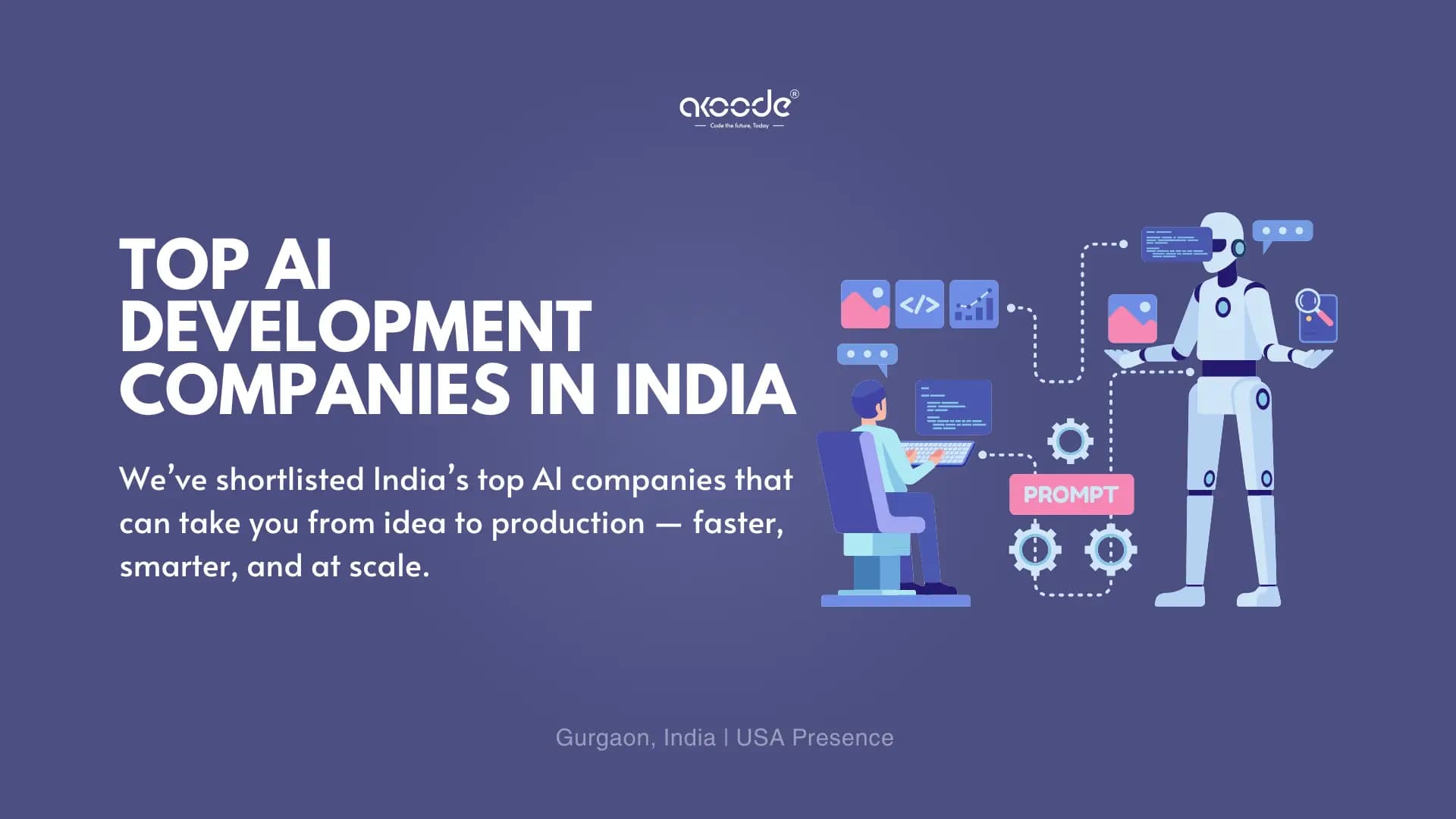
India's AI development landscape spans several genuinely different categories of company: hyperscale IT services firms running enterprise AI at global scale (TCS), enterprise decision-science and analytics specialists (Fractal Analytics), sovereign and foundational LLM builders backed by the IndiaAI Mission (Sarvam AI, Krutrim), enterprise conversational and agentic AI platforms that started in India and now serve global markets (Yellow.ai, Uniphore), AI-first cloud-native digital engineering firms (Quantiphi), and mid-size AI development partners serving startups and mid-market businesses directly (Akoode Technologies). There is no single independently verified "best" AI company in India the right fit depends heavily on whether you need enterprise-scale delivery, a foundational AI model, or a hands-on partner to build a specific AI feature into your product.
Why India Has Become a Major AI Development Market
India's AI market reached roughly USD 1.6 billion in 2025 and is projected to grow at a 26.5% compound annual rate toward USD 13.2 billion by 2034, according to market research firm IMARC Group. That growth is being actively steered by government policy: the IndiaAI Mission, backed by a ₹10,372 crore national allocation, has made over 34,000 GPUs available to domestic AI companies and selected a small group of startups, including Sarvam AI, to build India's first sovereign large language models. Enterprise adoption is following the same curve — IBM's 2026 Global AI Adoption Index found that 59% of enterprise-scale organizations in India now have AI actively deployed in production.
This mix of policy support, hyperscale IT services heritage, and a fast-growing startup layer is why "top AI company in India" searches return such a wide spread of results — from a 580,000-plus-employee public company to eighteen-month-old foundational-model startups. A single ranked list understates how different these companies actually are from one another.
Sources: IMARC Group India AI market sizing (via secondary industry coverage); IndiaAI Mission public disclosures; IBM 2026 Global AI Adoption Index.
Which AI Development Companies Are Based in India?
This section profiles eight companies with verifiable Indian origins or a substantial, publicly documented India-based AI operation. They're grouped by the kind of buyer they typically serve rather than ranked, since no independent, methodologically transparent ranking of Indian AI companies currently exists.
Hyperscale IT Services and Enterprise AI Platforms
Company: Tata Consultancy Services (TCS)
Headquarters: Mumbai, Maharashtra, India
Company type: Public (NSE: TCS, BSE: 532540), part of the Tata Group
Specialization: Global IT services and consulting, with AI increasingly embedded across its delivery model
AI capabilities: TCS AI WisdomNext, a generative AI platform that aggregates multiple foundation models into a single interface for enterprise clients, plus broader agentic AI and machine learning services
Key services: IT consulting, application development and maintenance, cloud, cybersecurity, and business process services
Industries: Virtually all major verticals, including banking, insurance, retail, manufacturing, and healthcare
Best suited for: Large enterprises needing AI delivered at global systems-integrator scale, with the accountability of a publicly listed company
Official website: tcs.com
Founded in 1968, TCS reported roughly 584,500 employees as of March 2026 and operates across dozens of countries. Its WisdomNext platform, launched in mid-2024, is explicitly built to help enterprise clients navigate and combine multiple generative AI models rather than lock into a single vendor's stack — a reflection of TCS's role as an integrator rather than a foundational-model builder.
Sources: TCS official site and newsroom; Wikipedia company infobox (employee/financial figures cross-checked against multiple financial-data sources); IndiaAI.gov.in coverage of the WisdomNext launch.
Enterprise AI and Decision Science
Company: Fractal Analytics
Headquarters: Dual headquarters in Mumbai, India, and New York City, United States
Company type: Public (NSE: FRACTAL, BSE: 544700), IPO'd in early 2026
Specialization: Enterprise AI and decision science for large, data-rich organizations
AI capabilities: Machine learning, agentic AI for decision-making, and a portfolio of specialized AI products built through an internal incubation model
Key services: Enterprise analytics and AI consulting, plus product lines including Crux Intelligence (AI-driven insights), Asper.ai (revenue growth management), Eugenie.ai (industrial sustainability), and its Qure.ai healthcare AI subsidiary
Industries: Financial services, retail, consumer goods, and healthcare and life sciences, which has become one of its fastest-growing segments
Best suited for: Large enterprises with complex, data-heavy decision-making problems rather than a single discrete AI feature Official website: fractal.ai
Founded in Mumbai in 2000 by Srikanth Velamakanni and Pranay Agrawal, Fractal has operated for a quarter-century before going public, giving it one of the longer track records of any AI-focused company with genuine Indian roots. Its "incubation" model — spinning off specialized AI product companies rather than keeping every capability under one general-purpose platform — differentiates it from broader IT services firms.
Sources: Fractal Analytics official site; company Wikipedia entry (founders, founding year, headquarters); recent Q1 FY27 financial disclosures reported via Indian financial press.
Sovereign and Foundational AI (Large Language Models)
Company: Sarvam AI
Headquarters: Bengaluru, Karnataka, India
Company type: Private, venture-backed
Specialization: Sovereign, India-focused large language models and multimodal AI
AI capabilities: Foundation models trained specifically for Indian languages and reasoning tasks, speech-to-text and text-to-speech systems, and enterprise copilots
Key services: Sarvam APIs, its Sarvam-105B and Sarvam-30B language models, Saaras speech models, and Sarvam Agents for enterprise deployment
Industries: Government and public-sector deployments (including UIDAI and NITI Aayog use), banking, and enterprise customer service
Best suited for: Organizations specifically needing Indian-language AI or a sovereign model that keeps data and inference within India
Official website: sarvam.ai
Founded in August 2023 by Vivek Raghavan and Pratyush Kumar, both previously with the AI4Bharat research initiative at IIT Madras, Sarvam AI was selected by the Indian government under the IndiaAI Mission to build the country's first fully homegrown sovereign LLM. The company has raised roughly $275 million to date across multiple funding rounds led by Lightspeed Venture Partners and, more recently, HCLTech and Bessemer.
Sources: Sarvam AI company profile via Wikipedia; Analytics India Magazine coverage of the IndiaAI Mission selection; Inc42 funding coverage.
Sovereign and Foundational AI (Consumer and Enterprise LLMs)
Company: Krutrim (Ola Krutrim)
Headquarters: Bengaluru, Karnataka, India
Company type: Private, part of the Ola Group
Specialization: Foundational AI models and Indic-language large language models
AI capabilities:Krutrim and Krutrim Pro LLMs trained on multilingual Indian-language data, a multilingual vision-language model (Chitrarth), a speech LLM (Dhwani), and Krutrim Cloud for GPU infrastructure
Key services: Consumer AI assistant (Kruti), enterprise LLM access, and cloud/GPU infrastructure for other AI developers
Industries: Consumer applications, enterprise customer service, and AI infrastructure for other Indian AI companies
Best suited for:Organizations wanting an India-based, Indic-language-first foundation model rather than adapting a Western LLM
Official website: krutrim.ai
Founded in April 2023 by Ola founder Bhavish Aggarwal, Krutrim became India's first AI startup unicorn in January 2024 after raising $50 million at a $1 billion valuation, reportedly the fastest Indian startup to reach that milestone. It has since committed to significant additional capital investment and has stated plans to develop its own AI chip, alongside its existing cloud and language-model business.
Sources: Krutrim funding coverage via Entrackr and TechCrunch; company profile aggregated from multiple funding-tracker sources; public statements from founder Bhavish Aggarwal reported in Indian business press.
Enterprise Conversational and Agentic AI
Company: Yellow.ai
Headquarters: Dual headquarters in San Mateo, California, and Bengaluru, India
Company type: Private, venture-backed (Series C+)
Specialization: Enterprise conversational and agentic AI for customer and employee experience
AI capabilities: A multi-LLM orchestration engine (DynamicNLP) powering autonomous AI agents across voice, chat, and messaging channels
Key services: Its Dynamic Automation Platform (DAP), covering customer service automation, employee-facing AI assistants, and voice AI
Industries: Retail, banking, telecom, and travel, among a broad enterprise customer base
Best suited for: Enterprises wanting an out-of-the-box conversational AI platform rather than a custom-built chatbot or agent
Official website: yellow.ai
Founded in Bengaluru in 2016 as Yellow Messenger, the company has raised more than $102 million in funding and reports handling billions of conversations annually across more than 30 channels and 100-plus languages for enterprise clients including several global consumer brands.
Sources: Yellow.ai official site and company profile pages; Sapphire Ventures portfolio page; multiple third-party vendor-comparison sites cross-checked for consistency.
Enterprise Conversational and Agentic AI (Emotion and Voice AI)
Company: Uniphore
Headquarters: Dual headquarters in Palo Alto, California, and Chennai, Tamil Nadu, India
Company type: Private, unicorn status since 2022
Specialization: Conversational automation with a specific focus on emotion AI and voice analytics
AI capabilities: Real-time conversational analytics, voice biometrics, tonal emotion detection, and generative and knowledge AI layered onto its core platform
Key services: Products including U-Analyze (speech analytics), U-Trust (voice biometrics), U-Self Serve (virtual assistants), and U-Assist (real-time agent support)
Industries: Banking, BPO, telecom, and healthcare contact centers
Best suited for: Large contact-center operations needing emotion and voice-analytics capability layered on top of existing conversational infrastructure
Official website: uniphore.com
Founded in 2008 by Umesh Sachdev and Ravi Saraogi and incubated at IIT Madras, Uniphore reached a $2.5 billion valuation in a 2022 funding round, making it one of the longer-established conversational AI companies with genuine Indian origins, alongside its current dual-headquarters structure in Chennai and Palo Alto.
Sources: Uniphore company profile via Wikipedia; IIT Madras Alumni & Corporate Relations coverage of the 2022 unicorn round; YourStory funding coverage.
AI-First Cloud-Native Digital Engineering
Company: Quantiphi
Headquarters: Global headquarters in Marlborough, Massachusetts, United States, with a large India engineering base including Mumbai
Company type: Private
Specialization: AI-first digital engineering built on deep hyperscaler partnerships
AI capabilities: Custom AI and machine learning solution development, generative AI products (including its baioniq platform), and cloud-native data engineering
Key services: AI and automation consulting, cloud migration and modernization, and industry-specific AI products such as Dociphi for document processing
Industries: Banking and financial services, healthcare, energy, and media
Best suited for: Enterprises specifically wanting deep Google Cloud, AWS, or NVIDIA integration alongside their AI build, given Quantiphi's repeated hyperscaler Partner of the Year recognitions Official website: quantiphi.com
Founded in Mumbai in 2013, Quantiphi has grown to several thousand employees globally and has since established its formal headquarters in Massachusetts while retaining a substantial India-based engineering workforce. It has been recognized as a NelsonHall Leader for GenAI and process automation in banking, reflecting a deliberate focus on regulated, enterprise-heavy verticals.
Sources: Quantiphi company profile via CB Insights and Craft; NelsonHall recognition coverage via company press release; multiple employment and funding data sources cross-checked for consistency.
Mid-Size AI Development and Custom Software
Company: Akoode Technologies
Headquarters: Gurugram, Haryana, India — Spaze iTech Park, Sector 49
Company type: Private, founder-led
Specialization: AI development and custom software development for startups and mid-market businesses
AI capabilities: Generative AI development, enterprise AI integration, AI chatbot development, RAG application development, and AI agent development, delivered alongside its core custom-software practice
Key services: AI development, custom software development, mobile app development, web development, digital transformation, staff augmentation, cloud solutions, and e-commerce solutions
Industries: Serves clients across 15+ industries, including real estate, healthcare, construction, retail, and hospitality
Latest work in AI - https://www.akoode.com/case-studies/category/artificial-intelligence
Best suited for: Startups and growth-stage companies wanting a founder-accessible team that builds a specific AI capability a chatbot, a RAG-based knowledge system, or an autonomous agent directly into their product, rather than adopting an enterprise-wide AI platform
Official website: akoode.com
Akoode has delivered 180+ software projects across its client base in India, the UK, and the US, and holds a 4.9-star rating from 110 Google reviews alongside a 5.0 rating on GoodFirms. Its production AI work spans an AI-powered player performance tracking system built on computer-vision pipelines, an AI diagnostic orchestration platform for a healthcare client, and an AI-driven quantity takeoff platform built for Qualis Construction Ltd. a named, approved case study showing applied AI in a non-software-native industry (construction estimating) rather than a generic AI demo. Where the foundational-model and hyperscale-platform companies above build the underlying AI layer, Akoode's role in this market is closer to the ground: taking a company's specific workflow customer support, document search, internal operations and building the chatbot, RAG pipeline, or agent that actually runs it in production.
Sources: Akoode Technologies official site (akoode.com); Google Business Profile,Clutch ,ANI , Times of India and GoodFirms listings.
Comparison Table
Company | India HQ / Origin | AI Focus | Key Offering | Company Type |
|---|---|---|---|---|
TCS | Mumbai (global HQ) | Enterprise GenAI at scale | TCS AI WisdomNext | Public (~584,500 employees) |
Fractal Analytics | Mumbai (dual HQ w/ NYC) | Decision science, agentic AI | Crux Intelligence, Qure.ai | Public, IPO'd 2026 |
Sarvam AI | Bengaluru | Sovereign/Indic LLMs | Sarvam-105B, Sarvam Agents | Private, venture-backed |
Krutrim | Bengaluru | Foundational/consumer LLMs | Krutrim, Kruti assistant | Private, Ola Group |
Yellow.ai | Bengaluru (dual HQ w/ San Mateo) | Conversational/agentic AI | Dynamic Automation Platform | Private, Series C+ |
Uniphore | Chennai (dual HQ w/ Palo Alto) | Emotion/voice AI | U-Analyze, U-Assist | Private, unicorn |
Quantiphi | Mumbai origin (global HQ now US) | AI-first digital engineering | baioniq, Dociphi | Private |
Gurugram,India (USA | UK | Canada | UAE) | Generative AI, agents, RAG, chatbots | Custom AI product builds | Private, founder-led |
How Much Does AI Development Cost in India?
There's no single market rate cost depends heavily on whether you're engaging a public systems integrator, a venture-backed platform company, or a project-based development partner, and on whether the work is a licensed platform subscription, a fixed-price build, or a dedicated team engagement. Enterprise engagements with firms like TCS, Fractal, or Quantiphi are typically scoped and priced per-project or per-platform-license rather than published as an hourly rate. Project-based development partners publish hourly-rate bands more often; third-party rate directories like Clutch typically list mid-size Indian AI and software development firms in the roughly $25–$50/hour range, with variation based on team seniority and project complexity. Because rates shift with scope and demand, the most reliable way to get an accurate figure for a specific project say, a RAG-based internal knowledge tool or a customer-facing AI chatbot is a scoped conversation with a shortlist of vendors rather than relying on a published rate card.
Sources: Clutch and other third-party vendor rate listings for Indian AI/software development firms.
How Long Does It Take to Build an AI Application in India?
Timelines vary substantially by project type. A narrowly scoped AI chatbot or a document-summarization feature built on an existing large language model can often move from kickoff to production in a matter of weeks, particularly with a mid-size development partner working directly with your team. A custom RAG application requiring data pipeline work, an AI agent integrated into multiple existing business systems, or an enterprise AI integration spanning several departments typically takes longer often several months because it involves data preparation, model evaluation, and integration testing beyond the AI component itself. Foundational-model work, of the kind Sarvam AI or Krutrim undertake, operates on an entirely different timeline measured in years rather than project sprints, and isn't a fair comparison point for a typical business buyer's AI project.
How Do I Choose an AI Development Company in India?
A few questions tend to separate a good fit from a mismatch faster than a general reputation check:
Does the company build foundational AI, or apply existing AI to your specific problem? Sarvam AI and Krutrim build models; most buyers evaluating "AI development companies" actually need the latter — a vendor that applies existing LLMs, computer vision, or automation to a concrete business workflow.
Does the vendor have a live, verifiable example in a similar problem domain — not just a generic "AI capabilities" page, but a named or at least concretely described project?
Who actually does the engineering work — an in-house team, or a subcontracted or offshored team elsewhere? This affects both quality control and communication overhead.
What happens after launch? Ask specifically how the vendor handles model monitoring, drift, and ongoing maintenance, since AI systems typically need more post-launch attention than traditional software.
Does the vendor's AI work sit alongside a broader software practice, or is it the entire business? Both models work, but they imply different depth of hands-on AI engineering talent versus platform breadth.
Which AI Companies in India Serve International Clients?
Most companies profiled here work with international clients as a core part of their business. TCS, Fractal Analytics, Yellow.ai, Uniphore, and Quantiphi all operate with dual or global headquarters structures that put a US or international office alongside their Indian origin, reflecting how central international revenue is to each. Akoode explicitly lists India, the UK, and the US as its served markets. Sarvam AI and Krutrim are the partial exceptions — both are currently focused primarily on the Indian market and government-backed sovereign AI initiatives, though Krutrim has stated ambitions to expand its cloud and language-model business more broadly.
Which Industries Use AI Development Companies in India?
Coverage spans nearly every major industry: banking, insurance, and financial services (TCS, Fractal, Quantiphi, Uniphore); retail and telecom (Yellow.ai, Fractal); healthcare and life sciences (Fractal's Qure.ai subsidiary, Quantiphi); government and public-sector services (Sarvam AI); consumer applications (Krutrim); and real estate, construction, healthcare, and hospitality among Akoode's client base. This breadth reflects both India's position as a long-established IT services hub and its newer role in sovereign AI development.
AI Development: Key Terms Defined
Generative AI: AI systems that can generate text, images, code, audio, or other content based on user instructions, typically built on large language models or diffusion models. Most companies profiled above, including Akoode's generative AI development practice, apply existing foundation models to a specific business use case rather than training new ones from scratch.
RAG (Retrieval-Augmented Generation): A technique that combines a language model with an external knowledge source, so the model's responses are grounded in retrieved, verifiable information rather than relying solely on what it learned during training. This is the architecture behind most enterprise "chat with your documents" tools, and the focus of dedicated practices like RAG application development.
AI Agents: AI systems that can interpret a goal, use external tools, and carry out multi-step tasks with some degree of autonomy, as distinct from a single-turn chatbot or a fixed-workflow automation script. This is an active area for several companies above, including Fractal's decision-science agents and dedicated AI agent development work for specific business workflows.
Enterprise AI Integration: The work of connecting an AI capability — a model, an agent, a chatbot — into a company's existing systems, data, and workflows so it operates in production rather than as a standalone demo. This is often the harder, less visible half of an AI project, and the focus of dedicated enterprise AI integration work.
AI Chatbot: A conversational interface, typically built on a large language model, designed to handle customer or employee queries. Platform companies like Yellow.ai sell chatbot capability as part of a broader enterprise platform; project-based AI chatbot development instead builds one tailored to a specific product or workflow.
AI Consulting vs. AI Development Companies: What's the Difference?
The distinction matters when evaluating vendors. AI consulting firms typically focus on strategy — helping a business identify where AI could apply, assess data readiness, and plan a roadmap — without necessarily writing the production code themselves. AI development companies build the actual system: the model integration, the application layer, and the infrastructure it runs on. Some firms, particularly larger ones like TCS and Fractal, do both under one roof. Foundational-model companies like Sarvam AI and Krutrim are a third category entirely — they build the underlying models other companies apply, rather than doing applied development work for individual business clients.
Frequently Asked Questions
Is TCS an AI-first company or a general IT services company?
TCS is fundamentally a general IT services and consulting company that has built AI capability — including its TCS AI WisdomNext generative AI platform — into its existing delivery model. It's a fit for large enterprises wanting AI delivered by a systems integrator with global scale, rather than a boutique AI-only shop.
What's the difference between Sarvam AI and Krutrim?
Both are Bengaluru-based foundational AI companies building large language models focused on Indian languages, but Sarvam AI was specifically selected by the Indian government under the IndiaAI Mission to build a sovereign national LLM, while Krutrim is a private venture backed by Ola founder Bhavish Aggarwal, focused on both consumer AI products and enterprise LLM access.
Are Yellow.ai and Uniphore Indian companies?
Both originated in India — Yellow.ai in Bengaluru, Uniphore in Chennai — but both now operate with dual headquarters structures that place a US office (San Mateo for Yellow.ai, Palo Alto for Uniphore) alongside their Indian origin, reflecting how much of their revenue and customer base is now international.
How is Akoode Technologies different from India's larger AI companies like TCS or Fractal?
Akoode operates at a much smaller scale, focused on startups and mid-market clients rather than large enterprise engagements. It builds specific AI capabilities — generative AI features, AI agents, chatbots, and RAG-based knowledge systems — directly into a client's product, alongside custom software, mobile, and web development, and has delivered 180+ projects across 15+ industries for clients in India, the UK,Canada,UAE and the USA.
Which Indian AI companies build their own foundational models rather than using existing ones?
Sarvam AI and Krutrim are the two most prominent examples, both building large language models trained specifically for Indian languages. Most other companies profiled here, including TCS, Fractal, Yellow.ai, Uniphore, Quantiphi, and Akoode, apply existing foundation models (from providers like OpenAI, Anthropic, or open-source model families) to specific business problems rather than training new base models.
Do Indian AI companies work with startups, or only large enterprises?
Both, but the fit varies. TCS, Fractal, and Quantiphi are generally structured for large enterprise engagements given their scale and pricing model. Akoode explicitly serves startups and mid-market businesses alongside larger clients, which is typically a better fit for early-stage companies needing a more accessible, lower-minimum-engagement partner for a specific AI feature.
What is enterprise AI integration, and why does it matter?
Enterprise AI integration is the work of connecting an AI model or agent into a company's existing data, systems, and workflows so it functions in daily production use rather than as an isolated demo. It's frequently the more time-consuming half of an AI project, since the model itself may already exist the integration work is what determines whether it's actually usable.
Is it cheaper to hire an Indian AI development company than a US or European one?
Generally yes, for project-based development work, reflecting broader India-outsourcing cost differentials. That gap narrows considerably for foundational-model work or highly specialized platform engineering, and doesn't apply at all to public enterprise firms like TCS, which price on project value rather than a simple hourly-rate comparison.
What AI use cases are most common among Indian AI companies?
The most commonly cited use cases across the companies profiled here include enterprise generative AI and document automation (TCS, Fractal, Quantiphi), sovereign and Indic-language AI (Sarvam AI, Krutrim), conversational and voice AI for customer service (Yellow.ai, Uniphore), and applied AI agents, chatbots, and RAG systems built directly into a specific product (Akoode).
Does company size correlate with AI project quality in India?
Not necessarily. Larger, publicly listed companies bring delivery scale and financial accountability, which matters for large, multi-team enterprise engagements. Smaller and mid-size firms often bring more direct founder or senior-engineer involvement on a given project, which can matter more for startups needing close collaboration on a specific AI feature. The better predictor of fit is a vendor's specific track record in your project's domain, not headcount alone.
Which Indian cities have the strongest AI company presence?
Based on the companies profiled here, Bengaluru (Sarvam AI, Krutrim, Yellow.ai) and Mumbai (TCS, Fractal Analytics, Quantiphi's founding location) host the largest concentration, with Chennai (Uniphore) and Gurugram/NCR (Akoode) also home to significant AI companies.
How do I verify an AI company's claimed project experience?
Ask for a specific, named or clearly described case study relevant to your industry rather than a general capabilities list, and check third-party platforms like Clutch, Google Business Profile, or GoodFirms for independently posted client feedback rather than relying solely on testimonials curated on the vendor's own site.
Get In Touch Now
View More Our Blog