 November 2, 2026
Short answer: A focused AI agent for a US business usually costs $15,000 to $50,000 as a pilot, $50,000 to $150,000 once it runs a real workflow across your systems, and $150,000 to $400,000 or more for a multi-system platform. Vendors put the yearly running cost at roughly 15% to 30% of the build price. Whether it pays off depends on one thing: how many hours of repeatable work it takes off your team, priced at real US wages. We work that math out below, with numbers you can swap for your own.
If AI agents keep landing in your inbox, you have probably noticed that nobody quotes the same price. One guide says $5,000. Another says $850,000. Both can be right, because "AI agent" covers everything from a smart email sorter to a system that handles a department's paperwork.
This guide is for the person who has to make the call: the owner, the COO, the head of operations, or the CTO who just got handed the project. We cover what an agent is in plain terms, where US businesses are using them, what they cost, and how to test the ROI yourself instead of trusting a vendor's slide.
We build these for a living, so we have a point of view. Where our interest and your budget pull in different directions, we say so.
What an AI agent is, in plain English
An agent does things, a chatbot answers questions
A chatbot answers. An agent acts. You give it a goal, such as "resolve this customer's refund request," and it works out the steps, uses tools you have connected (your helpdesk, CRM, billing system), takes actions within limits you set, and hands the case to a person when it is unsure.
That difference is the whole story on cost. Answering questions from a knowledge base is cheap. Letting software change records, send messages and spend money on your behalf means integrations, permissions, testing and monitoring. Our explainer on what agentic AI is goes deeper on the autonomy levels if you want them.
The new-hire test
Here is the simplest way we know to scope an agent. Imagine hiring a junior employee for this job. You would write a job description, give them access to a few systems, set a spending limit, and tell them who to ask when something looks odd. Build the agent the same way.
If you cannot write that job description on one page, the agent is not ready to be built yet. That single test saves more budget than any technology choice.
Where US businesses stand with AI agents right now
Large companies are moving from pilots to production
KPMG's Q3 2026 AI Pulse survey asked 314 US executives at companies with $1 billion or more in revenue, between July 24 and August 25. It found that 62% are building, testing or deploying AI agents, up from 53% the quarter before. Some 58% report measurable business value from AI, and 74% now build formal cost reviews into their AI approvals. The top barrier to deploying agents was getting data ready and accessible.
Mind the sample, though. These are billion-dollar companies with dedicated teams. Your situation is probably different, and the next number shows how.
Most US businesses are still early
The Census Bureau's Business Trends and Outlook Survey found that between December 2025 and May 2026, about 17% to 20% of US businesses reported using AI in at least one business function. The split by size is stark. Roughly 37% of firms with 250 or more employees used AI, against under 20% of firms with four or fewer. Later biweekly releases show the overall rate edging into the low 20s. Census also widened its question wording in November 2025, so compare older figures with care.
For a mid-sized US business, that gap cuts both ways. Most of your competitors have not built a serious agent yet, so a well-aimed first one is still an edge. It also means there are fewer proven playbooks at your size, which is a reason to start small.
The number to keep in the back of your mind
Gartner predicted in June 2025 that more than 40% of agentic AI projects will be canceled by the end of 2027, pointing to rising costs, unclear business value and weak risk controls. The same release said only about 130 of the thousands of vendors claiming agentic products were the real thing, and gave the relabeling of chatbots and automation tools a name: "agent washing."
That is a forecast, not a measurement. But the reasons it gives match what we see in scoping calls: no clear job, messy data, and nobody who owns the result.
AI agent use cases that tend to pay off for US businesses
These six come up most often when we scope projects. They are listed roughly in the order they clear a business case.
Customer support resolution
The agent reads the question, checks the order or account, answers from your policies, handles standard actions like a status check or a simple refund, and escalates the rest. It pays where ticket volume is high and the answers repeat. The watch-out is money: cap what it can refund or change without a person approving.
Lead response and sales follow-up
It answers inbound leads in minutes instead of hours, asks the qualifying questions, books the meeting and updates the CRM. It pays where leads go cold overnight. The watch-out is tone and promises, so keep a human on pricing and contract terms.
Back-office document work
Invoices, claims, intake forms and onboarding packets: the agent reads them, pulls out the fields, checks them against your rules and routes the odd ones to a person. It pays wherever someone retypes data from one screen to another. The watch-out is edge cases, so build a review queue from day one. We applied the same precision mindset to blueprint reading in our AI quantity takeoff project for Qualis Construction.
Scheduling and dispatch
Booking, rescheduling, reminders and technician routing. It pays in clinics, home services and logistics, where empty slots and phone tag cost real money. The watch-out is double-booking and old calendar systems. Our clinic workflow platform ties patient history, prescriptions and the next appointment into one flow, which is the kind of joined-up job these agents need to do well.
Internal helpdesk and knowledge agents
Employees ask HR, IT or policy questions and get answers pulled from your own documents, with the source shown. It pays once you have a few hundred people asking the same things. The watch-out is stale documents: the agent is only as current as your wiki.
Use cases to skip for now
Skip anything where one wrong action is expensive and hard to undo: autonomous payments, hiring decisions, or clinical decisions without a clinician signing off. Start where mistakes are cheap and reversible, and earn your way up.
What AI agent development costs in the USA: planning bands for 2027
Our planning bands
These are our planning figures, built from the published ranges in the next section and adjusted for what we see in scoped projects. They are not a quote.
Tier | Planning range | Typical timeline | What it usually means |
|---|---|---|---|
Pilot or single-task agent | $15,000 to $50,000 | 4 to 8 weeks | One job, one or two integrations, a person approves outputs. A ticket triager or a lead responder. |
Workflow agent | $50,000 to $150,000 | 2 to 4 months | Runs a full workflow across several systems (CRM, helpdesk, billing) with guardrails, logging and an escalation path. |
Multi-system or multi-agent platform | $150,000 to $400,000+ | 4 to 9 months | Several coordinated agents, legacy integrations, role-based access, evaluation tooling and an audit trail. |
Regulated enterprise | $400,000 and up | 9 months or more | Compliance review (HIPAA, financial rules), custom controls and heavy testing. |
For a line-by-line view that is not US-specific, see our global breakdown in AI agent development cost.
Why published prices run from $5,000 to $850,000
Source (2026 guides) | What it says |
|---|---|
Radixweb | Simple rule-based agents from $5,000, enterprise multi-agent systems at $400,000 or more. |
Bacancy | $10,000 for a pilot to $400,000+ for enterprise deployments. |
Sparkout | $25,000 to $50,000 for an MVP agent, $50,000 to $100,000 for a workflow agent, $150,000 to $300,000+ for an enterprise system. Annual running cost of 15% to 30% of build cost. |
Decipherzone | $15,000 for a focused single-task agent up to $400,000+ for a multi-agent system. Domain-specific enterprise agents at $150,000 to $500,000+. |
Codiste (US enterprise buyers) | $180,000 to $850,000 for the first deployed enterprise workflow. |
Three things explain the spread. The guides define "agent" differently, so a rules-based flow and an autonomous system share one price list. They disagree on who pays for integration work. And nearly all of them are written by agencies, which have a reason to anchor high or low depending on who they want to attract. Use them to find the range, not the answer.
What moves the price
Integrations. How many systems the agent touches, and how old they are. A modern, well-documented API is quick work. A 15-year-old on-premise system can take far longer.
Autonomy. What the agent can do without asking. Suggesting a refund is cheap. Issuing one needs approval rules, limits and an audit trail.
Data readiness. If the documents, tickets or records the agent needs are scattered or out of date, cleaning them becomes part of the project. Teams already on a cloud data warehouse skip a big chunk of this. If you are in Seattle, our page on AI development in Seattle covers how we approach that first data check.
Testing. You need a set of real cases the agent must pass before it goes live, and again every time the underlying model changes. This is the line item vendors forget to quote.
Compliance. Health, financial or children's data changes the architecture.
Human review screens. The interface where your staff approve, correct and override the agent. It is real software and it takes real time.
Running costs after launch
Plan on 15% to 30% of the build cost per year, which is the range Sparkout and similar guides use. We could not trace that range to an independent study, so treat it as a planning convention. It covers model usage, monitoring, tool updates and re-testing when the model underneath changes.
Packaged agents show this cost as a per-resolution fee. Custom agents show it as a hosting and maintenance line. Ask any vendor for both numbers. The same logic applies to ordinary software, which we cover in our custom software development cost guide.
The ROI math, with real US numbers
ROI claims get slippery fast. Here is a way to check one yourself in about ten minutes.
Step 1: Price the human work
The Bureau of Labor Statistics reports that US customer service representatives earned a median of $44,770 a year, or $21.53 an hour, in May 2025.
Wages are not cost. Benefits, payroll taxes, equipment and supervision sit on top. We use a planning multiplier of 1.3 to 1.5 for that, which is our assumption, so swap in your own HR number. It puts a support rep at about $28 to $32 an hour.
Step 2: A worked example
Say you run a support team with these numbers. Every one of them is an assumption you should replace:
10,000 tickets a month.
8 minutes of agent time per ticket.
The AI agent fully resolves 40% of them, which is 4,000 tickets. Vendors advertise higher rates, so we use a cautious one.
That is 4,000 tickets at 8 minutes, or about 533 hours of agent time a month. At $28 to $32 an hour, the work is worth roughly $14,900 to $17,100 a month, or about $179,000 to $205,000 a year.
Step 3: Build or buy
Packaged support agents publish their prices. As of 2026, comparison guides list HubSpot at $0.50 per resolved conversation, Intercom's Fin at $0.99 per resolution, Zendesk at roughly $1.50 per automated resolution, and Salesforce Agentforce at $2.00 per conversation. One detail matters: per-conversation pricing charges you even when the agent fails and a person takes over. Per-resolution pricing only charges for wins.
Using the $0.99 rate against a custom workflow agent built at $75,000 with 20% a year to run ($15,000), the costs look like this. The hours saved are the same either way.
Option | Year 1 cost | Three-year cost |
|---|---|---|
Buy, at $0.99 per resolution (4,000 a month) | $47,520 | $142,560 |
Build, $75,000 plus $15,000 a year to run | $90,000 | $120,000 |
At this volume, building only edges out buying over three years. The break-even is about 3,400 resolutions a month. Below that, buy. Above it, or when the packaged tool cannot reach your own systems, building starts to win. The custom build pays back its $75,000 in roughly five months once you count the running cost against the monthly savings.
When the ROI does not show up
Freed-up hours only turn into dollars if you hire fewer people, absorb growth without hiring, or cut overtime. If the saved time just becomes idle time, the ROI lives in a spreadsheet and nowhere else. The BLS projects customer service employment to fall about 5% between 2025 and 2035. Whatever your team does, decide in advance where the saved hours will go.
Here is the rule we use: if the numbers only work at your best-case savings, do not build. They should still clear the bar at half of what you expect.
Build, buy or blend?
Buy when the job is standard
Support, scheduling and basic lead handling are well served by packaged agents, especially when your data already lives in a tool the vendor supports. You get speed and a published price.
Build when your process is the edge
Build when the agent must act across your own systems, follow rules no packaged product knows, or when it is the product itself. A startup shipping an AI-native product is the clearest case. If that is you, see how we work with teams on AI development in San Francisco.
Blend when you can
Most real projects end up here: buy the model access and the platform pieces, build the integrations, guardrails and review screens. It keeps the custom part small, which is where the budget risk sits.
Risk and compliance for US deployments
Data rules that follow your data
Patient data brings HIPAA. Financial data brings GLBA and your regulators' expectations. Enterprise customers will ask for SOC 2 evidence. Individual states add their own privacy rules on top. Massachusetts, for example, has a data security regulation (201 CMR 17.00) covering the personal information of its residents, which matters if you serve customers there. Our AI development in Boston page explains how we plan for that kind of requirement.
State AI laws are still moving
Colorado is a good example of the churn. In May 2026 it replaced its 2024 AI Act with a narrower law, set to take effect January 1, 2027, built around consumer disclosures and human oversight for consequential automated decisions. Law firm summaries noted that enforcement depends on rulemaking that had not begun as of mid-June. If your agent touches hiring, lending, housing, insurance or health decisions, ask your lawyer which state rules apply. We are not lawyers, and this area changes monthly.
Cheap guardrails that prevent expensive mistakes
Hard limits on what the agent can spend, refund or change on its own.
A person approves anything that is hard to undo.
Every action is logged, so you can answer "why did it do that?"
A fixed test set of real cases that must pass before each release.
A kill switch that one person can use without a meeting.
Access limited to the systems the job needs, the same way you would limit a new hire.
How to start without burning a year
Weeks 1 and 2: pick one job and measure it
Choose a single workflow. Record today's volume, handle time, error rate and cost. Without a baseline you cannot prove ROI later, and you will want to.
Weeks 3 to 8: run a pilot with a person in the loop
Build the agent for one channel, with staff approving its outputs. If you are in Austin and want a second opinion on pilot scope, our AI development in Austin page is a good place to start.
Weeks 9 to 12: measure, then decide
Compare the pilot against your baseline. Expand, adjust or stop. Stopping is a valid outcome, and a cheap one if you started small.
How to choose an AI agent development partner
Questions to ask before you sign
Can you show me the agent taking a real action in a system like mine, not a demo video?
How do you test it, and who owns the test set?
What happens to accuracy when the underlying model changes?
Can you show me a project that failed or got cut back, and what you learned?
Which roles and how many hours sit behind your quote?
Is there a paid discovery phase before a fixed price?
Who owns the code, the prompts and the evaluation data?
Which named people will work on it, and does the contract keep them there?
Where the work happens affects your taxes
Since 2025, US tax law lets companies deduct domestic software development costs right away, while research performed outside the United States is still spread over 15 years. That can shrink the real savings of an offshore build. We explain the details in our software cost guide, and your tax advisor should check how it applies to you. We are an India-based engineering team with a US office in Jenks, Oklahoma, so we would rather you hear it from us.
How Akoode approaches AI agent projects
How we scope and price
We do not publish a rate card. A quote starts with a one-to-two-week discovery that settles the job description, the data, the integrations and the risks. It produces a roadmap and a scoped estimate tied to roles and hours. We work on a fixed-cost, dedicated-team or staff augmentation basis, depending on how settled your scope is. Our engineers are in-house, and you own the IP.
If you want the overview first, start with our AI development company in the USApage or our broader artificial intelligence services. For projects that add language models to an existing product, see generative AI integration.
Proof from delivered projects
Let us be straight about this: none of the projects below is a US customer-support agent, so we will not dress them up as one. They are production AI systems where accuracy and speed mattered.
For M2 Method, a California pelvic health program, we took an AI proof of concept to a production iOS and Android platform with real-time feedback capped at 300 ms. Read the case study.
For Qualis Construction Ltd., we built an AI quantity takeoff application that replaced manual blueprint counting. Read the case study.
We also built an AI-powered medical diagnostic system for real-time clinical decision support. Read the case study.
Our Google rating is 4.9 from 126 reviews, and we have delivered 180+ projects across 15+ industries.
Frequently asked questions
How much does AI agent development cost in the USA in 2027?
Plan on $15,000 to $50,000 for a pilot agent, $50,000 to $150,000 for an agent that runs a full workflow across your systems, and $150,000 to $400,000 or more for a multi-system platform. Vendors estimate yearly running costs at 15% to 30% of the build price. Published ranges vary widely, so a short paid discovery phase is the most reliable way to narrow your number.
How long does it take for an AI agent to pay for itself?
It depends on volume and wages. In our worked example, a support agent that resolves 4,000 tickets a month and replaces about 530 hours of agent time pays back a $75,000 build in roughly five months. Savings only count as cash if you hire fewer people or absorb growth without hiring. Rework the math with your own numbers.
Should I build a custom AI agent or buy one?
Buy when the job is standard and your data lives in a tool the vendor supports. Build when the agent must act across your own systems or your process is a competitive edge. In our example, a custom build only beats per-resolution pricing above about 3,400 resolutions a month over three years. Many teams blend: buy the platform, build the integrations.
What is the difference between an AI agent and a chatbot?
A chatbot answers questions. An agent pursues a goal: it decides the steps, uses tools such as your CRM or helpdesk, takes actions within limits you set, and hands off to a person when unsure. Gartner warns about agent washing, where vendors relabel chatbots as agents, so ask to see the agent take an action in your systems.
How long does it take to build an AI agent?
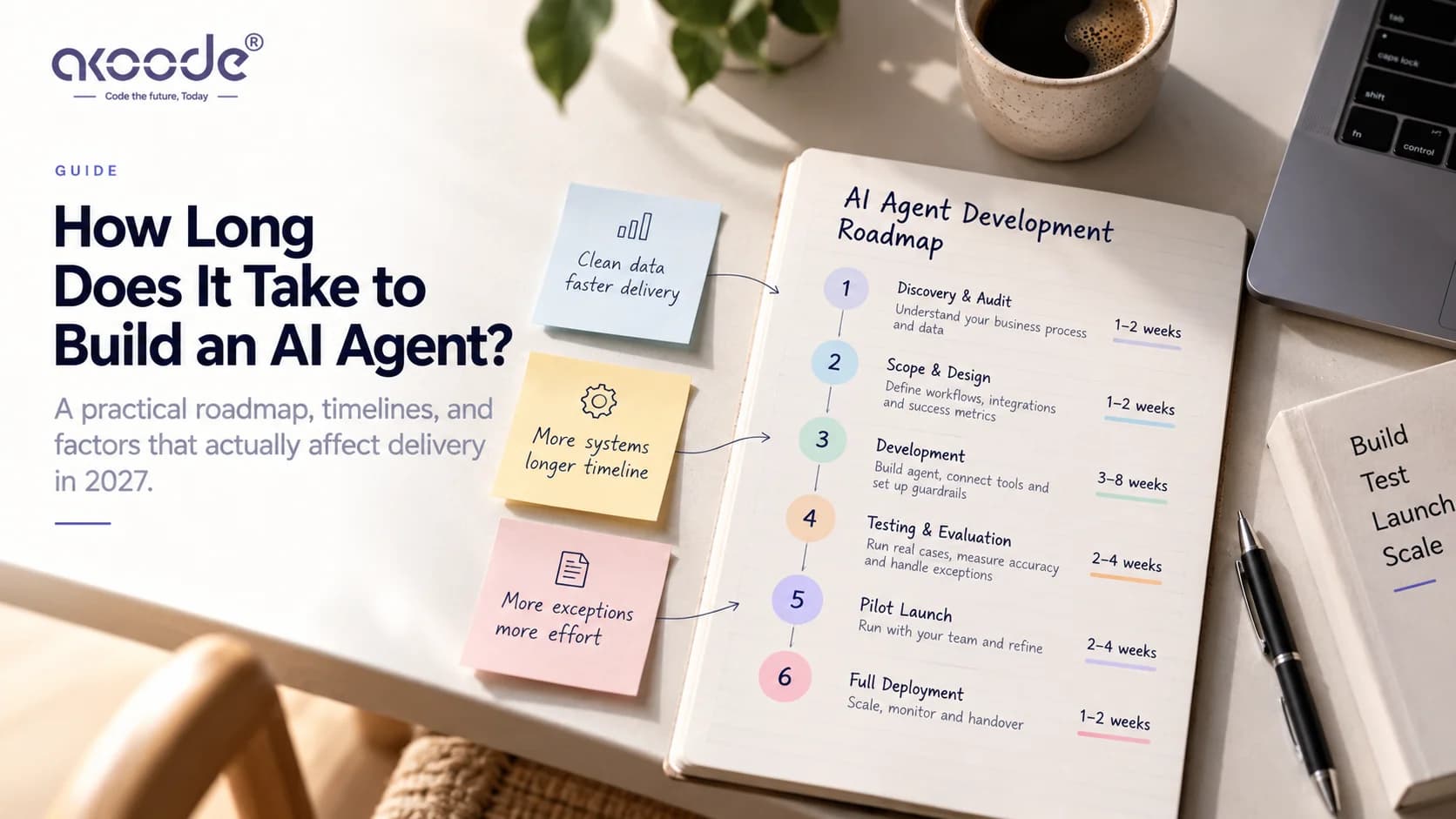
A pilot usually takes four to eight weeks, a workflow agent two to four months, and a multi-system platform four to nine months or more. These are planning figures. Integrations and data readiness set the pace more than model work does. A one-to-two-week discovery phase keeps the estimate honest.
What are the biggest risks of AI agents for US businesses?
The common ones are unclear scope, messy data, actions that are hard to undo, and compliance gaps under rules such as HIPAA or state AI laws. Gartner predicts over 40% of agentic AI projects will be canceled by the end of 2027, citing cost, unclear value and weak risk controls. Spending limits, human approval and logging remove much of the risk.
Do I need clean data before building an AI agent?
You need data that is accessible and trustworthy for the one job the agent will do, not a perfect company-wide dataset. KPMG's 2026 survey of large US companies lists data readiness and access as the top barrier to deploying agents. Check the specific documents, tickets or records your first agent needs before you commit to a build.
Get a scoped estimate for your first agent
If you have a workflow in mind and want to know which tier it falls into, book a technical consultation. Bring whatever you have: a ticket export, a process document, a list of systems. We will tell you what we would ask in discovery, what we would measure first, and where we think the budget risk sits, whether or not you end up working with us.
Get In Touch Now
View More Our Blog