 October 20, 2026
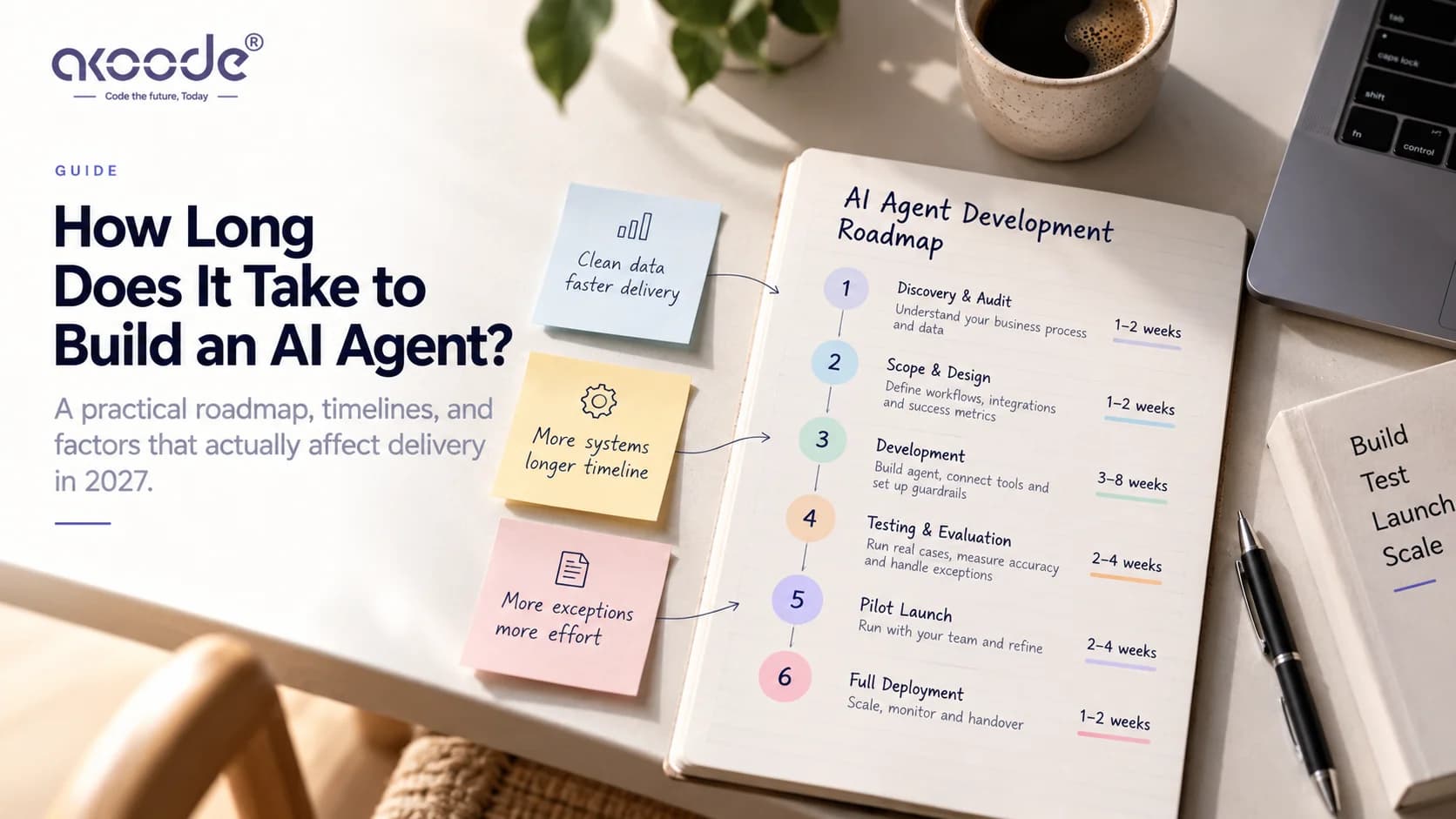
Ask ten vendors how long an AI agent takes to build and you will get ten confident answers and almost no reasoning. That is because the honest answer depends on things nobody can see until someone looks inside your business: how many exceptions your process really has, how clean your data is, and whether the systems the agent must touch will let it in.
This guide gives you the reasoning. It sets out the full roadmap of an AI agent project in 2027, from the pre-build audit to the first 30 days and the handover, along with three working tools: an Exception Census, a Scope Scorecard and a Client-Owned Work table. They are designed so that you can estimate your own project before you talk to anyone.
Akoode Technologies is led by a team with more than a decade of experience in AI consulting and technology development. Our developers are in house, qualified and certified, and everything we design is built and tested inside the company. Akoode has delivered 180+ software projects across 15+ industries, and the roadmap below reflects how that kind of delivery tends to unfold. For the bigger picture of what agents are and whether you need one, start with our complete guide to AI agent development.
How Long Does It Take to Build a Custom AI Agent?
Quick answer: A narrow pilot with clean data and one workflow is usually a matter of weeks. A production agent connected to several systems is usually a matter of months. Data readiness, number of systems, exception count, compliance needs and review loops decide where you land, so estimate those first and treat any quote that ignores them as a guess.
Timelines slip for the same few reasons, and none of them is the model. The model is usually the fastest part. What takes the time is getting access to systems, discovering exceptions nobody documented, building the test set that proves the agent works, and waiting for people on your side to make decisions.
Use the Akoode Scope Scorecard to see where your project sits. Score each factor 0, 1 or 2.
Factor | 0 points | 1 point | 2 points |
|---|---|---|---|
Workflows in scope | One | Two or three related | Several across departments |
Systems the agent touches | One | Two or three | Four or more, or any without an API |
Data readiness | Clean, structured, accessible | Usable with some cleanup | Scattered, inconsistent or locked in documents |
Exception count | A handful, all documented | Many, partly documented | Many, mostly in people's heads |
Compliance and approvals | Internal use, low stakes | Customer data involved | Regulated data or decisions with legal weight |
Interface | Back-office, one internal team | Several internal teams | Customer-facing |
0 to 4 points: a focused pilot, counted in weeks. 5 to 8 points: a production agent, counted in months, best delivered in stages. 9 to 12 points: a programme, delivered as a sequence of releases, with the first one deliberately small. The scorecard is a way to think, not a quote. We estimate real projects after a scoping call, because figures set before anyone understands your systems are guesses. It does let you walk into that call knowing which factors will drive the answer.
How Do You Scope an AI Agent Without Guessing?
Quick answer: Count the exceptions before you do anything else. Shadow the person who runs the process today, log every case that deviates from the standard path, group them by type, and note who resolves each. The exception count tells you more about effort, risk and timeline than the number of features does.
Most scoping documents list features. The agent should do A, B and C. That works for software with predictable behaviour. Agents are different, because the cost is in the cases that do not fit the pattern. We call the fix the Exception Census.
Sit with the process. Watch the person who does it today for a full working day, or a representative sample of cases. Do not rely on the written procedure.
Log every deviation. Every time the person does something not in the standard steps, write down what triggered it and what they did.
Group by type. Missing information, conflicting data, customer special cases, policy overrides, system errors, judgement calls.
Tag who resolves each. The agent, a reviewer, a manager, or another department.
Rank by frequency and risk. Frequent and low risk: the agent can learn it. Rare and high risk: route to a person, always.
The output is a one-page map of what the agent handles alone, what it proposes for approval and what it never touches. That page is the real scope. It is also the first draft of the evaluation set, because every logged case is a test.
What Is Included in a Typical AI Agent Development Project?
Quick answer: A complete project includes discovery, system integration, the agent itself, an evaluation set and testing, a pilot beside your team, rollout, monitoring, handover documentation and a support plan. Evaluation and handover are the two items most often left out of quotes, and the two that most affect whether the agent works after launch.
When you compare proposals, check each of these appears in writing:
Phase | What you should receive |
|---|---|
Audit and discovery | Process map, Exception Census, systems and access list, risk list, recommended approach, scoped estimate |
Design | Agent design, autonomy line, permission model, interface design if customer-facing |
Build | The agent, integrations, guardrails, logging |
Evaluation | A test set drawn from real cases, scoring criteria, a baseline report |
Pilot | Shadow-mode run on real work, comparison against current results, go or no-go review |
Rollout | Staged release, rollback plan, monitoring in place |
Handover | Architecture documentation, runbook, evaluation guide, training sessions, repository access |
Support | Defined response process, model-update protocol, review cadence |
If a proposal has a build line and a delivery date but no evaluation, pilot or handover lines, it is a proposal for a demo. Our enterprise AI agent architecture guide explains the technical parts behind these deliverables, and AI agent development cost shows how each one affects the price.
Can You Hire an AI Developer to Audit Your Systems Before Building?
Quick answer: Yes, and for any agent that touches several systems it is the safest first step. A pre-build audit checks whether your systems, data and permissions can support an agent, and ends with a recommendation to build, fix something first, or wait. It is usually cheaper than discovering the same problems mid-build.
An audit is a decision tool. At the end you should know whether to proceed, what to fix first, and what the realistic first release is. These ten checks cover the ground that most often decides the outcome:
API coverage. Does every system the agent must use expose an API, and does it support the actions needed, not just reads?
Authentication. Can the agent get its own scoped credentials, or does everything run through a shared personal login?
Rate limits and quotas. Will normal volume hit limits that stall the agent?
Data quality. Duplicate records, missing fields, inconsistent formats, free-text where structure is needed.
Source of truth. When two systems disagree, which wins, and who decides?
Test environment. Is there a sandbox where the agent can act without touching live data?
Sensitive data. What personal or regulated data will the agent see, and where may it be processed?
Audit trail. Can every action the agent takes be logged and traced to a case?
Change calendar. Are system upgrades, migrations or freezes planned during the project?
Human capacity. Is there someone to review exceptions in the first weeks, and do they have the time?
This work sits comfortably inside our enterprise AI integration and artificial intelligence services. If you are weighing who should do it, read how to choose an AI hiring model, which explains consultation-only engagements.
Who Does What? The Client-Owned Work Nobody Mentions
Vendor articles list what the vendor delivers. Almost none list what you must provide, and it is the main reason projects run late. Here is the Client-Owned Work table, phase by phase.
Phase | What you provide | What goes wrong if you do not |
|---|---|---|
Audit | System list, read-only access, an introduction to system owners | The audit runs on assumptions |
Discovery | A named decision maker, access to the people who run the process, a spread of real cases including the awkward ones | Exceptions stay hidden until the pilot |
Build | Sandbox access, answers within a working day or two, sign-off on the autonomy line | The team waits, and so does the schedule |
Evaluation | A reviewer who can judge whether outputs are right | Nobody can tell if the agent is good |
Pilot | Staff who run the process in parallel and compare results | The pilot proves nothing |
Rollout | Change communication, an owner for exceptions | The agent works and nobody uses it |
If you cannot staff these roles, say so early. A good partner will adjust the plan, and a plan that assumes your availability without asking is a plan that will slip.
How Much Training Will Your Team Need, and Will Your Developer Provide It?
Quick answer: Training depends on the role. People who review the agent's work need a few focused sessions and a one-page guide. Administrators need deeper technical training and a runbook. Leaders need a short briefing on what the agent can and cannot do. Put training and handover in the written scope, because they are not automatic.
Training is smaller than most teams fear, as long as it is aimed at the right group:
Reviewers and operators. They see the agent's output every day. Teach them what a good result looks like, how to correct a bad one, how to flag a pattern, and when to take over.
Process owners. They need to understand the autonomy line, how to change it, and how to read the performance reports.
Administrators and IT. They need the architecture, permissions, monitoring, the runbook and the incident process.
Leadership. A short briefing on scope, results, limits and what to expect over the first quarter.
Ask any provider to include four items in the written scope: walkthrough sessions for each group, a runbook for administrators, an evaluation guide that explains the test set, and repository access with documentation. Handover and training belong in the scope of every project, ours included.
What Should the First 30 Days Look Like?
The first month sets the tone. It should produce evidence, not slides. Here is the plan we recommend for the thirty days after kickoff. For Akoode dedicated team and fixed-scope engagements, kickoff typically happens one to two weeks after signing.
Week | Focus | You should have by the end |
|---|---|---|
Week 1 | Align and get access | Agreed goal and success measure, named owners on both sides, credentials and sandbox, the first batch of sample cases |
Week 2 | Map and census | Process map, Exception Census, first version of the autonomy line, the systems and permissions list |
Week 3 | Prototype on real cases | A working prototype on your data, a first evaluation set, a baseline score |
Week 4 | Review and decide | Evaluation results, the list of failures and their causes, a go or no-go recommendation for the pilot, and a plan for the next phase |
Two rules make this month work. Show working software every week, however small. And write down every decision on the autonomy line, because those decisions are what the agent will carry into production.
What Does an AI Agent Implementation Checklist Look Like?
Use this list at the end of the pilot, before you widen access. If you cannot tick every line, you are not ready to roll out.
The success measure is defined, baselined and measured the same way before and after.
The evaluation set covers the common cases and the high-risk exceptions.
Accuracy meets the agreed threshold on the evaluation set, not only on the demo cases.
The autonomy line is written down and approved by the process owner.
Permissions follow least privilege, with separate credentials for the agent.
Every action is logged and traceable to a case.
Escalation routes to a named human, and that person has capacity.
A rollback plan exists and has been tested.
Monitoring shows accuracy, volume, errors and escalations in one place.
Training has been delivered to every group that touches the agent.
Documentation and repository access have been handed over.
A support process and a model-update protocol are agreed.
What Does Akoode's Project Work Teach About Roadmaps?
Three of our builds shaped how we think about the order of work.
Build the test before the agent. On our AI quantity takeoff platform for Qualis Construction, the output feeds real decisions, so a plausible answer is not good enough. Work like that puts the evaluation set ahead of the prototype in the plan, not after it.
Design the human review in discovery. Our AI medical diagnostic system is built around orchestration and clinician review. In regulated settings, such as healthcare, the review path is part of the product and must be designed with the workflow, not bolted on at rollout.
Test every handoff. Our AI-powered advertisement catalogue generator chains several steps into one output. Quality there is won or lost in the handoffs between steps, so each handoff deserves its own checks during the prototype phase.
The same logic applies in manufacturing and energy and utilities, where exceptions carry operational and safety weight and the Exception Census earns its place in week two.
Akoode holds a 4.9 rating on Google from 126 reviews and a 5.0 out of 5 on GoodFirms. If you want a team to own the roadmap, see our AI agent development services.
What Should You Read Next?
Frequently Asked Questions
How long does it take to build a custom AI agent?
A narrow pilot with clean data and one workflow is usually a matter of weeks. A production agent connected to several systems is usually a matter of months. Data readiness, systems touched, exception count, compliance needs and review loops decide where you land, so estimate those first and confirm with a scoping call.
What is included in a typical AI agent development project?
A complete project includes discovery, system integration, the agent itself, an evaluation set and testing, a pilot beside your team, rollout, monitoring, handover documentation and a support plan. Evaluation and handover are the items most often left out of quotes, and the ones that most affect whether the agent works after launch.
Can I hire an AI developer to audit my current systems?
Yes. A pre-build audit checks whether your systems, data and permissions can support an agent, and ends with a recommendation to build, fix something first, or wait. It covers API coverage, authentication, data quality, test environments, sensitive data and audit trails, and it is cheaper than finding the same problems mid-build.
How much training will my team need for an AI agent?
It depends on the role. Reviewers need a few focused sessions and a short guide. Administrators need technical training and a runbook. Leaders need a brief on what the agent can and cannot do. Training is usually smaller than teams expect when it is aimed at the right group and included in the written scope.
Do AI developers provide training for my staff?
Many do, but it is not automatic, so put it in the written scope. Ask for walkthrough sessions for each group, a runbook for administrators, an evaluation guide and repository access with documentation. Handover and training should be part of delivery for any provider, and you should confirm them before you sign.
What should happen in the first 30 days of an AI agent project?
Week one covers goals, owners and access. Week two maps the process and counts exceptions. Week three builds a prototype on real cases with a first evaluation set. Week four reviews results and decides whether to start a pilot. You should see working software every week, not only slides.
What is the fastest way to start an AI agent project?
Pick one process with clear rules and clean data, count its exceptions, and run a narrow pilot beside your team. Speed comes from a small first scope and quick decisions on your side, not from skipping evaluation. Book a call with Akoode and we will help you choose the first workflow.
Plan Your First 30 Days With the Team That Builds
Bring a short description of the process, the systems it touches and the exceptions you already know about. We will help you score it, tell you honestly whether it is ready for an agent, and outline what a sensible first month looks like.
Book a call with Akhil Verma, Founder and CEO of Akoode Technologies, or explore our AI agent development services.
Written by the Akoode Technologies team. Akoode is headquartered in Gurugram, India, with a presence in Jenks, Oklahoma, and serves clients across India, the UK and the USA.
Get In Touch Now
View More Our Blog