


 October 18, 2026
Hiring an AI agent developer in 2027 is harder than hiring a normal software engineer, and the reason is not a talent shortage. It is that almost anyone can produce an impressive demo in an afternoon. A language model, a prompt and a clean data sample will make a convincing agent on a screen share. The difficulty starts the first time that agent meets your messy data, your permissions, your edge cases and your customers.
That gap between demo and production is where most hiring mistakes happen. This guide is built to help you see across it. It comes from Akoode Technologies, which was founded in 2023 by a leadership team with more than a decade of experience in AI consulting and technology development. Our developers are in house, qualified and certified, and everything we build is designed and tested inside the company, so we know this hiring conversation from the vendor side, and we have written down what we think buyers should ask.
If you are still deciding whether you need an agent at all, start with our complete guide to AI agent development. If you already know you need one, read on.
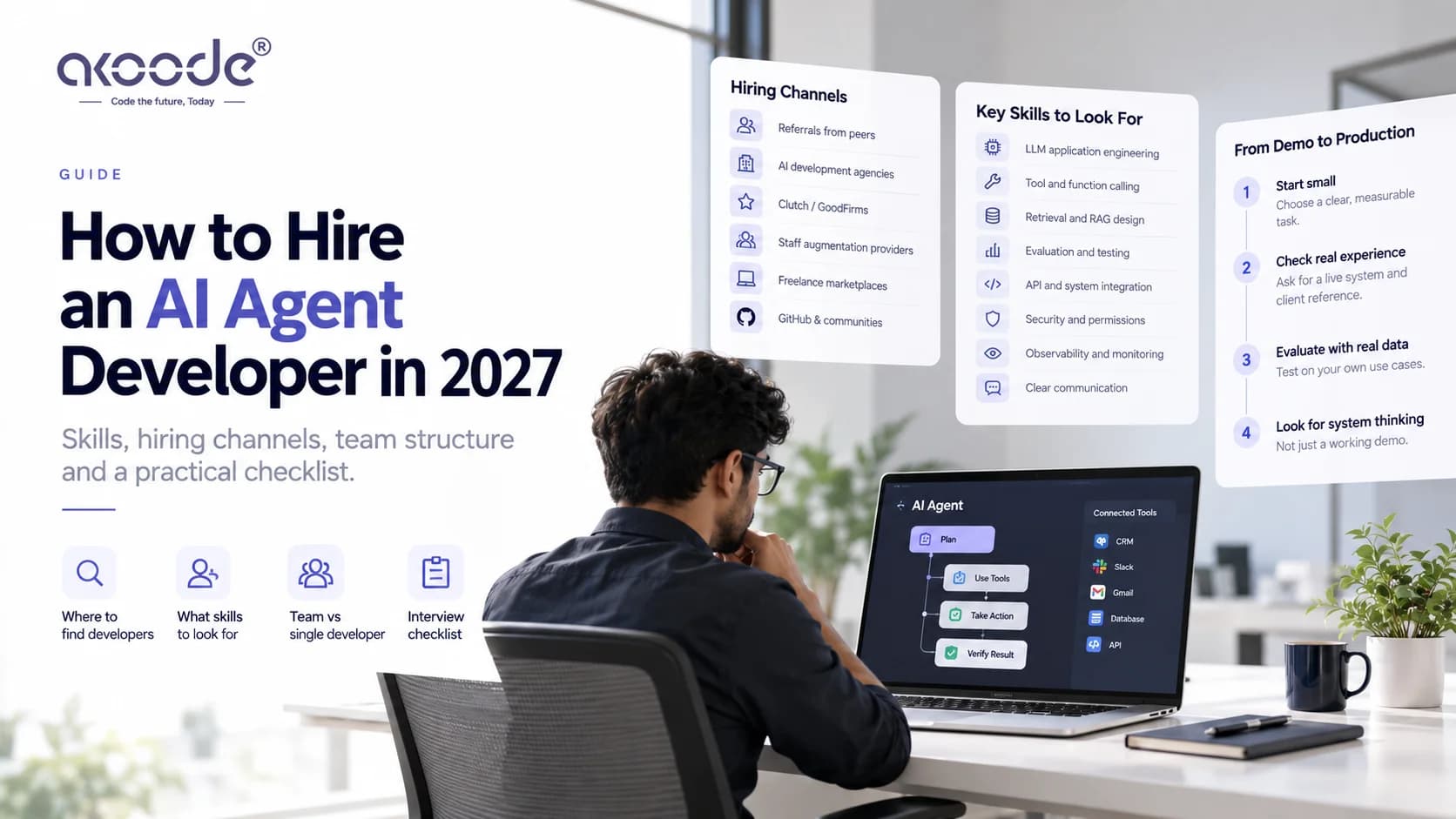
Where Can You Find Reliable AI Agent Developers?
Quick answer: Start with referrals from peers who run a live agent, then check agencies with verifiable case studies and independent reviews on platforms such as Clutch and GoodFirms. Freelance marketplaces suit small, well-defined tasks. Whatever the source, ask to see a system running in production and speak to a past client before committing.
There is no single best place. Each channel suits a different kind of project:
Source | Works best for | Main risk |
|---|---|---|
Referrals from peers with a live agent | Any project size | Their needs may differ from yours, so check fit |
AI development agencies with published case studies | Production systems, multi-system work | Some resell work to subcontractors, so ask who writes the code |
Independent review platforms (Clutch, GoodFirms) | Shortlisting agencies | Reviews show satisfaction, not technical depth |
Staff augmentation providers | Adding engineers to a team you already manage | You carry the management and architecture burden |
Freelance marketplaces | Small tasks, prototypes, short experiments | Hard to verify production experience and continuity |
GitHub and technical communities | Spotting engineers who build in public | Open-source activity does not equal business delivery |
Two habits improve any search. First, look for evidence from real operation: a case study, a running product, a client you can call. Second, notice how a candidate talks about failure. Developers who have run agents in production describe what broke, how they found out and what they changed. People who have only built demos describe what worked.
For teams hiring in India, we cover roles, trial structure and engagement terms in how to hire a dedicated AI developer in India, and our overview of AI development companies in India lists criteria worth applying to any vendor.
What Skills Should an AI Agent Developer Have?
Quick answer: Look for LLM application engineering, tool and function calling, retrieval design, evaluation and testing, API and system integration, security habits and monitoring. Strong developers also scope well and explain trade-offs plainly. Model knowledge alone is not enough, because most agent failures come from weak integration, poor evaluation and missing guardrails.
These are the skills that separate people who ship agents from people who prototype them:
LLM application engineering. Prompt design, structured outputs, context management, and knowing when a smaller or cheaper model is enough.
Tool and function calling. Giving an agent safe, well-described ways to act in your systems, with clear inputs and error handling.
Retrieval design. Chunking, indexing, ranking and citing sources so the agent answers from your data, not from guesswork. This is the core of a RAG application.
Evaluation and testing. Building test sets from real cases, scoring outputs, running regressions before every change. This is the single skill we weigh most heavily.
Integration engineering. Working with APIs, webhooks, authentication and databases, including the unglamorous legacy systems. Our enterprise AI integration work is mostly this.
Security and permissions. Least-privilege access, prompt injection awareness, data handling, audit logs.
Observability. Tracing what the agent did and why, so failures can be diagnosed in minutes instead of days.
Communication. Writing a clear scope, saying no to the wrong task, and reporting bad news early.
Notice what is missing: a list of model names. Models change every few months. A developer who understands evaluation, integration and failure modes will adapt to the next model. One who only knows the current one will not.
Do You Need a Full Team or Just One AI Developer?
Quick answer: One experienced developer can build a narrow pilot with clean data and a single workflow. Production systems that touch several tools and sensitive data usually need more: an engineer, someone dedicated to testing, and design or product input. A good partner scales the team to the project rather than starting with a full one.
Project type | Typical team shape |
|---|---|
Exploratory pilot, one workflow, clean data | One senior AI engineer with part-time review |
Production agent inside one or two systems | AI engineer, integration or backend engineer, QA |
Customer-facing agent with a conversation interface | The above plus a conversation or UX designer |
Multi-agent system across several departments | Technical lead, several engineers, QA, product owner, security review |
The mistake we see most is hiring a single developer for a multi-system build and expecting the same outcome as a team. The reverse also happens: a company signs up for a large team to run a pilot that one person could have finished. The right sizing comes out of a proper scoping conversation. We compare the engagement options in detail in our staff augmentation service overview.
What Questions Should You Ask Before Hiring an AI Developer?
Quick answer: Ask about agents they have run in production, how they measure accuracy, how they handle failures, what permissions the agent needs, who owns the code and data, how updates work, and who supports the system after launch. The specificity of the answers matters more than the answers themselves.
Use these twelve questions. After each one, we have noted what a good answer sounds like.
What agents have you taken to production, and can I speak to the client?Good: names a system, describes what it does, offers a reference. Weak: "we have done many chatbots."
How do you test an agent before launch? Good: a test set built from real cases, scoring criteria, regression checks. Weak: "we try it out and tweak the prompts."
What happens when the model gets it wrong? Good: detection, fallback, escalation to a person. Weak: "it rarely does."
What access will the agent need, and how do you limit it? Good: least privilege, separate credentials, approval gates for risky actions.
How do you handle our data? Good: where it is stored, who sees it, what goes to third-party model providers, how it is deleted.
Who will actually write the code? Good: named people on your team, in house. Weak: vague answers about "our network."
Who owns the code, prompts and trained assets? Good: you do, in writing, with repository access from day one.
How will we know it is working after launch? Good: defined metrics and a monitoring plan.
What will you need from us? Good: specific items such as sample cases, system access and a named decision maker.
What would make you advise against building this? Good: a real answer. Weak: "nothing, we can build anything."
How do you handle model updates and changes in provider terms? Good: a regression process before any swap.
Who supports the agent after go-live, and how? Good: the same team, with a defined response process.
Question ten is our favourite. A developer who can tell you when not to build is a developer who is thinking about your outcome and not their invoice.
How Do You Know If an AI Developer Is Actually Qualified?
Quick answer: Ask for production evidence, not demos. Check how they test before launch, how they handle integrations and permissions, and what they do when the model is wrong. A short paid trial task is the most reliable filter, because it shows how they think, communicate and document under real conditions.
Certificates and years of experience help, but in a field this new they are weak signals. We recommend a five-gate scorecard, the Akoode 5-Gate Vetting Scorecard, for vetting any AI developer, whether an individual or an agency. A candidate should pass all five.
Gate | What you are checking | A good sign | A warning sign |
|---|---|---|---|
1. Production evidence | Has this person run an agent that real users depend on? | Describes incidents, fixes and lessons from live systems | Only shows prototypes or screen recordings |
2. Evaluation discipline | Do they measure quality before and after changes? | Builds test sets and tracks results over time | Judges quality by "it looks right" |
3. Integration depth | Can they connect to messy real systems? | Talks about auth, rate limits, retries and bad data | Assumes every API is clean and documented |
4. Security habits | Do they treat access and data as a first-order concern? | Raises permissions and logging before you ask | Treats security as a later phase |
5. Communication | Can they explain trade-offs and bad news plainly? | Writes clear scopes and flags risks early | Avoids specifics, overpromises on timelines |
Then run a short paid trial. Give the candidate one real but low-risk task from your workflow, with sample data, and a few working days. You are not buying the output. You are watching the process: what questions they ask, how they structure the work, whether they test it, and how they hand it over. Paying for the trial keeps the relationship fair and filters out people who only want free work.
Our own AI quantity takeoff platform for Qualis Construction is a good example of why Gate 2 matters. When the output is a set of quantities that feed real decisions, a plausible-looking answer is not good enough. The evaluation layer is what makes it trustworthy.
How Do You Hire an AI Developer Without Getting Scammed?
Quick answer: Insist on written IP ownership, repository access from day one, staged payments tied to working milestones, and references you contact yourself. Be wary of guaranteed results, vague scopes, pressure to pay in full upfront and portfolios you cannot verify. A real developer welcomes a trial and a clear contract.
AI hype has attracted people who are good at selling and poor at building. These are the patterns to watch for:
Guaranteed outcomes. No honest developer promises a specific accuracy or revenue result before seeing your data.
A portfolio you cannot verify. Screenshots without a client name, a link or a reference call prove nothing.
Demo-only evidence. A polished video with no running system behind it.
Pressure to pay everything upfront. Or to move the conversation to untraceable channels.
Vagueness about who builds it. If you cannot get the names and roles of the people doing the work, assume they are not who you are talking to.
No questions about your business. Someone who quotes before understanding your workflow is quoting a template.
Resistance to a trial or to written terms. Reasonable developers expect both.
Build protections into the engagement itself:
Own the code. The contract should state that you own the source code, prompts and configuration, and that you get repository access from the first day.
Pay against milestones. Tie each payment to something working that you have seen, not to elapsed time.
Verify references yourself. Find the contact independently where you can, and ask what went wrong as well as what went right.
Set data rules in writing. What data the developer may access, where it may be processed, and what happens to it when the project ends.
Keep admin credentials. Your accounts, your cloud, your API keys. Developers get scoped access, not ownership.
In regulated sectors such as finance and banking, healthcare and the public sector, add a security review and data-processing terms before any development starts. We cover the controls in more depth in our enterprise AI agent architecture guide.
What Mistakes Do Companies Make When Hiring for AI?
The same handful of mistakes keeps appearing in AI hiring, and most of them are avoidable:
Hiring for the model instead of the system. The model is the smallest part of a working agent. Integration, evaluation and guardrails are the rest.
Skipping the scope. "Build us an AI agent" is not a brief. It leads to a build that solves a problem nobody had.
Judging on a demo. Demos are built to look good. Ask for the failure cases.
No owner on the client side. Agent projects need someone who knows the process and can make decisions in a day, not a month.
Ignoring the exceptions. The happy path is easy. The exceptions are the project.
Choosing on price alone. The cheapest quote often leaves out evaluation, security and support. You pay for them later, with interest. For what really drives cost, see AI agent development cost.
No plan for after launch. Models change, data drifts and tools update. Without support, even a good agent decays.
How Do You Brief an AI Developer on Your Project?
A good brief saves weeks. It does not need to be long, but it must be specific. Write one page covering these eight points:
The process. One workflow, described step by step as it happens today, including workarounds.
The goal. A measurable outcome, such as "reduce time to first response" or "cut manual data entry on invoices."
The volume. How often the process runs and how many cases per week.
The systems. Every tool the process touches, and whether each has an API.
The data. What exists, where it lives, how clean it is, and what is sensitive.
The exceptions. The cases that go wrong or need judgement, and who handles them now.
The boundaries. What the agent must never do and what always needs a person to approve.
The people. Who owns the decision, who knows the process best, and who will review results.
If you cannot answer some of these, say so. A developer who helps you find the answers during scoping is worth more than one who fills the gaps with assumptions.
Why Does It Matter That Your AI Developer Builds In House?
When you hire through a company, the most important question is also the simplest: who actually writes the code?
At Akoode, the answer is our own team. Our developers are qualified, certified and employed in house, and everything we design, build and test happens inside the company. There is no subcontracting chain between your requirement and the code. That matters for three practical reasons. Knowledge stays with a team you can reach, so changes six months later do not start from zero. Quality is tested by the same people who built it, so problems are caught before you see them. And your data and code pass through fewer hands.
Akoode holds a 4.9 rating on Google from 126 reviews and a 5.0 out of 5 on GoodFirms. If you want to add engineers to a team you already run, our staff augmentation service typically provides profiled engineers within 48 to 72 hours, with ramp-up usually within 5 to 7 days. If you want us to own delivery, our AI agent development services cover scoping, build, testing and support.
For a wider view of what we offer beyond agents, see our artificial intelligence services.
What Should You Read Next?
AI agent development in 2027: the complete business guide: what agents are and whether you need one.
AI agent development cost: what drives the price.
Enterprise AI agent architecture: the technical blueprint your developer should be able to explain.
How to hire a dedicated AI developer in India: roles, steps and trial structure.
Frequently Asked Questions
Where can I find reliable AI agent developers?
Start with referrals from peers who run a live agent, then check agencies with verifiable case studies and independent reviews on platforms such as Clutch and GoodFirms. Freelance marketplaces work for small, well-defined tasks. Whatever the source, ask to see a system running in production and speak to a past client before you commit.
What skills should an AI agent developer have?
Look for LLM application engineering, tool and function calling, retrieval design, evaluation and testing, API and system integration, security habits and monitoring. Good developers also scope well and explain trade-offs in plain language. Model knowledge alone is not enough, because most agent failures come from weak integration, poor evaluation and missing guardrails.
How do I know if an AI developer is qualified?
Ask for production evidence, not demos. Check how they test an agent before launch, how they handle integrations and permissions, and what they do when the model is wrong. A short paid trial task is the most reliable filter, because it shows how they think, communicate and document under real conditions.
How do I avoid getting scammed when hiring an AI developer?
Insist on written IP ownership, access to the code repository from day one, staged payments tied to working milestones, and references you contact yourself. Be wary of guaranteed results, vague scopes, pressure to pay in full upfront and portfolios you cannot verify. A real developer will welcome a trial and a clear contract.
Do I need a full team or just one AI developer?
One experienced developer can build a narrow pilot with clean data and a single workflow. Production systems that touch several tools and sensitive data usually need more: an engineer, someone on testing, and design or product input. A good partner scales the team to the project rather than starting with a full one.
What questions should I ask before hiring an AI developer?
Ask about agents they have run in production, how they measure accuracy, how they handle failures, what permissions the agent will need, who owns the code and data, how updates are handled, and who supports the system after launch. How specific the answers are matters more than the answers themselves.
Can I hire an AI developer through Akoode?
Yes. Akoode works through project-based delivery and dedicated teams, with in-house developers who design, build and test everything. Book a scoping call and we will tell you whether a single developer, a small team or a full project engagement fits your workflow and systems.
Talk to the Team Before You Decide
Bring your one-page brief, or just a few sentences about the process you want to improve. We will tell you honestly whether you need an agent, which team shape fits, and what a sensible first pilot looks like. If we are not the right fit, we will say that too.
Book a call with Akhil Verma, Founder and CEO of Akoode Technologies, or explore our AI agent development services.
Written by the Akoode Technologies team. Akoode is headquartered in Gurugram, India, with a presence in Jenks, Oklahoma, and serves clients across India, the UK and the USA.
Get In Touch Now
View More Our Blog