


 August 22, 2026
For the last few years, most enterprise AI investment went into systems that answer questions — a chatbot that responds to a prompt, a copilot that drafts something for a person to review. That work is largely solved territory now. What enterprises are building in 2026 is different in kind: systems that take a goal, plan a sequence of steps, pull in data, call tools, make decisions along that sequence, and only stop to ask a human when the stakes warrant it.
That shift changes what "building AI" actually means for an engineering team. Choosing a language model used to be the hard part of an AI project. It isn't anymore. The hard part is everything around the model: which tools it's allowed to call, what data it can see, how its actions get authorized, how a bad decision gets caught before it causes damage, and how the whole system gets monitored once it's live and making decisions without someone watching every step.
This article is about that engineering problem — the architecture, security model, and operational discipline behind an AI agent that a business can actually trust to run in production, not just perform well in a demo.
What Is an Enterprise AI Agent?
The term "AI agent" gets applied loosely enough that it's worth being precise about what separates it from the systems most people already understand.
Traditional automation follows a fixed path: a rule triggers a workflow, the workflow produces an output. It's reliable because it's rigid — there's no reasoning involved, just execution of a predefined sequence.
An AI chatbot takes a user's prompt, sends it to a model, and returns a response. The interaction is contained to a single exchange (or a conversational thread) — the model isn't taking actions in other systems, just generating text.
An AI copilot goes a step further: the AI assists with a task — drafting an email, suggesting code, summarizing a document — but a human makes the final decision and takes the final action. The AI augments; it doesn't execute independently.
An AI agent is different again: given a goal, it plans a sequence of steps, reasons about which tools or data it needs, takes actions using those tools, observes the result of each action, and decides what to do next — repeating that loop until the goal is met or it hits a point where it needs human input. The defining characteristic isn't intelligence, it's autonomy over a multi-step process.
A multi-agent system coordinates several specialized agents — one might handle research, another verification, another execution — sharing tools, data, and context to complete a task too broad or too specialized for a single agent to handle well on its own.
The practical distinction that matters for engineering purposes: a chatbot's worst-case failure is a bad answer. An agent's worst-case failure is a bad action — a wrong purchase order, an incorrect refund, a misfiled record — which is why the architecture around an agent has to be fundamentally more rigorous than the architecture around a chatbot.
Enterprise AI Agent Architecture
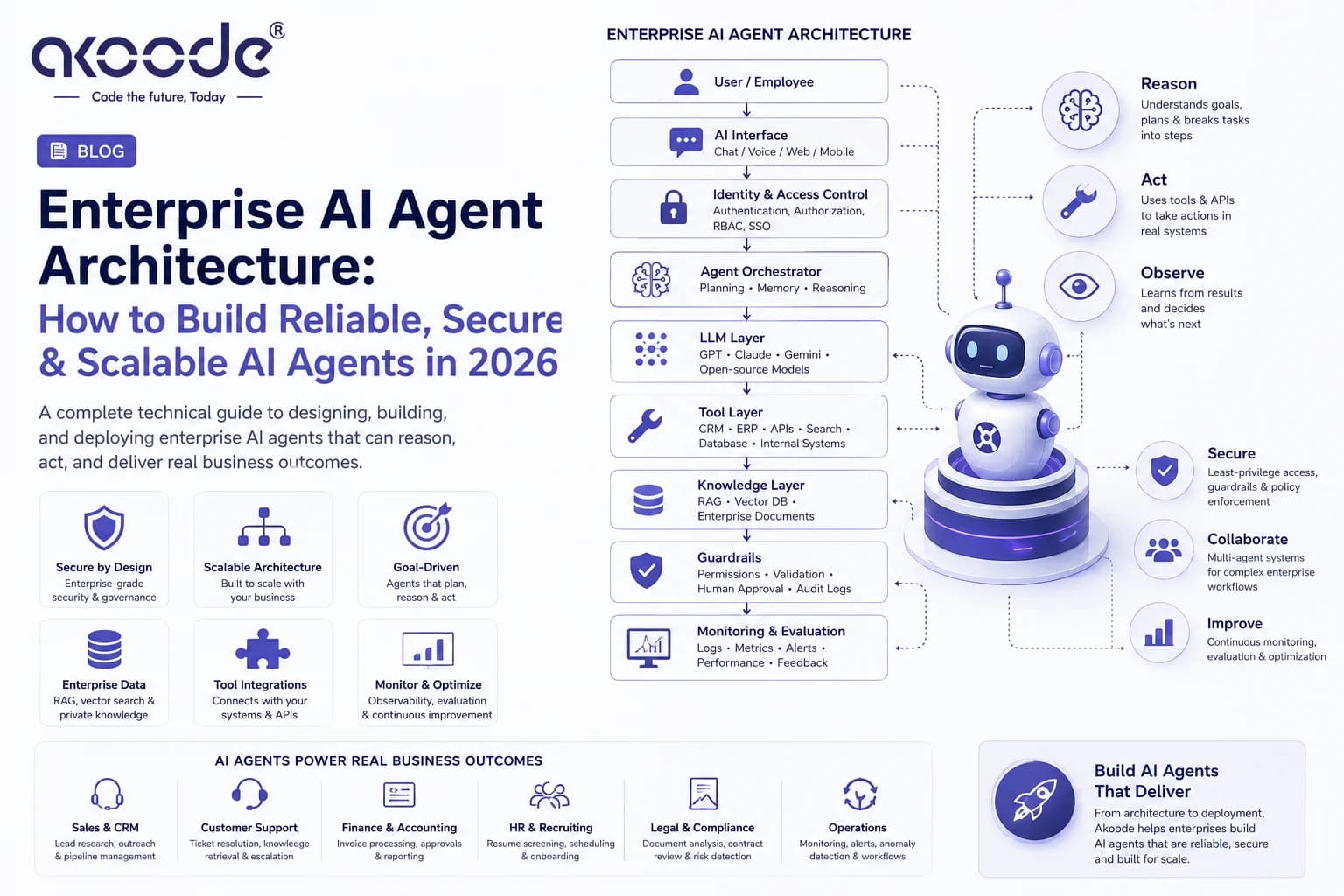
A production-grade agent system is built in layers, and each layer exists to solve a specific problem: reasoning, execution, data access, safety, and oversight are all distinct concerns that shouldn't be conflated into a single "the AI does it" box.
User / Employee
      │
      ▼
AI Interface
      │
      ▼
Identity & Access Control
      │
      ▼
Agent Orchestrator
      │
      ├── Planning
      ├── Memory
      ├── Reasoning
      │
      ▼
LLM Layer
      │
      ├── GPT
      ├── Claude
      ├── Gemini
      └── Open-source Models
      │
      ▼
Tool Layer
      │
      ├── CRM
      ├── ERP
      ├── APIs
      ├── Search
      ├── Database
      └── Internal Systems
      │
      ▼
Knowledge Layer
      │
      ├── RAG
      ├── Vector Database
      └── Enterprise Documents
      │
      ▼
Guardrails
      │
      ├── Permissions
      ├── Validation
      ├── Human Approval
      └── Audit Logs
      │
      ▼
Monitoring & Evaluation
This isn't the only valid architecture — a narrow, single-tool internal agent doesn't need the same depth as a customer-facing agent with write access to financial systems. But the layers themselves show up in some form in every production agent worth trusting with real business processes.
Identity & Access Control sits above the orchestrator deliberately. Before an agent reasons about anything, the system needs to know who's asking and what they're allowed to see or do — the agent's authority should never exceed the authority of the person or process invoking it.
The Agent Orchestrator is the coordination layer — it decides what the agent should do next, tracks the state of a multi-step task, and routes work to the right tools. This is arguably the most underappreciated layer in agent systems, because it's where most of the reliability engineering actually happens.
The LLM Layer is the reasoning engine — the component that interprets the goal, plans steps, and decides which tool to call next. It's a critical layer, but it's one component among many, not the whole system.
The Tool Layer is what makes an agent useful rather than just conversational — it's the set of actions the agent can actually take in the systems that run the business.
The Knowledge Layer gives the agent access to information beyond what's in its training data or the current conversation — company documents, policies, product data — retrieved and injected into context as needed.
Guardrails are the layer that keeps an agent's autonomy bounded — permission checks, output validation, and approval requirements that stand between "the agent decided to do this" and "this actually happened."
Monitoring & Evaluation closes the loop — without it, an enterprise has no way of knowing whether the agent is performing well, degrading, or quietly making mistakes nobody's caught yet.
The Core Components of an Enterprise AI Agent
1. Foundation Model
The LLM is the reasoning engine — it interprets the goal, decides what to do next, and generates the language or structured output the rest of the system acts on. Model selection isn't a one-time, universal decision; it depends on several factors that trade off against each other:
Accuracy on the specific type of reasoning the agent needs to do
Latency — a customer-facing agent has different tolerance than a back-office batch process
Cost per call, which compounds quickly in multi-step agent loops that call the model several times per task
Context window — how much data (documents, conversation history, tool outputs) the model needs to reason over at once
Privacy and data residency requirements, which sometimes rule out hosted APIs entirely
Reliability and consistency of output format, which matters more for agents than for chat, since a malformed tool call can break an entire workflow
There's no universally superior model here — a system might reasonably use a faster, cheaper model for simple classification steps and a stronger model for the parts of the task that require genuine reasoning.
2. Agent Orchestrator
The orchestrator handles the mechanics of running a multi-step agent loop: breaking a goal into a plan, deciding which tool to call at each step, tracking what's already been done, managing retries when a tool call fails, and routing the task to a human when the agent hits its limits. Frameworks like LangGraph, LangChain, and LlamaIndex provide scaffolding for this, but the framework is far less important than how well the orchestration logic itself is designed — state management, retry logic, and failure handling are what determine whether an agent behaves predictably under real conditions, not which library sits underneath it.
3. Tool Layer
An AI agent is only as useful as the actions it's authorized and technically able to perform. A model with excellent reasoning but no reliable way to actually query the ERP, update the CRM, or send an email is a demo, not a production system. This is also where the biggest chunk of engineering effort tends to go in real projects — each integration (CRM, ERP, internal API, payment system, document processor) is its own build, its own failure modes, and its own testing surface. Teams that scope an agent project around "the AI part" and treat the tool layer as an afterthought consistently underestimate both cost and timeline.
4. Knowledge and RAG Layer
Retrieval-augmented generation connects the agent to information that isn't in the model's training data — company policies, product catalogs, historical records — by embedding documents into a vector database, retrieving the most relevant pieces for a given task, and injecting them into the model's context. Reranking often sits between retrieval and injection, since the first-pass retrieval isn't always precise enough on its own. A detail enterprises frequently miss: retrieval needs to be permissions-aware — an agent shouldn't be able to retrieve a document the requesting user isn't authorized to see, which means the retrieval layer needs to respect the same access controls as the rest of the system, not operate as a separate, ungoverned data source.
RAG isn't necessary for every agent. A narrow agent operating entirely on structured data from an API doesn't need a document retrieval layer; it becomes necessary specifically when the agent needs to reason over unstructured enterprise knowledge that isn't otherwise accessible through a clean API.
5. Memory
Agents need different kinds of memory depending on the task: short-term state to track progress within a single multi-step task, conversation memory for multi-turn interactions, and sometimes long-term memory for user preferences or historical context across sessions. Enterprises need to be deliberate about what gets stored and for how long — persistent memory that retains sensitive data longer than necessary, or that isn't scoped correctly to the right user or permission level, becomes a data governance liability rather than a feature.
6. Guardrails
Guardrails are the mechanisms that keep an agent's behavior within acceptable bounds: validating outputs before they're acted on, enforcing policy constraints (an agent shouldn't be able to approve its own purchase request, for example), setting confidence thresholds below which the agent defers to a human, restricting which tools can be called under which conditions, and defining fallback behavior when something goes wrong. This layer is where a system moves from "the model probably won't do anything harmful" to "the system cannot take a harmful action even if the model tries."
7. Human-in-the-Loop
Autonomy should be graduated to the actual risk of the action, not applied uniformly across everything an agent does:
Low-risk actions — the agent acts automatically (looking up information, drafting a response, running a read-only query)
Medium-risk actions — the agent prepares the action and requests approval before executing (a refund under a defined threshold, a scheduling change)
High-risk actions — the agent can recommend, but a human must decide (a large financial transaction, a legal commitment, an action affecting a customer relationship)
This graduated model is one of the more important architectural decisions in an enterprise agent project, because it directly determines both the system's usefulness and its blast radius when something goes wrong.
Single-Agent vs. Multi-Agent Architecture
Factor | Single Agent | Multi-Agent |
|---|---|---|
Complexity | Lower — one reasoning loop to design and debug | Higher — requires coordination logic between agents |
Development Cost | Lower for most business tasks | Higher; each specialized agent adds its own scope |
Maintenance | Simpler to monitor and update | More moving parts to keep in sync as requirements change |
Coordination | Not applicable | Requires a defined protocol for handoffs and shared state |
Scalability | Scales well for well-defined, bounded tasks | Scales well for genuinely broad, multi-domain tasks |
Best Use Cases | A clearly scoped workflow (procurement, ticket triage, document extraction) | Tasks that naturally split into distinct specialized roles (research + verification + execution) |
Failure Modes | A single point of reasoning failure, easier to isolate and debug | Coordination failures, agents working from inconsistent state, harder to trace |
When to Choose | When one agent with the right tools can complete the task end-to-end | When the task genuinely requires distinct expertise or parallel work that a single agent's context can't hold cleanly |
Multi-agent does not automatically mean better. It's tempting to reach for a multi-agent design because it sounds more sophisticated, but coordination between agents is real engineering overhead — shared state has to stay consistent, handoffs have to be well-defined, and debugging a failure that emerged from two agents' interaction is harder than debugging a single reasoning loop. The right default for most enterprise use cases is a single, well-scoped agent; multi-agent architecture earns its complexity only when a task genuinely doesn't fit inside one agent's context and tool set.
How an Enterprise AI Agent Actually Works: A Procurement Example
Walking through a realistic example makes the architecture concrete.
Enterprise Procurement Agent:
An employee submits a purchase request through the AI interface — the entry point where identity and access control first apply.
The agent validates the request — checking it's complete and well-formed. This is the orchestrator's planning step, deciding what needs to happen next.
It retrieves the company's procurement policy from the knowledge layer via RAG — pulling the specific policy relevant to this category of purchase.
It checks the budget system through the tool layer — a live query against a finance API, not a cached or assumed figure.
It searches approved vendors — another tool call, this time against a vendor database or procurement system.
It compares pricing across the retrieved vendor options — reasoning performed by the LLM layer over structured data pulled from the tool layer.
It flags exceptions — if the request falls outside standard policy (an unapproved vendor, an amount above a threshold), the guardrails layer catches this and routes accordingly.
It requests approval — for anything above the low-risk threshold, the human-in-the-loop layer surfaces the prepared request to the appropriate approver rather than executing automatically.
It creates the purchase order — once approved, the tool layer executes the actual write action against the procurement system.
It updates the ERP — a second tool-layer action, keeping downstream systems in sync.
It logs the complete transaction — every step, decision, and tool call recorded by the monitoring and audit layer, so the full sequence can be reviewed later if needed.
Every step in this flow maps to a specific architectural layer. That mapping is exactly why the architecture matters: without it, "the AI does procurement" is an opaque black box; with it, every decision point is inspectable, and every action the agent takes has a defined authorization path behind it.
AI Agent Security Architecture
An agent with access to enterprise systems introduces a fundamentally different security model than a chatbot. A chatbot's worst case is generating an inappropriate response. An agent that can write to a CRM, issue a refund, create a purchase order, or access internal documents changes what "security" has to cover — the system has to control not just who can talk to the agent, but which tools the agent can invoke, under what conditions, and with what data.
Authentication and authorization establish who's making the request and what they're permitted to do — this has to be checked before the agent acts, not assumed from context.
Role-based access control (RBAC) and least-privilege access mean the agent itself should only ever hold the permissions necessary for its specific function — an agent built for customer support shouldn't have write access to payroll systems, even if the underlying model is technically capable of generating a request to do so.
Tool permissions need to be scoped per-tool and, ideally, per-action — read access to a system and write access to it are different permission grants, and an agent's ability to call a tool doesn't automatically mean it should have unrestricted use of every function that tool exposes.
API security covers the standard practices — authenticated, rate-limited, and monitored API access between the agent system and every business system it touches.
Data isolation matters especially in multi-tenant or multi-department deployments — an agent serving one team shouldn't have incidental access to another team's data because of a shared underlying data store.
Encryption and secrets management apply to both data at rest and in transit, and to the credentials the agent system itself uses to authenticate against business tools — those secrets need the same protection as any other production credential, not looser handling because "it's just for the AI."
Audit logging records every decision and action the agent takes, with enough detail to reconstruct exactly what happened and why — this is both a security control and, often, a compliance requirement.
Prompt injection is a risk specific to LLM-based systems: a malicious actor crafts input designed to make the model ignore its instructions or take an unintended action. Indirect prompt injection is the more insidious version — the malicious instruction arrives not from the user directly, but embedded in a document, email, or webpage the agent retrieves and processes as part of its normal task. Both risks mean an agent should never treat retrieved content as trusted instructions, and guardrails need to validate tool calls independent of what the model claims it should do.
Sensitive data exposure can happen when an agent's retrieval or reasoning surfaces information it shouldn't — permissions-aware retrieval and output filtering both matter here.
Malicious or unintended tool calls are why guardrails need to sit outside the model's own judgment — validation logic that checks a tool call against policy before it executes, rather than trusting the model's stated intent.
Model manipulation — attempts to get the model to behave outside its intended constraints — is mitigated by the same layered defense: the model's output is never the final authority on whether an action happens; the guardrails and permission system are.
Human approval and action limits are the last line of defense — capping what an agent can do autonomously, regardless of how confident its reasoning appears, for anything above a defined risk threshold.
AI Agent Governance
Security controls what the system can technically do. Governance defines who's accountable for what the system is allowed to do, and how that gets reviewed over time. For any agent operating in a regulated or genuinely enterprise environment, governance needs clear answers to:
Who owns the agent — a specific team or role accountable for its behavior, not a diffuse "the AI team" answer
What the agent is allowed to do, documented explicitly rather than implied by what it happens to be technically capable of
What data it can access, and under what permission model
Which actions require human approval, and at what threshold
How decisions are logged and for how long those logs are retained
How performance is evaluated, and by whom
What happens when the agent fails — a defined escalation and recovery process, not an ad hoc response
How models are changed — a new model version can shift behavior in ways that need review before deployment, not silent rollout
How permissions are reviewed — access grants should be periodically reassessed, the same way human employee access is
Governance matters more, not less, as an agent's autonomy grows — the systems with the least oversight tend to be the ones where a small error compounds furthest before anyone notices.
How to Make AI Agents Reliable
An agent has to be evaluated as a system, not merely as a language model. The model's raw capability is one input; the reliability of the full system depends on how well it's tested, monitored, and bounded.
Metrics worth tracking include:
Task completion rate — how often the agent actually achieves the stated goal
Tool-call accuracy — whether the agent calls the right tool, with the right parameters, at the right time
Hallucination rate — how often the agent asserts something false or unsupported
Latency — end-to-end time for a task, which compounds across multi-step agent loops
Failure rate — how often the agent fails outright rather than completing or escalating gracefully
Escalation rate — how often the agent correctly identifies when it should hand off to a human, and whether that rate is appropriate for the task
Cost per task — inference cost across the full multi-step loop, not a single prompt
Consistency — whether the agent produces similar outcomes on similar inputs, which matters for trust and auditability
Security testing outcomes — resistance to prompt injection and unauthorized tool use
Reliability testing happens in stages: happy-path testing confirms the agent works when everything goes as expected; edge-case testing checks behavior on unusual but legitimate inputs; adversarial testing deliberately tries to break the agent or manipulate it into unintended behavior; and production monitoring is the ongoing, ordinary-operation check that catches the failure modes no amount of pre-launch testing anticipated.
AI Agent Observability and Monitoring
Once live, an AI agent should be treated more like a continuously monitored production system than a static software feature — its behavior can shift over time even without any code change, simply because usage patterns or the data it encounters change.
What's worth monitoring on an ongoing basis:
Model latency and token usage, both of which affect cost and user experience
API costs, which can scale faster than expected in multi-step reasoning loops
Tool failures — how often integrations break or return unexpected results
Agent loops — cases where the agent gets stuck repeating steps without making progress, a distinct and common failure mode in agentic systems
Failed tasks and the patterns behind them
Hallucinations, tracked over time rather than assumed to be a solved, one-time problem
User feedback, both explicit and behavioral (did the person accept, reject, or correct the agent's output)
Escalation rates, and whether they're trending in a direction that suggests the agent is becoming less confident or the task distribution is shifting
Security events, including flagged prompt injection attempts or unauthorized tool call attempts
Retrieval quality, if the agent uses RAG — whether retrieved context is actually relevant to the task at hand
Without this layer, an enterprise has no reliable way to know whether an agent that worked well at launch is still working well six months later.
Cloud vs. On-Premise vs. Edge AI Agents
Cloud deployment is the default for most enterprise agents — it offers the fastest path to development, managed infrastructure, and straightforward scalability as usage grows. It's the right starting point unless a specific constraint rules it out.
On-premise deployment becomes necessary when data sensitivity or regulatory requirements mean information can't leave the organization's own infrastructure — common in finance, healthcare, defense, and any environment handling proprietary or classified data. It trades development speed and managed convenience for direct control over where data lives and how it's processed.
Edge deployment — running inference on local hardware close to where the data is generated — matters when latency has to be near-instant or when the environment can't reliably reach the cloud at all: industrial equipment, physical security systems, or field operations without consistent connectivity.
In practice, hybrid architectures are common and often the most practical answer: an agent might run its reasoning in the cloud while keeping sensitive data processing on-premise, or run detection locally at the edge while syncing structured results to a cloud dashboard. The deployment model should follow from the constraint driving it, not from a default assumption that cloud is always simplest.
Enterprise AI Agent Technology Stack
Layer | Example Technologies |
|---|---|
Frontend | React, Next.js, Flutter |
Backend | Python, Node.js |
Models | OpenAI, Anthropic, Gemini, open-source models |
Orchestration | LangGraph, LangChain, LlamaIndex |
Databases | PostgreSQL, MongoDB |
Vector Search | Vector databases (for RAG and semantic retrieval) |
Cache | Redis |
Cloud | AWS, Azure, Google Cloud |
Monitoring | Logs, traces, evaluation pipelines |
Security | IAM, RBAC, encryption, audit logs |
These are examples of common choices, not a mandatory stack — the right combination depends on existing enterprise infrastructure, team expertise, and the specific constraints of the use case.
Real-World Enterprise AI Agent Use Cases
Sales — an agent that researches a lead, qualifies it against defined criteria, logs the result in the CRM, drafts outreach, and manages structured follow-up. Human review typically stays in place before outbound messages send, at least initially.
Customer Support — a ticket comes in, the agent retrieves relevant knowledge base content, diagnoses the likely issue, drafts or sends a response for low-complexity cases, and escalates to a human agent when confidence is low or the issue falls outside its defined scope.
Finance — an invoice arrives, the agent extracts the relevant data, validates it against purchase orders and budget rules, updates the ERP, and routes anything with exceptions or above a threshold for human approval before payment.
HR — a candidate applies, the agent screens the application against defined criteria, ranks candidates, and schedules interviews through the applicant tracking system — with human judgment retained for the actual hiring decision.
Legal — a document comes in for review, the agent extracts key terms, compares it against a standard template or prior agreements, flags deviations or risk areas, and prepares a summary for human legal review. Legal decisions themselves stay with a qualified human at every stage.
Operations — an agent monitors system or process metrics, detects anomalies, investigates likely causes using available data sources, and either takes a predefined low-risk corrective action or raises an alert for human investigation.
Construction & Engineering — a drawing or document is submitted, the agent detects and measures the relevant elements (materials, fixtures, dimensions), verifies the results, and generates a structured report — a workflow that maps closely to computer-vision-based document processing, where accuracy on the detection step directly determines how much a human still needs to double-check downstream.
Across all of these, the consistent pattern is that human approval stays in place wherever an action is costly to reverse, affects a customer relationship, or carries legal or financial risk — autonomy is earned for narrower, lower-stakes steps first, not granted wholesale from day one.
How Much Does Enterprise AI Agent Development Cost?
Cost isn't the focus of this article, but it's worth addressing directly: enterprise AI agent development cost depends on the number of tools and integrations required, how much autonomy the agent has (and therefore how much guardrail and approval-workflow engineering it needs), data complexity, whether RAG is required, security and compliance requirements, deployment model (cloud, on-premise, or edge), the number of users the system needs to support, and the ongoing monitoring and testing investment.
For a detailed breakdown by agent complexity and typical cost ranges, see How Much Does It Cost to Build an AI Agent in 2026?
Common Enterprise AI Agent Mistakes
Starting with the model instead of the business problem — choosing an LLM before defining exactly what decision or action the agent needs to own
Giving an agent too much autonomy too early — skipping the graduated risk model and granting broad action rights before the system has proven reliable on narrower tasks
Underestimating integrations — treating the tool layer as a minor detail rather than the largest real engineering surface in most agent projects
Ignoring security — applying chatbot-level security thinking to a system that can take real actions in business systems
No human escalation path — building an agent that either does everything autonomously or fails silently, with no defined middle ground
No evaluation framework — launching without metrics for task completion, accuracy, or failure rate, which makes it impossible to know if the agent is actually working well
No monitoring — treating deployment as the finish line rather than the start of an ongoing operational responsibility
Building multi-agent systems unnecessarily — adding coordination complexity for a task a single well-scoped agent could have handled
Ignoring inference costs — not modeling that multi-step agent loops call the model multiple times per task, which changes the cost profile significantly from a single-prompt feature
Treating the agent as a one-time project — assuming the system is done at launch rather than planning for ongoing tuning as real usage reveals gaps
From AI Prototype to Production
A working prototype and a production-grade agent are different engineering artifacts, even when they perform the same demo task.
Prototype — proves the concept works technically: the model can plan, call a tool, and produce a reasonable output in a controlled test.
MVP — adds the minimum real infrastructure to be usable by actual users on a narrow, well-defined task, typically with heavy human oversight still in place.
Production — adds the layers that make the system trustworthy at real usage volume: proper security, tested guardrails, monitoring, defined escalation paths, and reliability under realistic, messy inputs rather than curated test cases.
Enterprise scale — adds governance, cost optimization across higher usage volume, permission review processes, and the operational discipline to support the agent as a long-lived system rather than a project with a fixed end date.
The gap between prototype and production is where most of the real engineering effort lives — architecture, security, testing, monitoring, infrastructure, permissions, reliability, and cost optimization all get built out in that gap. Teams that budget primarily for the prototype stage and treat the rest as a formality tend to be the ones whose "AI project" never quite makes it to reliable daily use.
How to Choose an Enterprise AI Development Partner
A capable AI engineering partner should be able to demonstrate, not just claim:
AI engineering expertise that goes beyond prompt writing — real experience with the orchestration, tool-integration, and evaluation work covered in this article
LLM experience across model selection trade-offs, not allegiance to a single provider
RAG experience, including permissions-aware retrieval, not just a basic vector-search demo
Agent orchestration experience — state management, retries, and failure handling in real multi-step systems
API integration capability across the actual enterprise systems involved (CRM, ERP, internal tools)
Broader enterprise software development capability, since the agent is a small part of the full system it needs to operate within
Cloud infrastructure expertise, and comfort with on-premise or edge deployment where required
A serious security posture — RBAC, least-privilege design, and an understanding of prompt injection and tool-call risks
A real evaluation and monitoring practice, not just a launch-and-hope approach
Evidence of production deployments, not only proof-of-concept work
Relevant industry experience, where the domain has specific compliance or workflow requirements
Post-launch support for the ongoing tuning production agents require
Akoode Technologies approaches AI agents as complete software systems rather than isolated AI features — combining models, orchestration, business integrations, data, security, cloud infrastructure, monitoring, and user experience into a single engineering effort rather than treating the AI component as separable from the rest of the system. The company works across AI development, generative AI integration, computer vision, custom software, mobile applications, cloud and DevOps, and data science — the range of disciplines a real agent project tends to touch, rather than a narrow AI-only scope.
Two examples illustrate what "system, not feature" looks like in practice. A real-time, multi-camera player performance tracking platform built for a professional football coaching organization combines computer vision detection and tracking with a full data pipeline and reporting layer — the AI model is one component in a system that also handles ingestion, re-identification through occlusion, and structured output generation. An AI-powered quantity takeoff platform built for Qualis Construction Ltd., a Canadian estimator, runs entirely offline — detecting materials and measurements directly from engineering drawings without any cloud dependency, because the drawings contain proprietary project data that couldn't be sent to a third-party API. Neither system is "an AI feature bolted onto a product" — both are engineered as complete systems around a specific business constraint.
Frequently Asked Questions
What is enterprise AI agent architecture?
It's the full technical system built around an AI model to let it operate reliably and safely in a business environment — including orchestration, tool access, data retrieval, security controls, human approval workflows, and monitoring, not just the model itself.
How does an AI agent work?
An agent takes a goal, plans a sequence of steps, uses tools or data sources to complete each step, observes the outcome, and decides what to do next — repeating that loop until the task is complete or it needs human input.
What is the difference between an AI agent and a chatbot?
A chatbot responds to a prompt with a single answer. An agent plans and executes a multi-step process, taking actions in other systems rather than just generating a response.
What is the difference between an AI agent and an AI copilot?
A copilot assists a human who makes the final decision and takes the final action. An agent can take the action itself, within the boundaries defined by its guardrails and approval workflow.
What is a multi-agent system?
A system where multiple specialized agents coordinate — sharing tools, data, and context — to complete a task that's too broad or too specialized for a single agent to handle effectively alone.
When should a company use RAG?
When an agent needs to reason over unstructured enterprise knowledge — documents, policies, historical records — that isn't otherwise available through a clean, structured API.
How secure are enterprise AI agents?
Security depends entirely on how the system is architected — least-privilege tool access, permissions-aware retrieval, validated tool calls, and audit logging are what make an agent secure; the underlying model provides none of this on its own.
Can AI agents work with existing ERP and CRM systems?
Yes, through the tool layer — agents connect to these systems via APIs, with permissions scoped to exactly what the agent's function requires.
Can AI agents run on-premise?
Yes. On-premise deployment is common where data sensitivity or regulatory requirements mean information can't leave the organization's own infrastructure.
How much does it cost to build an enterprise AI agent?
Cost depends on the number of tools and integrations, autonomy level, data complexity, security requirements, and deployment model — see our dedicated pricing guide for detailed ranges by complexity.
How long does enterprise AI agent development take?
It varies significantly with scope — a narrow, single-tool agent can take weeks; a domain-specific agent with custom data processing, security requirements, or offline deployment typically takes several months.
How do you evaluate an AI agent?
As a system, not just a model — tracking task completion rate, tool-call accuracy, hallucination rate, latency, failure rate, escalation rate, and cost per task, tested across happy-path, edge-case, and adversarial scenarios before and after launch.
Should every enterprise use multi-agent architecture?
No. A single, well-scoped agent is the better default for most business tasks. Multi-agent architecture is worth its added coordination complexity only when a task genuinely requires distinct specialized roles working in parallel.
What are the biggest risks of enterprise AI agents?
Excessive autonomy granted before the system has proven reliable, inadequate tool permissioning, prompt injection (direct and indirect), insufficient human escalation paths, and the absence of ongoing monitoring once the agent is live.
Get In Touch Now
View More Our Blog