


 September 20, 2026
A citizen used to visit a government office three times to get one certificate — once to file the application, once to correct a form error nobody explained clearly, and once to finally collect it weeks later. Today the same citizen uploads a document, an AI agent verifies it against the required format instantly, flags the one field that needs correction before submission instead of after, and the certificate is approved without the citizen ever standing in a line. The final decision on anything genuinely discretionary still sits with a human official. The three trips for what should have been a five-minute task mostly aren't necessary anymore.
Public sector AI carries a different kind of pressure than almost any other industry in this series: the customer is a citizen who often has no alternative provider, the stakes of an unfair or opaque decision are a matter of public trust rather than customer churn, and the honest state of adoption globally is uneven — ambitious government AI strategies exist almost everywhere, but turning those strategies into everyday practice remains inconsistent even among leading countries. This guide covers what AI in public sector and government actually means in 2026, every category of AI agent a government agency, public-sector technology vendor, or govtech business can realistically build, how they're engineered to meet a public-trust bar, and what's different about building for Gurgaon/NCR, India, and global markets.
Why Government AI Adoption Is Accelerating, Unevenly, Everywhere at Once
Market sizing for AI in government is inconsistent across analyst firms, as it is across most fast-moving categories, but the direction is unmistakable: most credible 2026 estimates put the global AI-in-government-and-public-services market between $19 billion and $31 billion, with virtually every forecast agreeing on 17-32% CAGR through the mid-2030s and projections landing anywhere from $80 billion to $160 billion by 2036 depending on scope. Government agencies themselves are expected to account for 65% of end-use demand in 2026, and public safety and security is the single largest application category, commanding roughly 40% of market share as law enforcement and emergency-management agencies deploy predictive analytics and coordination tools at scale.
A global Public Sector AI Adoption Index surveying more than 3,300 public servants across ten countries — including India — frames the honest state of play precisely: the question is no longer whether governments should adopt AI, but whether ambitious national strategies actually translate into everyday practice, and that translation remains genuinely uneven across countries. What's consistent is that budget pressure is a real accelerant rather than a constraint: agencies facing mandates to deliver more citizen services with limited resources are turning to AI-powered automation for document processing, eligibility determination, and administrative work specifically because the efficiency case is direct and immediate, not speculative.
India's public sector AI story is one of the fastest-growing and most deliberately structured government AI programs globally — Future Market Insights identifies India as the second-fastest-growing country market for government AI, with a 22.3% CAGR, trailing only China. The Cabinet approved the ₹10,372 crore IndiaAI Mission in March 2024, building national compute infrastructure that had already surpassed 34,000 GPUs by mid-2025, alongside dedicated pillars for AI governance, startup financing, and skilling. India released its formal AI Governance Guidelines in November 2025 and hosted the India-AI Impact Summit in New Delhi in February 2026, explicitly centered on the theme "AI for Good Governance: Empowering India's Digital Future." Haryana specifically has moved with unusual speed and specificity: the state launched the Haryana AI Mission in early 2026, backed by roughly ₹470-474 crore in World Bank assistance, and — in a detail that matters directly for this guide — the state's Global Artificial Intelligence Centre (GAIC), one of the mission's central infrastructure investments under a ₹1,160 crore national scheme, is being established in Gurugram specifically, alongside a Haryana AI Sandbox that the state's Chief Minister personally launched in Gurugram to test governance-focused AI solutions before wider rollout.
What "AI in Public Sector & Government" Actually Means
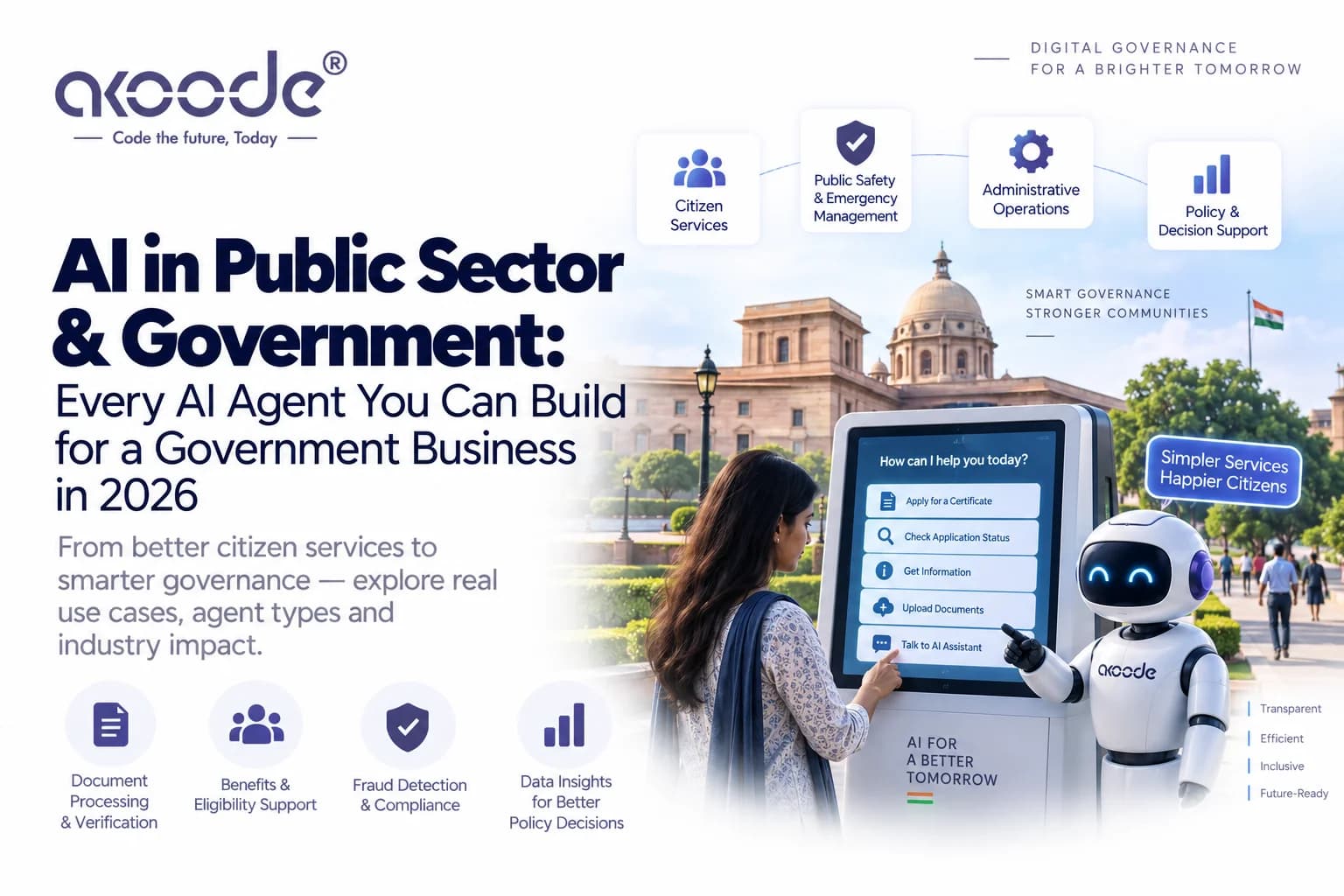
AI in government spans four connected areas, and each carries a different trust and accountability bar: citizen services(benefits, permits, digital identity — the fastest-adopted category because the efficiency case is immediate and visible), public safety and emergency management (predictive analytics, disaster coordination, infrastructure monitoring — the largest application category by market share), administrative operations (document processing, fraud detection, records management — where AI removes the most repetitive government work), and policy and decision support(data-driven forecasting, regulatory compliance, cross-department interoperability — where AI informs, but rarely replaces, a human policy judgment).
An AI agent, in this context, owns a defined task end-to-end at the appropriate accountability tier for its function — not a portal that displays eligibility rules, but a system that actually determines eligibility and explains its reasoning in a way a citizen can understand and, if necessary, appeal; not a dashboard flagging an anomaly, but an agent that verifies a document, routes a genuine exception to a human reviewer, and maintains the audit trail a public body is obligated to keep.
The Complete List: AI Agents You Can Build for a Government or Public Sector Business
Citizen Services and Digital Identity Agents
Conversational citizen-services agent. Answers questions about government services, benefits, and procedures across chat and voice, resolving the high volume of routine queries that otherwise overwhelm call centers and in-person service windows, and escalating anything genuinely complex to a human caseworker.
Multilingual public-service agent. Delivers citizen services in regional and minority languages, essential for any government serving a linguistically diverse population — a category with particular relevance in India, where public digital infrastructure has increasingly prioritized multilingual accessibility as a design requirement rather than an afterthought.
Benefits eligibility and enrollment agent. Determines eligibility for social programs and guides applicants through enrollment, cutting the time between application and benefit delivery while maintaining an explainable, auditable decision trail — non-negotiable for any agent making a determination that affects a citizen's access to public support.
Permit and license processing agent. Automates document verification and processing for permits, licenses, and certifications, converting a process that often requires multiple in-person visits into one a citizen can complete remotely with fast, clear feedback on what's missing.
Digital identity verification agent. Verifies citizen identity for service access using document and biometric verification, foundational infrastructure for virtually every other citizen-facing government AI agent on this list.
Grievance redressal and case-tracking agent. Routes citizen complaints and service requests to the right department, tracks resolution status, and proactively updates the citizen — directly addressing one of the most common sources of public frustration with government service delivery: not knowing where a request actually stands.
Public Safety and Emergency Management Agents
Predictive analytics agent for public safety. Analyzes crime and incident pattern data to inform resource allocation and patrol planning, a category that requires unusually careful governance design given well-documented historical concerns about bias in predictive policing systems, and one where transparency and independent oversight need to be built into the architecture, not added after deployment.
Disaster prediction and resource pre-positioning agent. Combines weather data, population density, and infrastructure information to predict disaster impact and pre-position emergency resources, directly supporting the kind of proactive emergency management that saves both response time and lives.
Emergency response coordination agent. Coordinates multi-agency response during an active emergency, synthesizing information across departments faster than a manual coordination process during a crisis when every minute matters.
Infrastructure and surveillance monitoring agent. Uses computer vision to monitor public infrastructure and spaces for safety issues, and, where deployed for surveillance specifically, requires explicit legal authorization and privacy safeguards proportionate to the sensitivity of what's being monitored.
Administrative Operations and Compliance Agents
Document processing and records-digitization agent. Extracts and structures data from paper and legacy digital records, a category with genuine, immediate value for government agencies still operating on decades of accumulated paper records.
Fraud, waste, and abuse detection agent. Identifies patterns consistent with benefits fraud, procurement irregularities, or improper payments, directly protecting public funds while requiring the same fairness safeguards as any other agent making determinations that affect individuals or vendors.
Procurement and contract-compliance agent. Monitors government contracts and vendor performance against compliance requirements, reducing manual oversight burden while maintaining the transparency public procurement processes are legally required to demonstrate.
Budget forecasting and resource-allocation agent. Models revenue and expenditure patterns to support budget planning and resource allocation across departments, replacing periodic manual forecasting with continuous, data-grounded projection.
Tax assessment and property-valuation agent. Automates property assessment and tax calculation using comparable data and verified property records, a category with direct revenue implications for local and state governments.
Policy and Decision Support Agents
Policy-impact simulation agent. Models the likely effects of a proposed policy change using historical and demographic data, supporting evidence-based policymaking without replacing the actual political and value judgments a policy decision requires.
Regulatory compliance monitoring agent. Tracks compliance across regulated entities and flags likely violations, supporting a regulator's oversight capacity without a proportional increase in inspection headcount.
Cross-department interoperability and data-sharing agent. Enables secure, appropriate data sharing across government departments and agencies, directly addressing what public-sector AI adoption research consistently identifies as a critical success factor: interoperability between departments determines whether citizen-facing AI actually delivers a coherent experience or just automates each department's silo independently.
Legislative and regulatory research agent. Summarizes and cross-references legislation, regulations, and case law to support policy staff and legal teams, compressing research time on questions that would otherwise require extensive manual review.
Smart City and Public Infrastructure Agents
Traffic management and smart-city agent. Optimizes traffic signal timing and public transit scheduling based on real-time congestion and demand data, a category with direct daily-life impact for citizens in any mid-size or large city.
Public infrastructure asset-monitoring agent. Tracks the condition of roads, bridges, and public utilities to predict maintenance needs before failure, applying the same predictive-maintenance logic that's proven itself in the private sector to publicly owned infrastructure.
Orchestration: When Multiple Agents Serve the Same Citizen Interaction
The government agencies capturing the most value from AI aren't deploying isolated point tools — they're connecting agents across a citizen's actual journey through government services: a digital-identity agent verifies who someone is, a benefits-eligibility agent determines what they qualify for, a multilingual conversational agent guides them through the application in their preferred language, and a grievance-tracking agent keeps them informed if anything goes wrong along the way — all working off the same citizen record rather than five disconnected department systems that force a citizen to re-explain their situation every time they interact with a different office. This kind of interoperability is exactly what public-sector AI adoption research identifies as the difference between an ambitious national AI strategy and one that actually improves a citizen's daily experience of government.
How These Agents Are Actually Built
The underlying architecture is consistent across every agent type above, with the accountability posture shifting sharply depending on which function the agent serves:
A large language model (GPT, Claude, or Gemini class, selected per use case) handles the conversational and reasoning layer — powering citizen-services chatbots, multilingual support, and policy-document summarization.
Specialized prediction and anomaly-detection models — pattern-detection models for fraud, forecasting models for disaster prediction and budget planning — handle the tasks that require statistical rigor a general-purpose language model can't reliably provide on its own, particularly for determinations that affect an individual's benefits or legal standing.
Retrieval-augmented generation (RAG) grounds citizen-services and compliance agents in the actual, current regulations and program rules governing a specific service, never letting an agent answer from generic policy knowledge when the current, applicable rule should govern the answer.
Legacy system and records integration connects the agent to the often decades-old systems that actually hold government records, since a genuinely large share of public-sector AI value depends on working with — not replacing outright — infrastructure that predates modern APIs.
A transparency, fairness, and audit-trail layer matters more distinctly in government than in almost any other industry in this series: any agent making a determination that affects a citizen's benefits, legal standing, or access to a service needs an explainable rationale, a clear appeal path, and an audit trail that would satisfy public-records and due-process requirements — this is the layer independent oversight bodies, courts, and citizens themselves will eventually scrutinize, and it needs to be built in from the start.
This is where public-sector AI engineering diverges most sharply from private-sector work: the technical build is often the easier half. Getting the transparency, fairness, and legal-compliance architecture right — in a way that survives scrutiny from auditors, courts, and the public — is what actually determines whether a government trusts a system enough to deploy it beyond a pilot.
Building AI Agents for Public Sector Businesses in Gurgaon and the NCR
Gurgaon sits at the literal center of Haryana's state AI strategy in a way few other cities in this series can claim as directly:
Haryana's Global Artificial Intelligence Centre (GAIC) is being established in Gurugram specifically, as one of the central infrastructure investments under the state's AI Mission, positioned to anchor research, high-performance computing, and AI deployment across sectors including governance itself.
The Haryana AI Sandbox — a dedicated initiative to test AI solutions for public service delivery and governance before wider rollout — was launched in Gurugram by the state's Chief Minister, making the city a literal testing ground for the kind of citizen-services and governance AI agents this guide covers.
State-level e-governance modernization is an active, funded priority in Haryana specifically, creating direct demand for citizen-services chatbots, benefits-eligibility agents, and grievance-tracking systems built for state and local government use.
Multilingual and Hindi-first citizen service design matters for any NCR-based govtech platform, given how much of Haryana and the broader NCR's citizen base engages with government services in Hindi rather than English.
Building for the Indian Market Broadly
Beyond Haryana and Gurugram's specific AI infrastructure investment, three things matter for AI government agents built for the wider Indian market: alignment with India's national AI Governance Guidelines, released in November 2025, is increasingly a practical requirement for any vendor selling into government procurement, since agencies are evaluating AI systems against a formal national framework rather than an informal internal standard; integration with India's Digital Public Infrastructure — the Aadhaar identity layer, UPI-adjacent payment rails, and sector-specific platforms like DIKSHA and ABDM — is foundational to any citizen-services agent aiming for genuine India-scale reach rather than a standalone departmental tool; and regional and minority-language support is essential given how many Indian citizens interact with government services in a language other than English or Hindi, a design requirement India's own digital public infrastructure has increasingly built in as standard rather than optional.
Building for a Global Market
For public sector and government AI businesses operating internationally, the same agent categories apply, but the regulatory and procurement landscape shifts substantially: the EU AI Act classifies many public-sector AI use cases — particularly in law enforcement, migration, and benefits determination — as high-risk, imposing rigorous conformity-assessment and transparency obligations; US federal AI spending through small-business set-asides has grown sharply as agencies modernize procurement pathways for AI vendors specifically; and government AI programs in South Korea, Japan, Singapore, and Australia are pursuing distinctly national approaches to public-sector AI adoption, meaning a vendor selling across multiple government markets needs genuinely modular compliance architecture rather than one global framework applied uniformly.
What to Actually Prioritize First
Not every government agency or govtech business needs the full stack above on day one. A practical build sequence for most agencies and public-sector technology vendors:
Conversational citizen services and document processing — because it's the fastest to deploy, delivers immediate, visible efficiency gains, and carries comparatively lower accountability risk than a benefits or eligibility determination.
Grievance tracking and case management — because it directly addresses one of the most common sources of citizen frustration with minimal technical complexity.
Fraud, waste, and compliance monitoring — because it protects public funds with a clear, measurable return, provided the fairness safeguards are built in from the start.
Benefits eligibility and permit processing — once the transparency and audit-trail architecture is proven at lower stakes, because these agents make determinations that directly affect citizens' access to services.
Predictive public safety and cross-department interoperability — the highest-value but highest-accountability-bar category, appropriate only with the governance, oversight, and transparency architecture genuinely in place from the outset.
Proof This Works
Akoode hasn't yet published a public-sector-specific case study, and it's more useful to say that plainly than to stretch an unrelated project to fit. What does carry over directly is the engineering discipline this category depends on most: document processing and structured data extraction at scale, and conversational AI systems built for genuinely diverse, multilingual users — the same core capabilities a citizen-services or records-digitization agent depends on, applied to a different domain. If public-sector AI is what you're evaluating a partner for, the questions below will tell you more than a case study from an unrelated industry would about whether a team actually understands the accountability bar this sector runs at.
Choosing a Partner to Build This
A few questions separate a real public-sector AI engineering partner from a generic AI vendor applying a govtech label:
Can they explain how their agent's determinations are explainable and appealable, not just "we log everything for compliance"?
Do they understand India's AI Governance Guidelines, or the relevant regulatory framework for your government market, rather than applying a generic private-sector compliance approach?
Have they built systems that work with legacy government records infrastructure, not just a demo against clean, modern sample data?
Can they show a genuinely multilingual citizen-services system handling real linguistic diversity, not an English-first product with a translation layer bolted on?
Do they have a clear answer for how their agent's fairness and bias safeguards were tested, particularly for any use case touching benefits, law enforcement, or eligibility determinations?
Where to Start
AI in public sector and government is moving from ambitious national strategy toward everyday practice — unevenly, but genuinely. The agencies and govtech businesses pulling ahead in 2026 — anchored around Gurugram's role in Haryana's state AI infrastructure, across India's fast-scaling and increasingly well-governed national AI program, and globally — are the ones building citizen-facing systems with real transparency and accountability architecture from day one, not systems that work well in a demo and fail the first serious audit.
Akoode has delivered AI-powered platforms for clients across India, the UK, and the USA, with a 4.9 Google rating from 110+ reviews and a 97% client retention rate. If you're scoping an AI agent — or a full agent portfolio — for a government agency, public-sector technology vendor, or govtech business, book time with Akhil Verma, Founder & CEO of Akoode, and bring a short brief on what you're building. The first call is where we map which agents matter most for your citizens and your accountability obligations, not a generic list.
This piece completes our full series covering every one of Akoode's industry verticals. If you're evaluating AI agents across more than one sector, see our companion guides on AI agents for real estate, AI agents for travel and hospitality, AI agents for retail and e-commerce, AI agents for healthcare, AI agents for finance and banking, AI agents for logistics and supply chain, AI agents for manufacturing, AI agents for insurance, AI agents for media and entertainment, AI agents for automotive, AI agents for agriculture, AI agents for telecommunication, AI agents for energy and utilities, and AI agents for education and e-learning.
Frequently Asked Questions
What AI agents can a government or public-sector business build? Government and public-sector businesses can build conversational citizen-services agents, benefits eligibility agents, permit and license processing agents, digital identity verification agents, predictive public-safety analytics agents, disaster prediction agents, fraud and waste detection agents, and cross-department interoperability agents, each owning a distinct part of citizen service delivery or government operations.
How is government AI different from private-sector AI in terms of accountability? Government AI agents making determinations that affect a citizen's benefits, legal standing, or access to services need explainable rationale, a clear appeal path, and an audit trail that satisfies public-records and due-process requirements, a materially higher transparency bar than most private-sector customer-facing AI carries.
Will AI replace government employees and caseworkers? Current evidence points toward augmentation rather than replacement. AI is absorbing repetitive document processing, routine citizen queries, and administrative work, while caseworkers and officials retain final judgment on discretionary decisions and complex citizen situations.
What makes AI agent development different for Gurgaon and NCR public-sector businesses? Gurugram is the site of Haryana's Global Artificial Intelligence Centre, a central pillar of the state's AI Mission, and hosted the launch of the state's AI Sandbox for testing governance solutions, making Gurgaon a literal testing ground for citizen-services and governance AI in India.
What is the biggest risk in deploying AI in public sector and government specifically? Bias and lack of transparency in determinations that affect citizens carry the most direct legal and public-trust exposure, which is why predictive public-safety systems and benefits-eligibility agents specifically require rigorous fairness testing and independent oversight built into the system from the start.
How is India's national AI strategy shaping government AI adoption? The IndiaAI Mission's ₹10,372 crore investment in compute infrastructure, combined with the national AI Governance Guidelines released in November 2025, has created both the technical foundation and the formal governance framework driving India's position as the second-fastest-growing government AI market globally.
Which AI agent should a government agency build first? Most government agencies see the fastest, lowest-risk return from conversational citizen services and document processing, since these deliver immediate efficiency gains without making a determination that directly affects a citizen's benefits or legal standing, followed by grievance tracking and case management.
Get In Touch Now
View More Our Blog