


 September 20, 2026
A grid operator used to watch a wall of dashboards, wait for a fault alarm, and dispatch a crew to drive out and manually locate the problem on a line that could span dozens of kilometers. Today an AI agent has already correlated sensor data across the network, pinpointed the fault to within a few hundred meters, and dispatched the crew with the likely cause already diagnosed before they leave the depot. The operator still makes the call on anything genuinely ambiguous. The hours of manual fault-hunting on a dark, unfamiliar stretch of line mostly aren't part of the job anymore.
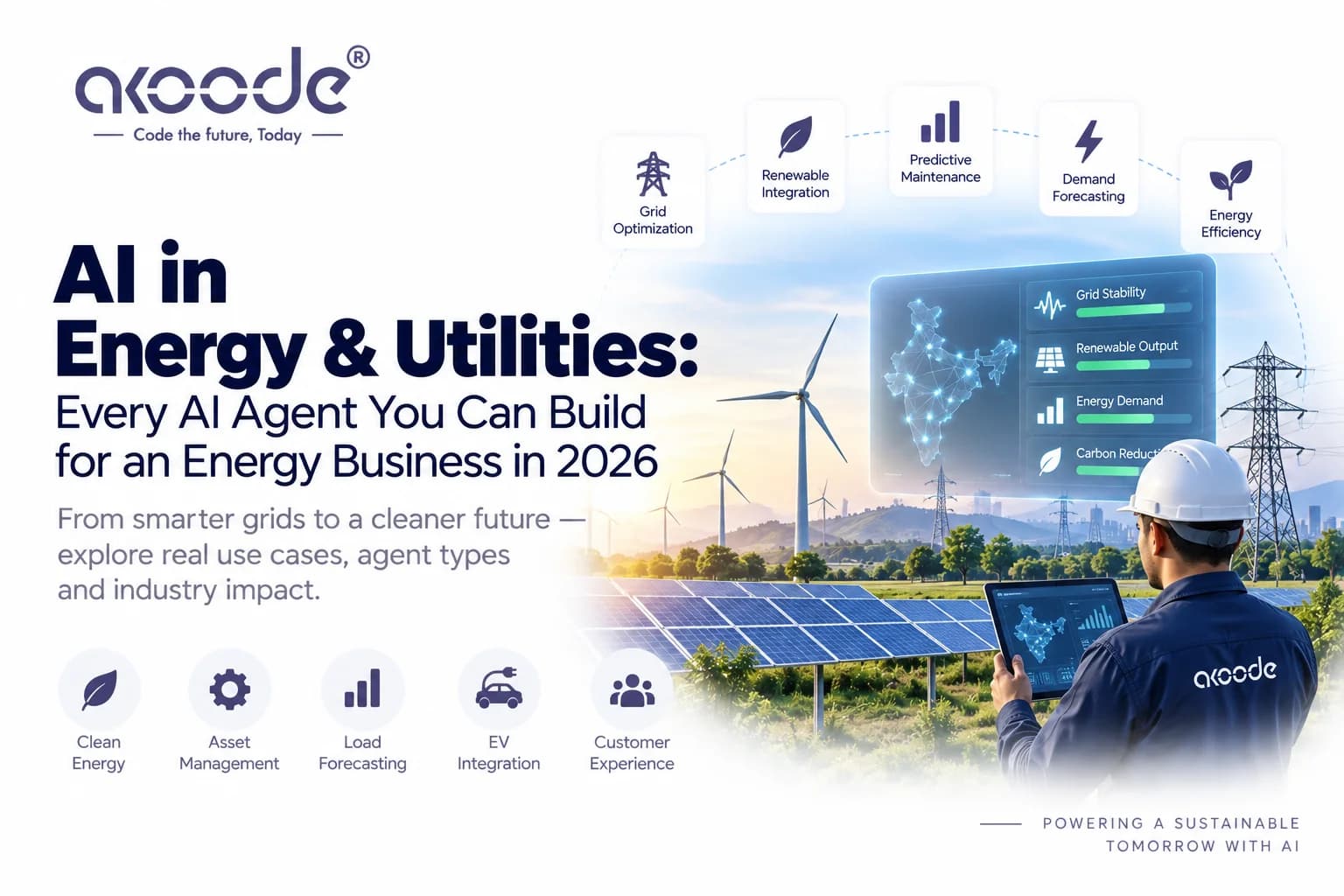
Energy and utilities is undergoing a structural shift that has nothing to do with AI hype and everything to do with physics: grids built for one-way power flow from a handful of large plants now have to manage millions of rooftop solar installations, batteries, and EV chargers pushing power in every direction, on infrastructure where, in the US alone, more than 70% of transmission lines are already over 25 years old. AI is becoming the layer that makes a grid this complex operable in real time, and the industry's own investment intentions reflect how urgent that's become. This guide covers what AI in energy and utilities actually means in 2026, every category of AI agent a utility, renewable energy company, grid operator, or energy-tech business can realistically build, how they're engineered, and what's different about building for Gurgaon/NCR, India, and global markets.
Why Energy and Utilities Is Moving From Pilot to Control-Room Reality
Market sizing for AI in energy and utilities is inconsistent across analyst firms, as it is for most fast-moving categories — 2026 estimates range from roughly $6 billion to over $20 billion depending on scope, with most projections agreeing on a CAGR above 20% through the early 2030s regardless of which number is used as the baseline. What's far more telling than the market-size range is utility leadership's own stated intent: Gartner reports that 94% of power and utility CIOs plan to increase AI investment in the near term, with an average planned spending increase above 38%, and Gartner separately projects that 40% of power and utility control rooms will deploy AI-driven operators by 2027 — a genuinely fast timeline for an industry historically associated with cautious, multi-year technology adoption cycles.
The documented operational results explain why utilities are moving this fast. E.ON's research suggests predictive maintenance can reduce grid outages by up to 30% compared to scheduled maintenance, Enel's sensor-and-machine-learning approach has cut power outages on monitored cables by 15%, and transmission and distribution utilities are seeing 10-20% savings in asset management through advanced analytics. A genuinely new driver has entered the picture in 2026 specifically: AI data centers themselves are becoming one of the largest new sources of electricity demand utilities have ever had to plan for, and Siemens announced roughly $1 billion in grid-manufacturing capacity expansion in the US in February 2026 explicitly to address the surge in electricity demand from digital infrastructure and AI data centers — meaning AI is simultaneously the technology utilities are adopting internally and one of the biggest external forces reshaping how much power they need to deliver.
India's energy sector is scaling on an enormous and distinct trajectory. India's power capacity has crossed 500 GW, with non-fossil fuel sources now accounting for more than 51% of total installed capacity, and the country is targeting 500 GW of non-fossil capacity by 2030 under initiatives like "One Sun, One World, One Grid." The Revamped Distribution Sector Scheme has driven real, measurable improvement in distribution company performance — aggregate technical and commercial losses have fallen from nearly 22% in 2021 to 15.04% in 2025 — but real structural strain remains: roughly 40 GW of auctioned renewable capacity currently sits without signed power purchase agreements because financially stressed distribution companies are hesitant to commit, and grid evacuation constraints mean renewable projects are increasingly completed physically before the transmission infrastructure to actually move that power exists. AI-linked data center investment in India, projected past $200 billion with installed capacity reaching 8-10 GW by 2030, is now directly reshaping the renewable-energy financing conversation, since hyperscalers' investment-grade balance sheets are making it easier for renewable developers to raise debt than relying on financially stressed state distribution companies alone. Gurgaon sits at a genuine center of this shift: ReNew Energy Global, one of India's largest renewable energy companies and the first Indian renewable energy company listed on Nasdaq, is headquartered in Gurgaon, alongside Sembcorp Green Infra (over 7.6 GW of wind and solar capacity) and OMC Power, a distributed energy and microgrid company — making Gurgaon a genuine renewable-energy business hub, not just a general tech city with an energy company or two.
What "AI in Energy & Utilities" Actually Means
AI in energy and utilities spans four connected operational domains, and each carries a different priority: grid operations (load balancing, outage management, control-room automation — where reliability is the core mandate), asset health (predictive maintenance for generation, transmission, and distribution infrastructure — where AI's ROI is most measurable), renewable and distributed energy integration (forecasting, storage optimization, virtual power plants — the fastest-growing category as the grid becomes more decentralized), and customer and revenue (smart meter analytics, demand response, loss detection — where AI directly protects utility revenue and improves customer experience).
An AI agent, in this context, owns a defined task end-to-end within one of these domains — not a dashboard showing an anomalous sensor reading, but a system that pinpoints the fault location and dispatches the right crew with the diagnosis already attached; not a solar-output forecast sitting in a report, but an agent that actively adjusts battery dispatch to smooth the variability that forecast predicts.
The Complete List: AI Agents You Can Build for an Energy or Utilities Business
Grid Operations and Control Room Agents
Self-healing grid and fault-restoration agent. Automatically detects, isolates, and reroutes power around a fault, restoring service to unaffected sections of the grid without waiting for a full manual diagnosis — the core capability behind the 15-30% outage reductions utilities are already documenting from mature deployments.
Load balancing and demand forecasting agent. Continuously predicts and balances electricity demand across the grid using weather, historical consumption, and real-time smart meter data, feeding directly into generation dispatch and storage decisions.
AI control-room copilot agent. Assists grid operators by synthesizing sensor data, flagging anomalies, and recommending operator actions in real time — the exact category Gartner expects to reach 40% of power and utility control rooms by 2027, reflecting how central this has become to modern grid operations rather than a specialist add-on.
Outage prediction and crew-dispatch agent. Predicts likely outage locations from weather and grid-condition data and pre-positions or dispatches crews proactively, converting outage response from reactive to anticipatory.
Predictive Maintenance and Asset Health Agents
Transmission and distribution asset predictive-maintenance agent. Analyzes sensor and inspection data from transformers, substations, and line equipment to predict failure before it causes an outage, delivering the 10-20% asset-management savings and outage reductions utilities are already reporting from advanced analytics deployments.
Wind turbine health-monitoring agent. Analyzes vibration, thermal, and acoustic sensor data from turbines to predict blade erosion, gearbox degradation, and generator faults before a physical inspection would catch them, avoiding the cost and risk of unnecessary technician climbs or helicopter inspections.
Solar performance and fault-detection agent. Uses thermal imaging and performance-monitoring data to identify underperforming panels, inverter faults, and wiring issues before they cause material energy-output losses, a category increasingly essential as utility-scale and rooftop solar capacity scales rapidly.
Vegetation management and wildfire-risk agent. Analyzes satellite and drone imagery to identify vegetation encroachment near transmission lines that could cause an outage or, in fire-prone regions, ignite a wildfire — a category with direct safety and liability stakes for utilities operating in high-risk terrain.
Renewable Integration and Storage Agents
Renewable generation forecasting agent. Predicts solar and wind output using weather models, satellite data, and historical generation patterns, feeding directly into grid-balancing and storage-dispatch decisions that become substantially harder to make accurately as renewable penetration increases.
Battery and energy-storage optimization agent. Continuously optimizes battery charge and discharge cycles to smooth renewable variability and capture the highest-value moments for storage dispatch, directly addressing the real limitation that renewable generation without adequate storage support significantly reduces the usable value of clean power.
Virtual power plant (VPP) orchestration agent. Coordinates distributed energy resources — rooftop solar, home batteries, EV chargers — across thousands of individual sites as a single, dispatchable resource, an increasingly critical capability as grids become genuinely decentralized rather than centrally generated.
Distributed energy resource (DER) management agent. Manages the interconnection, monitoring, and grid-impact assessment of distributed generation and storage assets at scale, a category with outsized relevance for utilities managing rapidly rising rooftop solar and net-metering volumes.
EV charging grid-integration agent. Manages EV charging load to avoid local grid overload while optimizing for renewable availability and off-peak pricing, coordinating a rapidly growing and highly variable new demand category.
Customer and Revenue Agents
Smart meter data analytics agent. Processes high-frequency smart meter data to identify consumption patterns, detect anomalies, and generate personalized usage insights, turning a data stream most utilities already collect but underutilize into an operational and customer-facing asset.
Energy theft and non-technical loss detection agent. Identifies patterns consistent with meter tampering, unauthorized connections, and billing anomalies, directly relevant to the technical and commercial loss reduction that's become a central performance metric for utilities under India's distribution-sector reform programs specifically.
Demand response optimization agent. Identifies and engages the customers and loads best suited to shift or reduce consumption during peak periods, executing demand-response programs dynamically rather than through blanket, one-size-fits-all appeals.
Conversational customer service and billing agent. Handles billing questions, outage reporting, and account management across chat and voice, reducing call-center volume during the high-stress moments — a major outage, a billing dispute — when customers most need a fast, accurate response.
Personalized energy-efficiency advisory agent. Analyzes a customer's usage pattern to recommend specific, actionable efficiency improvements, moving beyond a generic monthly usage comparison toward genuinely individualized guidance.
Trading, Markets, and Compliance Agents
Energy trading and price-forecasting agent. Predicts wholesale energy price movements and informs trading and hedging strategy using weather, demand, and generation-mix data, a category with direct financial stakes for any utility or energy company participating in wholesale markets.
Power purchase agreement (PPA) and capacity-matching agent. Matches renewable generation capacity with buyers and structures contract terms, an increasingly important category given how much auctioned renewable capacity in markets like India currently sits without a signed PPA due to counterparty credit concerns.
Grid cybersecurity and OT security agent. Monitors operational technology networks for anomalous activity that could indicate a cybersecurity intrusion, a non-negotiable requirement as grid infrastructure becomes more connected and exposes a larger attack surface than the largely isolated control systems of a decade ago.
Emissions tracking and regulatory-compliance agent. Tracks emissions data and automates regulatory reporting obligations, increasingly relevant as environmental disclosure requirements tighten across major markets and as utilities pursue decarbonization targets that require genuine, auditable tracking rather than periodic estimation.
Orchestration: When Multiple Agents Run the Same Grid
The utilities and energy companies capturing the most value from AI aren't running isolated point tools — they're connecting agents across grid operations and customer experience simultaneously: a renewable-forecasting agent predicts a drop in solar output, a storage-optimization agent adjusts battery dispatch to compensate, a demand-response agent engages flexible loads to smooth the remaining gap, and a control-room copilot surfaces the whole sequence to a human operator as one coherent recommendation rather than four separate alerts that the operator has to mentally connect themselves. This connected approach is what actually makes a modern, renewable-heavy grid operable at the speed real-time balancing now requires.
How These Agents Are Actually Built
The underlying architecture is consistent across every agent type above, with the data sources and models swapped per use case:
A large language model (GPT, Claude, or Gemini class, selected per use case) handles the language and reasoning layer — powering control-room copilots, customer service agents, and compliance-report generation.
Specialized forecasting and anomaly-detection models — time-series models for demand and renewable-output forecasting, anomaly-detection models for asset health and fraud — handle the tasks that require statistical rigor a general-purpose language model isn't built to provide, particularly for real-time grid telemetry.
IoT and SCADA integration connects the agent to live sensor data from smart meters, substations, turbines, and grid infrastructure, grounding every recommendation in real, current conditions rather than a historical average.
Retrieval-augmented generation (RAG) grounds customer-service and compliance agents in a customer's actual account data or a utility's actual current regulatory obligations, rather than answering from generic policy knowledge.
A safety and guardrail layer is the layer that matters most distinctly here: any agent that can actually act on grid infrastructure — rerouting power, adjusting storage dispatch — needs guardrails that prevent an unsafe autonomous action, while an agent recommending a course of action for human sign-off carries a materially lower but still real reliability bar.
This is where energy AI engineering diverges most sharply from most other industries: grid infrastructure failures have real safety consequences, which means the functional-safety and fail-safe design discipline this category demands is closer to what's required in aviation or medical devices than what most enterprise software AI needs to meet.
Building AI Agents for Energy Businesses in Gurgaon and the NCR
Gurgaon hosts a genuine concentration of major renewable energy companies, and a few things are specific to building here:
ReNew Energy Global, one of India's largest renewable energy companies and the first Indian renewable energy company listed on Nasdaq, is headquartered in Gurgaon, alongside Sembcorp Green Infra's more than 7.6 GW of wind and solar capacity and OMC Power's distributed microgrid business — making renewable-generation forecasting, asset health monitoring, and PPA-matching AI a genuinely strong local build category.
DISCOM performance and AT&C loss reduction is an active national priority under India's distribution-sector reform programs, making energy-theft detection and smart meter analytics agents a practical, measurable-ROI build for any NCR-based utility technology company.
Grid evacuation and renewable-integration constraints — a documented national challenge where completed renewable capacity sits stranded behind transmission bottlenecks — creates real demand for grid-capacity forecasting and DER management tools among the renewable developers concentrated in Gurgaon specifically.
Data center and AI infrastructure electricity demand is becoming a genuine local planning consideration given the scale of announced AI-linked infrastructure investment in India, which is starting to reshape how NCR-based energy companies think about long-term capacity and grid-integration planning.
Building for the Indian Market Broadly
Beyond Gurgaon's renewable-energy concentration, three things matter for AI energy agents built for the wider Indian market: DISCOM financial stress is a structural constraint that any India-focused energy AI platform needs to design around, since agents that help distribution companies improve billing efficiency and reduce technical losses address a genuinely acute pain point rather than a marginal optimization; grid evacuation and transmission-capacity forecasting matter more here than in most developed markets, given how much completed renewable capacity in India currently can't fully deliver its output due to transmission bottlenecks; and rural and semi-urban smart-meter rollout is still in progress under national reform programs, which means demand-response and consumption-analytics agents need to work with partial smart-meter coverage rather than assuming universal high-frequency data availability the way a mature Western utility deployment might.
Building for a Global Market
For energy and utilities businesses operating internationally, the same agent categories apply, but the regulatory and infrastructure context shifts: aging grid infrastructure is a defining constraint in mature markets like the US, where more than 70% of transmission lines are already over 25 years old, making predictive maintenance and asset-health AI a particularly high-value category; wholesale market participation with system operators like PJM and CAISO in North America requires AI trading and forecasting agents built for specific, regulated market structures; and the surging electricity demand from AI data centers themselves is reshaping capacity planning and grid-investment priorities in every major market simultaneously, creating a genuinely new category of demand-forecasting work utilities haven't had to account for at this scale before.
What to Actually Prioritize First
Not every energy or utilities business needs the full stack above on day one. A practical build sequence for most utilities, renewable developers, and energy-tech businesses:
Predictive maintenance on highest-value assets — because it's the most mature, best-documented use case, with clear outage-reduction and cost-savings data to model ROI against.
Renewable generation forecasting and demand forecasting — because it's foundational to every downstream grid-balancing and storage decision, and the ROI compounds as renewable penetration increases.
Smart meter analytics and loss detection — because it directly protects revenue with a clear, measurable financial return, particularly relevant for utilities focused on DISCOM performance improvement.
Conversational customer service and demand response — because it improves customer experience during high-stress moments while directly supporting grid-balancing goals.
Control-room copilots and virtual power plant orchestration — the highest-value but most operationally complex category, appropriate once a utility has real production experience with the lower-complexity agents above.
Proof This Works
Akoode hasn't yet published an energy or utilities-specific case study, and it's more useful to say that plainly than to stretch an unrelated project to fit. What does carry over directly is the core engineering discipline this category depends on: real-time data processing at scale and the guardrail-conscious system design that any agent touching physical infrastructure requires. If energy or utilities AI is what you're evaluating a partner for, the questions below will tell you more than a case study from an unrelated industry would about whether a team actually understands the safety and reliability bar this sector runs at.
Choosing a Partner to Build This
A few questions separate a real energy AI engineering partner from a generic AI vendor applying an energy label:
Can they explain how their agent's guardrails prevent an unsafe autonomous action on physical grid infrastructure, not just "we have safety checks"?
Have they integrated with real SCADA or smart meter data systems, not just built a demo against sample sensor data?
Do they understand the difference between grid-operations AI, which requires real-time reliability with safety consequences, and customer-facing AI, which has a different but equally real accuracy and trust bar?
Can they show experience with renewable-forecasting or asset-health models validated against real generation or failure data, not a generic industry benchmark?
Do they have a clear answer for how their agent would work with India's DISCOM-specific constraints — partial smart-meter coverage, financially stressed distribution companies — if that's the market you're serving?
Where to Start
AI in energy and utilities is moving from pilot projects to genuinely load-bearing infrastructure — control-room copilots, self-healing grids, and virtual power plants that coordinate thousands of distributed assets as one resource. The businesses pulling ahead in 2026 — in Gurgaon's renewable-energy corridor, across India's rapidly transforming and reform-driven power sector, and globally — are the ones connecting grid operations, asset health, and customer systems into one coordinated platform, not treating each as a separate problem for a separate team.
Akoode has delivered AI-powered and real-time data platforms for clients across India, the UK, and the USA, with a 4.9 Google rating from 110+ reviews and a 97% client retention rate. If you're scoping an AI agent — or a full agent portfolio — for a utility, renewable energy company, grid operator, or energy-tech business, book time with Akhil Verma, Founder & CEO of Akoode, and bring a short brief on what you're building. The first call is where we map which agents matter most for your grid and your customers, not a generic list.
If you're evaluating AI agents across more than one industry, see our companion guides on AI agents for real estate, AI agents for travel and hospitality, AI agents for retail and e-commerce, AI agents for healthcare, AI agents for finance and banking, AI agents for logistics and supply chain, AI agents for manufacturing, AI agents for insurance, AI agents for media and entertainment, AI agents for automotive, AI agents for agriculture, and AI agents for telecommunication.
Frequently Asked Questions
What AI agents can an energy or utilities business build? Energy and utilities businesses can build self-healing grid agents, predictive maintenance agents for transmission and generation assets, renewable generation forecasting agents, battery storage optimization agents, virtual power plant orchestration agents, smart meter analytics agents, and energy trading agents, each owning a distinct part of grid operations or customer management.
How much can AI actually reduce grid outages? Documented deployments show predictive maintenance reducing grid outages by up to 30% compared to scheduled maintenance approaches, with sensor-and-machine-learning monitoring reducing outages on monitored cables by around 15% in other reported deployments.
Why is AI adoption accelerating so fast in utilities specifically in 2026? Aging infrastructure, rising renewable and distributed energy penetration that makes manual grid balancing impractical, and a new wave of electricity demand from AI data centers themselves are combining to make AI-driven grid automation an operational necessity rather than an optional efficiency improvement.
What makes AI agent development different for Gurgaon and NCR energy businesses? Gurgaon hosts ReNew Energy Global, one of India's largest renewable energy companies, alongside Sembcorp Green Infra and OMC Power, making renewable-generation forecasting, asset health monitoring, and PPA-matching AI particularly strong local build categories.
Will AI replace grid operators and utility field technicians? Current evidence points toward augmentation rather than replacement. AI is absorbing routine fault diagnosis, forecasting, and anomaly detection, while operators and technicians retain final decisions on genuinely ambiguous or safety-critical situations.
How is India's DISCOM financial stress affecting AI adoption in the power sector? DISCOM financial stress is accelerating AI adoption in areas with direct revenue impact, such as smart meter analytics and energy theft detection, since these directly address the technical and commercial losses that reform programs are specifically targeting.
Which AI agent should an energy business build first? Most utilities and energy companies see the fastest, best-documented return from predictive maintenance on their highest-value assets, since the ROI is easiest to model against existing outage and maintenance-cost data, followed by renewable generation and demand forecasting.
Get In Touch Now
View More Our Blog