


 September 20, 2026
A student used to hit a wall on a math problem, wait until the next class to ask, and often just move on without ever actually understanding the concept. Today the same student asks an AI tutor at 11 p.m., gets an explanation pitched exactly to where their understanding breaks down, and works through three more practice problems before bed. The teacher still designs the curriculum and makes the judgment calls a student's actual growth requires. The wait until tomorrow for a question that could have been answered tonight mostly isn't necessary anymore.
Education is one of the few industries where AI adoption on the ground has genuinely outpaced institutional policy — 88% of students globally already use AI in their learning, while only 18% of US K-12 teachers report having any formal written guidance on how to use it themselves. That gap between grassroots adoption and institutional readiness is exactly the opportunity for education businesses building real, well-designed AI systems rather than students improvising with a general-purpose chatbot on their own. This guide covers what AI in education and e-learning actually means in 2026, every category of AI agent a school, university, EdTech platform, or corporate training business can realistically build, how they're engineered, and what's different about building for Gurgaon/NCR, India, and global markets.
Why Education AI Adoption Is Moving Faster From the Bottom Up Than the Top Down
Market sizing for AI in education is inconsistent across analyst firms, as it is across most fast-moving categories — 2026 estimates range from roughly $8.7 billion to $11.4 billion, with most forecasts agreeing on a CAGR in the 25-40% range through the early 2030s and projections landing anywhere from $32 billion to over $130 billion by the mid-2030s depending on scope. What's far more consistent — and more telling — is adoption on the ground: 88% of students and 77% of faculty across 35 countries now use AI in learning or teaching in some form, 47% of higher education institutions report using AI structurally in teaching and administration, and 83% of institutions surveyed plan to deploy some form of AI teaching assistant by the end of 2026.
The documented impact where AI has been deployed well is genuinely strong. Adaptive learning platforms improve student outcomes by an average of 23%, with some deployments — Carnegie Learning's MATHia platform, studied across more than a million students — showing improvements as high as 42%. Teachers using AI tools at least weekly save an average of 5.9 hours a week, equivalent to roughly six weeks over a school year, and AI-powered tutoring platforms now serve over 85 million students worldwide. The honest complication worth naming directly: 71% of educators cite data privacy and algorithmic bias as top concerns, and EdTech venture funding actually declined in early 2026 — a signal the market is maturing past hype toward businesses that can demonstrate genuine learning outcomes, not just engagement metrics.
India's education technology sector is scaling on the back of a deliberate, large-scale national policy push rather than market forces alone. The National Education Policy 2020 and the National Curriculum Framework 2023 have driven direct AI integration into the school curriculum: CBSE now offers a 15-hour AI skill module from Class VI onward and AI as an optional subject for Classes IX-XII, NCERT has incorporated AI content into Class XI Computer Science textbooks, and — in a genuinely striking example of AI applied to educational access — NCERT used AI and machine learning to translate Grade 1-2 textbooks into 22 Indian languages. DIKSHA, the Ministry of Education's national digital learning platform, uses AI specifically for inclusivity: AI-based keyword search inside video lessons and a read-aloud feature for visually impaired students. Gurgaon and the wider NCR host a genuine and growing EdTech presence: DeltaView Technologies, a smart-classroom hardware and AI company, is headquartered in Gurugram, and Physics Wallah — one of India's most disruptive EdTech unicorns, which completed its IPO in November 2025 — is headquartered in neighboring Noida and has built "Alakh AI," an in-house AI personal tutor delivering personalized learning and instant doubt resolution to millions of students, a concrete, already-live example of exactly the kind of AI tutoring agent this guide covers.
What "AI in Education" Actually Means
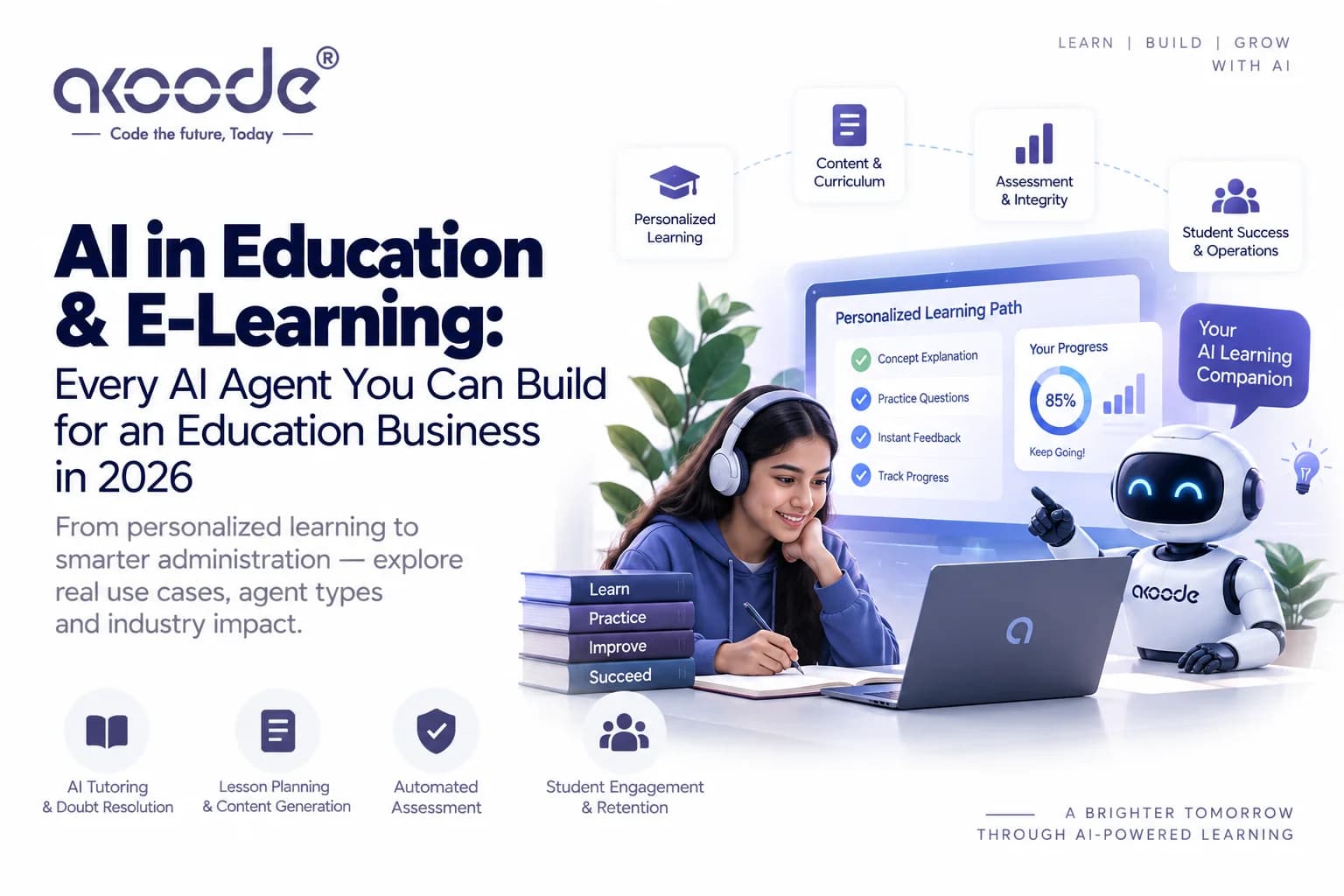
AI in education spans work across the full learning lifecycle, and each stage calls for a different kind of agent: personalized learning (adaptive content, tutoring, doubt resolution — the category with the most documented outcome improvement), content and curriculum (lesson planning, content generation, localization — where AI compresses the most time-consuming teacher and institution work), assessment and integrity (grading, plagiarism detection, proctoring — where trust and fairness matter as much as accuracy), and student success and operations(engagement analytics, dropout prediction, admissions, career guidance — where AI turns institutional data into proactive intervention rather than a lagging report).
An AI agent, in this context, owns a defined task end-to-end within one of these areas — not a dashboard flagging a student's declining engagement, but a system that triggers the right intervention before that student actually falls behind; not a chatbot answering a generic FAQ, but a tutor that identifies exactly where a specific student's understanding breaks down and adapts its explanation accordingly.
The Complete List: AI Agents You Can Build for an Education or E-Learning Business
Personalized Learning and Tutoring Agents
Adaptive learning path agent. Continuously adjusts content difficulty and sequencing based on a student's actual demonstrated mastery, the core mechanism behind the 23-42% outcome improvements documented across large-scale adaptive learning deployments.
AI tutoring and doubt-resolution agent. Provides instant, conversational explanation and practice support pitched to where a specific student's understanding actually breaks down, the same category of agent already live at national scale in India through Physics Wallah's Alakh AI tutor.
Intelligent content-recommendation agent. Surfaces the specific lesson, practice set, or resource a student needs next based on their actual performance data, rather than a fixed, one-size-fits-all course sequence.
Accessibility and inclusive-learning agent. Provides read-aloud, keyword search inside video content, and other accessibility features for students with visual, auditory, or learning-difference needs — directly modeled on the accessibility features India's national DIKSHA platform has already built into public digital learning infrastructure.
Multilingual and regional-language tutoring agent. Delivers instruction and doubt resolution in a student's native language, essential for reaching learners beyond English-first, urban populations — the same problem NCERT addressed at national scale by using AI to translate early-grade textbooks into 22 Indian languages.
Content and Curriculum Agents
AI curriculum and lesson-content generation agent. Generates lesson plans, practice questions, and instructional content from a curriculum framework, directly addressing the multi-hour weekly time savings teachers using AI tools already report.
Teacher-assistant and lesson-planning agent. Assists educators with lesson planning, differentiation for mixed-ability classrooms, and administrative tasks, freeing teacher time for actual instruction and student interaction rather than preparation overhead.
Content localization and translation agent. Adapts existing curriculum content into new languages and cultural contexts at scale, a category with outsized value for any education business serving a linguistically diverse population, in India or globally.
Video and multimedia content-generation agent. Compresses course-video production timelines that traditionally take dozens of hours down to a fraction of that, a documented, high-adoption use case among instructors building digital-first course content.
Assessment and Integrity Agents
Automated grading and feedback agent. Grades assignments and provides substantive, individualized feedback at a speed and consistency no manual grading process at scale can match, freeing instructor time for the feedback conversations that genuinely need a human.
Plagiarism and AI-content detection agent. Identifies unoriginal or AI-generated content in student submissions, a category that's become significantly more complex — and more necessary — as generative AI writing tools have become nearly universal among students.
Exam proctoring and integrity-monitoring agent. Monitors online assessments for integrity violations using behavioral and environmental signals, balancing genuine academic-integrity needs against student privacy concerns that educators and regulators are actively debating.
Skills and competency-assessment agent. Evaluates a learner's actual competency against a skills framework, increasingly important for corporate training and vocational education where the goal is verified capability, not just course completion.
Student Success and Institutional Operations Agents
Dropout-risk and early-warning agent. Analyzes engagement, attendance, and performance signals to flag students at risk of disengaging or dropping out early enough for a genuine intervention, rather than discovering the problem only after a student has already withdrawn.
Student engagement analytics agent. Tracks learning-platform engagement patterns to identify what's working and what isn't at a course or content-module level, informing continuous curriculum improvement rather than a single end-of-term review.
Admissions and enrollment-support agent. Handles prospective student inquiries, application guidance, and enrollment logistics conversationally, reducing the response-time lag that often determines whether a prospective student actually completes an application.
Conversational LMS and student-support agent. Answers routine student questions about course logistics, deadlines, and platform navigation across chat, reducing support-ticket volume for institutional support teams.
Career counseling and pathway-guidance agent. Recommends academic and career pathways based on a student's interests, performance, and labor-market data, particularly valuable as career guidance has historically been one of the most under-resourced services in large institutions.
Corporate Training and Higher Education Agents
Corporate upskilling and learning-path agent. Designs personalized professional-development pathways based on an employee's role, skill gaps, and career trajectory, a fast-growing category as corporate learning and development functions adopt the same AI-personalization logic K-12 and higher-ed platforms have pioneered.
Compliance-training tracking agent. Manages mandatory compliance-training assignment, completion tracking, and reporting across an organization, removing a genuine administrative burden from corporate L&D teams.
Alumni and donor-engagement agent. Personalizes outreach and identifies engagement opportunities across an institution's alumni base, a category with direct fundraising and community-building value for higher-education institutions specifically.
Orchestration: When Multiple Agents Work the Same Student Journey
The education businesses seeing the most value from AI aren't deploying isolated point tools — they're connecting agents across a learner's journey: an adaptive-learning agent adjusts content difficulty in real time, a dropout-risk agent flags a student whose engagement is slipping before a grade reflects it, a tutoring agent proactively offers support on the specific concept the student is struggling with, and a career-guidance agent uses the accumulated performance data to inform a genuinely personalized pathway recommendation — all working off the same student record rather than five disconnected platforms a student or teacher has to navigate separately.
How These Agents Are Actually Built
The underlying architecture is consistent across every agent type above, with the data sources and models swapped per use case:
A large language model (GPT, Claude, or Gemini class, selected per use case) handles the conversational and reasoning layer — powering tutoring, doubt resolution, feedback generation, and lesson-content drafting.
Specialized assessment and analytics models — grading-consistency models, engagement-prediction models for dropout risk — handle the tasks that require statistical rigor and fairness auditing a general-purpose language model can't reliably provide on its own, particularly for anything that influences a grade or an academic-standing decision.
Retrieval-augmented generation (RAG) grounds tutoring and content agents in the actual curriculum, textbook, and course material a student is studying, rather than answering from generic subject knowledge that may not match what's actually being taught.
LMS and student-information-system integrations connect the agent to the systems that actually hold enrollment, performance, and course data, since an agent that can't read from or write to a school or platform's real student records isn't usable in a genuine institutional workflow.
A fairness, privacy, and academic-integrity guardrail layer matters more distinctly in education than in most other industries: any agent influencing a grade, a plagiarism flag, or a proctoring decision needs auditable, explainable logic and a clear appeal path, since these decisions carry real academic and, in some cases, legal consequences for a student.
This is where education AI engineering diverges from most other industries: the technical build is often the easier half. Getting the fairness, privacy (particularly for minors), and academic-integrity architecture right — with genuine transparency for students, parents, and educators — is what actually determines whether an institution trusts a system enough to deploy it at scale.
Building AI Agents for Education Businesses in Gurgaon and the NCR
Gurgaon and the wider NCR aren't India's largest EdTech hub — that concentration sits mainly in Bangalore, home to platforms like BYJU'S, Unacademy, and Vedantu — but the region has a genuine and specific role worth being accurate about:
DeltaView Technologies, a smart-classroom hardware and AI company, is headquartered in Gurugram, reflecting a local strength in classroom-technology and hardware-integrated AI rather than pure content-platform EdTech.
Physics Wallah, one of India's most disruptive EdTech unicorns, is headquartered in neighboring Noida within the NCR, and its Alakh AI tutor is a concrete, already-scaled example of the AI tutoring category covered in this guide — a strong local proof point for what a well-built AI tutor can achieve at national scale.
Corporate training and L&D technology has a strong natural fit in Gurgaon specifically, given the density of large enterprise headquarters in the corridor, making corporate upskilling and compliance-training AI a practical local build category alongside K-12 and higher-ed platforms.
Multilingual content localization matters for any NCR-based education platform aiming for reach beyond an English-first, urban audience, following the same 22-language translation model India's own national curriculum body has already proven at scale.
Building for the Indian Market Broadly
Beyond NCR's specific positioning, three things matter for AI education agents built for the wider Indian market: NEP 2020 and NCF 2023 alignment is increasingly a practical requirement for any platform serving schools directly, since AI content and curriculum tools that don't map to the national framework face a real adoption barrier in the government and institutional segment; regional-language support is essential given how much of India's next wave of digital learners are outside English-first, urban populations; and low-bandwidth, mobile-first design matters more here than in most developed education markets, since a large share of India's students access learning platforms primarily through mobile devices with inconsistent connectivity, a constraint most Western-designed EdTech platforms weren't built to handle gracefully.
Building for a Global Market
For education businesses operating internationally, the same agent categories apply, but the regulatory and infrastructure context shifts substantially: FERPA and state-level student-privacy statutes in the US create a genuinely fragmented compliance landscape that any student-data-handling agent needs to navigate market by market, the EU AI Act imposes conformity-assessment requirements on AI-enabled educational tools that shape vendor certification pathways across Europe, and GDPR governs how European institutions can use student data in personalization and analytics models. Higher education institutions and large K-12 districts in mature markets also increasingly evaluate AI vendors on demonstrated learning-outcome data specifically, not engagement metrics alone, reflecting the same maturation signal visible in declining EdTech venture funding even as adoption itself keeps climbing.
What to Actually Prioritize First
Not every education business needs the full stack above on day one. A practical build sequence for most schools, universities, EdTech platforms, and corporate training businesses:
AI tutoring and doubt resolution — because it's the most mature, best-documented use case with proven outcome improvements, and directly addresses the gap between student demand and current institutional support capacity.
Content and lesson-planning generation — because it's low-risk, delivers immediate time savings, and doesn't touch anything that influences a grade or academic standing.
Automated grading and feedback — once the content foundation is stable, because it removes a genuine instructor bottleneck while keeping the fairness and appeal architecture central to the design.
Dropout-risk and engagement analytics — because early intervention has outsized impact on student retention and outcomes relative to its implementation complexity.
Proctoring and academic-integrity systems — the highest-value but most privacy-sensitive category, appropriate only once the fairness and transparency architecture is genuinely in place, not as an afterthought.
Proof This Works
Akoode hasn't yet published an education-specific case study, and it's more useful to say that plainly than to stretch an unrelated project to fit. What does carry over directly is the engineering discipline education AI depends on most: conversational AI systems that need to work reliably across genuinely varied user needs, and multilingual, accessibility-conscious product design — the same core capabilities a tutoring or accessible-learning agent depends on, applied to a different domain. If education AI is what you're evaluating a partner for, the questions below will tell you more than a case study from an unrelated industry would.
Choosing a Partner to Build This
A few questions separate a real education AI engineering partner from a generic AI vendor applying an EdTech label:
Can they explain how their tutoring or grading agent handles fairness and provides an appeal path for a student who disputes an AI-influenced decision?
Do they understand FERPA, India's DPDP Act, or the relevant student-privacy framework for your market, particularly given how much of the user base in education is minors?
Have they built genuinely multilingual, low-bandwidth-tolerant systems, or does "multilingual" mean a translation layer bolted onto an English-first product?
Can they show a working example of an AI system grounded in real curriculum content, not a demo answering from generic subject-matter knowledge?
Do they have a clear answer for how their agent's outputs are validated against actual learning-outcome data, not just engagement or usage metrics?
Where to Start
AI in education has already outpaced institutional policy — students and educators are using it whether or not a formal system exists to support them well. The education businesses pulling ahead in 2026 — in Gurgaon and Noida's growing EdTech corridor, across India's policy-driven national AI-in-education push, and globally — are the ones building genuinely well-designed, fair, and outcome-validated systems, not chasing engagement metrics that don't translate into real learning.
Akoode has delivered AI-powered and conversational platforms for clients across India, the UK, and the USA, with a 4.9 Google rating from 110+ reviews and a 97% client retention rate. If you're scoping an AI agent — or a full agent portfolio — for a school, university, EdTech platform, or corporate training business, book time with Akhil Verma, Founder & CEO of Akoode, and bring a short brief on what you're building. The first call is where we map which agents matter most for your learners, not a generic list.
If you're evaluating AI agents across more than one industry, see our companion guides on AI agents for real estate, AI agents for travel and hospitality, AI agents for retail and e-commerce, AI agents for healthcare, AI agents for finance and banking, AI agents for logistics and supply chain, AI agents for manufacturing, AI agents for insurance, AI agents for media and entertainment, AI agents for automotive, AI agents for agriculture, AI agents for telecommunication, and AI agents for energy and utilities.
Frequently Asked Questions
What AI agents can an education or e-learning business build? Education businesses can build adaptive learning agents, AI tutoring agents, curriculum and content-generation agents, automated grading agents, plagiarism detection agents, dropout-risk prediction agents, admissions-support agents, and career-counseling agents, each owning a distinct part of the learning lifecycle.
Does AI tutoring actually improve student outcomes? Yes, with strong documented evidence. Adaptive learning platforms show an average 23% improvement in student outcomes, with some deployments studied across more than a million students showing improvements as high as 42%.
Will AI replace teachers? Current evidence points toward augmentation rather than replacement. Teachers using AI tools weekly save an average of 5.9 hours, time redirected toward instruction and student interaction, while curriculum design, mentorship, and judgment calls about individual student needs remain teacher-led.
What makes AI agent development different for Gurgaon and NCR education businesses? Gurgaon and the NCR aren't India's largest EdTech hub, but the region hosts DeltaView Technologies (smart-classroom hardware, Gurugram) and neighbors Physics Wallah (Noida), whose Alakh AI tutor is a proven, scaled example of AI tutoring already live in the Indian market, alongside a strong local fit for corporate training AI given NCR's enterprise density.
How is India's National Education Policy shaping AI adoption in schools? NEP 2020 and NCF 2023 have driven direct AI integration into the curriculum, including a CBSE AI skill module from Class VI and AI as an optional subject for Classes IX-XII, while national platforms like DIKSHA already use AI for accessibility features like read-aloud and multilingual textbook translation.
What is the biggest risk in deploying AI in education specifically? Fairness and student-data privacy are the two risks with the most direct institutional and legal exposure, particularly given how much of education's user base is minors, which is why 71% of educators cite data privacy and algorithmic bias as their top AI concerns.
Which AI agent should an education business build first? Most education and EdTech businesses see the fastest, most well-documented return from AI tutoring and doubt resolution, given the strong outcome data already available, followed by content and lesson-planning generation for teacher time savings.
Get In Touch Now
View More Our Blog