


 September 15, 2026
A dispatcher used to plan routes on a whiteboard, call drivers individually when a delivery window slipped, and find out about a stockout the same day a customer complained about it. Today an AI agent replans a route the moment traffic data shifts, notifies the affected customer before they have to ask, and flags the stockout three days before it happens because it's already watching the demand signal that caused it. The dispatcher still makes the judgment calls that need a human — an exception, a customer relationship, a genuinely unusual disruption. The routine replanning mostly isn't theirs to do manually anymore.
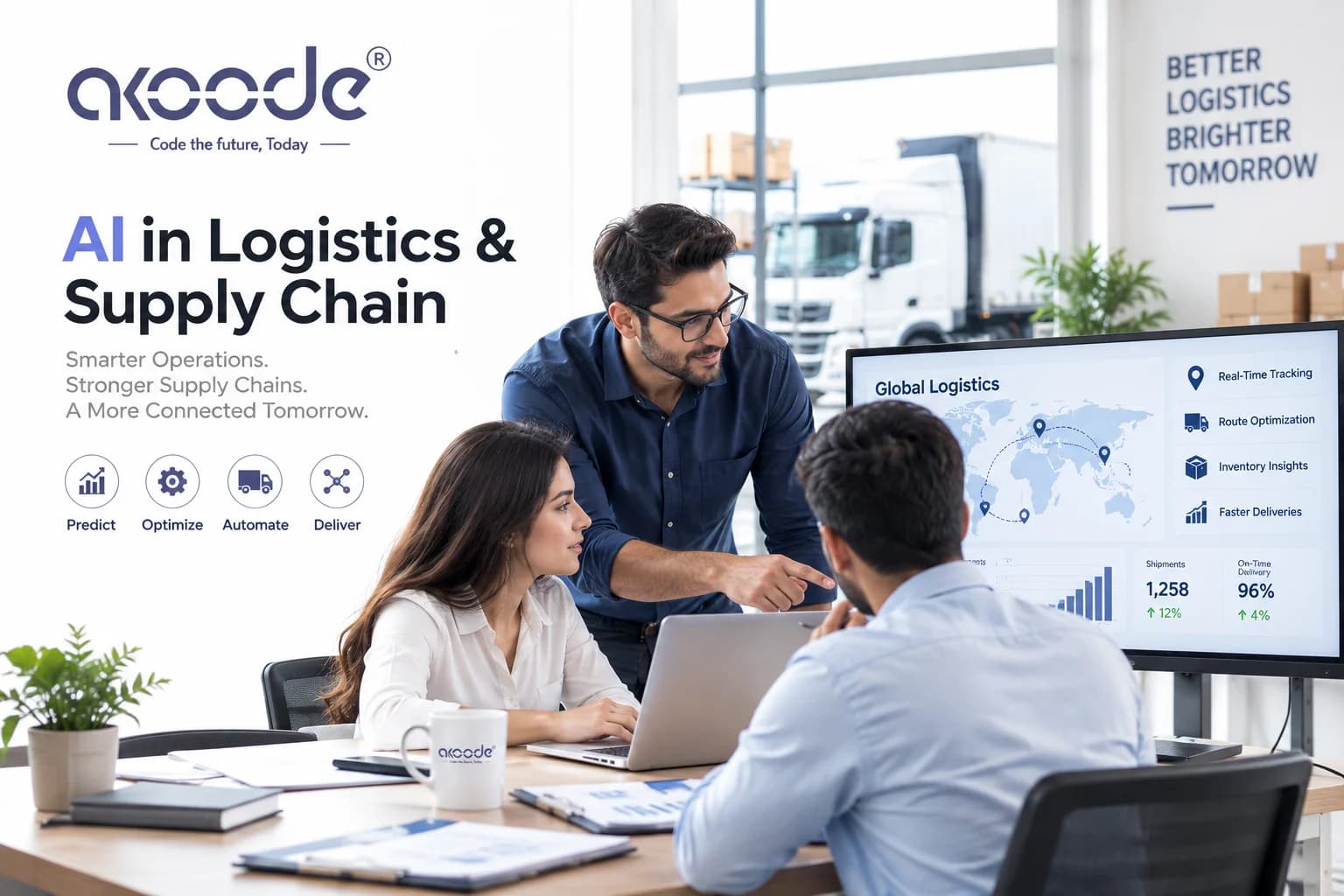
Logistics and supply chain is where AI's return on investment is easiest to prove in hard numbers, because the industry already measures everything — cost per mile, on-time delivery rate, inventory carrying cost — and AI's impact on those numbers shows up fast and unambiguously. This guide covers what AI in logistics and supply chain actually means in 2026, every category of AI agent a logistics company, 3PL, manufacturer, or distributor can realistically build, how they're engineered, and what's different about building for Gurgaon/NCR, India, and global markets.
Why Logistics Is One of the Clearest ROI Stories in Enterprise AI
Supply chain and logistics functions lead enterprise AI adoption at 44%, ahead of most other business functions, and the reason is straightforward: the ROI is measurable almost immediately. Organizations with AI deployments mature enough to measure report an average return of roughly 307% within 18 months, and AI-mature supply chains are measurably more profitable than their peers. The global AI-in-supply-chain market reached around $19.8 billion in 2026, up from roughly $6.5 billion just four years earlier — a near-tripling driven by demand forecasting, route optimization, and warehouse automation moving from pilot to production at scale.
The honest caveat the industry's own data surfaces is a real gap between adoption and proven impact: the large majority of organizations report using AI somewhere in their supply chain, but a much smaller share can point to a documented effect on their bottom line. That gap is less about AI not working and more about point solutions that were never connected to the rest of the operations stack — a forecasting tool that doesn't talk to the routing system, a routing system that doesn't talk to the warehouse. The organizations actually capturing the 307% ROI figure are the ones that built connected systems, not isolated pilots.
The frontier that's opening up now is agentic — AI that doesn't just recommend a route or a reorder quantity but executes it and adjusts autonomously when conditions change. Gartner forecasts that supply chain management software with genuine agentic AI capabilities will grow from under $2 billion in spend in 2025 to roughly $53 billion by 2030, and has projected that a majority of supply chain disruptions will be resolved without human intervention within the next five years.
India's logistics sector is scaling on the back of a deliberate, large-scale government push rather than market forces alone. The National Logistics Policy and PM Gati Shakti have earmarked roughly ₹11 lakh crore for logistics infrastructure, with dedicated freight corridors already cutting containerized freight transit time by 30-40% on key routes and 35 multimodal logistics parks under development nationwide. Delhi NCR and Gurgaon specifically are named among India's primary logistics hubs set to benefit most directly from this infrastructure push, alongside Mumbai, Bengaluru, and Pune — which makes NCR-based logistics and 3PL companies unusually well positioned to combine improving physical infrastructure with AI-driven operational efficiency at the same time.
What "AI in Logistics" Actually Means
AI in logistics and supply chain spans four connected domains, and most businesses need agents working across all of them to see the full return: planning (demand forecasting, inventory optimization — deciding what to have, where, and how much), transportation (route optimization, carrier selection, fleet management — deciding how to move it), warehouse operations (picking, packing, inventory tracking — deciding how to handle it physically), and visibility and exceptions (shipment tracking, disruption management — knowing what's actually happening and reacting fast when it doesn't go to plan).
An AI agent, in this context, owns a specific job end-to-end within one of these domains — not a dashboard that shows a stockout risk, but a system that actually triggers the reorder; not an alert that a shipment is delayed, but an agent that recalculates downstream schedules and notifies affected customers automatically.
The Complete List: AI Agents You Can Build for a Logistics or Supply Chain Business
Planning and Forecasting Agents
Demand forecasting agent. Predicts SKU-level and lane-level demand using historical patterns, seasonality, promotions, and external signals, replacing static forecasting models that don't adapt fast enough to actual demand volatility. This is consistently one of the highest-adoption AI use cases in supply chain because forecasting error compounds into every downstream decision — inventory, transportation, staffing.
Inventory optimization agent. Continuously recalculates optimal stock levels and safety stock across warehouses and distribution centers based on the live demand forecast, replacing fixed reorder points that don't account for changing seasonality or supply variability.
Supplier risk and procurement agent. Monitors supplier performance, financial health signals, and geopolitical risk factors to flag likely supply disruptions before they hit, and can automate routine purchase order generation and supplier communication for standard reorders.
Network design and capacity-planning agent. Models optimal warehouse and distribution-center placement, and forecasts capacity needs ahead of demand shifts, replacing the periodic manual network-review exercise most companies still run on a multi-year cycle rather than continuously.
Transportation and Fleet Agents
Route optimization agent. Continuously recalculates optimal delivery routes based on real-time traffic, weather, and delivery-window constraints, adjusting mid-route when conditions change rather than locking in a plan at the start of the day and hoping nothing shifts.
Dynamic carrier selection and freight-rate agent. Selects the optimal carrier for each shipment based on real-time rate, capacity, and service-level data, replacing manual carrier negotiation and selection processes that don't adapt to daily market conditions.
Fleet maintenance and predictive-failure agent. Monitors vehicle telematics data to predict maintenance needs before a breakdown happens, reducing unplanned downtime that otherwise cascades into missed delivery windows across an entire route.
Driver scheduling and hours-of-service compliance agent. Optimizes driver assignments against delivery demand while automatically tracking hours-of-service compliance, a category with direct regulatory stakes in most markets.
Last-mile delivery optimization agent. Manages the specific complexity of last-mile routing — delivery-window commitments, failed-delivery re-attempts, real-time customer communication — which behaves differently from long-haul route optimization and increasingly needs its own dedicated logic as delivery-speed expectations compress.
Warehouse and Fulfillment Agents
Warehouse picking and slotting optimization agent. Optimizes pick paths and product slotting based on actual order patterns, reducing the walking time and picking errors that come from a static warehouse layout that hasn't adapted to changing SKU velocity.
Computer vision inventory and quality-inspection agent. Uses warehouse cameras to verify inventory counts, detect misplaced items, and catch quality defects during receiving or packing, replacing periodic manual cycle counts and visual inspection.
Order allocation and fulfillment agent. Decides which warehouse or fulfillment center should service each order based on inventory position, shipping cost, and delivery-speed requirements, particularly valuable for multi-node fulfillment networks where the optimal choice changes order by order.
Returns processing and reverse-logistics agent. Automates the intake, inspection routing, and disposition decision for returned goods, a workflow that most companies still handle with significantly more manual overhead than forward logistics.
Visibility and Exception-Management Agents
Real-time shipment tracking and visibility agent. Provides end-to-end shipment visibility across carriers and modes, proactively surfacing exceptions rather than requiring a customer or ops team to manually check status.
Disruption detection and response agent. Monitors external signals — weather, port congestion, geopolitical events — to flag likely disruptions before they hit a specific shipment, and can automatically trigger a rerouting or customer-notification workflow rather than waiting for a human to notice the disruption has already happened.
Customer communication and delivery-notification agent. Proactively notifies customers of delivery status changes and manages the conversational back-and-forth around delivery preferences, reducing "where is my order" support volume without a human touching every ticket.
Freight audit and invoice reconciliation agent. Automatically verifies freight invoices against contracted rates and actual shipment data, catching billing discrepancies that otherwise go unnoticed at the volume most logistics operations run.
Orchestration: When Multiple Agents Work the Same Supply Chain
The organizations actually capturing the 307% ROI figure aren't running isolated point solutions — they're connecting agents across the chain: a forecasting agent feeds an inventory-optimization agent, which feeds a procurement agent, while a route-optimization agent and a fleet-maintenance agent share data with a disruption-detection agent so that a delayed shipment automatically triggers a downstream schedule recalculation and a customer notification, without a human manually connecting those dots. Some AI systems are now coordinating vehicle-fleet and inventory-replenishment decisions together in real time — a level of cross-functional coordination that was operationally impossible before agents could share live data across what used to be separate systems.
How These Agents Are Actually Built
The underlying architecture is consistent across every agent type above, with the data sources and integrations swapped per use case:
A large language model (GPT, Claude, or Gemini class, selected per use case) handles the conversational and reasoning layer — explaining a routing decision, summarizing a disruption, drafting a customer notification.
Specialized forecasting and optimization models — time-series models for demand forecasting, combinatorial optimization for routing and slotting — handle the mathematical core of planning and transportation decisions, since these problems require rigor a general-purpose language model isn't built to provide on its own.
Retrieval-augmented generation (RAG) grounds every response in live inventory, shipment, and network data, so an agent never recommends a route through a closed facility or a reorder against inventory that's already been allocated elsewhere.
TMS, WMS, and ERP integrations connect the agent to the systems that actually hold operational data — transportation management systems for routing and carrier data, warehouse management systems for inventory and fulfillment, ERP systems for procurement and financials.
A guardrail and escalation layer defines what an agent can act on autonomously (a routine reorder within approved parameters, a standard route recalculation) versus what needs human sign-off (a large capital procurement decision, an unusual disruption response) — the difference between a system that's trusted to run daily operations and one that creates a costly mistake the first time it acts outside its actual competence.
This is where the gap between a generic AI vendor and genuine logistics AI engineering shows up clearly. Anyone can build a forecasting demo against historical data. Integrating cleanly with a real TMS or WMS, keeping data grounded to what's actually happening on the ground in real time, and building guardrails around procurement and routing decisions is the engineering work that determines whether a system survives contact with a real, messy supply chain.
Building AI Agents for Logistics Businesses in Gurgaon and the NCR
Gurgaon and the wider NCR sit inside one of India's primary logistics hubs, directly benefiting from the government's infrastructure push, and a few things are specific to building here:
ULIP integration — the government's Unified Logistics Interface Platform, which connects customs, railways, highways, and shipping data on a single platform — is increasingly a practical requirement for any visibility or exception-management agent aiming for genuine multimodal tracking rather than single-mode visibility.
Dedicated Freight Corridor-aware routing matters for any transportation-optimization agent serving lanes near the operational Western and Eastern DFCs, since the 30-40% transit-time reduction on containerized freight along these corridors changes the optimal mode and route choice in ways a generic routing model won't capture without that data built in.
GST e-way bill and compliance automation needs to be built into any procurement, transportation, or invoice-reconciliation agent operating in India, since e-way bill generation and validation is a mandatory, high-volume compliance requirement most manual logistics workflows still handle inefficiently.
3PL and multimodal logistics park density in the Gurgaon-Manesar-Bawal industrial corridor means a meaningful share of the local AI opportunity is B2B infrastructure sold to logistics providers and manufacturers, rather than direct-to-consumer delivery apps, which changes both the integration requirements and the buyer conversation.
Building for the Indian Market Broadly
Beyond Gurgaon's specific infrastructure advantages, three things matter for AI logistics agents built for the wider Indian market: multimodal complexity is higher than in most single-mode-dominant markets, since India's logistics network increasingly spans road, rail, port, and the emerging dedicated freight corridors simultaneously, which means routing and visibility agents need genuine multimodal logic rather than road-only assumptions; regional connectivity to tier-2 and tier-3 cities is expanding rapidly under the multimodal logistics park program, creating new lane and warehousing options that a static routing model trained on old infrastructure data won't reflect; and India's historically high logistics cost as a share of GDP relative to developed economies means the ROI case for AI-driven cost optimization is proportionally larger here than in markets where logistics efficiency is already closer to its ceiling.
Building for a Global Market
For logistics and supply chain businesses operating internationally, the same agent categories apply, but the integration and compliance layer shifts: customs and cross-border compliance automation for international freight, integration with the established enterprise planning suites (Blue Yonder, o9 Solutions, Kinaxis, SAP IBP) that dominate large-enterprise supply chain planning, and increasing regulatory attention on emissions reporting — Europe's CSRD requirements are already pushing logistics operators toward AI-driven emissions tracking and route optimization that accounts for carbon cost alongside financial cost, not as a separate initiative but as a built-in constraint on the routing decision itself.
What to Actually Prioritize First
Not every logistics or supply chain business needs the full stack above on day one. A practical build sequence for most companies:
Demand forecasting — because it's the foundation every other planning decision depends on, and forecasting error compounds downstream into inventory, transportation, and staffing costs.
Route optimization and real-time visibility — because the ROI is immediate and highly visible to both operations teams and customers.
Inventory optimization — once the demand forecast is stable enough to ground safety-stock and reorder decisions accurately.
Warehouse picking and fulfillment optimization — because it directly reduces labor cost and error rates in the physical operation.
Disruption detection and cross-functional orchestration — the highest-value but most complex category, best approached once the individual planning, transportation, and warehouse agents are stable and sharing data cleanly.
Proof This Works
Akoode's engineering discipline for real-time, operational tracking systems shows up in projects that share the core requirements a logistics platform demands: live data ingestion, accurate real-time state tracking, and systems built to coordinate physical assets and capacity rather than just displaying a dashboard. A parking and vehicle-space allocation platform Akoode built demonstrates exactly this kind of real-time asset-tracking and allocation logic — the same underlying discipline a fleet-tracking or warehouse-slotting agent depends on, applied to a different physical-asset problem.
Choosing a Partner to Build This
A few questions separate a real logistics AI engineering partner from a generic AI vendor applying a supply chain label:
Can they explain how their forecasting or routing agent stays grounded in live inventory and shipment data, rather than working from a static snapshot?
Have they integrated with a real TMS, WMS, or ERP platform, not just built a demo against a sample dataset?
Do they understand the difference between planning-layer AI (forecasting, procurement) and execution-layer AI (routing, warehouse operations), which require very different engineering approaches?
Can they show a live production example of an AI system coordinating multiple parts of an operation — not a single-point tool?
Do they have a clear answer for how their agent handles India-specific requirements like GST e-way bill compliance and multimodal routing, if that's relevant to your operation?
Where to Start
AI in logistics has moved past isolated pilot projects for the organizations actually capturing measurable ROI. The businesses pulling ahead in 2026 — in Gurgaon's logistics and 3PL corridor, across India's infrastructure-driven logistics modernization, and globally — are the ones connecting forecasting, routing, warehouse operations, and exception management into one coordinated system, not five disconnected tools each solving one problem in isolation.
Akoode has delivered AI-powered and real-time operational platforms for clients across India, the UK, and the USA, with a 4.9 Google rating from 110+ reviews and a 97% client retention rate. If you're scoping an AI agent — or a full agent portfolio — for a logistics company, 3PL, manufacturer, or distributor, book time with Akhil Verma, Founder & CEO of Akoode, and bring a short brief on what you're building. The first call is where we map which agents matter most for your operation, not a generic list.
If you're evaluating AI agents across more than one industry, see our companion guides on AI agents for real estate, AI agents for travel and hospitality, AI agents for retail and e-commerce, AI agents for healthcare, and AI agents for finance and banking.
Frequently Asked Questions
What AI agents can a logistics or supply chain business build? Logistics and supply chain businesses can build demand forecasting agents, inventory optimization agents, route optimization agents, fleet maintenance agents, warehouse picking and slotting agents, real-time shipment visibility agents, disruption detection agents, and freight audit agents, each owning a distinct part of the supply chain.
What kind of ROI can AI deliver in logistics and supply chain? Organizations with mature AI deployments report an average ROI of roughly 307% within 18 months, though ROI varies significantly by function and maturity level, and the strongest returns typically come from connected systems rather than isolated point solutions.
Will AI replace logistics jobs like dispatchers and planners? Current evidence points toward augmentation rather than replacement for most roles. AI is absorbing routine route replanning, demand forecasting, and exception monitoring, while dispatchers and planners increasingly focus on exceptions, customer relationships, and judgment calls AI isn't positioned to make.
What makes AI agent development different for Gurgaon and NCR logistics businesses? Gurgaon sits inside one of India's primary logistics hubs directly benefiting from PM Gati Shakti and the National Logistics Policy, which means agents built here can leverage ULIP integration, Dedicated Freight Corridor-aware routing, and built-in GST e-way bill compliance automation.
Which AI agent should a logistics business build first? Most logistics and supply chain businesses see the fastest return from demand forecasting, since it's the foundation every other planning decision depends on, followed by route optimization and real-time shipment visibility, where the ROI is immediate and visible to both operations and customers.
Get In Touch Now
View More Our Blog