




 September 14, 2026
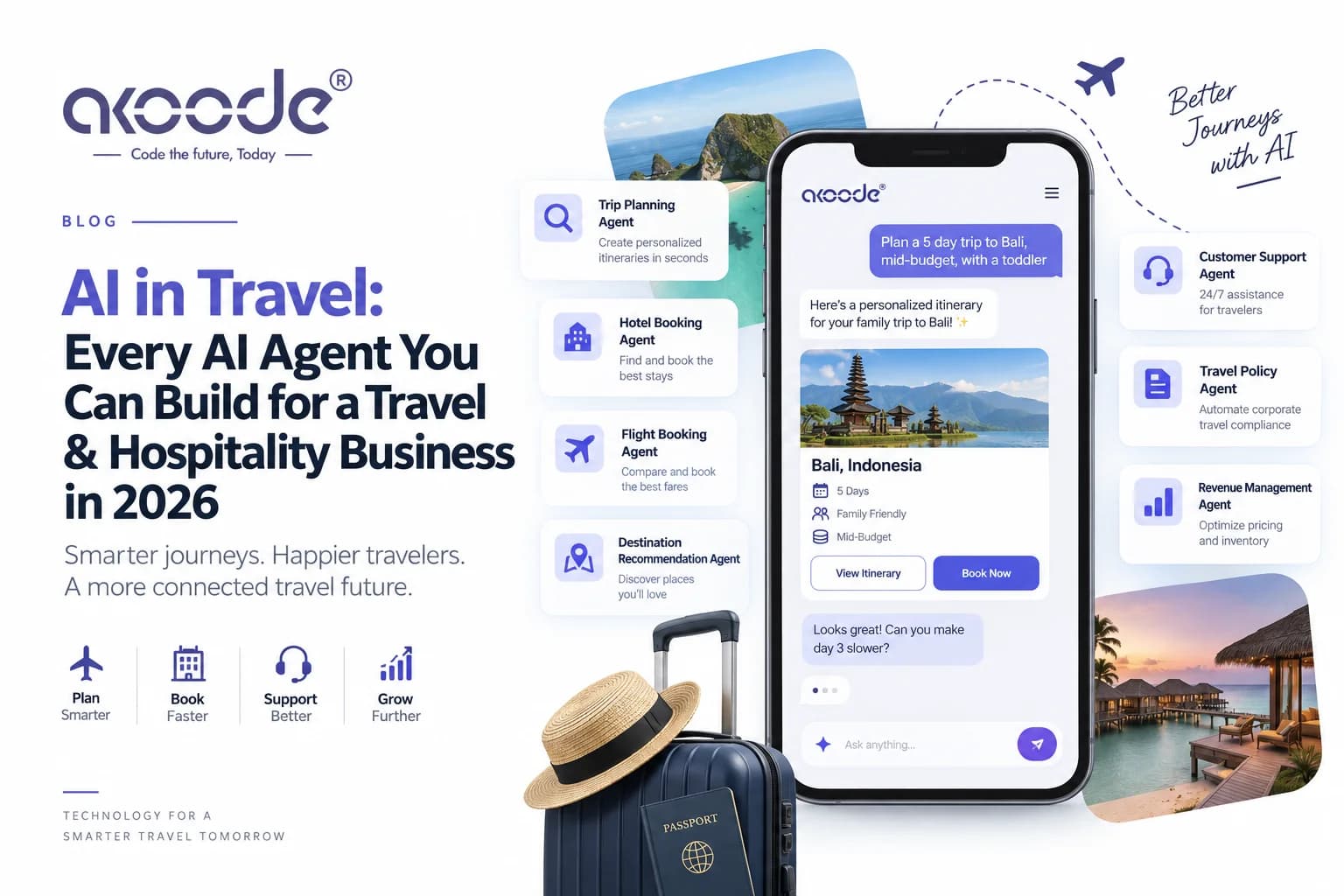
A traveler used to call an agent, wait for a callback, and take whatever three package options showed up in an email. Today the same traveler types "5 days in Bali, mid-budget, traveling with a toddler" into a chat window and gets a live itinerary, real prices, and a booking link in under a minute — then messages back "actually make day 3 slower" and watches the plan rebuild itself instantly.
That shift — from a human doing the searching to an AI agent doing the searching, comparing, and often the booking — is what's pulling travel and hospitality businesses into a wave of AI investment far bigger than the chatbot-on-a-website phase most of the industry went through a few years ago. This guide covers what AI in travel actually means today, every category of AI agent a travel, tourism, or hospitality business can realistically build in 2026, how they're engineered, and what's different about building for Gurgaon/NCR, India, and global markets.
Why Travel Is One of the Fastest-Moving Industries for AI Right Now
Travel has always generated the kind of messy, high-intent, multi-step decision-making that AI is good at untangling — compare hundreds of options, factor in dates and budget and preferences, then commit to something irreversible and expensive. That's exactly why the category is growing faster than almost any other AI-in-industry segment.
The global AI-in-travel market is on track to more than triple over the next few years, growing from roughly $165 billion in 2025 toward $710 billion by 2030 — a pace driven by the expansion of online booking platforms, digital customer service tools, and increasingly, real-time personalization engines. Adoption on the traveler side is moving just as fast: industry forecasts put AI involvement in a majority of customer interactions by the end of this year, and more than three-quarters of travelers now say they expect personalized recommendations as standard, not a premium feature. A widely cited industry pattern also holds here: AI isn't replacing the travel agent channel outright — a large share of packages, and the bulk of cruise and luxury bookings, still move through a human — but the agents who use AI to move faster are pulling ahead of the ones who don't.
The bigger structural shift happening in 2026 is the move from rule-based chatbots to genuinely agentic AI — systems that don't just answer a question about a hotel, but actually compare fares, hold a booking, and rebook automatically when a flight changes. That's the version of AI in travel this guide focuses on: agents that complete a task, not just widgets that answer one.
India's numbers add a second, complementary growth curve on top of the global one. The domestic travel and tourism market is scaling toward roughly $40 billion by the early 2030s, business travel alone is projected to more than double toward $80+ billion over the same period, and India's travel technology segment is expanding on the back of AI-driven personalization, smart booking, and contactless payment adoption. Gurgaon sits inside this growth as a corporate travel and MICE (meetings, incentives, conferences, exhibitions) hub, with a dense concentration of enterprises that need automated travel-policy compliance and expense management at scale — a very different AI use case from the leisure-personalization angle most global travel AI coverage focuses on.
What "AI in Travel" Actually Means
"AI in travel" spans four distinct moments in a traveler's journey, and each one calls for a different kind of agent: discovery (where should I go, what should I do), booking (compare, hold, confirm), in-trip support (something changed, I need help now), and post-trip and operations (loyalty, reviews, revenue management on the business side). A single chatbot bolted onto a booking site typically only covers a sliver of the first two. A genuinely useful AI system for a travel or hospitality business is a set of agents, each owning one of these moments end-to-end and handing off cleanly to the next.
The Complete List: AI Agents You Can Build for a Travel or Hospitality Business
Discovery and Planning Agents
Conversational trip-planning agent. Takes a traveler's loose description — destination, budget, dates, who's traveling, pace — and generates a structured, bookable itinerary, then revises it conversationally when the traveler asks for changes. This is the single clearest generative-AI win in travel because trip requirements almost never map cleanly onto a filter form the way a flight search does.
Personalized recommendation agent. Learns from past bookings, browsing behavior, and stated preferences to surface destinations, hotels, and activities a traveler is statistically likely to want but hasn't searched for — the same logic e-commerce uses for cross-sell, applied to travel inventory.
Destination and activity-matching agent. Answers open-ended discovery questions ("somewhere warm, not touristy, good for solo travel in March") by reasoning across destination data rather than requiring a traveler to already know where they want to go.
Booking and Transaction Agents
Fare and rate comparison agent. Continuously compares flight, hotel, and package pricing across sources and alerts a traveler or books automatically when a rate hits their target — the autonomous version of what used to be a manual fare-watching habit.
Booking and reservation agent. Handles the full booking flow conversationally — hold, confirm, payment, confirmation — for flights, hotels, cars, and activities, reducing the number of screens a traveler has to click through to complete a transaction.
Dynamic pricing and revenue management agent. On the business side, continuously adjusts room rates, package pricing, and seat inventory based on demand signals, competitor pricing, and booking pace — the operator's equivalent of the traveler-facing fare-comparison agent, running in reverse.
Group and MICE booking coordination agent. Manages the significantly more complex logistics of group travel and corporate events — multiple travelers, shared itineraries, block bookings, approval workflows — a category with outsized relevance for a market like Gurgaon's dense corporate and conference travel demand.
In-Trip Support Agents
24/7 conversational concierge agent. Handles in-trip questions and requests — local recommendations, itinerary changes, translation help — across chat and voice, in the traveler's language, without the traveler needing to find and call a help desk.
Disruption management and rebooking agent. Monitors flight status and automatically rebooks or proactively notifies a traveler when a flight is delayed or cancelled, instead of leaving the traveler to discover the problem at the gate and start rebooking from scratch.
Multilingual translation and communication agent. Provides real-time translation for in-trip communication — with hotel staff, drivers, tour guides — removing one of the most persistent friction points in international travel.
Expense and policy-compliance agent (corporate travel). Checks bookings against a company's travel policy in real time, flags out-of-policy spend before it's booked rather than after the expense report is filed, and automates the reconciliation that corporate travel managers otherwise do manually.
Post-Trip, Loyalty, and Operations Agents
Review and sentiment-analysis agent. Processes guest reviews and post-trip feedback at scale to surface recurring operational issues — a specific amenity complaint, a check-in bottleneck — before they show up as a rating trend a property or OTA account manager has to chase down manually.
Loyalty and retention agent. Identifies which travelers are likely to book again, and which are showing signs of churn, then triggers personalized retention offers rather than blasting the same discount to an entire customer list.
Demand-forecasting agent. Predicts booking demand at a property or route level using historical patterns, seasonality, and external signals (events, holidays, weather), feeding directly into the dynamic-pricing agent above so pricing decisions are grounded in an actual forecast rather than a fixed calendar of high/low seasons.
Fraud and chargeback-detection agent. Flags suspicious booking patterns — stolen-card usage, fake reviews, account takeover — a persistent and costly risk category across OTAs and direct-booking platforms alike.
Property management and guest-services agent (hospitality-specific). Handles routine guest requests — housekeeping, room service, check-in/check-out logistics — conversationally, freeing front-desk and operations staff for the interactions that actually need a human.
Orchestration: Multiple Agents Working the Same Trip
The travel businesses seeing the most value from AI aren't running one assistant — they're running a handoff chain: a discovery agent hands a shortlisted itinerary to a booking agent, which hands a confirmed trip to an in-trip support agent, which hands post-trip signals to a loyalty agent, all logging into the same customer record. That's the architecture behind Expedia's own "Romie" assistant, which explicitly spans planning, booking, and last-minute changes in one continuous agent rather than as separate tools — That's the direction the whole category is moving, from single-purpose chatbots toward what the industry is now calling autonomous travel agents — the same shift covered in more technical depth in what agentic AI actually is and how enterprise-grade agent architecture stays reliable once autonomy is involved.
How These Agents Are Actually Built
The underlying architecture is consistent across all of the agent types above, with the data sources and integrations swapped per use case:
A large language model (GPT, Claude, or Gemini class, selected per use case) handles the conversational and reasoning layer — understanding a loose trip request, explaining a rebooking decision, drafting a personalized offer.
Retrieval-augmented generation (RAG) grounds responses in real, live inventory — actual fares, actual room availability, actual policy documents — instead of letting the model guess at prices or availability that may have changed since its training data.
GDS, OTA, and PMS integrations connect the agent to the systems that actually hold booking and inventory data — global distribution systems for flights, channel managers for hotel inventory, property management systems for in-stay operations.
A payments and transaction layer handles the actual booking and payment execution securely, with PCI-DSS-compliant handling wherever a card transaction is involved.
A guardrail and escalation layer defines exactly what an agent can commit to autonomously (holding a fare) versus what needs human sign-off (a large group booking, a policy exception) — the difference between an agent that's genuinely useful and one that creates a liability the first time it books something it shouldn't have.
This is also where a generic chatbot integration and a properly engineered travel AI system diverge sharply. Anyone can wire a model to a FAQ page. Grounding an agent in live GDS or channel-manager data, keeping pricing accurate to the second, and building the guardrails that stop an autonomous booking agent from overcommitting is the real engineering work — and it's the difference between a demo and a system that survives a real booking season.
Building AI Agents for Travel Businesses in Gurgaon and the NCR
Gurgaon's travel and hospitality demand looks structurally different from a leisure-travel market, and that changes what to build first. The core agent-development approach still follows the same playbook covered in our guide to custom AI agent development in Gurgaon, applied specifically to travel and corporate-mobility workflows:
Corporate and MICE travel dominates the local demand base. Gurgaon's dense enterprise and conference ecosystem means group-booking coordination, policy-compliance, and expense-reconciliation agents typically deliver faster ROI here than consumer-facing itinerary planners.
Multi-stakeholder approval workflows are the norm, not the exception — a corporate travel agent needs to route bookings through manager approval and cost-center allocation, which most consumer-first travel AI tooling isn't built to handle out of the box.
Hindi-English code-switched communication, exactly how NCR business travelers actually message on WhatsApp and internal chat tools, needs to be handled natively by any conversational concierge or support agent, not bolted on as a translation layer.
Integration with Indian payment rails and GST-compliant invoicing matters for any booking or expense agent serving Indian corporate clients, which a platform built primarily around US or European payment assumptions typically doesn't handle cleanly.
Building for the Indian Market Broadly
Beyond Gurgaon's corporate-travel specifics, three things matter for any AI travel agent built for the wider Indian market: multilingual support needs to go beyond Hindi-English to the regional languages relevant to a platform's traveler base, given how much of India's domestic travel demand — including the fast-growing spiritual and pilgrimage tourism segment — is not English-first; integration with Indian rail booking (a booking category most global travel AI platforms don't touch at all) is often necessary for genuine India-market coverage; and payment and invoicing flows need to handle UPI and India-specific compliance requirements natively rather than as an afterthought bolted onto a global payment stack.
Building for a Global Market
For travel and hospitality businesses operating internationally, the same agent categories apply, but the integration and compliance layer shifts: GDS integration (Amadeus, Sabre, Travelport) for flight and multi-modal inventory, direct OTA and channel-manager connections for hotel distribution, PCI-DSS compliance for payment handling across jurisdictions, and increasing regulatory attention on cross-border data localization for AI-driven personalization — a live policy area currently being negotiated between governments and travel-tech providers, which makes data-residency architecture a genuine build consideration, not just a compliance checkbox.
What to Actually Prioritize First
Not every travel or hospitality business needs the full stack above on day one. A practical build sequence for most businesses:
Conversational concierge / customer support agent — because it's the fastest to deploy, immediately reduces support load, and the risk of getting it wrong is low.
Booking and rate-comparison agent — because it directly improves conversion from browse to purchase.
Disruption management and rebooking — because it turns a frequent negative experience (a delayed flight) into a moment that builds loyalty instead of losing it.
Dynamic pricing and demand forecasting — once there's enough booking data flowing through the earlier agents to ground pricing decisions accurately.
Loyalty, review-sentiment, and retention agents — as the compounding layer once the operational agents are stable and generating usable behavioral data.
Proof This Works: What's Already Been Built
A travel-focused mobile and AI platform Akoode built for Mifever, a Switzerland-based client, combined mobile app engineering with AI-driven matching logic to power a travel-companion product — proof of the same mobile-plus-AI engineering discipline that a booking, itinerary, or concierge agent for a travel business depends on: a responsive mobile experience backed by AI that actually reasons over user preferences rather than just filtering a list.
That combination — production mobile engineering plus AI reasoning working together, not as separate workstreams — is exactly what a travel AI agent build requires, since a discovery or booking agent is only as good as the app experience a traveler actually interacts with it through.
Choosing a Partner to Build This
A few questions separate a real AI-engineering partner from a chatbot reseller wearing a travel-industry label:
Can they explain how their agent stays grounded in live fare and inventory data (RAG plus real-time API integration), rather than answering from a static or stale dataset?
Do they have real experience integrating with GDS systems, channel managers, or PMS platforms — not just a generic booking-form demo?
Have they built agents that hand off to each other (discovery → booking → in-trip support), or only a single standalone chatbot?
Do they understand the difference between consumer leisure-travel AI and corporate/MICE travel AI, which need almost entirely different feature sets?
Can they show a live production example of mobile and AI working together for a real client, not a proof-of-concept?
Where to Start
AI in travel has moved past the single-chatbot phase. The businesses pulling ahead in 2026 — in Gurgaon's corporate travel corridor, across India's fast-growing domestic and business travel market, and globally — are the ones building connected agent systems: discovery that hands off to booking, booking that hands off to in-trip support, in-trip support that feeds loyalty and pricing decisions. Not five disconnected pilots. One system that gets smarter the more of the traveler's journey it covers.
Akoode has delivered AI-powered platforms and mobile engineering for clients across India, Europe, and the USA, with a 4.9 Google rating from 110+ reviews and a 97% client retention rate. If you're scoping an AI agent — or a full agent portfolio — for a travel, tourism, or hospitality business, book time with Akhil Verma, Founder & CEO of Akoode, and bring a short brief on what you're building. The first call is where we map which agents matter most for your business, not a generic list.
If you're evaluating AI agents across more than one vertical, our companion guide on AI agents for real estate businesses covers the same architecture applied to property discovery, valuation, and compliance.