


 September 12, 2026
A custom AI agent is a system built around your specific business data, tools and workflows — not a pre-packaged chatbot with your logo on it. It connects a language model such as GPT or Claude to your CRM, your knowledge base, your internal APIs and your approval rules, so it can actually check an order, update a record, draft a proposal or triage a ticket, rather than only answering questions about a script it was given. Off-the-shelf chatbots are built to handle the common case for every customer who buys them; a custom agent is built to handle your case, including the exceptions that make your business different from the one down the road.
Akoode Technologies designs and builds these systems from Gurugram, Haryana, working with startups, SMEs and enterprises across Delhi NCR, India and internationally. For a Gurgaon-based business — whether a fast-growing SaaS startup in Cyber City, a real estate developer, a financial services firm, or an enterprise back-office team — a custom AI agent is usually the difference between "we tried an AI chatbot and it didn't help" and an assistant that genuinely removes repetitive work from a team's day. This guide explains what custom AI agent development actually involves, how it differs from the chatbot most businesses have already tried, what it costs to think about, and how to evaluate a development partner properly before you commit budget.
What Is Custom AI Agent Development?
In plain business terms: an AI agent is software that can understand what you're asking it to do, figure out the steps required, go and check or change things in your actual business systems, and tell you what it did — escalating to a person when it isn't confident or the action is too consequential to make alone. Custom development means that system is built around your specific tools, data and rules rather than a generic template.
It helps to place the term against the others it gets confused with, because they describe genuinely different levels of capability — see our deeper explainer on what an AI agent actually is for the full technical distinction.
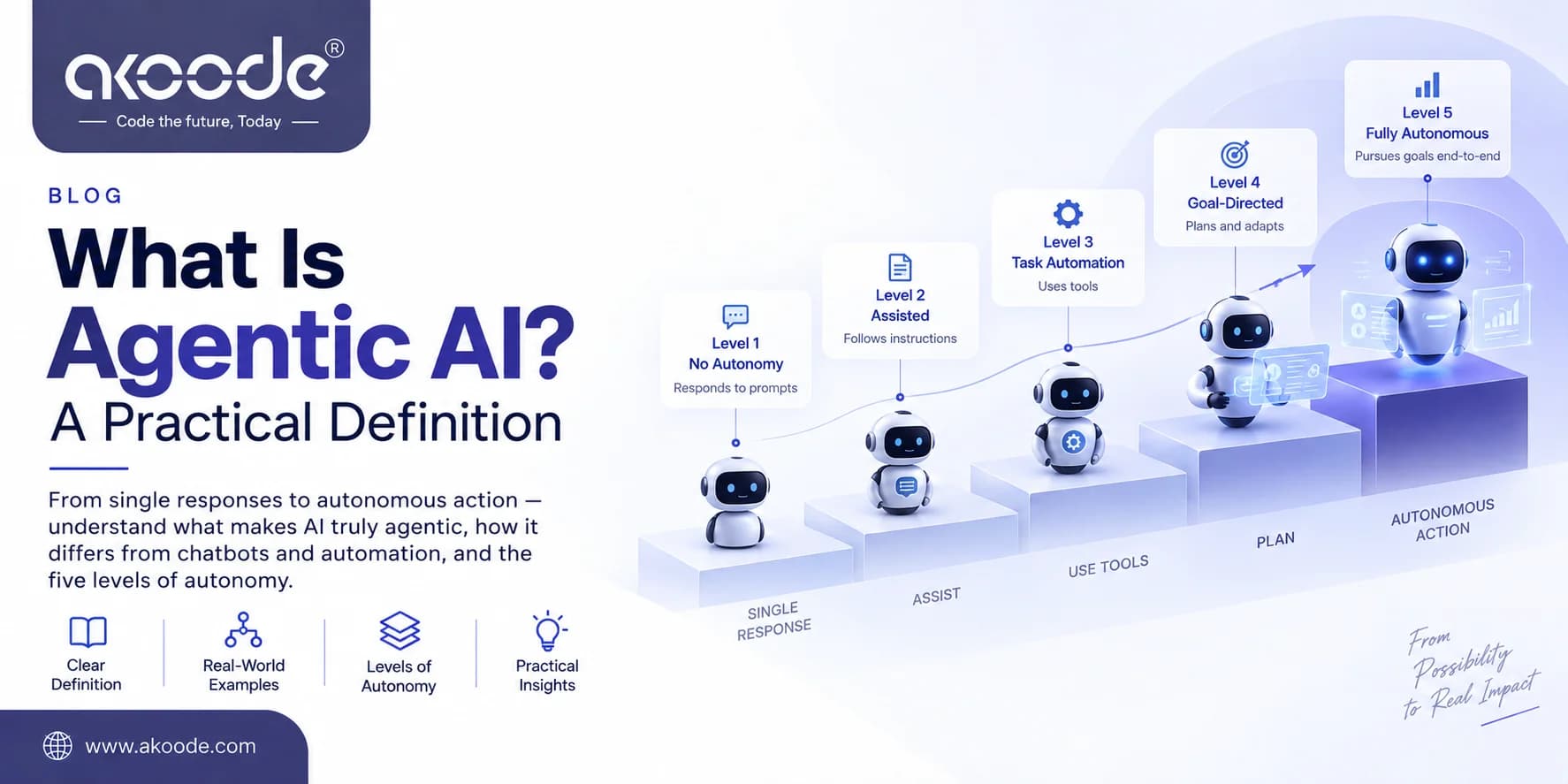
Traditional chatbot — answers questions from a fixed script or FAQ. No access to your live data, no actions taken.
AI assistant — uses a language model to have a more natural conversation and can draft content, but a person still reviews and acts on every output.
AI copilot — sits inside a tool your team already uses (a CRM, a support desk) and suggests the next action or drafts a response, with a person approving each step.
AI agent — plans a short sequence of steps itself and executes them through your tools and APIs, checking its own results, with a person reviewing outcomes rather than every individual step.
Autonomous AI agent — operates across a broader task with less frequent human checkpoints, escalating only at defined thresholds (a refund above a certain amount, for instance).
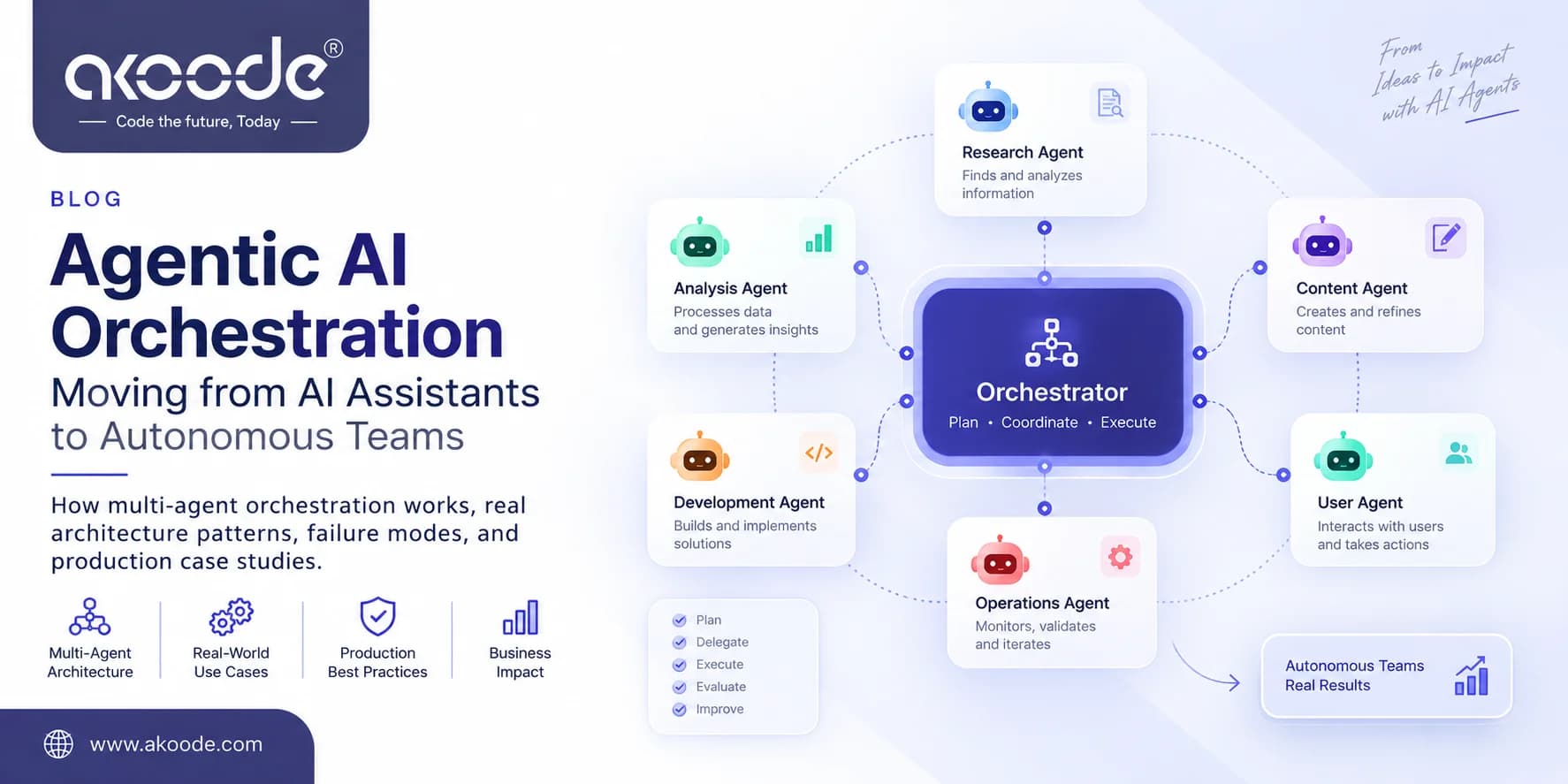
Multi-agent system — several specialist agents, each handling a distinct part of a larger task, coordinated so the whole task gets done end to end.
What a working AI agent actually does, step by step:
Understands the request — in plain language, from a customer, an employee, or a triggering event like a new form submission.
Reasons about the task — decides what information it needs and what steps are required to complete it.
Accesses approved information — searches your knowledge base, database or documents, scoped to only what it's permitted to see.
Uses tools and APIs — queries your CRM, checks an order in your ERP, looks up a policy document.
Executes actions — updates a record, drafts a reply, schedules a meeting, raises a ticket.
Verifies results — checks that the action actually succeeded rather than assuming it did.
Escalates to humans when necessary — when confidence is low, the action is high-stakes, or something doesn't match expectations.
A simple example: a Gurgaon-based real estate firm gets a WhatsApp enquiry about a property. A custom AI agent reads the enquiry, checks the CRM for whether this is a returning lead, pulls the relevant property details and current availability, drafts a personalised reply, and — if the enquiry is straightforward — sends it and logs the interaction in the CRM automatically. If the enquiry is about financing or a legal question, it escalates to a human agent with full context already attached, rather than a bare notification.
How AI Agents Differ From Traditional Chatbots
Capability | Traditional Chatbot | Custom AI Agent |
|---|---|---|
Conversation | Scripted, decision-tree or keyword-matched | Natural, understands intent and context |
Reasoning | None — follows pre-set branches | Plans steps based on the specific request |
Business data | None, or a static FAQ document | Live access to your CRM, ERP, databases and documents |
Tool usage | None | Calls APIs and internal tools to get real answers |
API integrations | Rare, usually a single fixed integration | Multiple integrations, added as your workflows require |
Workflow execution | Cannot take action, only responds | Executes multi-step actions end to end |
Memory / context | Resets every conversation, or session-only | Retains relevant context across a task and often across sessions |
Human escalation | A generic "contact support" fallback | Structured escalation with full context attached |
Automation capability | None — informational only | Automates the actual work, not just the conversation |
Customisation | Configuration within a vendor's template | Built around your specific data, tools and rules |
Why companies are moving beyond FAQ chatbots: a scripted chatbot answers the questions its designer anticipated and fails, often visibly, the moment a real customer's situation falls outside that script. Businesses that adopted chatbots early are now discovering the ceiling on that approach — a chatbot can tell a customer what your refund policy says, but it cannot check their specific order, decide whether they qualify, and process the refund. That gap between "answering" and "resolving" is exactly what a custom AI agent is built to close, and it's why most companies re-evaluating their chatbot investment are asking about agents, not a better chatbot.
Why Businesses in Gurgaon Are Investing in AI Agents
Gurgaon (Gurugram) sits at the centre of one of India's densest technology and services corridors — a large startup base, the regional headquarters of numerous IT and consulting firms, a concentration of financial services and fintech companies, and a fast-growing real estate and retail sector, all within the wider Delhi NCR economy. That density creates a specific set of business drivers for AI agents, distinct from generic AI hype:
IT and technology companies use agents for internal knowledge search, support ticket triage, and code-adjacent documentation tasks, freeing engineering time from repetitive internal questions.
Financial services and fintech firms use agents for document processing, policy lookups and structured client communication, where accuracy and auditability matter more than conversational flair.
Real estate developers and brokerages — a sector with a strong Gurgaon and NCR presence — use agents to qualify inbound leads, answer property-specific questions instantly, and keep CRM records current without manual entry.
Healthcare providers and diagnostics networks use agents for appointment coordination, patient query handling and document-heavy administrative work, with the accuracy and escalation discipline the sector demands.
Education and training providers use agents to handle admissions queries, course information, and routine student support around the clock.
E-commerce and D2C businesses use agents for order status, return processing and product queries at a volume a human support team cannot sustainably cover alone.
Professional services and B2B companies use agents for lead qualification, proposal drafting assistance, and research tasks that currently consume associate or analyst time.
Customer support operations across sectors use agents to resolve the high-volume, repetitive share of tickets, so human agents handle the judgment-heavy cases.
Sales organisations use agents to keep CRM data current, follow up on leads consistently, and prepare reps for calls with research done in advance.
Back-office and operations teams use agents for data entry, internal approvals routing, and document processing that currently sits in someone's inbox as a recurring chore.
The common thread across all of these is not that AI is fashionable in Gurgaon's business community — it's that repetitive, rules-adjacent-but-not-quite-rules-based work is exactly the shape of problem a well-built agent is suited to, and NCR's density of exactly these business types is why the demand for custom agent development has grown here specifically rather than only in larger enterprise markets.
Custom AI Agent Development Services by Akoode Technologies
Akoode builds AI agents scoped to what your business actually needs them to do. The categories below describe the kinds of agents we build most often — the specific tools, integrations and data sources any of them use depend entirely on your systems, your data availability and your security requirements, which is why every engagement starts with a discovery conversation rather than a fixed package.
AI Customer Support Agents
Handle the repetitive share of support volume so your team focuses on what actually needs a person:
Answer customer questions from your knowledge base and documentation
Check order status directly against your systems
Create and categorise support tickets automatically
Escalate complex or sensitive cases with full context attached
Retrieve accurate information from your existing knowledge base rather than a static FAQ
AI Sales Agents
Support a sales team through the parts of the process that consume time without requiring judgment on every instance:
Lead qualification against your defined criteria
Lead research, pulling relevant public and CRM information before a call
CRM updates that happen automatically instead of after the fact
Consistent follow-ups that don't depend on a rep remembering to send them
Meeting scheduling coordinated directly with prospects
Proposal drafting assistance based on the specifics of a deal
AI Marketing Agents
Assist a marketing function with research- and content-heavy work:
Content research across your market and competitors
First-draft content generation for review and refinement
Competitor research and positioning updates
Campaign coordination assistance
Lead enrichment ahead of handoff to sales
AI Knowledge Agents
Let employees or customers securely search your company's own documents, policies, SOPs and internal knowledge repositories in natural language, with access scoped to what each user is actually permitted to see — a distinct and more security-sensitive discipline than public-facing search, covered further in the security section below.
AI Operations Agents
Support internal operations with the coordination work that otherwise sits with whoever has time:
Data entry from forms, emails or documents into your systems of record
Reporting assembled from data that currently requires manual pulling
Internal approvals routed and tracked automatically
Workflow coordination across teams and systems
Document processing for recurring internal paperwork
AI Finance and Document Agents
Assist finance and back-office functions with document-heavy, accuracy-critical work:
Invoice processing and data extraction
Document extraction from contracts, forms and statements
Classification of incoming documents by type and required action
Financial data assistance for reconciliation and reporting
Report generation from structured financial data
What determines which of these fits your business is your specific workflow, the systems you already use, what data is available and in what condition, and what level of security and access control your business and industry require. This is exactly what a proper discovery process establishes before any development begins.
GPT, Claude, Gemini and Other AI Models for Custom Agents
A custom AI agent is not simply an API call to GPT or Claude with a system prompt attached. That's roughly where a basic assistant stops. A production agent involves considerably more engineering around the model itself:
Foundation model selection — GPT models, Claude models, Gemini models, or open-source LLMs, chosen for the task rather than by default
Embedding models — for turning your documents and data into a form the system can search by meaning, not just keyword
Retrieval-augmented generation (RAG) — grounding the agent's answers in your actual documents and data rather than the model's general training
Vector databases — the infrastructure that makes fast, accurate retrieval over your knowledge base possible at scale
Function and tool calling — the mechanism that lets the model actually query your CRM or call an API, rather than only generate text about it
APIs and workflow orchestration — the connective layer between the model's decisions and your actual business systems
Business database integration — reading from, and where appropriate writing to, your systems of record
Authentication — ensuring the agent only acts within the permissions of the user or process invoking it
Monitoring — tracking what the agent is doing, how well, and at what cost, once it's live
On model choice specifically: the right foundation model depends on your requirements, not on which one is currently most talked about. Relevant factors include cost per request at your expected volume, latency requirements, how large a context window your task needs, the depth of reasoning the task demands, and — increasingly relevant for Indian and NCR businesses handling sensitive data — where the model is hosted and what your data residency and privacy requirements are. GPT models, Claude models and Gemini models each have genuine strengths depending on the task; there is no universally correct choice, and a development partner recommending the same model for every client regardless of the brief is a signal worth noticing.
How Custom AI Agents Work
At an architectural level, a custom AI agent follows a consistent flow:
User → AI Agent → LLM → Knowledge/Data → Tools/APIs → Business Systems → Action → Response
Each stage does specific work:
The LLM provides the reasoning — understanding the request and deciding what to do about it, guided by system instructions that define its role, boundaries and tone.
RAG and the knowledge base ground the agent's understanding in your actual documents and data, retrieved from a vector database built specifically for fast, meaning-based search over that content.
Tool calling and APIs let the agent take real action — querying, updating, scheduling — rather than only describing what it would do.
Authentication ensures every action happens within the correct permission scope for the user or process behind the request.
Memory and context let the agent track where it is in a multi-step task, and in some cases retain relevant history across sessions.
Guardrails constrain what the agent is permitted to do and say, and define confidence thresholds below which it escalates instead of acting.
Monitoring tracks the agent's performance, accuracy and cost once it's live, so issues surface as data rather than as customer complaints.
Human-in-the-loop checkpoints sit at the points where an action is costly to reverse or the agent's confidence is too low to proceed alone.
A practical example — an AI sales agent connected to a CRM: a new lead fills out a form on your website. The agent receives the notification, checks the CRM to see if this contact already exists, enriches the record with publicly available company information, scores the lead against your qualification criteria, and — if it qualifies — schedules a follow-up call on the assigned rep's calendar and drafts a personalised outreach email for review. Every one of those steps is a tool call against a real system (the CRM, a calendar API, an enrichment service), not a simulated action inside a chat window. This is the level of engineering our companion piece on how AI agents are actually built covers in more technical depth, and our guide to enterprise AI agent architecture covers what reliability and security look like once an agent like this is handling real customer and business data at scale.
AI Agent Use Cases Across Industries
Industry | AI Agent Use Case | Potential Business Benefit |
|---|---|---|
Healthcare | Appointment scheduling, patient query handling, document-heavy admin intake | Faster patient response times, less administrative load on clinical staff |
Real Estate | Lead qualification, property Q&A, CRM record updates from enquiries | Faster lead response, more consistent CRM data |
Finance | Document processing, policy lookup, structured client query handling | Reduced manual document handling, more consistent client responses |
E-commerce | Order status, returns processing, product query handling | Support volume absorbed without proportional headcount growth |
Education | Admissions queries, course information, routine student support | Round-the-clock response without additional staffing |
SaaS | In-product support, onboarding guidance, usage-based upsell prompts | Reduced support ticket volume, more consistent onboarding |
Logistics | Shipment status queries, exception flagging, delivery coordination | Fewer manual status-check requests reaching a person |
Manufacturing | Internal knowledge search across SOPs and compliance documents | Faster access to procedure information for floor and quality teams |
Professional Services | Research assistance, proposal drafting support, client query triage | Time freed from repetitive research and drafting work |
Travel | Itinerary queries, booking status, change and cancellation handling | Faster resolution during high-volume travel disruption periods |
Hospitality | Guest query handling, booking coordination, service requests | Consistent guest response without round-the-clock staffing |
Recruitment | Candidate screening support, interview scheduling, status updates | Faster candidate response times, reduced coordinator workload |
Actual outcomes depend on your specific data, workflows and integration scope — this table describes realistic categories of benefit, not guaranteed results for any given business.
Custom AI Agent Development Process
Akoode's approach to building a custom AI agent follows a consistent sequence, regardless of industry:
1. Business & Requirement Discovery Understand the workflow the agent needs to support, who will use it, what outcome defines success, what data is available, and what constraints — security, compliance, existing systems — apply.
2. AI Agent Strategy Determine the right shape of solution: a simple assistant, a single agent, a broader automation workflow, a RAG-based knowledge system, or a multi-agent architecture — based on the actual task, not on which approach sounds most advanced.
3. Architecture & Technology Selection Select the foundation model, APIs, databases, frameworks, integrations and infrastructure appropriate to the requirements established in discovery.
4. Prototype / Proof of Concept Build and validate the core workflow against real or representative data before committing to the full build.
5. AI Agent Development Develop the agent itself, along with its tools, integrations, interfaces and supporting workflows.
6. Testing & Evaluation Test for accuracy, reliability, hallucination risk, edge cases, permission boundaries and correct workflow execution — not just whether the demo looks right.
7. Deployment Deploy into your preferred environment, whether that's your existing cloud infrastructure, a dedicated environment, or a hybrid setup dictated by your data requirements.
8. Monitoring & Optimisation Monitor performance once live, and continue improving prompts, workflows, retrieval quality, tool behaviour and model selection as real usage data accumulates.
What Does It Cost to Build a Custom AI Agent in India?
There is no single, honest answer to this without knowing your specific requirements — and any vendor quoting a fixed number before understanding your workflows, integrations and data situation is guessing. What actually drives cost:
Number of distinct workflows the agent needs to handle
Which AI model is used, and expected usage volume
Number and complexity of integrations (CRM, ERP, internal tools, third-party APIs)
Data sources involved, and how ready that data is to work with
Whether retrieval-augmented generation over a knowledge base is required
Whether a custom user interface is needed, or the agent operates inside existing tools
Authentication and access-control requirements
Security and compliance requirements specific to your industry
Overall agent complexity — a single-workflow assistant versus a multi-agent system
Number of users and expected concurrent usage
Hosting choice — cloud, dedicated, or hybrid
Third-party API costs that scale with usage
Ongoing maintenance, monitoring and improvement after launch
Indicative project categories, to give a sense of scale rather than a quote:
Basic AI assistant — a single, well-scoped conversational assistant answering questions from a defined knowledge base, minimal integrations
Custom business AI agent — a single agent handling a specific workflow end to end, with two or three system integrations
Integrated workflow agent — an agent or small set of agents deeply integrated across several business systems, with more complex data and permission requirements
Enterprise / multi-agent system — multiple specialist agents coordinated across a broader operational process, with the governance, monitoring and evaluation infrastructure that scale requires
Final pricing requires a technical and business discovery process — talk to us and we'll size your specific requirement rather than working from an assumed template.
How to Choose an AI Agent Development Company in Gurgaon
Gurgaon and the wider NCR market has no shortage of firms describing themselves as an "AI company" right now. The label tells you very little. What actually predicts whether a vendor can deliver:
AI and LLM expertise — genuine experience working with foundation models, not just calling an API and wrapping it in an interface
Custom development capability — real software engineering behind the agent, not a no-code template
API integration experience — demonstrated work connecting AI systems to CRMs, ERPs and internal tools, which is where most of the engineering effort in a real agent project actually goes
Security practices — a clear answer on data access control, encryption and permission scoping, not a general assurance
RAG experience — specific experience building retrieval systems grounded in a client's own data, not just prompting a model
Workflow automation experience — proof of building systems that take real action, not only generate text
Product development capability — the ability to build the interfaces and applications an agent needs to live inside, not just the AI layer
Testing and evaluation methodology — a described approach to measuring accuracy and catching hallucination risk before launch, not an assumption that the model "just works"
Scalability — evidence the architecture can grow with usage rather than needing a rebuild
Post-launch support — a defined plan for monitoring and improving the system after go-live, not a handover and goodbye
Communication — direct access to the engineers building your system, not only an account manager
Understanding of business requirements — a vendor who starts by asking what outcome you need, not which model you'd like to use
Evaluate technical capability directly rather than choosing a vendor because their homepage says "AI company." For the full ten-question evaluation framework and scoring model we recommend using with any shortlist, see how to choose an AI development company.
Why Choose Akoode Technologies for Custom AI Agent Development?
Akoode Technologies is headquartered in Gurugram, Haryana, with a US office in Jenks, Oklahoma, and has delivered 180+ software projects across 15+ industries for clients across India, the UK and the US, holding a 4.9 rating from 110 reviews on Google and a 5.0 rating on GoodFirms.
What that means for how we approach an AI agent project: we don't start by asking which AI model to use. We start by understanding what the business needs the AI agent to accomplish. The model, the framework, the architecture — all of that follows from the requirement, not the other way round. In practice, this looks like:
Requirement-driven development — scoping the agent around your actual workflow rather than a template
Custom AI solutions — built around your data, tools and rules, not a configured product
Web and mobile development capability — the same team can build the application your agent lives inside, not just the AI layer, drawing on our software development and mobile app development practice
AI and automation together — an agent that reasons is only useful if it's also reliably wired into the systems it needs to act on
API integration depth — the connective engineering between your AI agent and your CRM, ERP or internal tools, which is where most projects succeed or stall
Business workflow understanding — discovery that maps your actual process before any model gets selected
Flexible technology selection — GPT, Claude, Gemini or open-source models, chosen for the task
Prototype-to-production development — validating the core workflow before committing to the full build
Ongoing support — monitoring and improvement after launch, not a one-time delivery
Explore Akoode's AI development services for the full range of AI capability behind this, from generative AI and computer vision to enterprise AI integration.
Custom AI Agent vs Off-the-Shelf AI Tools
Factor | Off-the-Shelf AI Tool | Custom AI Agent |
|---|---|---|
Customisation | Configuration within the vendor's template | Built entirely around your workflow |
Business workflows | Must adapt your process to fit the tool | Built to fit your existing process |
Data integration | Limited to available connectors | Integrates with whatever systems you actually use |
APIs | Fixed set, vendor-controlled | Built to whatever your business requires |
Security | The vendor's fixed posture | Designed around your specific requirements |
Branding | Often visibly the vendor's product | Fully yours |
Scalability | Bound by the vendor's pricing tiers and limits | Scoped and scaled to your actual usage |
Ownership | You rent access, vendor controls the roadmap | You own the system, the code and the data pipeline |
Cost | Lower upfront, recurring per-seat or per-usage fees | Higher upfront, often lower total cost at real scale |
Control | Limited to what the vendor exposes | Full control over behaviour, data and integrations |
When an off-the-shelf tool is genuinely enough: common, well-defined tasks — generic customer FAQ handling, basic meeting scheduling, standard content drafting — where your process doesn't differ meaningfully from any other business buying the same tool.
When custom development makes more sense: your workflow is specific to how your business actually operates, your data needs to stay inside your own environment, you've outgrown a tool's limits, or the exceptions in your process are exactly where the value would be if only the tool could handle them — which is usually where it can't.
Security and Governance for AI Agents
Security decisions need to be made at the architecture stage, not added afterward. What a properly built AI agent addresses:
Authentication and authorisation — every action the agent takes happens within the permission scope of the user or process behind it
Data access controls — the agent only retrieves and sees information it's explicitly permitted to access
Sensitive information handling — defined rules for what the agent can process, store or expose
Encryption — data protected in transit and at rest
Audit logs — a record of what the agent did, when, and on whose behalf, for accountability and review
Prompt injection risk — treating any content the agent reads from external or user-supplied sources with appropriate caution, since it's exactly the kind of input an attacker could try to manipulate
Hallucination risk — grounding responses in your actual data and setting confidence thresholds that trigger escalation rather than a guess
Tool permissions — scoping exactly which systems and actions each agent can access, rather than granting broad access by default
Human approval — requiring sign-off on actions that are costly or difficult to reverse
Data retention — clear policy on what's kept, for how long, and why
Monitoring — ongoing visibility into what the agent is doing and how accurately
Model and provider considerations — understanding where your data goes when it reaches a model provider, and what that provider's terms actually say
This is architecture, not a compliance checkbox — we don't make legal or regulatory compliance guarantees, and any vendor promising blanket compliance certification for your specific regulatory context should be asked exactly what that claim covers. You can review Akoode's own AI usage policy as an example of the kind of transparency worth expecting from any AI development partner, including us.
Production Evidence: What We've Actually Built
Claims about AI capability are cheap. Here is what Akoode has shipped, stated precisely rather than stretched to sound more "agentic" than it is.
The clearest example of the multi-stage, tool-connected engineering discipline an AI agent depends on is a generative AI catalogue pipeline we built: a modular system that interprets a product image, generates structured marketing copy across multiple formats, and renders downloadable assets deterministically — the same input reliably produces the same output, across six templates and nine visual styles. That's the orchestration discipline — one stage's validated output feeding the next — that a well-built agent's internal workflow depends on.
Alongside that, four systems demonstrate the domain-specific engineering that goes into the specialist reasoning layer of a production AI system: a dual-stream diagnostic AI model reaching 99.1% and 98.4% accuracy on spine fracture and chest pathology detection with sub-two-second inference and clinician-readable explainability; an on-device biomechanical AI system delivering feedback in under 300 milliseconds with a configurable rule engine, built for M2 Method in the USA; a real-time performance tracking system analysing athletic movement live; and an offline AI quantity takeoff platform built for Qualis Construction Ltd., a Canadian estimating firm, running with zero cloud dependency because their drawings could not leave their environment — direct proof of building under a strict data-isolation constraint, exactly the discipline a custom agent handling your business data requires.
Browse our full case studies for the complete picture of what we've delivered.
Frequently Asked Questions About AI Agent Development
What is an AI agent?
An AI agent is a software system that can understand a request, plan the steps needed to fulfil it, access approved data, use tools and APIs to take real action, verify the outcome, and escalate to a person when it isn't confident or the action is too consequential. It's distinct from a chatbot in that it acts, not just responds.
What is custom AI agent development?
It's the process of building an AI agent around your specific business data, workflows, tools and rules, rather than configuring a generic template. It typically involves selecting an appropriate AI model, building retrieval over your knowledge base, integrating with your systems via APIs, and defining the guardrails and escalation rules the agent operates within.
How much does it cost to build an AI agent in India?
Cost depends on the number of workflows, integrations, data readiness, security requirements and overall complexity — a single-workflow assistant and a multi-agent enterprise system are entirely different scopes of project. There's no honest fixed price without a discovery conversation about your specific requirements.
How long does it take to develop an AI agent?
Timelines vary with scope, but a typical path runs from a proof of concept validating the core workflow, through development and testing, to a production deployment — with the discovery and requirement-gathering phase at the start being the step most projects underestimate.
Can you build an AI agent using GPT?
Yes. GPT models are a common foundation for custom AI agents, chosen when they fit the specific requirements around cost, performance, and integration needs for your use case.
Can you build an AI agent using Claude?
Yes. Claude models are another common and often strong choice, particularly for tasks requiring careful reasoning or handling of sensitive content, again selected based on your specific requirements rather than by default.
Can an AI agent connect with CRM software?
Yes — CRM integration is one of the most common requirements in custom agent projects, allowing the agent to check, update and act on customer records directly rather than just discussing them.
Can AI agents automate business workflows?
Yes. A well-built agent doesn't just answer questions about a workflow — it can execute the steps of that workflow directly, from data entry to document processing to multi-step approvals, within defined permission boundaries.
What is the difference between an AI chatbot and an AI agent?
A chatbot answers questions from a script or a document, with no access to your live systems and no ability to act. An AI agent understands a request, checks and acts on your real business data and tools, and completes the actual task rather than only describing what should happen next.
Can AI agents use company documents?
Yes, through retrieval-augmented generation (RAG) — the agent searches your actual documents, policies and knowledge base to ground its answers, with access scoped to what each user or process is permitted to see.
Are custom AI agents secure?
Security depends entirely on how the system is architected — authentication, data access controls, encryption, audit logging and tool permission scoping all need to be designed in from the start. No AI system is inherently secure or insecure; it's a function of the engineering behind it.
Can AI agents work with existing software?
Yes. Most custom AI agent projects are built specifically to integrate with software you already use — your CRM, ERP, support desk or internal tools — rather than replacing them.
What industries can use AI agents?
Most industries with repetitive, data-heavy or communication-heavy workflows benefit, including healthcare, real estate, finance, e-commerce, education, SaaS, logistics, manufacturing, professional services, travel, hospitality and recruitment — see the industry use-case table above for specifics.
Should my business build a custom AI agent or use an existing AI tool?
If your workflow is common and an off-the-shelf tool already handles it well, buying is usually faster and cheaper. If your process is specific to your business, your data needs to stay in your own environment, or the exceptions in your workflow are where the real value sits, custom development is usually the better long-term choice.
How do I choose an AI agent development company in Gurgaon?
Evaluate technical capability directly: ask about their LLM and RAG experience, API integration depth, security practices, testing methodology, and whether you'll have direct access to the engineers building your system — not just whether they call themselves an AI company. See our full evaluation framework for the complete checklist.
Conclusion
A custom AI agent earns its cost when it's built around what your business actually needs it to do — connected to your real data, your real tools and your real workflow, rather than configured from a template that was built for every business at once. For Gurgaon and Delhi NCR businesses evaluating whether to move beyond a basic chatbot, the questions worth asking are the same ones this guide has walked through: what specific task needs solving, what level of autonomy it actually requires, and whether the vendor you're evaluating can demonstrate the engineering discipline — not just the AI model — that makes an agent reliable in production.
Akoode Technologies builds custom AI agents from Gurugram for businesses across India and internationally, starting every engagement by understanding your workflow before recommending a single piece of technology. If you're ready to discuss what a custom AI agent could actually do for your business, explore Akoode's AI development services or get in touch directly.
CTA — Talk to an AI Engineer A working discovery conversation about your specific workflow — what it would take to build, what it would cost to run, and whether an assistant, a single agent, or a broader system is the right fit.
Talk to an AI engineer · Post your requirement · Book a call: calendly.com/akhil-akoode/ak
Get In Touch Now
View More Our Blog