


 August 2, 2026
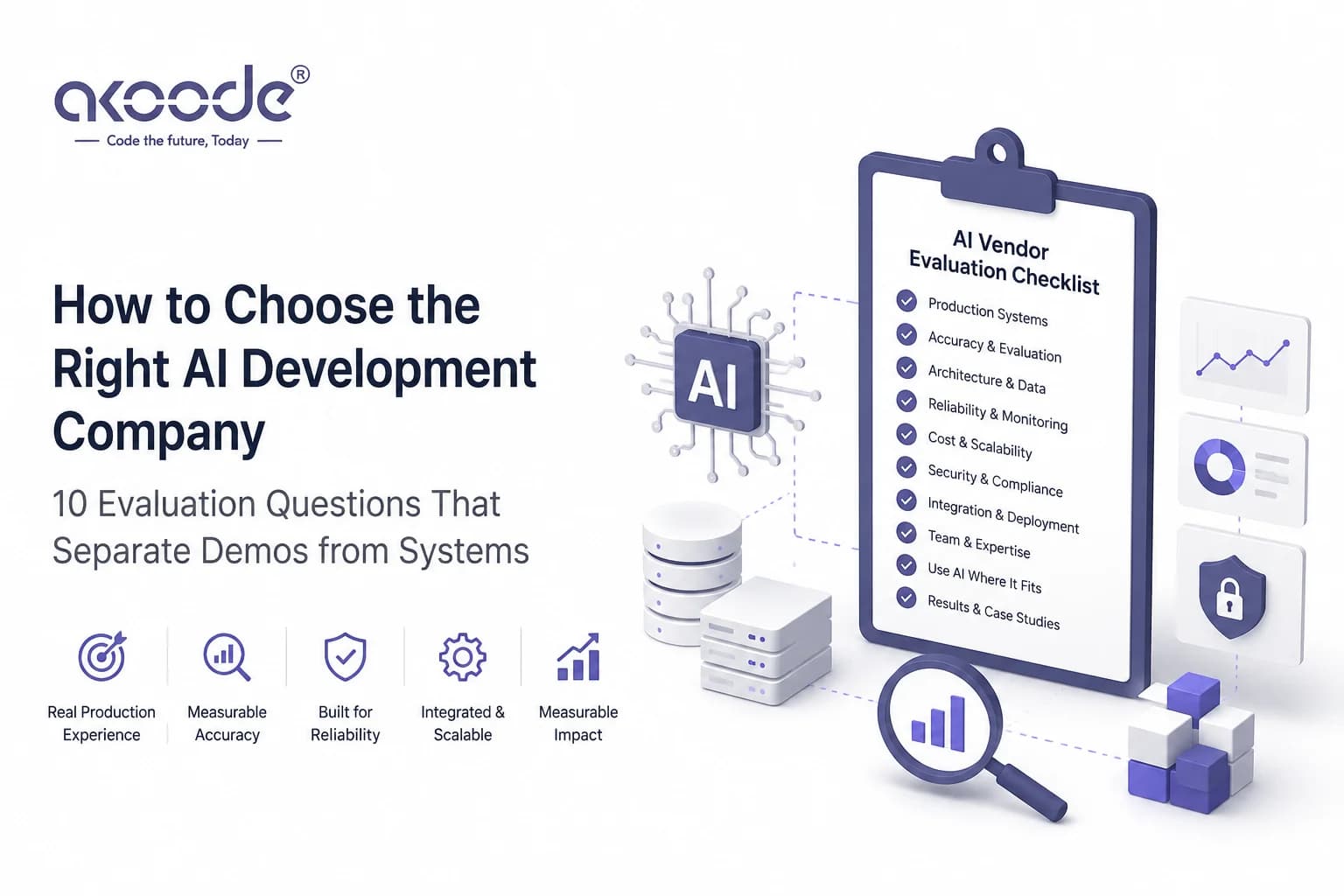
Choose an AI development company on evidence of production systems, not on capability claims. The three things that separate a partner who will deliver from one who will produce an impressive demo are: they can show you a system running in production today and describe how it has failed; they can tell you how accuracy will be measured and who builds the evaluation set; and they will tell you which parts of your problem should be solved without AI. Everything else — frameworks, model names, team size, portfolio volume — is secondary and easy to fake.
This article gives you ten evaluation questions, what a competent answer to each sounds like, what should disqualify a vendor, and a scoring model to compare shortlisted firms consistently.
1. Why this decision fails more often than it should
The failure rate in enterprise AI is not a rumour. MIT's Project NANDA study The GenAI Divide: State of AI in Business 2025 analysed roughly 300 publicly disclosed enterprise AI deployments alongside executive interviews and surveys, and found that around 95% of generative AI pilots delivered no measurable impact on profit and loss. Only about one in twenty produced value the business could point to.
The researchers were explicit that the cause was not model quality. It was approach: how the problem was chosen, how deeply the system was integrated into real workflows, and whether it could learn from feedback rather than repeating the same mistakes on every run.
One finding in that study matters directly for this decision. Organisations that bought from specialised vendors or built through partnerships succeeded substantially more often than those that built entirely in-house. That is not an argument that external help guarantees success — it is an argument that the selection of the partner is doing a lot of the work. The same study describes plenty of vendor-led pilots that went nowhere.
So the question is not whether to bring in an AI development company. It is how to identify the small proportion who have actually operated systems in production, as opposed to the much larger group who have built demos.
The structural problem with this market: AI capability is unusually difficult to assess from outside. A firm with three engineers who have read documentation can produce a demo that looks identical to one built by a team who has run inference at scale for two years. The difference only appears at month four, when production data turns out to be messier than the sample, when the token bill arrives, when the model provider updates a version and outputs shift, or when nobody can say whether last week's change made the system better or worse.
Your evaluation process has to surface that difference before the contract, not after.
2. The five types of firm calling themselves AI development companies
Understanding which category a vendor falls into explains most of what you will experience later.
Type | What they actually do | Good fit for | Watch for |
|---|---|---|---|
API integrators | Connect hosted model APIs to your systems. Real software engineering, limited AI engineering. | Well-defined features on top of a commercial model where accuracy tolerance is generous | No evaluation practice, no retrieval engineering, no cost modelling. Ask what they do when accuracy is insufficient |
Software agencies with a new AI page | General development firms who added AI to the service list in the last 18 months | Projects that are 80% conventional software with an AI component | Portfolio depth in AI specifically, not in software generally. Ask for AI systems in production, dated |
Research-heavy AI labs | Genuine model research, novel architectures, publications | Problems requiring something that does not yet exist | Very high cost for applied work. Most enterprise problems do not need frontier research |
AI product companies doing services | Sell a product, take custom work alongside it | Use cases close to their product's shape | Your custom build may be steered toward their roadmap. Ask about IP and portability |
Applied AI engineering firms | Build and operate custom AI systems end to end: data engineering, models, application, integration, MLOps | Most enterprise AI work | The category that contains both the best and the most inflated claims. This is where the ten questions matter most |
Checking breadth against depth
A related test: ask which AI disciplines the firm staffs in-house rather than subcontracts. A team that covers computer vision, deep learning, generative AI integration, data science and predictive analytics and integrated intelligence platforms can recommend the right approach to your problem. A team that only does one of them will recommend the one they do.
That is not an argument that broader is always better — a specialist vision firm may be the correct choice for a vision problem. It is an argument that you should know which you are hiring, because a single-discipline firm has a structural incentive to frame your problem in terms of the discipline they sell.
Note also that most AI projects are mostly software projects. The model is a component; the system around it is custom software, and it ships inside a web application, a mobile app, a SaaS product or an eCommerce platform. A vendor without real software engineering depth will build a working model and an unusable product.
Information gain worth internalising: most enterprise AI problems are applied engineering, not research. If a vendor is positioning on research credentials — lab affiliations, publication counts, academic pedigree — for a project that connects an existing model to your data, you are being sold something you are not buying. The reverse is also true: if your problem genuinely requires a novel approach, an integration shop will discover that four months in.
Classify honestly before you shortlist. The classification determines your budget range far more than geography does.
3. Should you hire at all? A four-question decision tree
[ORIGINAL ASSET 2 — decision tree graphic]
Before evaluating vendors, confirm that hiring one is the right move.
Question 1 — Can you write down the decision rule? If the logic is stable and expressible as rules, build conventional software. It will be cheaper, faster, testable, and it will not drift. → Do not hire an AI vendor.
Question 2 — Does a product already solve this well? Transcription, generic writing assistance, standard CRM enrichment, meeting summarisation and common support deflection are solved categories. Buying beats building unless your exceptions are where the cost lives. → Buy the product.
Question 3 — Do you have, or can you build, an internal team that will own this for years? AI systems require ongoing ownership. If the capability is core to your product and you can hire and retain the team, in-house is the right long-term answer — though the MIT data suggests the transition is harder than most organisations expect. → Build in-house, possibly with an external partner for the first system, or use staff augmentation to add specialist AI engineers to a team you already have.
Question 4 — Does the data exist? If the historical examples, documents or labelled images the use case requires do not exist and cannot be collected in a reasonable timeframe, the first project is building the data foundation. That is legitimate work, but scope it as data engineering and analytics rather than as an AI project. → Hire, but scope phase one as data readiness.
If you clear all four, hiring an AI development company is the right decision, and the rest of this article applies.
4. The ten evaluation questions
Ask these in the first technical conversation. Score the answers using the model in section 8.
Q1. Which parts of this problem would you solve without AI?
Why it matters: it is the fastest test of whether the vendor is optimising for your outcome or for scope. Any real problem has components better served by rules, a database query, a process change or an off-the-shelf tool.
A competent answer names specific components and explains why. "The routing logic is deterministic — that should be a rules engine. The extraction step needs a model. The validation is a schema check, not a model call."
Disqualifying answer: everything requires AI. Or a vague acknowledgement that "sometimes traditional software is better" without applying it to your problem.
Q2. How will accuracy be measured, on what data, and who builds the evaluation set?
Why it matters: this is the single strongest signal of production experience. Teams who have only shipped demos have never had to build an evaluation set, because nobody asked them to prove the system worked at month six.
A competent answer describes a labelled evaluation set built with your domain experts, scoring per case type rather than only in aggregate, a threshold that gates release, and continued sampling in production. For retrieval systems, they will separate retrieval quality from generation quality without being prompted — because a generation model cannot recover from being handed the wrong documents.
Disqualifying answer: benchmark scores for the underlying model. The model's performance on a public benchmark tells you nothing about your task.
Q3. What is the expected cost per transaction at our real volume, and what drives it up?
Why it matters: inference cost is the largest ongoing expense in most AI systems and the one most sensitive to design decisions. Vendors who have run systems at volume have opinions about this. Vendors who have not will quote build cost and go quiet on run cost.
A competent answer discusses context size, model routing between smaller and larger models by task difficulty, caching, output constraints, and the difference between cost per call and cost per successful task. They will ask about your volume before answering.
Disqualifying answer: "the API costs are negligible." They are negligible in a pilot and material in production. Read our AI development cost breakdown for the full driver list.
Q4. Where does our data go, who processes it, and what is retained?
Why it matters: it is an architecture question disguised as a compliance question, and the quality of the answer reveals whether they have deployed under real constraints.
A competent answer presents options rather than one default: commercial model APIs under contractual data terms, models hosted inside your own cloud tenant, or self-hosted open-weight models where data cannot leave your environment. They will describe what leaves your perimeter, retention for prompts and outputs, and how retrieval respects the permissions of the requesting user.
Disqualifying answer: a general assurance that the provider is secure, with no discussion of topology, retention or access control.
Q5. What does the system do when it is not confident?
Why it matters: every AI system is wrong sometimes. Production readiness is defined by what happens next, not by how rarely it happens.
A competent answer describes abstention behaviour, confidence thresholds that route cases to human review, citation requirements so an answer can be checked, structured output validation, and escalation paths. For agents, they will mention approval gates on anything that spends money, contacts a customer or writes to a system of record.
Disqualifying answer: claims that their approach eliminates hallucination. It does not. Grounding reduces error rates; it does not remove them, and a vendor who says otherwise is either inexperienced or selling.
Q6. Who owns the code, the models, the fine-tuned weights and the training data afterward?
Why it matters: ambiguity here becomes leverage later, particularly with vendors who also sell a product.
A competent answer is unambiguous and appears in the contract: full transfer on completion, including source code, model weights, training data and documentation. They will also be clear about what they cannot transfer — a commercial model provider's weights are not theirs to give.
Disqualifying answer: ownership described as "shared", or IP terms deferred to a later stage.
Q7. What happens after go-live — who monitors it, on what cadence, and at what cost?
Why it matters: this is where AI investments quietly stop paying back. Models drift, upstream data schemas change, providers update models, user behaviour shifts.
A competent answer covers drift monitoring on inputs and outputs, scheduled evaluation runs against a golden test set, a defined retraining trigger, a named owner, and a stated ongoing cost. They will tell you that leading indicators — rising human override rates, falling confidence scores — appear before any dashboard turns red, which is why the dashboard has to be instrumented up front.
Disqualifying answer: support framed only as bug fixing, or an assumption your team will handle it without any handover plan.
Q8. Show us a system you built that is running in production today, and describe how it failed at some point.
Why it matters: the second half is the real question. Every production system has failed. A vendor who cannot describe a failure has either not operated one long enough or is not being straight with you.
A competent answer is specific: what broke, how it was detected, how long it took, what changed afterward. Detection method is the most revealing detail — teams with real operational experience describe monitoring; teams without describe a customer complaint.
Disqualifying answer: only success stories, or failures attributed entirely to the client.
Q9. What will you need from us, and what happens if we cannot provide it?
Why it matters: AI projects slip on client-side dependencies more than on engineering. Access to source systems, domain experts to build evaluation sets, security review, data quality remediation.
A competent answer names the dependencies, puts them on the critical path in the plan, and describes what happens to the timeline if they are late. Vendors who have delivered will raise this before you do.
Disqualifying answer: a timeline with no client-side dependencies in it. That plan is fiction.
Q10. What would make you tell us not to proceed?
Why it matters: a partner who has no stopping conditions has no judgment you can rely on.
A competent answer names conditions: insufficient data, accuracy requirements the task cannot support, a use case where the volume does not justify the run cost, a process that needs fixing before automating. Good firms will describe a project they declined or advised a client out of.
Disqualifying answer: none. Every project is a fit.
5. How to verify production experience
Claims are cheap. These verification methods are not.
Ask for a live demonstration of a running system, not a slide. Sanitised is fine. What you are looking for is the operational surface: the monitoring dashboard, the evaluation results, the admin tooling. Teams who built for production have these. Teams who built for a pitch do not.
Ask what the system's accuracy is today versus at launch. The answer requires them to have measured both. Any specific number here is more informative than a portfolio.
Read a published case study for architecture, not adjectives. Look for the technical decisions and the constraints. As an example of the level of detail worth expecting: a diagnostic imaging system built to detect cervical spine fractures at individual vertebra level and classify chest pathologies, processing each study in under two seconds with explainability overlays clinicians could act on, is a set of specific engineering constraints — latency budget, granularity, interpretability requirement. Compare that to "we built an AI healthcare solution."
Check domain familiarity before the first meeting. A vendor who arrives already understanding your regulatory environment, data patterns and operational constraints shortens discovery and builds something that fits how the business runs. Ask what they have delivered in your sector — healthcare, finance and banking, insurance, manufacturing, logistics and supply chain, retail and eCommerce or real estate — and what constraint in that sector caught them out.
Two further examples of the specificity worth expecting: an offline quantity takeoff application built to run with zero cloud dependency because the drawings could not leave the firm's environment, and a generative AI catalogue pipelinebuilt for deterministic output because a marketing team needed identical rendering between runs. Both describe a constraint, not a capability. Browse full case studies for the pattern.
Ask a reference the right questions. Most reference calls are wasted on satisfaction. Ask instead:
What did they get wrong, and how did they handle it?
What did the project cost against the original estimate, and why did it change?
Who is maintaining the system now?
What is it costing you to run?
Would you give them the next project, and if not, what would need to be different?
Check whether the engineers on the call are the engineers on the project. Ask directly. Then ask to speak to the person who would actually be the technical lead. Some firms staff sales calls with senior people and delivery with juniors; the way to detect it is to ask early and specifically.
6. Cost and commercial structure
Cost is driven by data readiness, integration count, accuracy requirements, inference volume and security constraints far more than by the model. Two projects described identically can differ by an order of magnitude.
Structure | Best for | Advantage | Risk |
|---|---|---|---|
Fixed cost | Well-defined scope — proofs of concept, MVPs, defined launches | Budget certainty, milestone acceptance criteria | Change requests become adversarial; vendors pad estimates for uncertainty |
Time and materials / dedicated team | Evolving products, long-running development | Flexibility, priority control, capacity that scales | Requires active management; cost is open-ended without governance |
Filling a specific skill gap alongside an internal team | Fast, no recruitment overhead, your team keeps ownership | You supply the architecture and direction | |
Outcome-based | Rare, and usually the wrong shape for AI | Aligns incentives in principle | Attribution is genuinely hard — if accuracy is 92% and the business result is flat, who is accountable? |
A pattern worth using: fixed-cost the discovery and proof of concept, then decide. If you are a startup, this is the same logic as MVP development: buy the smallest artefact that produces real evidence before committing to the full build. It caps your exposure on the phase with the most uncertainty, gives you a real evidence base, and lets you evaluate the vendor's working style before committing to the build.
Two commercial signals worth noting. First, a vendor who quotes a full enterprise build without seeing your data is guessing, and the guess will be revised. Second, a proposal with no line for evaluation, monitoring or data preparation is not cheaper — it has moved those costs to month six.
7. Security, data handling and IP due diligence
Security decisions in AI systems are architectural. They are expensive to add after the system is live, which means they belong in the evaluation, not in the contract review.
What to establish before signing:
Deployment topology. Which of your data reaches a third-party model provider, under what contractual terms, in which region. This is as much a cloud and DevOps question as a modelling one, and the vendor should be able to answer both halves.
Access control in retrieval. If the system reads your documents, retrieval must be filtered by the requesting user's permissions at query time. A knowledge assistant that ignores document-level access control is a data leak with a friendly interface. Ask specifically how source-system permissions are mirrored.
PII handling. Detection and redaction before content reaches a model where the use case allows, tokenisation where identifiers must persist, encryption in transit and at rest, defined retention for prompts, outputs and logs.
Prompt injection exposure. Any system reading documents, emails, tickets or web content is reading text an attacker may control. Ask what mitigations apply: treating retrieved content as data rather than instruction, scoping agent tools narrowly, requiring approval on state-changing actions, validating outputs against a schema. A vendor claiming prompt wording alone solves this has not shipped one of these systems.
Audit logging. Request tracing, retained inputs and outputs subject to policy, recorded approvals on consequential actions, replayable agent execution traces.
Regulatory posture. For EU and UK operations, ask how the architecture produces evidence for the EU AI Act's obligations for your risk category. Note the distinction between a vendor who builds compliance-aware architecture and one who claims to certify your compliance. The second claim should make you cautious.
Subcontractors. Ask who else touches the code and the data.
It is also reasonable to ask whether the vendor publishes its own position on AI use. Akoode's is at AI usage policy.
On certifications: ask what the vendor actually holds, and treat described controls as more informative than claimed certifications. A firm that can walk you through its data flow diagram is telling you more than one that shows a badge.
8. The scoring model
[ORIGINAL ASSET 1 — vendor scoring matrix, downloadable]
Score each shortlisted vendor 1–5 against these criteria, weighted. Score immediately after each conversation, not from memory a week later.
Criterion | Weight | 1 = weak | 5 = strong |
|---|---|---|---|
Production evidence | 20% | Prototypes and pilots only | Multiple systems live, can describe failures and detection |
Evaluation practice | 15% | No evaluation methodology | Labelled sets, per-case scoring, release gates, production sampling |
Problem framing | 15% | Applies AI to everything | Names what should not use AI, proposes narrower scope than you asked for |
Integration depth | 10% | API calls only | Auth, permissions, data contracts, staged rollout, rollback |
Cost transparency | 10% | Build cost only | Run cost modelled, cost drivers named, cost per successful task |
Security architecture | 10% | Generic assurances | Topology options, retrieval-level access control, injection mitigations |
Post-launch model | 10% | Bug fixing | Monitoring, drift triggers, retraining cadence, named owner, stated cost |
Team access | 5% | Account manager intermediated | Direct access to the engineers building it |
Commercial terms | 5% | Ambiguous IP, shared ownership | Full transfer stated in contract, NDA before discovery |
Interpreting the result: a weighted score below 3.0 should be eliminated regardless of price. Between 3.0 and 3.8 is workable for a bounded first project. Above 3.8 is a candidate for a long-term relationship.
One override rule: a score of 1 on either production evidence or evaluation practice is disqualifying no matter how high the total. Those two criteria predict outcomes better than the other seven combined, because they are the hardest to fake and the most expensive to lack.
9. Common mistakes buyers make
Shortlisting on portfolio volume. Number of projects delivered says little about AI specifically, and nothing about how many are still running. Ask how many AI systems are in production right now.
Treating the demo as evidence. Demos are built to work. Ask what the demo would do with your messiest hundred records, then ask to see it.
Choosing on hourly rate. Rate differences of 30% are irrelevant next to a project that produces nothing. The MIT data is a reminder that the modal outcome in this category is zero return — optimising the price of a zero is not a saving.
Skipping the data assessment to save time. The assessment is where you find out whether the project is viable. Skipping it does not remove the risk, it defers its discovery to after the contract.
Buying an enterprise platform first. Organisations getting real value almost always started with one process where the cost was measurable, built it properly, measured it honestly and used the result to fund the next one. Platform-first programmes are the ones that appear in failure statistics. If the goal genuinely is organisation-wide change, treat it as a sequenced digital transformation programme with AI inside it, not as a single AI purchase.
Not asking who owns it afterward. Naming an internal owner before the build starts changes what gets built — because monitoring, documentation and handover become requirements rather than optional extras.
Confusing responsiveness with capability. The fastest proposal is often from the firm with the least work on. Judge the content, not the turnaround.
10. Recommendation
Run a three-stage process.
Stage one — classify. Decide whether your problem is applied engineering or research, and whether it should be built, bought or left alone. Use the decision tree in section 3. Most organisations skip this and shortlist vendors for a project that should not exist in its proposed form.
Stage two — evaluate on a real use case. Give three vendors the same specific problem, with real constraints and, under NDA, a representative data sample. Ask each for a technical conversation rather than a capability presentation. Score using section 8 immediately after each call.
Stage three — buy the discovery, not the build. Commission a fixed-cost discovery and data assessment from the leading candidate. It is a bounded investment, it produces something you own regardless of what follows, and it lets you evaluate how the vendor works before you commit to the build. If the assessment concludes the use case should wait, that is a successful outcome — you have avoided the modal failure in this market at a fraction of its cost.
FAQs
How long should choosing an AI development partner take?
Three to six weeks for a mid-sized project: one week to define the use case internally, two to three weeks of vendor conversations and technical sessions, one week to score and decide. Rushing it produces the failure modes in section 9; extending it past two months usually means the internal use case is not defined well enough.
How many vendors should we evaluate?
Three is the practical number. Two gives no comparison baseline; five produces evaluation fatigue and inconsistent scoring. Screen a longer list on written responses to questions 1, 2, 3 and 8, then run full technical sessions with three.
Should we choose a local firm or an international one?
Judge on capability, time-zone overlap and communication practice rather than location. Applied AI engineering skills are globally distributed and the quality ceiling is the same. What matters operationally is overlap hours with your team, whether you speak to the engineers directly, and whether they can meet your data residency requirements. Akoode works this way with clients in the United States and the United Kingdom from delivery teams in India and a US office.
Is a bigger AI development company safer?
Not inherently. Size correlates with process maturity and with the risk of your project being staffed by whoever is available. Ask the same question either way: who specifically will build this, and can we meet them.
What should the first project be?
One process where the current cost is measurable, the data already exists, and the outcome is visible enough to fund the next one. Avoid making the first project the most strategically important one — build the capability on something where a delay is survivable.
Do we need our own data scientists to work with an AI vendor?
No, but you need domain experts available to define correctness and help build the evaluation set. That is the dependency that most often delays projects, and it cannot be outsourced — only your people know what a right answer looks like.
What if we already have a failed AI pilot?
That is useful evidence, not a setback. Bring it to the evaluation and ask each vendor to diagnose why it failed. The quality of the diagnosis is one of the most informative signals you will get, and it costs nothing to obtain.
How do we avoid vendor lock-in?
Contract for full IP transfer including model weights and training data, require documentation as a deliverable rather than a courtesy, insist the system runs on infrastructure you control or can migrate to, and avoid proprietary abstraction layers that only the vendor can maintain.
Conclusion
The evidence on enterprise AI is not that the technology fails. It is that most organisations approach it in a way that cannot succeed — the wrong problem, insufficient data, no evaluation, no integration into real work, and no owner after launch. A well-chosen partner corrects for most of those failure modes, because they have already encountered each one.
Judge candidates on three things above all: production systems they can demonstrate and discuss honestly, a specific answer on how accuracy will be measured, and a willingness to tell you which parts of your problem do not need AI. Those three signals are difficult to manufacture and they predict the outcome better than anything on a capability slide.
If your organisation has moved past experimentation and needs a partner to design, build, integrate and operate a production AI system, explore Akoode's AI development capabilities. We start every engagement with a data and feasibility assessment, and we will tell you when a use case should wait or be solved without AI.
Request an AI Feasibility Assessment A working session on one specific use case: what your data supports, the architecture, what it would cost to run at your volume, and whether AI is the right tool for it.
Talk to an AI engineer
Related reading
AI development cost breakdown — the full driver list behind any estimate you receive
AI use cases in healthcare — what sector-specific evaluation looks like in practice
AI software development trends — context on what capable vendors should already be building
Get In Touch Now
View More Our Blog