


 May 1, 2026
Healthcare has always moved carefully. Every decision carries real consequences. A missed diagnosis. A delayed treatment. A wrong prescription. The stakes are higher than in almost any other industry.
That is exactly why AI in healthcare is such a significant development.
Around 66% of physicians now use health AI tools, nearly double the rate from just two years ago. That shift did not happen because of hype. It happened because AI is solving real clinical and operational problems at measurable scale.
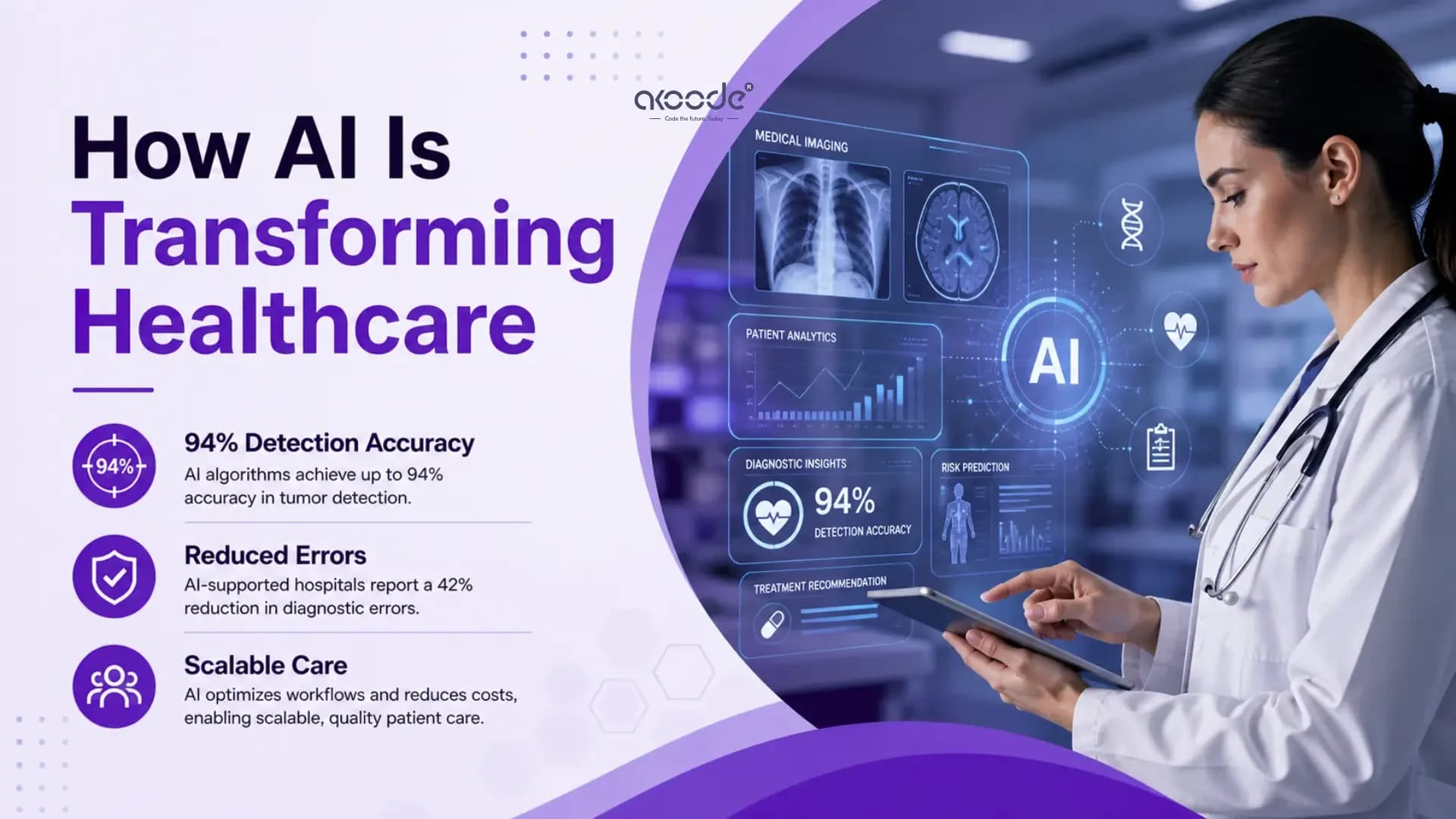
AI algorithms now achieve up to 94% accuracy in tumor detection. AI-supported hospitals report a 42% reduction in diagnostic errors. And AI is projected to reduce administrative costs by 20 billion dollars annually in the US alone.
These are not forecasts. They are outcomes from systems already running in hospitals and clinics today.
This guide covers the top AI use cases in healthcare in 2026, with real-world context for each one. It is written for healthcare leaders, founders building healthtech products, and business decision-makers evaluating where AI can create the most impact.
Why Is AI Adoption in Healthcare Accelerating Right Now?
The case for AI in the healthcare industry has existed for years. But adoption has moved faster in the last two years than in the previous decade combined.
Several things changed at once.
Over 340 FDA-approved AI tools are now in active clinical use, focused primarily on diagnostic imaging for conditions like brain tumors, strokes, and breast cancer. Regulatory clarity reduced one of the biggest barriers to adoption.
Electronic health records have created massive structured datasets that AI models can actually learn from. Hospitals now have years of digitized patient records, lab results, imaging data, and outcomes data sitting in systems that AI can read.
The average return on AI investment in healthcare is 3.20 dollars for every dollar spent, with most organizations seeing that return within 14 months. The financial case became impossible to ignore.
And the cost of not adopting has risen. Clinician burnout, staff shortages, and growing patient volumes have put pressure on every part of the system. AI is not just a capability upgrade. For many healthcare organizations, it is becoming an operational necessity.
How Is AI Being Used in Medical Imaging and Diagnostics?
Medical imaging is the most mature and widely deployed area of AI in healthcare applications. The results are consistently strong.
Radiology accounts for 76% of all AI-enabled medical device authorizations from regulators through the end of 2025. The concentration makes sense. Medical imaging is a pattern recognition task at its core. AI models trained on millions of scans get extremely good at spotting the kind of subtle variations that lead to early diagnosis.
Medtronic's GI Genius system detects colorectal polyps in real time during endoscopy. Philips, Siemens Healthineers, and GE HealthCare have integrated AI into imaging across ultrasound, brain scans, and other modalities. These are not pilots. They are production systems running in clinical environments daily.
Viz.ai analyzes brain scans to detect strokes and flag urgent cases within minutes, significantly reducing the time between scan and clinical decision. In stroke treatment, speed of intervention directly determines outcomes. Cutting that decision window has real consequences for patient survival and recovery.
AI algorithms can now measure parameters like ejection fraction from echocardiogram videos and segment brain lesions on MRI scans, tasks that previously required significant manual effort from trained specialists. Automating these measurements produces consistent, quantitative data. It also frees specialist time for more complex clinical judgment.
The practical benefit for hospital radiology departments is significant. Radiologists review more scans per shift with fewer missed findings. Workflow speed increases. Diagnostic confidence improves.
How Does AI Support Clinical Decision-Making?
Clinical decision support is one of the fastest-growing categories of AI in healthcare in 2026. The model is straightforward. AI analyzes patient data in real time and surfaces recommendations that support the clinician's judgment.
Electronic health records enhanced with generative AI can save physicians time by producing concise summaries of patient histories before appointments, simplifying navigation, and automating note-taking during consultations.
This matters more than it might sound. Physician documentation burden is one of the primary drivers of burnout. Clinician burnout rates declined from 51.9% to 38.8% after short-term adoption of AI-assisted documentation tools. That is a significant human and operational outcome from a relatively contained technology change.
AI clinical decision tools also help at the diagnostic level. A 2024 study published in JAMA Network Open found that medical diagnoses based on AI-assisted analysis were significantly more accurate than those made by doctors working without AI support. The research is still building, but the directional signal is consistent across multiple studies.
In practice, the most effective implementations treat AI as a support layer. The clinician makes the final call. The AI surfaces patterns, flags risks, and reduces the chance that something important gets missed.
How Is AI Changing Predictive Analytics and Patient Monitoring?
One of the most valuable shifts AI brings to the healthcare industry is moving care from reactive to proactive.
Nearly 70% of healthcare providers now use predictive analytics to identify high-risk patients and intervene before their condition worsens. Providers using these tools have achieved up to a 50% reduction in hospital readmissions.
That number is significant in both clinical and financial terms. Hospital readmissions are expensive for providers and painful for patients. Reducing them by half through earlier intervention changes the economics and outcomes of care delivery.
One health system using an AI-guided remote patient monitoring program cut 30-day readmissions by 70% and reduced cost of care by 38%.
Remote patient monitoring is the delivery mechanism for much of this predictive capability. AI-enabled sensors track vitals, glucose levels, cardiac rhythms, and other markers continuously. When readings drift outside safe ranges, the system alerts care teams before a crisis develops.
The market for AI-assisted virtual nursing tools is projected to generate 20 billion dollars in annual savings globally. These tools do not replace nurses. They handle routine monitoring and flagging so clinical staff focus where their judgment is actually needed.
AI can rule out heart attacks twice as fast as humans with 99.6% accuracy. In emergency settings, speed of ruling out a serious condition is as important as diagnosing one. Faster triage means faster treatment for the patients who genuinely need it.
How Is AI Accelerating Drug Discovery and Development?
Drug development is one of the most expensive and time-consuming processes in any industry. A single drug typically takes over a decade and billions of dollars to reach patients. AI is beginning to compress both timelines and costs.
The core application is molecular screening. AI models trained on biological and chemical data can analyze millions of molecular compounds to identify which ones are likely to interact effectively with a target pathogen. What used to require years of lab work can now be explored computationally in weeks.
AI can screen a pharmaceutical company's molecular library for efficacy and help predict drugs' safety profiles and potential side effects before clinical trials begin. This shifts a significant amount of early-stage risk away from expensive human trials toward computational analysis.
AI is also improving clinical trial design and recruitment. Pharmaceutical companies are analyzing patient health records to identify trial participants more precisely, matching patient profiles to trial criteria faster and more accurately than manual screening allows.
The FDA released its first draft guidance on AI use in drug development in early 2026, acknowledging that AI use in regulatory submissions has grown exponentially since 2016. Regulatory frameworks are catching up with the pace of adoption, which will accelerate the path from AI-assisted discovery to approved treatments.
How Does AI Improve Hospital Operations and Administration?
The clinical applications get most of the attention. But some of the most consistent and measurable AI value in healthcare comes from operational improvements.
AI is projected to reduce administrative costs in US healthcare by 20 billion dollars annually. The sources of that saving are spread across scheduling, billing, documentation, and resource allocation.
Scheduling is one of the clearest wins. AI systems analyze historical patterns, staff availability, equipment utilization, and patient volume forecasts. They produce schedules that reduce bottlenecks and improve throughput without the manual planning overhead that scheduling teams currently carry.
Billing and prior authorization are significant time drains for clinical staff. AI-based tools can help write prior authorization letters to insurance companies, automate billing workflows, and remind patients of upcoming screenings and appointments. Each of these tasks is repetitive, rule-based, and well-suited to AI automation.
AI-generated operative reports show 87.3% accuracy, outperforming surgeon-written reports which averaged 72.8% accuracy. This is an important finding. The documentation that follows a procedure is critical for billing, compliance, and continuity of care. Higher accuracy here has downstream benefits across the system.
71% of US acute-care hospitals have now integrated predictive AI into their electronic health record systems. The technology is no longer a niche experiment. It is becoming standard infrastructure for hospital operations.
How Is AI Being Used in Personalized Medicine?
Standard treatment protocols are designed for populations. But individual patients vary in how they respond to drugs, absorb medications, and recover from procedures. Personalized medicine uses patient-specific data to adjust treatment plans.
AI makes this practical at scale.
AI algorithms can analyze individual patients' genetic profiles to predict how they will respond to specific drugs, helping clinicians determine optimal dosage and timing based on personal biology rather than population averages.
Genomic data is central to this. As genetic sequencing has become cheaper and more accessible, the volume of genomic data available to train AI models has grown sharply. The result is models that can match patient profiles to treatment options with increasing precision.
This approach is particularly relevant in oncology, where treatment selection has historically involved significant trial and error. AI models trained on outcomes data across large patient populations can identify which treatment protocols perform best for patients with a given tumor profile, genetic markers, and health history.
The longer-term trajectory of this capability is significant. As more patient data accumulates and models improve, personalized medicine will shift from a specialist capability to a standard clinical practice across more conditions.
How Is AI Changing Surgical Procedures?
Robotic surgery has existed for decades. AI is now adding a layer of intelligence that changes how those systems perform.
The AI-assisted robotic surgery market is projected to generate 40 billion dollars in annual value by 2026, making it the largest single application category in the AI healthcare market.
AI contributions to surgery include pre-operative planning, instrument positioning guidance, and real-time feedback during procedures. The systems analyze medical imaging to map anatomy before an operation and guide instrument movement with greater precision than unaided human control allows.
The clinical outcomes are measurable. AI-assisted procedures consistently show lower complication rates, reduced blood loss, and shorter hospital stays compared to traditional approaches in the same procedure categories. The combination of AI planning with robotic execution removes some of the variability that comes with individual surgeon technique.
AI-assisted surgeries could shorten average hospital stays by more than 20%, generating potential annual savings of 40 billion dollars. At that scale, the impact reaches beyond individual outcomes to the structural capacity of healthcare systems.
What Are the Challenges of AI in Healthcare Applications?
Real adoption requires honesty about where the model does not work cleanly.
Data quality and silos. AI models are only as good as the data they train on. Healthcare data is often fragmented across incompatible systems. Cleaning, standardizing, and connecting that data is expensive and slow. The lack of interoperability across electronic health records from different vendors has significantly limited the data available for AI model training.
Clinician trust. Medical practitioners can be reluctant to rely on systems that could produce errors or appear to replace clinical judgment. AI tools need to function as genuine assistants that improve care, starting with lower-risk use cases before moving into higher-stakes decisions.
Bias in training data. AI models trained on datasets that do not represent diverse patient populations can produce biased outputs. A diagnostic model trained primarily on data from one demographic group may perform less accurately for others. This is an active research and governance challenge across the industry.
Regulatory complexity. Healthcare is one of the most regulated industries in any market. Deploying AI in a clinical environment requires navigating approval frameworks, liability structures, and compliance requirements that vary by country and by the specific clinical application.
Black box decisions. Many AI models cannot fully explain how they reached a conclusion. In healthcare, where clinicians need to understand and defend their decisions, unexplainable AI outputs create trust and accountability problems that purely accurate models cannot solve on their own.
What Are the Key AI Trends in Healthcare Shaping the Next Phase?
The next wave of AI in healthcare will be driven by two emerging categories: agentic AI systems capable of autonomous decision-making and task execution, and physical AI systems powering robotics and intelligent clinical hardware.
Generative AI is expanding beyond documentation into clinical reasoning support. Large language models are being tested for consultation transcription, medical record management, and differential diagnosis support. Tools like Claude and ChatGPT are being evaluated for transcribing clinical consultations and structuring medical records, reducing time spent on documentation by clinical staff.
Population health management is shifting from retrospective reporting to real-time forecasting. AI systems are beginning to identify at-risk communities and guide preventive interventions before conditions become crises. This moves healthcare spending from treatment toward prevention, which is both more cost-effective and better for patients.
By 2030, the global AI in healthcare market is projected to reach 110 billion dollars. That growth will not be evenly distributed. Organizations that build the data infrastructure, governance frameworks, and clinical workflows to support AI today will be positioned to move faster as capability continues to compound.
Conclusion
AI in healthcare has passed the proof-of-concept stage. The results are real, the adoption is accelerating, and the organizations that move deliberately now will carry a meaningful advantage in clinical outcomes, operational efficiency, and cost structure.
The most important thing to understand is that AI in the healthcare industry is not a single technology. It is a set of capabilities applied across imaging, diagnostics, drug discovery, operations, and patient monitoring. Each application has its own maturity curve, its own implementation requirements, and its own return on investment profile.
Getting the technology right matters less than getting the implementation right. The hospitals and health systems seeing measurable results are the ones that combined AI capability with clean data, proper clinical workflows, and a clear governance structure from the start.
Akoode builds custom AI-powered healthcare platforms including patient management systems, diagnostic web applications, and data integration tools for healthtech startups and hospital networks
Akoode Technologies is a leading AI and software development company headquartered in Gurugram, India, with a US office in Oklahoma. From AI-powered web applications and machine learning integrations to custom healthcare software and full stack development, Akoode builds technology that solves real operational and clinical challenges for healthcare organizations, startups, and enterprises across 15+ industries globally. If you are building or evaluating AI for a healthcare application, the right technical foundation makes the difference between a system that scales and one that stalls.
Frequently Asked Questions
1. What are the top AI use cases in healthcare in 2026?
The leading use cases include medical imaging and diagnostics, clinical decision support, predictive patient monitoring, drug discovery, administrative automation, personalized medicine, and AI-assisted robotic surgery. Each area has active deployments producing measurable clinical and operational outcomes.
2. What is AI in healthcare and how does it work?
AI in healthcare uses machine learning models trained on clinical data to identify patterns, make predictions, and support decisions across medical and operational functions. The models process inputs like medical images, patient records, lab results, and genomic data to produce outputs that support or automate specific tasks.
3. What are the real benefits of AI in the healthcare industry?
Benefits include faster and more accurate diagnostics, reduced clinician burnout through documentation automation, lower hospital readmission rates through predictive monitoring, accelerated drug discovery timelines, and significant reductions in administrative costs. The average return on AI investment in healthcare is around 3.20 dollars per dollar spent.
4. What are the biggest challenges of using AI in healthcare applications?
The main challenges are data quality and fragmentation across systems, clinician trust and adoption, bias in training datasets, regulatory complexity, and the difficulty of explaining AI-generated decisions in clinical contexts. None of these are insurmountable, but each requires deliberate planning before deployment.
5. What are the current AI trends in healthcare to watch in 2026?
Key trends include the expansion of generative AI into clinical documentation and reasoning support, growth in agentic AI systems that can execute multi-step clinical workflows autonomously, deeper integration of predictive analytics into electronic health records, and the use of AI to manage population health at scale.
6. How is AI being used in healthcare in India?
AI adoption in Indian healthcare is growing, with applications in diagnostic imaging, telemedicine platforms, drug discovery at pharmaceutical companies, and hospital operations management. The combination of large patient populations, growing digital health infrastructure, and strong AI engineering talent makes India both a significant market for AI healthcare applications and an active development hub for the underlying technology.
Get In Touch Now
View More Our Blog