



 April 21, 2026
The Evidence Is Already Here
Something has shifted permanently in the global AI landscape — and the data makes it impossible to ignore.
In February 2026, 92 countries and international organisations endorsed the India AI Impact Summit Declaration in New Delhi. The same summit catalysed over $200 billion in AI-related investment commitments across infrastructure, foundation models, hardware, and applications. India hosted that summit. India wrote that declaration. And India is already running the infrastructure on which much of the world's next chapter of AI will be built.
This is no longer a prediction. It is a description of what is already happening in May 2026.
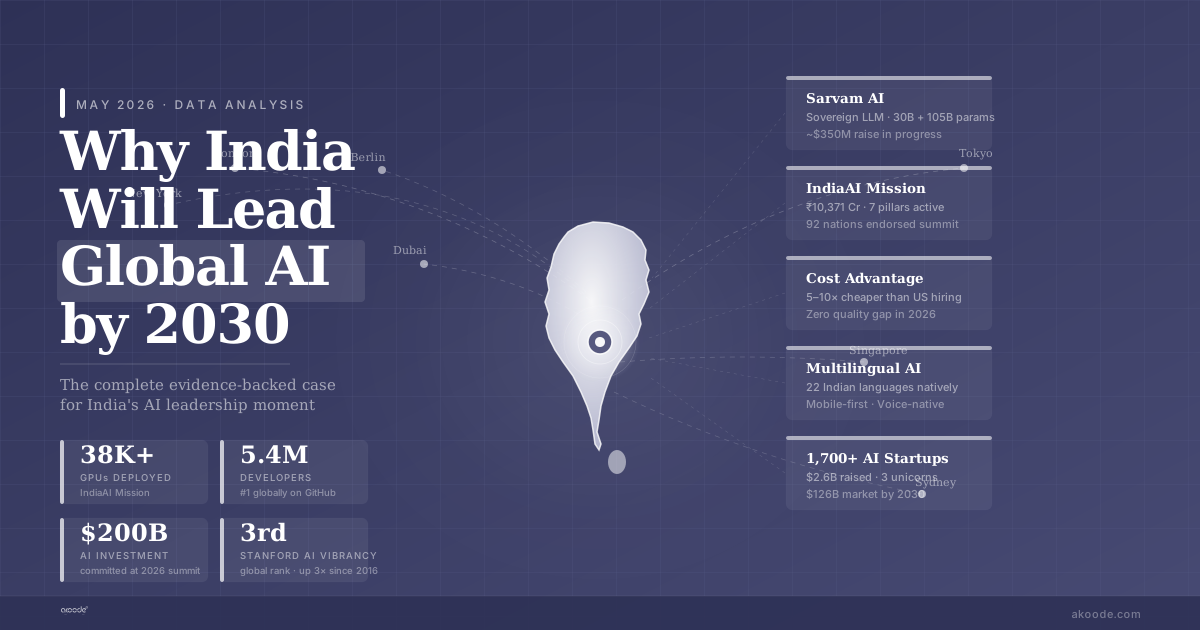
India today sits at third place in Stanford University's Global AI Vibrancy Tool — a composite ranking of talent, infrastructure, research output, and adoption. Its AI talent concentration has grown more than threefold since 2016. More than 1,700 AI-focused startups operate in the country. The national AI compute cluster has surpassed 38,000 GPUs provisioned under the IndiaAI Mission, with another 20,000 announced for deployment in the weeks following the February summit.
At Akoode Technologies, we build AI-powered software for global clients from Gurugram. What we're watching from inside India's technology ecosystem right now is unlike anything in three decades of Indian IT — including the outsourcing boom, the mobile revolution, or the SaaS wave. Those were India servicing global technology. What's happening in 2026 is India creating it.
India's Position in the Global AI Race Right Now
Before examining why India is positioned to lead, it's worth establishing where it stands in May 2026 with verifiable data:
3rd globally in Stanford's AI Vibrancy Tool, behind only the US and China
5.4 million software developers — the most in the world on GitHub open-source contributions
1,700+ AI-focused companies and startups, with 3 AI unicorns confirmed (Krutrim, Neysa, Kore.ai)
$2.9 billion+ in venture capital raised across India's top AI players
₹10,371.92 crore ($1.1 billion USD) government commitment to the IndiaAI Mission
38,000+ GPUs already operational in the national AI compute pool
India's AI market projected at $126 billion by 2030, with a potential $1.7 trillion GDP impact by 2035, per the Google / Inc42 Bharat AI Startups Report 2026
62% of Indian workers regularly use generative AI at work, per the EY 2025 Work Reimagined Survey — one of the highest adoption rates globally
India is not closing in on AI leadership. It is exercising it.
The IndiaAI Mission: What's Actually Been Built
Most coverage of India's AI ambitions focuses on the announced budget. What's more instructive is what has actually been delivered as of May 2026 — because the gap between announcement and execution is where most countries' AI strategies quietly die.
India's gap has not been quiet. It has been closed at speed.
The IndiaAI Mission, approved by the Union Cabinet in March 2024 with a ₹10,371.92 crore outlay, is structured across seven pillars. Here is the on-the-ground status of each, as of Q1 2026:
Compute Infrastructure: The national AI compute pool surpassed 38,000 GPUs, with access offered at a subsidised rate of ₹65 per hour — a benchmark that makes high-performance AI training economically viable for university labs, solo researchers, and early-stage startups alike. This is not theoretical access. Startups are actively training models on this infrastructure today.
Foundation Models: The government selected 12 startups — including Sarvam AI, Soket AI, Gnani AI, IIT Bombay's BharatGen consortium, Fractal Analytics, and Tech Mahindra Maker's Lab — to develop India's first indigenous large multimodal models. Sarvam AI, the government's primary pick for a sovereign foundational model, unveiled both Sarvam-30B and Sarvam-105B at the India AI Impact Summit 2026.
AIKosh Dataset Platform: As of December 2025, the platform hosts over 5,500 datasets and 251 AI models spanning 20 sectors, with 385,000+ platform visits, 11,000 registered users, and 26,000 dataset downloads. This is the largest structured open AI training dataset in the Asia-Pacific region.
AI Application Development Initiative: 30 applications approved by July 2025 across healthcare, agriculture, climate, governance, and assistive learning. Active sector-specific hackathons including the CyberGuard AI Hackathon are continuously feeding production-ready AI solutions into public systems.
FutureSkills: Supporting 500 PhD fellows, 5,000 postgraduate students, and 8,000 undergraduate students. 200+ fellowship awards made by mid-2025. 31 Data and AI Labs established in Tier-2 and Tier-3 cities via NIELIT. 174 ITIs and polytechnics across 27 states approved to set up additional AI labs.
AI Governance Framework: India published its AI governance guidelines in November 2025 — a "light-touch," risk-based approach that explicitly encourages innovation while maintaining accountability. The framework aligns with EU, US, and UK regulatory philosophies without duplicating their compliance burden on Indian developers.
Startup Financing Facility: Direct risk capital and grant support flowing to deep-tech AI ventures, with the broader sector attracting over $200 billion in announced investment commitments at the February 2026 summit.
India's execution track record on digital public infrastructure — UPI, Aadhaar, ONDC, DigiLocker — is the strongest of any large democracy in history. The IndiaAI Mission is following the same delivery architecture. The results are already visible.
India's Homegrown AI Companies Competing Globally
The most important development in India's AI story in 2025–2026 is not government policy. It is the emergence of genuinely world-class AI companies built from scratch in India, for the world.
Sarvam AI is the clearest example. Founded in 2023 by Vivek Raghavan and Pratyush Kumar — who previously built AI4Bharat at IIT Madras — Sarvam has raised approximately $53.8 million from Lightspeed, Peak XV Partners, and Khosla Ventures, with a reported $350 million funding round at a ~$1 billion valuation in advanced discussions as of early May 2026. The government selected Sarvam from 67 competing companies to build India's first sovereign foundational LLM. Its Sarvam-1 model runs four to six times faster than competing models in Hindi and 10 regional languages, while operating efficiently on mobile phones. Its Bulbul V3 voice model delivers 35 professional voices across 11 languages. In February 2026, it launched Sarvam Edge, an on-device AI stack that runs entirely offline — a genuinely novel architecture for privacy-preserving inference at the edge. Sarvam also signed an MoU with the Tamil Nadu government for India's first Sovereign AI Park, with projected investment of ₹10,000 crore.
Krutrim made headlines as India's first AI unicorn, reaching a $1 billion valuation in early 2024. It has trained its models on over 2 trillion tokens and supports understanding and generation in 22 Indian languages. In 2026, Krutrim pivoted toward AI cloud infrastructure — a strategically sound move that reflects the real market dynamics of India's enterprise AI segment. The company reported ₹3 billion (~$31.5 million) in revenue for FY2026, a threefold increase year-over-year, with its first annual net profit and margins above 10%. Over 25 enterprise customers across telecom, financial services, and healthcare now use its compute infrastructure, with most GPU capacity committed to external workloads.
Neysa is another AI unicorn focused on compute and data centre infrastructure, having secured $50 million in equity and $1.2 billion in financing commitments. It is directly addressing India's need for accessible, energy-efficient AI training infrastructure.
Fractal Analytics, valued at $1.6 billion (formerly $2.4 billion in private markets), serves Fortune 500 clients globally and is actively preparing for an IPO. Qure.ai is transforming medical imaging with AI diagnostics. Uniphore, with nearly $985 million in total funding and a $2.5 billion valuation, leads in conversational AI for enterprise.
India now has more than 170 funded AI startups that have collectively raised over $2.6 billion. The highest number of new generative AI startups were founded in 2023 — the same year ChatGPT went mainstream globally. India's founding velocity matched Silicon Valley's. The exit velocity is beginning to follow.
The World's Largest English-Speaking Developer Workforce
India produces approximately 1.5 million engineering graduates every year. They learn, code, document, and collaborate in English. This single structural fact is worth more to the global AI economy than any GPU cluster.
English is the language of open-source development. It is the language of GitHub, of AI research papers at NeurIPS, ICLR, and ACL, of enterprise contracts, and of international product teams. China's developer base — larger in absolute numbers — is fundamentally language-isolated from global collaboration. India's workforce is globally plug-and-play from graduation day.
India's 5.4 million developers are not just the largest English-speaking technical workforce in the world. They are the most globally networked. Indian researchers now co-author papers at NeurIPS, ICLR, and CVPR at rates rivalling any European country. Indian engineers hold Kaggle Grandmaster titles. They lead ML infrastructure teams at Google DeepMind, Meta AI, and Microsoft Research.
The AI talent concentration has grown more than threefold in India since 2016. It is growing faster than anywhere except the US. And unlike the US, the pipeline is accelerating, not plateauing.
For a company in New York, London, Dubai, or Sydney: an Indian AI engineer hired on Monday is making meaningful contributions to a production codebase by Friday, with zero language overhead, zero cultural friction in written communication, and zero time lost to translation.
Digital Public Infrastructure as an AI Superpower
India's public digital infrastructure is already one of the most strategically significant AI assets on the planet — and most people outside India still haven't internalised what that means.
UPI processed over 13 billion transactions in a single month in 2025. Aadhaar has enrolled 1.38 billion people with biometric verification. DigiLocker has issued over 6 billion verifiable government documents. ONDC is actively dismantling e-commerce monopolies by opening up supply chains to any participant.
Taken together, these systems represent the world's largest collection of real-world transactional and behavioural training data across healthcare, agriculture, rural finance, logistics, and government — at planetary scale, across populations that Western AI training datasets have barely touched. The models that will be built on this data will be genuinely unlike anything trained on Western internet text alone.
This is not aspirational. Nations including Singapore, the UAE, France, Brazil, and Indonesia are actively studying and adopting India's infrastructure architecture. The approach has become a geopolitical export in its own right — India exporting the template for how nations build AI-ready digital infrastructure.
UPI's architecture is the global standard for real-time domestic payments. Aadhaar's scale is unmatched by any identity system anywhere. When Indian AI labs begin systematically mining this data under proper governance frameworks, the resulting models will have advantages in diversity, recency, and breadth of population coverage that no competitor can replicate.
Building AI for the Next 3 Billion Users
The next billion AI users are not English-speaking professionals on high-bandwidth desktop computers. They are farmers in Maharashtra accessing crop advisory tools in Marathi on a budget smartphone. They are healthcare workers in Uttar Pradesh using diagnostic assistance in Hindi on a 4G connection. They are students in Tamil Nadu interacting with intelligent tutoring in Tamil on an ₹8,000 device.
Indian AI companies are the only organisations building natively for this reality at any meaningful scale — and the architecture they're developing is the right architecture for the majority of the human population, not just India.
AI4Bharat at IIT Madras covers all 22 constitutionally scheduled Indian languages with state-of-the-art NLP benchmarks and openly available datasets. Sarvam AI's models are explicitly designed for low-latency, mobile-first, voice-native deployment in low-bandwidth environments. Bhashini, the government's AI-powered language translation initiative, enables real-time machine translation across Indian languages in live applications — and its live demo at the India AI Impact Summit 2026 drew international attention.
India isn't solving a niche regional market. It is solving the AI problem that the world's largest companies have consistently failed to solve: how do you make AI genuinely work for people who don't speak English, don't have reliable broadband, and are accessing your product on a three-year-old mid-range phone?
Whoever solves that problem at scale wins the next two billion AI users. India is the only ecosystem currently doing so.
The Reverse Brain Drain Reshaping India's AI Ecosystem
For roughly two decades, the pattern was predictable: India's best engineers built Google, Microsoft, Meta, and OpenAI — and stayed abroad. That pattern is visibly reversing in 2025 and 2026.
Senior engineers and product leaders who built AI systems at the world's most demanding companies are returning to India to found startups. They are bringing more than technical skill. They are bringing fundraising relationships, product intuition developed on systems used by hundreds of millions of people, and the credibility to close enterprise contracts in New York and London from a Bengaluru office.
The market has responded. India attracted over $8 billion in venture capital annually in recent years, with AI leading sector allocation in Q1 2025 ($3.1 billion across 232 deals). The India AI Impact Summit 2026 alone catalysed $200+ billion in announced investment commitments.
The companies that will define the next decade of global software are being founded in India right now. The founders building them understand global markets because they spent years working in them. The difference from the previous generation is that they chose to build from India, for the world — rather than building in Silicon Valley for the Silicon Valley market.
2026 Developer Cost Comparison: India vs USA
The cost advantage of building in India is not a secret. But the precise scale of it — stated in verified 2026 numbers — is worth spelling out explicitly, because it has direct implications for every technology organisation's build vs. delay decision.
The figures below reflect confirmed market rates as of May 2026. Indian figures represent CTC at Tier-1 firms in Bengaluru, Gurugram, Hyderabad, and Pune. US figures include base salary, employer-paid benefits, payroll taxes, and standard equity grants.
Role | India CTC (INR/year) | India CTC (USD/year) | US Total Comp (USD/year) | Effective Savings |
|---|---|---|---|---|
Senior AI / ML Engineer | ₹25–58 Lakh | ~$27K–$62K | $250K–$400K | Up to 85% |
Senior Full-Stack Developer | ₹12–30 Lakh | ~$13K–$32K | $140K–$200K | Up to 84% |
Mobile App Developer | ₹10–25 Lakh | ~$11K–$27K | $130K–$180K | Up to 85% |
Data Scientist | ₹20–50 Lakh | ~$21K–$53K | $180K–$320K | Up to 83% |
DevOps / Cloud Engineer | ₹15–35 Lakh | ~$16K–$37K | $150K–$220K | Up to 83% |
Dedicated Team via Akoode Staff Augmentation | ₹1.2L/month | ~$1,277/month | $15K–$25K/month | Up to 91% |
The critical question in 2026 is not whether Indian engineering costs less. It does, by 5–10x. The critical question is whether the quality difference justifies the premium for US-based hiring.
The answer, in 2026, is clearly no. The same engineers who hold Kaggle Grandmaster titles, publish at NeurIPS, and lead ML infrastructure at Google are also available in Bengaluru and Gurugram. The cost differential has not closed. The quality differential has.
Every month a global organisation delays building its India engineering presence is a month of compounding cost disadvantage. At ₹94 = $1 USD, a single senior AI role in San Francisco at $350,000 total compensation costs more than 8 equivalent Bengaluru roles. That delta funds your entire product engineering bench — for the cost of one US hire.
India vs USA vs China: The Full AI Scorecard
Factor | India | USA | China |
|---|---|---|---|
Developer volume | 5.4M, fastest growing globally | ~4M | 7M+ |
English-language ecosystem | Native technology culture | Native | Major structural barrier for global collab |
Government AI investment | ₹10,371 Cr + $200B invited commitment | $1.8B+ federal | $15B+ state-directed |
Open-source culture | Strong, government-mandated openness | World-leading | Heavily restricted |
Cost for global companies | 5–10x cheaper than USA | Highest globally | 3–4x cheaper than USA |
Multilingual AI (non-English) | 22 Indian languages, voice-native | English-first | Mandarin-centric |
Global trust and governance | High — democratic, transparent | High | Low — state supervision, geopolitical risk in EU/US/UK markets |
Digital public infrastructure | UPI, Aadhaar, ONDC, DigiLocker, Bhashini | Fragmented, private-sector led | WeChat / Alipay ecosystem |
Startup ecosystem rank | 3rd globally | 1st | Growing but restricted |
AI vibrancy rank (Stanford) | 3rd | 1st | 2nd |
Enterprise regulatory risk | Low | Low | Growing — EU AI Act, US executive orders create active risk |
The comparison that matters most for international enterprises is not raw investment volume. It is the risk profile of the AI ecosystem you're building on. China's state-directed, opaque AI infrastructure presents growing compliance risks for organisations subject to EU, UK, and US AI governance frameworks. India's democratic, open-source-first approach aligns naturally with the regulatory direction of every major Western market.
Choosing an AI development partner in 2026 is a 20-year decision about which ecosystem your technology stack is aligned with.
What Global Businesses Should Do Right Now
The companies winning the next decade of AI are combining world-class product leadership with the execution velocity and cost structure that only an India-first engineering strategy delivers.
This is not a theoretical model. It is the operating reality of Amazon, Google, JPMorgan, Salesforce, and dozens of other category leaders whose India engineering centres are not back-office functions — they are the teams responsible for production AI infrastructure their customers rely on daily.
For organisations that haven't structured a dedicated India engineering presence yet, the financial logic is stark: every month spent hiring AI engineers at US market rates is a month the same capability could have been built in India at 1/8th the cost, from a talent pool with no quality deficit.
The practical path for most organisations:
Start with a dedicated team engagement. Rather than attempting to replicate your entire US engineering org in India overnight, begin with a focused AI/ML team of 3–5 engineers working on a defined scope. Within 90 days you have calibration data on quality, communication, and delivery velocity. The vast majority of organisations that start this way expand.
Use India for AI R&D, not just execution. The talent profile in Bengaluru, Hyderabad, and Gurugram in 2026 includes researchers who publish, not just engineers who ship. If you're building original AI capability — not just integrating existing models — India has the research talent to do it.
Prioritise multilingual and mobile-first architecture from day one. If your product will eventually reach non-English-speaking users or users on mobile-first devices (which is most of the world's next billion internet users), building your AI stack in India from the start means you're building with the team that's already solved those architectural problems.
Explore Akoode's AI and software development services →
View Akoode case studies for global clients →
Talk to Akoode about dedicated AI team options →
Road to 2030: Milestones Already Happening
The projections below are not optimistic scenarios. They are the continuation of trends that are already measured and verified.
2026 — The Infrastructure Year (already underway)
The national AI compute pool surpassed 38,000 GPUs and is actively expanding. Sarvam AI has launched 30B and 105B parameter foundation models. Sarvam Edge introduces offline-capable on-device AI. The India AI Impact Summit attracted 92-country endorsement and $200B+ in investment commitments. Maharashtra's AI Policy 2026 targets ₹10,000 crore in state-level AI investment and 1.5 lakh new jobs by 2031. State-level AI ecosystems in Telangana, Karnataka, and Tamil Nadu are operating in parallel with national programmes.
2027–2028 — The Quality Recognition Years
Indian AI development firms begin winning substantial enterprise contracts in the US and Europe not on cost alone, but because their multilingual, mobile-first, low-latency architectures are objectively superior for the use cases that will drive the most user growth. India's IT exports cross ₹37 lakh crore, with AI and ML services representing the majority of net-new contract value. The first cohort of one million AI professionals trained under IndiaAI FutureSkills completes certifications.
2029–2030 — Leadership Consolidation
An Indian-developed AI model or platform architecture achieves global standard status — comparable to how UPI became the template for real-time payments globally, now studied by Singapore, UAE, France, and Brazil. India hosts a top-two international AI research conference. The businesses that built India engineering partnerships in 2025 and 2026 hold a structural competitive position that rivals will spend years and hundreds of millions of dollars attempting to close.
The Indian AI market is projected to reach $126 billion by 2030. The GDP impact by 2035 is modelled at $1.7 trillion. These numbers are not predictions — they are the mathematical consequence of the infrastructure, talent, and capital already deployed.
Frequently Asked Questions
Why is India becoming a global AI leader?
India combines seven structural advantages simultaneously: 5.4 million English-speaking developers (the world's most globally integrated technical workforce); a ₹10,371 crore government AI mission with 38,000+ GPUs already operational; planetary-scale digital infrastructure generating the world's most diverse real-world AI training data; native multilingual AI capability across 22 languages; a measurable reverse brain drain bringing Silicon Valley experience home; a 5–10x cost advantage over US engineering with no quality deficit; and an open-source governance framework that aligns with EU, US, and UK regulatory direction. No other country replicates all seven simultaneously.
What is the current status of the IndiaAI Mission in May 2026?
The IndiaAI Mission has deployed 38,000+ GPUs in its national compute pool, selected 12 startups to build indigenous foundation models (including Sarvam AI for the sovereign foundational LLM), launched AIKosh with 5,500+ datasets, established 31 Data and AI Labs in Tier-2 and Tier-3 cities, and published a comprehensive AI governance framework. The February 2026 India AI Impact Summit drew 92-country endorsement and $200+ billion in investment commitments. The mission is on track for its 5-year horizon (2024–2029).
What does it cost to hire an AI developer in India in 2026?
A Senior AI/ML Engineer in Bengaluru or Gurugram costs ₹25–58 lakh per year (~$27,000–$62,000 USD). A Data Scientist costs ₹20–50 lakh (~$21,000–$53,000). For comparison, equivalent US roles carry $250,000–$400,000 in total annual compensation — a 5–10x differential that has not closed despite years of salary growth in India's tech hubs. Akoode's dedicated team engagements start from ₹1.2 lakh/month (~$1,277/month).
Which Indian AI companies are globally competitive in 2026?
The leading players as of May 2026 include: Sarvam AI (government-selected sovereign LLM developer, launching 30B and 105B parameter models, Sarvam Edge offline AI); Krutrim (India's first AI unicorn, pivoted to profitable AI cloud infrastructure, 25+ enterprise customers, ₹3B in FY2026 revenue); Neysa (AI compute unicorn, $1.2B in financing commitments); Fractal Analytics (Fortune 500 enterprise AI, $1.6B valuation, IPO-track); Qure.ai (healthcare AI diagnostics); Uniphore ($2.5B valuation, conversational AI); and Akoode Technologies for custom enterprise AI development and staff augmentation for global clients.
How does India compare to China for AI in 2026?
India has structural advantages that matter specifically for international enterprise adoption: English is the native technology language; development culture is open-source by default; democratic governance builds trust with global legal, procurement, and regulatory teams; and India faces no active geopolitical restrictions in EU, US, or UK markets. China has more raw state investment and a larger absolute developer base — but Indian AI is systematically better positioned to win the international enterprise market where commercial and financial value concentrates. As AI governance frameworks tighten globally, the compliance risk of building on state-supervised Chinese AI infrastructure is growing, not shrinking.
Should my company build an AI team in India now?
Yes — and the urgency of acting in 2026 rather than later is financially quantifiable. The 5–10x cost advantage is a present-day reality. The talent quality differential that once justified US-only hiring has closed. Every quarter spent hiring at US market rates is a quarter of compounding cost disadvantage that takes years to reverse. Organisations that build India partnerships now — before this arbitrage becomes universal consensus — will hold a durable structural advantage over those that delay.
Start a conversation with Akoode →
About the Author
Sourabh Kushwaha leads AI strategy and enterprise technology partnerships at Akoode Technologies — a Clutch-recognised software development company headquartered in Gurugram, India. Akoode builds AI-powered software for clients across the US, Europe, and the Middle East, including custom AI solutions, computer vision, generative AI integration, and dedicated development teams.
Related Reading
India AI 2026, IndiaAI Mission, AI development India, Sarvam AI, India software development, AI engineering cost India, India vs China AI, AI leadership 2030
Get In Touch Now
View More Our Blog