


 April 24, 2026
Something shifted in software development in 2025. It happened fast.
A developer named Andrej Karpathy, co-founder of OpenAI, posted about a new way of building software. He called it "vibe coding." The idea was simple. You describe what you want in plain language. The AI writes the code. You ship it.
That post changed how millions of developers think about their work.
By 2026, 72% of developers use AI-powered coding tools daily, and 41% of global code is now AI-generated. Those are not small numbers. That is a structural shift in how software gets built.
But the conversation has moved on from excitement. Now the real questions are being asked. What are the actual differences between vibe coding and traditional development? Where does each approach hold up? And where does it quietly fail?
This guide breaks it all down, practically and honestly.
What Is Vibe Coding, and Why Is Everyone Talking About It?
Vibe coding is a development approach where you describe what you want to build in natural language, and an AI model generates working code from that description.
You do not write syntax. You do not define functions line by line. You give the AI an intent, like "build a dashboard with login, user roles, and export features," and the system generates the interface, backend logic, and API connections to match.
Tools like Cursor, GitHub Copilot, Windsurf, Claude, and ChatGPT each promise to make software creation easier. The appeal is straightforward. You skip the slow parts of early development. You test ideas in hours instead of days. You lower the barrier for people who have an idea but not a codebase. Non-technical founders, product managers, and small teams can build working prototypes without waiting weeks for a developer to be available. That alone has changed how early-stage product decisions get made.
That is the honest appeal of vibe coding. It lowers the barrier. It speeds up the first mile. It makes experimentation cheap.
But it also changes something fundamental about how code gets made, reviewed, and owned. That change has consequences.
How Does Traditional Software Development Actually Work?
Traditional development is the process of writing software manually, line by line, with full awareness of every function, dependency, and architectural decision.
A developer writes the code. Another reviews it. Automated tests run against it. It passes staging checks before it ever reaches production. Every decision is deliberate. Every risk is assessed by a human who understands what they built.
Traditional development has built-in friction. You write code. You review it. Someone else reviews it. You test it. You argue about it. Only then does it ship. Trend Micro
That friction is not a flaw. It is a feature. It is what makes production software trustworthy.
Traditional development takes longer. It requires deeper technical knowledge. But it gives you something vibe coding cannot guarantee: code that a real person fully understands, can maintain, and can defend in a compliance audit.
For complex systems in finance, healthcare, logistics, or enterprise software, that is not optional. It is the baseline.
Vibe Coding vs Traditional Development: How Do They Compare?
Here is an honest side-by-side look at both approaches across the factors that actually matter for business decisions.
Factor | Vibe Coding | Traditional Development |
|---|---|---|
Speed to prototype | Very fast | Slower |
Code ownership | Often unclear | Fully owned |
Code quality | Variable, needs review | Consistent, human-verified |
Security | Higher risk | Lower risk with proper review |
Scalability | Limited for complex systems | Designed for scale |
Compliance readiness | Rarely built-in | Can be structured in |
Maintenance over time | Gets harder quickly | More predictable |
Technical debt | Accumulates fast | Managed through process |
Learning requirement | Lower for beginners | Steep, ongoing |
Enterprise readiness | Selective use only | Full-stack fit |
Neither approach wins across every row. That is the point. The question is which row matters most for your specific project.
What Are the Real Risks of Vibe Coding That Teams Often Miss?
This is where most vibe coding articles go soft. They list the benefits, mention "some risks," and move on. That is not useful.
Here is what actually happens when vibe coding meets production.
Security gaps enter quietly
Around 45% of AI-generated code contains vulnerabilities, such as hardcoded secrets or improper input validation. These are not obvious bugs. They pass basic tests. They look fine in demos. They surface later, when real users touch real data.
Code ownership becomes fragmented
One of the biggest risks in vibe coding is not that nobody owns the code. It is that ownership becomes fragmented. The committer may be clear, but intent, generation path, dependency rationale, and review independence often are not. When something breaks six months later, it can be very hard to trace why a decision was made.
Technical debt compounds fast
Vibe-coded projects accumulate technical debt 3x faster than traditionally developed software. Debugging becomes exponentially harder, with developers reporting spending 63% more time fixing AI-generated bugs.
Context is lost between sessions
AI does not remember your previous decisions. Each prompt starts fresh, and the context window has limits on how much information it can hold. You might establish a pattern for handling API errors in one session. The AI will not automatically apply that pattern next time.
The gap between demo and production is brutal
Teams vibe-code a prototype, stakeholders get excited, then engineers face a choice: rebuild with proper architecture, or harden the prototype. Neither is fast. The gap between demo and deployment is where most vibe-coded projects die.
These are not edge cases. They are patterns that show up consistently across teams using AI-generated code in production.
When Does Vibe Coding Actually Make Sense?
Despite those risks, vibe coding has real, legitimate uses. The key is being precise about what those uses are.
Rapid prototyping and MVPs
If you need to test an idea fast, validate a concept with users, or show stakeholders a working demo, vibe coding is excellent. The cost of getting things wrong is low. Speed is the priority. Structure can come later.
Internal tools with limited scope
A dashboard for one team, an internal reporting tool, or an automation script for a simple workflow. These are low-risk environments where AI-generated code can be quickly reviewed and used without long-term maintenance burden.
Boilerplate and repetitive structures
Login flows, CRUD interfaces, standard API scaffolding. Vibe coding handles these well. Experienced developers can review and validate the output quickly, saving hours of repetitive work.
Non-technical founders testing a concept
A product manager or founder who needs to see if an idea works before hiring an engineering team. Vibe coding makes that possible. It removes the dependency on a developer for early exploration.
Hackathons and time-boxed experiments
When the goal is speed and the output is throwaway, vibe coding is the right tool. No one expects hackathon code to reach production.
The pattern is clear. Vibe coding works well when the stakes of getting things wrong are low and the value of moving fast is high.
When Should You Not Use Vibe Coding?
This is the question most teams skip asking until it is too late.
Avoid vibe coding for enterprise or production applications, healthcare and finance systems with compliance requirements, projects requiring long-term maintenance, security-sensitive applications, and any project where you cannot thoroughly review and understand all generated code.
More specifically, traditional software development should lead when:
Your system handles sensitive data, financial transactions, or personal health information. The risk of a security flaw is not a performance issue. It is a legal and regulatory one.
Your codebase will be maintained by a team over months or years. Vibe-coded code that no one fully understands becomes a liability as the team grows and changes.
You need clear audit trails and compliance documentation. AI-generated code rarely includes the governance structures that enterprise procurement and legal teams require.
Your application needs to scale reliably under real user load. Production software must be built, secured, and maintained over time. Vibe coding tools optimize for speed and correctness in simple cases, but they do not optimize for the operational requirements of real systems.
How Are Smart Engineering Teams Combining Both Approaches?
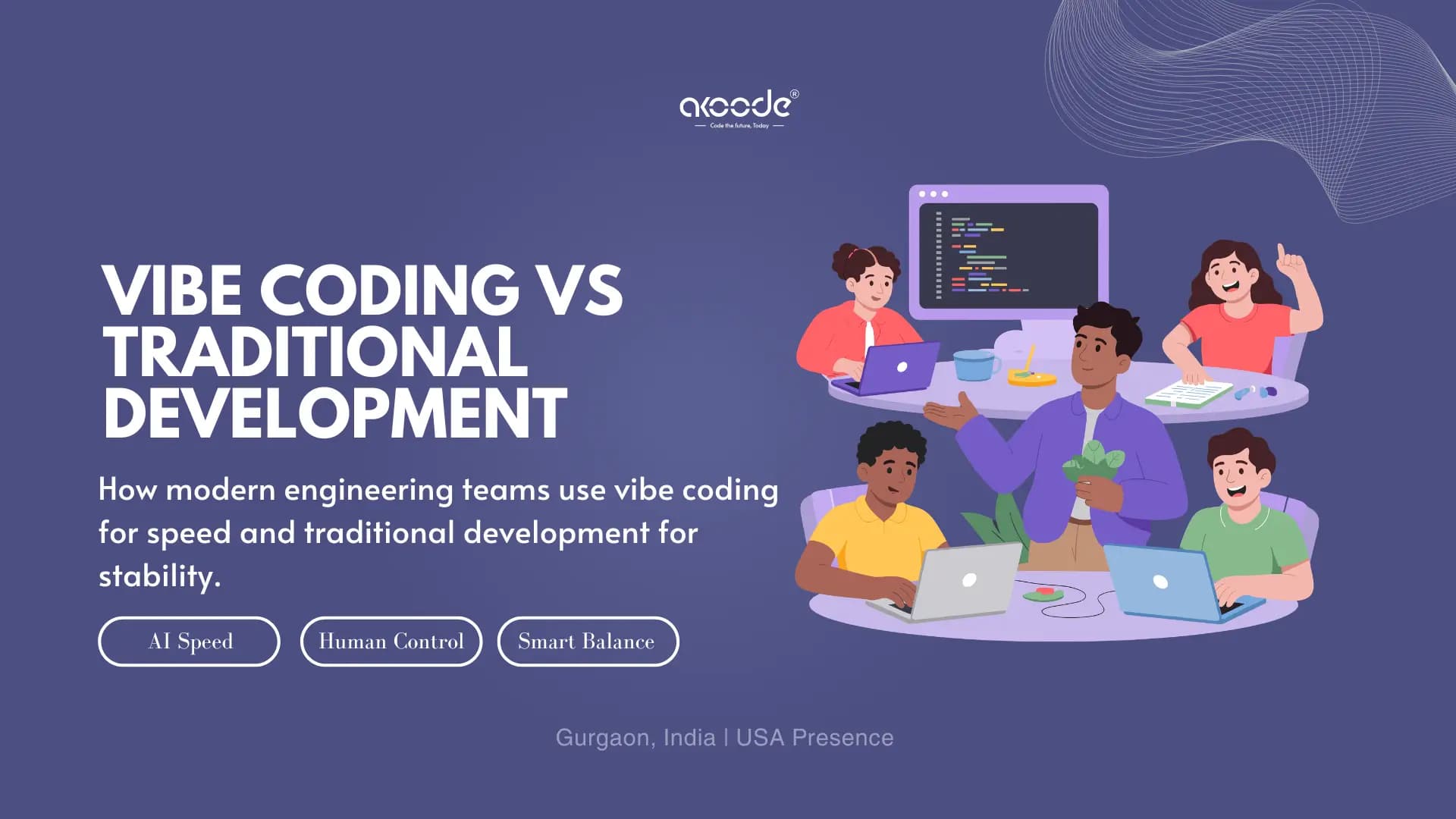
The most honest answer to the vibe coding debate is that the best teams are not choosing one or the other. They are combining them deliberately.
Use vibe coding to generate initial structure, explore solutions, and prototype quickly. Use traditional development to review, refine, harden, and scale.
This is not a compromise. It is a strategy.
The smarter engineering teams are not debating which approach is better. They have already moved past that question. They use AI to generate early structure quickly, then bring experienced engineers in to review every line before it touches production. Security scanners run automatically. Peer reviews are mandatory. Nothing ships because a prompt said it was ready. It ships because a real engineer verified it. The result is faster delivery without the hidden costs that come from skipping process. That balance is the actual goal.
That is the model. AI accelerates the early stages. Human engineering judgment governs what goes to production.
For full stack development teams, this hybrid approach changes the workflow without abandoning the rigor that makes production software reliable. The developers are not replaced. Their role shifts. They spend less time writing boilerplate and more time on architecture, security review, and system design.
For businesses evaluating AI web development capability in a software partner, this hybrid model is what separates a capable team from an irresponsible one. Anyone can generate code with a prompt. The real skill is knowing when to trust it, when to rewrite it, and when to stop and think.
Also Check: What Is MERN Stack Development? A Business Guide
What Does This Mean for Founders and Non-Technical Business Leaders?
If you are a founder or business owner evaluating how to build your product, here is what the vibe coding conversation means for you practically.
Vibe coding will not replace your need for experienced developers. It will change what they spend their time on. A skilled engineer using AI tools can move faster. But the decisions about architecture, security, data structure, and scalability still require genuine expertise.
Be cautious of vendors or agencies that build your product entirely through vibe coding without a structured review process. Speed at the prototype stage can create serious problems at the production stage.
Ask your development partner two direct questions. First, how do you review and validate AI-generated code before it reaches production? Second, what is your process for long-term maintenance and security updates?
The answers will tell you a lot about whether you are working with an engineering team or a prompt-and-ship operation.
Conclusion
Vibe coding is real. It is useful. It is changing how software gets built. And it carries risks that teams are still learning to manage.
Traditional development is not outdated. It is the foundation that makes production software trustworthy, scalable, and maintainable. The engineers who will define the next decade of software are not choosing between these two approaches. They are using both, at the right time, for the right purpose.
Akoode Technologies is a leading AI and software development company headquartered in Gurugram, India, with a US office in Oklahoma. From custom web development and full stack development to AI-powered web applications and enterprise platforms, Akoode builds software that combines the speed of modern AI tooling with the engineering discipline that production systems demand. They serve startups, SMEs, and enterprises across 15+ industries globally. If you are building something that needs to last, the conversation starts with the right partner.
Frequently Asked Questions
1. What is vibe coding in simple terms?
Vibe coding is a way of building software where you describe what you want in plain language and an AI model generates working code from that description. Instead of writing syntax manually, you give intent and the AI fills in the technical details.
2. Is vibe coding safe to use for production applications?
Not without serious oversight. Research shows that a significant share of AI-generated code contains security vulnerabilities that pass basic tests but create problems in production. Vibe coding works well for prototypes and internal tools. For production systems, every piece of AI-generated code needs thorough human review before it ships.
3. How does vibe coding compare with traditional development for enterprise software?
Traditional development is almost always the safer choice for enterprise software. Enterprise systems require compliance structures, audit trails, access controls, and long-term maintainability. Vibe coding tools are not optimized for any of those requirements. A hybrid model works best, using AI for speed in early stages and traditional engineering discipline for anything going to production.
4. Can non-technical founders use vibe coding to build their product?
For early-stage exploration, yes. Vibe coding tools allow founders to prototype ideas, validate concepts, and test interfaces without a full engineering team. However, anything intended to reach real users with real data needs experienced developers to review, secure, and structure the codebase properly.
5. What is the biggest hidden risk of vibe coding?
Fragmented code ownership. When AI generates code, the person who prompted it often does not fully understand every decision the AI made. Over time, this creates a codebase where no one can clearly explain why things were built the way they were. That becomes a serious problem when bugs appear, the team grows, or compliance needs to be demonstrated.
6. How do the best engineering teams use vibe coding and traditional development together?
They treat the two approaches as tools with different jobs. Vibe coding handles rapid prototyping, boilerplate generation, and early exploration. Traditional development takes over for security review, architecture decisions, scaling, and anything that will be maintained over a long period. The key is having experienced engineers who know exactly when to use each.
Get In Touch Now
View More Our Blog