


 July 30, 2026
Software Development Cost: The Complete 2026 Guide
The short answer
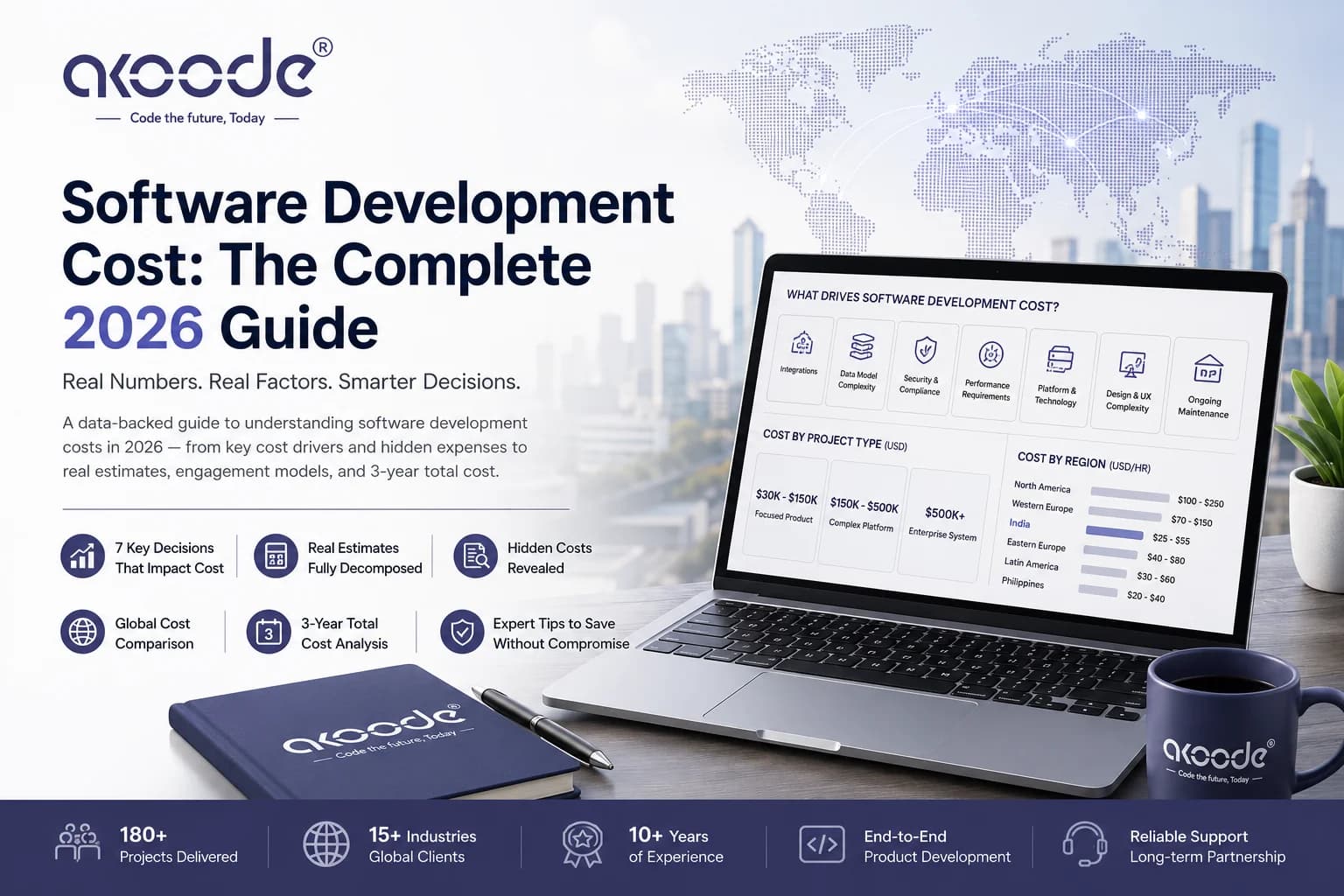
Custom software development in 2026 costs $30,000 to $150,000 for a focused product, $150,000 to $500,000 for a platform with genuine complexity, and $500,000 upward for enterprise systems carrying compliance obligations, multiple integrations, and legacy dependencies.
Those brackets are nearly useless on their own, and every cost article that stops there has wasted your afternoon. The number that matters is the one attached to your project, and across the 180+ software products we have delivered at Akoode — 15+ industries, clients in the United States, United Kingdom and India — it is consistently set by seven decisions most buyers make without realising they are pricing decisions at all.
This guide covers those decisions, shows you how to decompose an estimate yourself, and explains how to read a proposal well enough to know whether the number in front of you is honest.
Looking for a specific market or project type? This guide covers the universal cost model. For local rates and market conditions, go straight to the breakdown for India, the UK, New York or California. For project types, see MVP development cost, mobile app development cost or healthcare app development cost.
Why estimates are wrong, and by how much
Start here, because it reframes everything that follows.
McKinsey, working with the University of Oxford, analysed more than 5,400 IT projects with budgets above $15 million. On average those projects ran 45 percent over budget and 7 percent over schedule, while delivering 56 percent less value than predicted. Broken out by category, software fared worst: an average cost overrun of 66 percent against 43 percent for non-software work.
The mechanism is scope movement. PMI's research found that 52 percent of projects experienced scope creep or uncontrolled changes to scope in the preceding twelve months, up from 43 percent five years earlier.
Two conclusions follow, and both should change how you read a quote.
Treat every estimate as a distribution, not a number. A quote of $180,000 is really a statement that the vendor believes the likely outcome sits between roughly $180,000 and $260,000. A vendor presenting a single figure with no range is not more confident. They are less transparent.
The overrun is usually not incompetence. It is the business learning things after the contract was signed, which is healthy. The real question is whether your commercial structure absorbs that learning cheaply or expensively.
Cost is set by decisions, not feature counts
The most common estimating error in incoming briefs — and nearly every online cost calculator encourages it — is counting features.
A buyer lists twenty-two screens, assumes a per-screen cost, multiplies, and lands on a number. The real quote arrives at double and it feels like padding.
It usually isn't. Features are cheap. The conditions features run under are expensive. The same login screen is three days or three weeks depending on whether it needs SSO, SCIM provisioning, audit logging, and SOC 2 evidence behind it.
The model we use internally: cost is roughly feature surface × complexity multipliers, and the multipliers dominate.
Condition | Multiplier on the same feature set |
|---|---|
Single-tenant, internal users only | 1.0× (baseline) |
Multi-tenant with data isolation | 1.4 – 1.8× |
Regulated data (HIPAA, PCI DSS, GDPR, DPDP) | 1.5 – 2.2× |
Real-time or sub-second latency requirement | 1.4 – 2.0× |
Offline-capable mobile with sync | 1.6 – 2.2× |
Integration with a legacy system you don't control | 1.3 – 2.5× (widest variance of any item) |
High availability against a contractual SLA | 1.3 – 1.7× |
They compound. A multi-tenant healthcare platform integrating with a legacy EHR is not 1.4× a simple application. It is closer to 3×, before anyone has written a feature list.
This is why two vendors quote wildly different numbers for an identical brief. They assumed different multipliers, not different features. Ask each one which multipliers they priced for. The answers reveal more than the prices do.
The seven decisions that move the number most
Ranked by the impact we observe across our own delivery history, largest first.
1. How much you integrate with systems you do not control
The single largest source of estimate variance in commercial software work, and chronically underestimated by both sides.
Building against a modern, documented, versioned API is predictable engineering. Building against a twelve-year-old ERP with no sandbox, undocumented behaviour, and a two-week turnaround on questions is not estimable in any honest sense until an engineer has spent a week inside it.
What we do: carve every unknown integration into a separately priced spike. Three to five days, fixed price, output is a written integration assessment. It costs a fraction of one percent of the project and removes the largest single risk from the estimate. Clients who skip this are the ones who later discover the integration was the project.
2. Whether the data model is settled
Late data model changes are the most expensive class of rework in software. Adding a field is trivial. Changing the relationship between two core entities in month eight means migrations, API changes, frontend changes, backfills, and a full regression cycle.
An hour spent on entity relationship design before the build starts is worth roughly a week spent on it in month six. That ratio is not rhetorical.
3. Compliance scope
HIPAA, PCI DSS, SOC 2, GDPR and India's DPDP Act impose architectural requirements, not paperwork requirements. Encryption at rest and in transit, granular access control, audit logging, data residency, retention and deletion policy, breach notification tooling.
Retrofitting compliance costs three to five times what designing for it costs. If there is a realistic chance you need SOC 2 in eighteen months, design for it now. We have run both versions of this project and the difference is not close.
4. Number of client platforms
Web, iOS, Android, tablet and an admin panel is five surfaces, not one product. Cross-platform frameworks genuinely help — Flutter and React Native builds typically land 30 to 40 percent below fully native development for equivalent scope — but they do not collapse five surfaces into one. Design, QA, release management and store compliance still multiply.
5. The performance requirement you have not written down
"It should be fast" is not a requirement. "Search results under 200ms at 500 concurrent users" is, and it changes your architecture: caching layers, read replicas, possibly a dedicated search index.
The gap between an application serving 100 users and one serving 100,000 is neither linear nor small. Decide which you are building. Building for 100,000 when you have 100 is the most common form of expensive over-engineering. Discovering at 10,000 that you built for 100 is the most common form of expensive rework.
6. Design maturity at kickoff
Builds entering development with finalised, component-based designs run materially cheaper than those where design and development happen in parallel. Parallel design is not faster. It generates rework in both directions, and the rework is invisible until it isn't.
7. Your own decision-making speed
Rarely quoted, frequently decisive, and the one we raise at every kickoff.
A development team blocked four days waiting on a business decision costs exactly what a team building costs. On a five-person pod, consistent two-day decision latency can add 10 to 15 percent to total project cost over six months, and it will never appear on an invoice as a line item.
Name one decision-maker with real authority. It is free, and it is among the highest-return decisions in the entire project.
Cost by project type
Ranges reflect competent delivery by a senior team and exclude ongoing costs. These are global figures; local variance is covered in the regional guides linked below.
Project type | Typical range | Timeline | Dominant driver |
|---|---|---|---|
$25,000 – $70,000 | 6–12 weeks | Scope discipline | |
Internal business tool | $40,000 – $120,000 | 8–16 weeks | Integration count |
$60,000 – $180,000 | 12–24 weeks | UX complexity, scale target | |
$50,000 – $150,000 | 12–20 weeks | Offline sync, native features | |
SaaS platform, single-tenant | $90,000 – $250,000 | 20–36 weeks | Billing, roles, admin surface |
SaaS platform, multi-tenant | $150,000 – $450,000 | 28–52 weeks | Tenancy model, data isolation |
$120,000 – $600,000 | 24–60 weeks | Process mapping, migration | |
Ecommerce platform, custom | $80,000 – $350,000 | 16–40 weeks | Catalogue scale, payments, ERP sync |
$100,000 – $500,000+ | 20–52 weeks | Data readiness, evaluation cycles | |
Legacy modernisation | $150,000 – $1,000,000+ | 36 weeks – 3 yrs | Undocumented business logic |
On AI specifically: the range is wide because the variance lives in your data, not the model. A retrieval system over clean, structured documents is predictable engineering. The same system over fifteen years of inconsistently scanned PDFs is a data engineering project with a language model attached, and the data work will be 60 to 70 percent of the cost. We tell every AI prospect this before quoting, and it changes about half of them.
Deeper breakdowns by project type: MVP development cost · mobile app development cost · ecommerce website development cost · healthcare app development cost · fleet management software cost · agritech app development cost
Cost by region
Blended senior engineer rates, 2026, indicative.
Region | Hourly | Monthly FTE | Deep dive |
|---|---|---|---|
United States / Canada | $100 – $200 | $17,000 – $30,000 | |
Western Europe / UK | $75 – $150 | $13,000 – $22,000 | |
Australia / New Zealand | $80 – $150 | $14,000 – $24,000 | — |
Eastern Europe | $45 – $80 | $8,000 – $13,000 | — |
Latin America | $45 – $85 | $8,000 – $14,000 | — |
India | $25 – $55 | $5,500 – $10,000 | |
Southeast Asia | $25 – $50 | $5,000 – $9,000 | — |
Two cautions that matter more than the table.
Rate is not cost. A $30/hour engineer needing two rounds of rework costs more than a $60/hour engineer who ships correctly first time. The metric that predicts total spend is cost per shipped, accepted feature across a quarter. We would rather be measured on that than on our rate card.
The headline offshore saving is not the real one. A US onshore build at $150/hour blended over 4,000 hours is $600,000. The same build at $40/hour is $160,000 — a 73 percent headline saving. Add your internal management time, specification rework, and the schedule cost of decision latency across time zones, and the effective figure lands nearer $214,000, a real saving of 62 percent. Still excellent, and better than almost any other cost lever available to a software business. But budgets break in the gap between 73 and 62, and that gap is entirely predictable.
Time zone overlap carries a price. Four hours of live overlap works. One hour does not, and the cost surfaces as decision latency rather than hourly rate. We run US and UK engagements with committed overlap windows written into the SOW, because the alternative is a hidden cost nobody quoted.
Cost by engagement model
The commercial structure changes total cost independently of scope.
Model | Pricing | Premium | Best when |
|---|---|---|---|
Fixed cost | One agreed price | 15–30% contingency built in | Scope is genuinely locked |
Dedicated team | Monthly per engineer | No contingency premium | Scope will evolve |
Hourly or monthly per person | 5–10% below dedicated | You already run delivery |
Fixed price carries contingency because the vendor absorbs estimation risk. That is a fair price for certainty and worth paying when scope is stable. Beyond roughly four months, dedicated teams are usually cheaper in absolute terms for equivalent output — you stop paying for insurance you no longer need.
We covered the full comparison, including how to switch models mid-project without renegotiating everything, in our guide to software development engagement models.
A real estimate, fully decomposed
The section most cost guides refuse to show, and the one that lets you audit any quote you receive.
The product: a B2B field service management platform. Web admin, technician mobile app, customer portal. Job scheduling, dispatch, photo capture, invoicing, one accounting integration. Single-tenant, no regulated data, 200 concurrent users at launch.
Workstream | Engineer-days | Note |
|---|---|---|
Discovery, architecture, data model | 15 | Fixed-price spike, delivered first |
UX and UI design | 30 | Component system, three surfaces |
Backend: core domain and API | 55 | Jobs, users, scheduling, assets |
Backend: scheduling and dispatch logic | 25 | Highest-complexity domain area |
Backend: invoicing | 18 | |
Accounting integration | 12 | Assumes documented, sandboxed API |
Web admin frontend | 40 | |
Customer portal | 18 | |
Mobile app, cross-platform | 45 | Includes offline photo queue |
QA and test automation | 35 | ~15% of build effort |
DevOps, CI/CD, environments | 15 | |
Project management and delivery | 30 | ~12% of total |
Contingency | 40 | 15%, stated openly |
Total | 378 engineer-days |
Converted at three rate points:
Delivery region | Blended rate | Total |
|---|---|---|
United States onshore | $150/hr | ≈ $454,000 |
Eastern Europe | $65/hr | ≈ $197,000 |
India | $40/hr | ≈ $121,000 |
What to check in any quote
QA is 9 percent of total and PM is 8 percent. If a proposal itemises neither, they are buried in the developer estimate or not happening. Ask which.
Contingency is visible at 15 percent. A fixed-price quote with no visible contingency has hidden it in the rates or plans to recover it through change requests.
The integration is 12 days with a stated assumption. If that API turns out undocumented, the line could triple — which is exactly why it should be a spike, not an estimate.
Scheduling logic is 25 days for what a feature list describes in one line. Feature count is not effort.
A vendor who cannot produce this decomposition has not estimated. They have guessed and rounded.
The parts of the bill nobody quotes
Third-party services. Payments, transactional email, SMS, mapping, error monitoring, analytics, auth providers. Collectively $400 to $2,500 a month for a mid-sized product.
Cloud infrastructure. $300 to $3,000 a month for a moderate production workload, scaling with usage. Ask for an architecture-based estimate rather than a guess — standard practice in our cloud and DevOps engagements.
App store compliance. Developer accounts, review cycles, engineering time to answer rejections. Two to four weeks of calendar time for a first submission.
Data migration. Replacing an existing system means extraction, cleaning, mapping, validation, reconciliation and a rollback plan. On legacy replacements this reaches 20 percent of total build.
Security assessment. A pre-launch penetration test runs $5,000 to $20,000. Skipping it on anything touching customer or payment data is a false economy with a long tail.
Training and adoption. For internal tools, adoption is the entire point. Budget for documentation and training or you will have paid for software nobody uses.
Three-year total cost of ownership
Build cost is the smaller half of the story for any product living past eighteen months.
Category | Year 1 | Year 2 | Year 3 |
|---|---|---|---|
Initial build | 100% of build | — | — |
Maintenance and support | 10–15% of build | 15–20% | 15–20% |
New feature development | — | 30–60% of build | 30–60% |
Infrastructure | $4k–$36k | Scales | Scales |
Third-party services | $5k–$30k | Scales | Scales |
Security and compliance | $5k–$25k | $5k–$25k | $5k–$25k |
Maintenance is not optional and it is not evidence of a bad build. Dependencies need patching. Mobile platforms deprecate APIs on a published schedule. Security advisories arrive whether or not you budgeted for them. Software left unmaintained for two years is not a stable asset — it is a growing liability, and the catch-up costs more than the maintenance would have.
The month-fourteen pattern. Most products reach a point around month fourteen where the original architecture starts straining against usage that has changed shape. Budgeting nothing for year two is the most common financial planning error in custom software, and it is exactly how a healthy product becomes a legacy system.
How to read a proposal
Six things to look for. Their absence is informative.
A stated assumptions list. Good proposals declare what they assumed: user volumes, integration availability, design readiness, browser support, decision turnaround. Assumptions are how you discover what the vendor priced for.
An exclusions list. What is not included matters more than what is. Cheapest insurance in the document.
Effort visible by workstream. Not a single total. Design, backend, frontend, QA, DevOps and PM should be separable.
QA as its own line. If QA is not itemised, developers are testing their own work, which is not QA.
A named team with stated seniority. "We will assign from our pool" means you are buying whoever is free that Monday.
A change process with a quoting SLA. How changes get priced, and how fast. Without a deadline, change requests become a negotiating lever.
Red flags — including in ours
A quote produced in under 48 hours for a complex build. Nobody estimated that.
A number with no range and no visible contingency.
A bid 40 percent below every other. Something is omitted, usually QA, PM, or seniority.
Refusal to price a small paid discovery phase first.
Silence on IP assignment and repository access.
Any answer other than a direct no to "will any part of this be subcontracted?"
Cutting cost without wrecking the product
The decision tree we actually walk clients through.
Is your budget more than 30 percent short of the quote? → Yes: cut scope, never quality. Ship fewer things properly.
Can any workflow stay manual at launch? → Yes: keep it manual. Automating a process before you know its real shape is the most common form of wasted spend. An admin doing something by hand for 200 users is cheap and teaches you what to build.
Are you building for scale you have not reached? → Yes: build for 10× current, not 1000×. Architect so scaling is possible; do not pay to implement it now.
Can any integration be phased? → Yes: phase it. CSV export at launch and live sync in month four is often 80 percent of the value at 20 percent of the cost.
Are you building custom what you could configure? → Auth, payments, email, search, analytics: buy these. Custom authentication is almost never the right decision and carries permanent security liability.
Is design finalised before development starts? → If not, finalise it. Parallel design and development is not faster and generates rework both ways.
Applied together, these routinely remove 25 to 40 percent from a first-phase budget without reducing what launches.
What never to cut
Each has a predictable payback. Cutting them is borrowing at a punitive rate.
Discovery and architecture. The cheapest phase of the project, and the one that sets the cost of every phase after it.
QA. Production bugs cost roughly an order of magnitude more to fix than development bugs, before reputational cost.
Automated tests on critical paths. You do not need full coverage. You need the critical paths covered, or every future change becomes a manual regression cycle that grows forever.
Security fundamentals. Input validation, parameterised queries, real authentication, dependency scanning, secrets management. The OWASP Top 10 is the floor, not the ceiling.
Senior engineering on architecture. Junior engineers write fine code. Architecture mistakes made in month one get paid for in every month after.
Documentation. Architecture decisions, environment setup, deployment. The cost of missing documentation lands entirely on whoever maintains the system next, and that is frequently you.
How Akoode prices work
Stated plainly, so you can compare it against anyone else's.
Discovery is priced and delivered separately. Two to three weeks, fixed price. Output is a technical architecture, prioritised backlog, risk register, and an estimate defensible to a board. If we are wrong for you, you find that out for the price of a discovery phase rather than a full build.
Every unknown integration becomes a spike before it becomes a line item. We will not quote a number against an API we have not opened.
Estimates are ranges with visible contingency. You see the assumptions, the workstream split, and the buffer.
Engineers are named in the SOW. Senior engineers lead every engagement. We do not subcontract any part of delivery.
Full IP transfer on payment, not on completion, with repository access from day one.
Across 180+ software products delivered globally in 15+ industries, the projects that went well were rarely the ones with the biggest budgets. They were the ones where discovery was honest, one person could make decisions, and both sides priced the unknowns instead of pretending they weren't there.
You can see how that plays out in our AI quantity takeoff platform, where document ingestion — not the model — was the dominant cost; and in our enterprise HRMS platform, where regulatory edge cases drove the engagement model choice before a line was written.
Frequently asked questions
How much does custom software development cost in 2026?
Custom software typically costs $30,000 to $150,000 for a focused product, $150,000 to $500,000 for a complex platform, and $500,000 or more for enterprise systems with compliance requirements and legacy integrations. Integration complexity, compliance scope and scale requirements drive the number far more than feature count.
Why do quotes vary so much for the same brief?
Because vendors assume different complexity multipliers, not different features. Multi-tenancy, regulated data, real-time requirements and legacy integrations each multiply the cost of an identical feature set. Ask each vendor which assumptions they priced for and the spread usually explains itself.
How much does software maintenance cost annually?
Budget 15 to 20 percent of original build cost per year for maintenance and support, plus separate budget for new features — typically 30 to 60 percent of build cost annually for an actively growing product. Maintenance covers dependency updates, security patches, platform API deprecations and bug fixes.
How accurate are software cost estimates?
Historically poor. McKinsey's study of 5,400+ large IT projects found average overruns of 45 percent, rising to 66 percent for software specifically. Treat any estimate as a range and expect the top of it if requirements are still moving.
Is offshore development actually cheaper?
Yes, but by less than the rate card suggests. The headline saving against US onshore rates is roughly 70 percent; the realistic figure after internal management time, specification rework and decision latency is 45 to 60 percent. Still substantial — just budget for the real number.
Should I choose fixed price or a dedicated team?
Fixed price when scope is documented and stable — you pay a 15 to 30 percent contingency premium for budget certainty. A dedicated team when scope will evolve. Beyond roughly four months, dedicated teams usually cost less in absolute terms for equivalent output.
How much does an MVP cost?
A genuine MVP costs $25,000 to $70,000 over six to twelve weeks. The discipline is entirely in scope: an MVP tests one core assumption. Products described as MVPs carrying twenty features are not MVPs and they price accordingly.
What is the most underestimated cost in software projects?
Integration with systems you do not control. It carries the widest variance of any line item, and an undocumented legacy API can triple its own estimate. Price every unknown integration as a separate three-to-five-day discovery spike before committing to a total.
Does AI reduce software development cost?
It reduces some costs and adds others. AI-assisted coding measurably speeds up boilerplate, test scaffolding and documentation. It does not reduce architecture, integration, QA or domain modelling effort, which are the majority of a serious build. Expect modest efficiency gains, not transformation.
How do I reduce cost without reducing quality?
Cut scope rather than quality. Keep low-volume workflows manual at launch, phase integrations, build for 10× current scale rather than 1000×, buy commodity components like authentication and payments rather than building them, and finalise design before development starts. These typically remove 25 to 40 percent from a first-phase budget.
What should a software development proposal include?
A stated assumptions list, an exclusions list, effort broken out by workstream, QA as a separate line, named engineers with stated seniority, a change-control process with a quoting SLA, and explicit terms on IP assignment and repository access.
What is the minimum realistic budget for custom software?
A genuine MVP starts around $25,000. Below roughly $15,000 you are buying a template implementation or a very junior team, and neither extends well. If your budget sits under that, a better use of it is a paid discovery phase producing a defensible plan you can raise or budget against.
Conclusion
The cost of custom software is not a market rate you look up. It is the output of decisions — integration surface, compliance scope, tenancy model, scale target, platform count, design maturity, and how quickly your organisation can make up its mind.
Which makes the most valuable thing you can do before requesting a single quote this: write down your assumptions across those seven dimensions. Vendors will price against them. Wherever a vendor's assumptions differ from yours, you have found either a risk or a misunderstanding, and both are far cheaper to find now than in month six.
If you want a real number for your project, book a call with me directly. Bring whatever you have — a specification, a deck, or a paragraph. We will decompose it properly and show you where the variance sits, which is more useful than a figure.
You can also see how we structure custom software development engagements, or post your requirement and we will respond within one business day.
Get In Touch Now
View More Our Blog