


 August 16, 2026
Most real estate technology briefs start in the wrong place. Someone decides they need an app, or a portal, or "something with AI," and the scope gets written around the artefact rather than around the problem.
The businesses that get value from a build almost always start somewhere else — with a specific point where they are losing money. Enquiries going cold because two agents called the same buyer. Listings nobody updates because publishing one takes an hour. Buyers researching for three weeks and never making contact because nothing on the site helps them decide. Agents at a site visit who cannot reach a single useful record.
Each of those is a different build. This guide covers what real estate businesses in Delhi NCR actually commission, which one fits which problem, and what changes depending on whether you operate in Gurgaon, Noida or Delhi — because they are genuinely different markets with different data requirements.
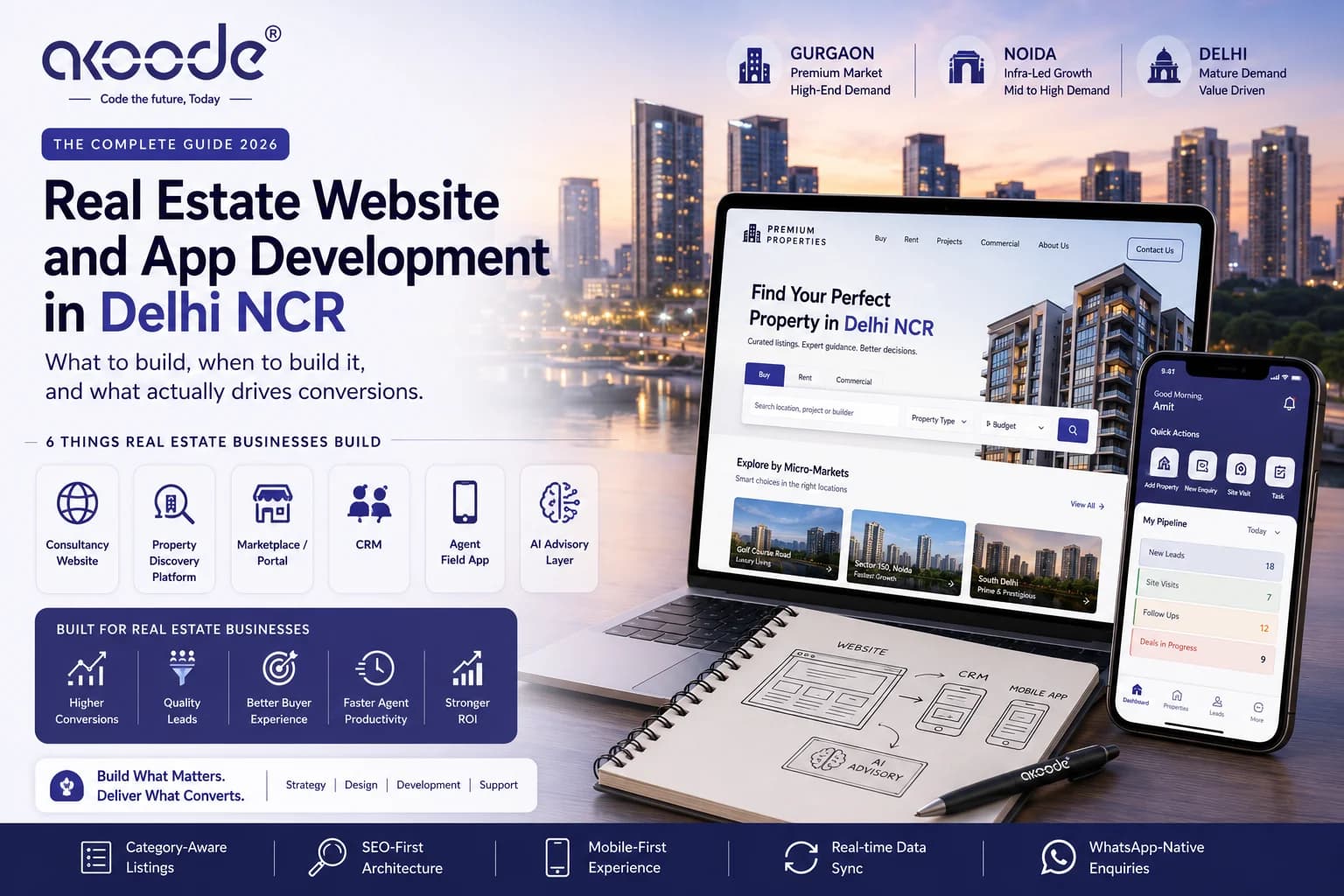
Six Things Real Estate Businesses Build
Almost every brief we receive resolves into one of these. Knowing which one you need saves more money than any negotiation.
Build | Solves | Right when |
|---|---|---|
Consultancy website | Buyers arrive and leave without contact | You have inventory and traffic but weak conversion |
Property discovery platform | Buyers cannot evaluate or compare | Multi-category inventory, research-heavy buyers |
Marketplace / portal | You want third-party supply | You have a supply acquisition plan and capital for it |
CRM | Leads leak, ownership is unclear | Enquiry volume exceeds what chat threads can track |
Agent field app | Agents are desk-bound | Field staff lose real time to being away from records |
AI advisory layer | Buyers need guidance before an agent call | Long research cycles, repetitive agent questions |
Most businesses need two of these, sequenced — not all six at once. The most common expensive mistake is commissioning the marketplace when the consultancy platform was the answer.
Real Estate Website and Platform Development
The web platform is where most NCR property businesses should start, because it is the only build that both acquires demand and converts it.
What separates a platform from a brochure site:
Category-aware property records. Residential apartments, commercial units, SCO plots, branded residences and industrial land share almost no attributes. Carpet area means something different on a plot. Possession date is meaningless on resale. One rigid form covering all of them produces listing pages full of empty fields, filters that return nonsense, and agents who stop filling things in because the form is exhausting. The fix is category-specific field sets over a shared base record.
Micro-market intelligence. Location pages that carry infrastructure narrative, price context and an investment thesis — not just a filtered list. This is simultaneously your differentiator against the portals and your organic acquisition channel, because micro-market queries are the winnable ground.
Structured comparison. Before a comparison tool exists, evaluating two properties means opening tabs and reconciling numbers by hand. A normalised side-by-side matrix across price per square foot, floor plan, possession, developer and location score addresses the highest-friction moment in the Indian purchase journey. It has to work across every category without data gaps, and it has to swipe on mobile.
SEO architecture, decided before information architecture. This is the decision that most often gets made too late. Search engines need stable, crawlable URLs; users need dynamic filters with instant response. The resolution is hybrid rendering — static generation for location, category and project pages, with filter states handled client-side and URL-encoded so filtered views stay shareable. Metadata, slugs, schema and Open Graph should be generated systematically at the architecture level, because a property platform creates pages continuously and any manual metadata step stops happening by month three.
Performance as acquisition, not polish. NCR property traffic runs mobile-majority, and property listings need large photography. Those fight each other. WebP through an image CDN, lazy loading and responsive srcset resolve it. Get this wrong and the entire location page strategy underneath is worthless, because the pages load too slowly to rank or convert.
WhatsApp-native lead capture. Forms into a mailbox are not how Indian property buyers make first contact. Pre-filled WhatsApp enquiries carrying property context mean the enquiry arrives as a live conversation with the buyer's specific interest already visible.
Real Estate App Development: Buyer App or Agent App
This is where we most often disagree with what a client arrives asking for, so it is worth being direct.
The buyer-facing app is usually the wrong first build
Property purchase is infrequent and high-consideration. Nobody installs an app to buy one apartment, uses it for three weeks, and keeps it. There is no retention story, which means no reason for the app to exist as a channel.
Mobile web with strong performance serves property buyers better, reaches them from search rather than requiring a download, and costs substantially less. If someone is selling you a buyer app as phase one, ask them what the retention model is. If the answer is vague, you are buying a portfolio piece.
The exceptions are real, though: a genuine marketplace with repeat rental search behaviour, a property management app where residents interact monthly, or an NRI investment product with portfolio tracking. All of these have a reason to be reopened.
The agent-facing app is often the right build
This is where mobile earns its cost. Agents spend the working day away from a desk. Every record they cannot reach on site becomes a phone call to the office, a note on paper, or a memory that fades by evening.
What an agent app should do:
Create and edit listings on site, with photo and video capture attached directly to the record
Log site visits at the property, not that evening
Move deal stages between meetings
Capture voice notes that transcribe to searchable text
Show the agent their own book of leads with server-enforced ownership
Receive assignment and visit notifications in real time
The architecture that matters: the app and the web dashboard must be two views onto the same data, sharing one API and one contract — not two products that sync. Where they diverge, they should diverge deliberately: the field app optimised for one-handed use at a property, the dashboard for volume work at a desk. Neither should own state the other cannot see.
On cross-platform: a single Flutter codebase shipping to both stores prevents the drift that kills native pairs — not in month one, but in month fourteen, when a fix lands on iOS and not Android and agents on different phones start seeing different behaviour. For a product whose entire value is consistency, that drift is precisely what you are paying to avoid.
One constraint to plan for early: if your app touches subscriptions or paid digital access, Apple does not permit a third-party payment gateway inside an iOS app. That shapes your commercial architecture, not just your code, and it should be settled in the first design conversation rather than discovered during App Store review.
AI Agents for Property Advisory
The most common failure in real estate AI is placement, not technology. A chatbot bubble in the corner of a listings page gets ignored, because users read that widget as customer support and they do not have a support question. They have a decision problem.
An AI property advisor works when it sits at the decision moments — alongside search, on property detail pages, as a direct entry point from the homepage — and when it is grounded in your actual inventory and your actual micro-markets. A buyer asking about average 3BHK prices in a specific sector, or which corridor suits a given budget and horizon, should get a contextual answer rather than a redirect to a filter.
What it changes commercially: agents in premium real estate spend enormous time on questions that do not need a human — price bands by sector, what SCO means, which corridor is appreciating. Moving those to an always-available advisor means the agent enters the conversation when the buyer is closer to deciding, and the buyer arrives better informed.
Four things to get right:
Ground it in your inventory. An advisor answering like a general search engine adds nothing.
Place it where decisions happen, not where a widget is easy to embed.
Connect every answer to an action — an exchange that ends the conversation is wasted. Route into WhatsApp or a booking with context attached.
Define its assertion boundaries in writing. Property pricing and investment guidance sit close to financial advice. Decide before integration what the advisor states as fact, what it frames as a starting point, and what it must hand to a human. Review that scope as your inventory and the model change.
That fourth point is the one most teams skip, and it is the one that carries real consequences.
CRM and Lead Management
WhatsApp is excellent at first contact and poor at pipeline. Once enquiry volume exceeds what a team can hold in chat threads, you need something with structure.
What a real estate CRM has to do that a general sales CRM does not:
Enforce lead ownership at the API, not by convention. A field labelled "assigned agent" that anyone can act around is not ownership. The duplicate-contact problem — two agents calling the same buyer within an hour — is only solved when the server refuses the second action.
Model your property categories properly, for the same reason the website must.
Handle channel partner attribution if you work with sub-brokers, because commission splits are a data model decision and retrofitting them onto a system that assumes one agent per lead is painful.
Feed from the website, not parallel to it. A CRM that agents update separately from the platform buyers use is two sources of truth, which is one more than you can maintain.
The Admin CMS Nobody Scopes Properly
This determines whether your platform is still current a year after launch, and it is consistently the most under-specified part of a brief.
The failure pattern: during the build, listings get loaded by developers, so nobody notices the admin experience is painful. After handover, publishing a property takes an hour of fighting a form. Agents stop doing it. Inventory goes stale. Within six months the platform is a brochure everyone has quietly stopped trusting, and the buyer-facing work you paid for is worthless because the data behind it is wrong.
What a listing workflow needs:
A multi-step wizard, not one enormous form
Real-time validation at the field, not errors on submit
Auto-save drafts, because a listing takes longer than an uninterrupted session
Bulk image upload — premium listings need many photographs, and one-at-a-time uploading is the single most common reason listings never get refreshed
Category-aware fields, so an SCO listing never asks for a bedroom count
Floor plans, nearby locations and amenity detail attached to the record
Agent assignment and permissions
The benchmark: a listing should publish in minutes, not hours. Ask any partner what their target is and how they will measure it.
Test it yourself during UAT, with your own agents, on real listings. If it is painful then, it will be abandoned later.
Integrations That Matter in the Indian Market
WhatsApp Business API — the primary conversion channel, not a nice-to-have
Google Maps and Places — proximity to metro, schools, hospitals, expressways and commercial hubs, which is often the deciding factor and is invisible on most platforms
Portal feeds — 99acres, MagicBricks, Housing. Decide early whether you push listings out, pull performance back, or stay independent
Payment gateway — for booking amounts or, if you are licensing the platform, subscription billing
Telephony and IVR — call logging against the lead record, which is how most enquiries actually progress
Image CDN — not optional on an image-heavy, mobile-majority platform
Analytics and tag management — configured at build, not bolted on when someone asks for a report
Every integration is a maintenance liability as well as a build cost. Integrate what gets used daily; defer the rest.
Building for Gurgaon NCR India
Gurgaon is the deepest property technology market in NCR and the one with the most specific data requirements. Our own office is in Sector 49, so this is a market we work in as well as build for.
Corridor and sector structure in the data model, from day one. Gurgaon inventory is discussed by corridor, not city — Golf Course Road, Golf Course Extension Road, Dwarka Expressway, Sohna Road, Southern Peripheral Road, MG Road, New Gurgaon, Manesar. A platform storing free-text addresses cannot generate corridor landing pages later, and corridor pages are where the winnable organic traffic sits.
SCO plots need their own category. SCO is a Gurgaon-specific asset class with its own buyer, its own investment logic and its own search demand. Folding it into "commercial" loses the data fidelity and the keyword together.
Branded residences are a distinct segment. Developer-brand partnerships carry different buyer expectations, different content requirements and different price positioning. They do not fit a standard residential template.
Channel partner and builder relationships as first-class entities. Much of Gurgaon primary sales runs through channel partnerships with named developers. Builder pages capture buyers searching a developer name, and they only exist if builders are modelled as entities rather than a text field on a listing.
Project-level pages. Primary-market buyers search by project name once they have narrowed down. Those pages are high-intent and only possible if projects are first-class in your schema.
RERA record-keeping. Agents in Haryana register with HARERA and carry disclosure and record-keeping obligations. Requirements change, so confirm current position with HARERA or your legal advisor rather than any vendor's summary. If compliance display matters to you, raise it at briefing — it is a data model decision, not a page added later.
Building for Noida and Greater Noida
Noida is structurally different from Gurgaon and platforms built for one often fit the other badly.
Sector numbering is the primary geography, and it is dense. Buyers search by sector number far more than by corridor name. Your location taxonomy needs sectors as real entities with their own pages, alongside the corridors — Noida-Greater Noida Expressway, Yamuna Expressway, Noida Extension.
Greater Noida and Greater Noida West are separate markets, not suburbs of Noida. Treating them as one location destroys the search value of both.
Authority allotment and leasehold structures create documentation and title questions that buyers ask early. A platform that surfaces plot status, allotment type and lease details answers questions competitors leave to a phone call.
Industrial and institutional plots are a meaningful Noida category with an entirely different buyer — one evaluating power load, road width, permitted use and authority approvals rather than bedrooms.
Jewar airport proximity has reshaped investment logic across the Yamuna Expressway corridor. Any micro-market intelligence layer serving Noida needs infrastructure narrative that accounts for it.
Building for Delhi
Delhi is the market most often handled badly by platforms designed for NCR's newer cities, because its inventory does not behave like theirs.
Colony and locality, not sector. Delhi buyers search by named locality — Vasant Kunj, Greater Kailash, Dwarka, Rohini, Punjabi Bagh. Sector-based taxonomy imported from Gurgaon or Noida simply does not map.
Resale dominates, new launch is scarce. That inverts several assumptions. Possession date matters less; construction status, age of property and title history matter more. Payment plans are largely irrelevant.
Builder floors and independent houses are a substantial category with attributes that apartment templates handle poorly — floor number and total floors, whether the terrace is included, parking rights, independent entry, lift availability.
DDA and freehold-versus-leasehold status is a primary filter for Delhi buyers and absent from most platforms.
Commercial and retail in established markets — Connaught Place, Nehru Place, Karol Bagh — behave differently again, with rent yield and footfall mattering more than amenity lists.
Practical consequence: if you operate across Delhi and Gurgaon, do not force one location model onto both. A shared base record with city-appropriate location taxonomies is more work upfront and far less painful than the alternative.
Platforms We've Built
Two live NCR property platforms, both built end to end by Akoode.
WeGrowInfraventures — a data-driven property discovery platform for an agency operating across Gurugram, Noida, Delhi, Panipat and beyond. Built on Next.js with a Node.js backend, it covers residential, commercial, SCO plots, industrial plots and branded residences as distinct categories, with a trending-locations engine spanning corridors including Golf Course Road, Dwarka Expressway, Southern Peripheral Road, Sohna Road, MG Road, Manesar and the Noida-Greater Noida Expressway. It carries a multi-property comparison tool, a market trends and news-and-insights layer, role-based accounts for agents and multi-user access, a sell-your-property flow, and a custom agent CMS that cut listing publish time from hours to minutes. SEO architecture was built into the information design rather than added afterwards.
BigCatRealty— a premium Gurugram consultancy platform built around advisory rather than listing volume. It carries an AI property advisor that answers plain-language questions about pricing, locations and investment options, positioned inside the buyer journey rather than as a corner widget. Lead capture is WhatsApp-native throughout: every property page generates a pre-filled enquiry carrying the listing name, location and price, so the team receives a live conversation with context attached. The platform models builder and channel-partner relationships as first-class entities with their own pages, spans Gurgaon, Delhi, Noida, Greater Noida and beyond, and runs an insights layer targeting high-intent corridor and project queries.
Both are running in production. More NCR property platforms are in development.
Technology Choices
The stack matters less than most vendors imply, but three properties are non-negotiable.
A rendering strategy decided per page type. Location, category and project pages are search assets and should be statically generated. Filter states are interactive and belong client-side, URL-encoded. Treating every page the same is how platforms end up either invisible or sluggish.
A data model that tolerates category difference. Category-specific field sets over a shared base record. Not one rigid schema with every possible field, which produces null-field pollution. Not separate collections per type, which produces slow joins and painful cross-category comparison.
One API serving every client. Web dashboard, buyer-facing site and agent app reading the same contract. Two clients with two contracts is how they start disagreeing about what a record means.
For reference, the platforms above use Next.js with hybrid rendering, Node.js backends, and Flutter where a field app is in scope. Those are good choices, not the only ones. Choose for the three properties above, not for what a vendor's team already knows.
How to Choose a Development Partner
Questions that separate teams who have shipped property platforms from teams who have shipped websites.
"How will you handle SEO and dynamic filters together?" If the answer is "we'll add schema" rather than a rendering strategy per page type, they have not built one of these.
"Show me an admin CMS you've built, and tell me your listing publish time target." Vagueness here predicts stale inventory.
"How would you model SCO plots alongside apartments?" Looking for category-specific field sets, not "custom fields."
"What's your plan for Delhi localities versus Gurgaon sectors?" Tests whether they understand NCR is several markets.
"Who owns the code, and when does it transfer?" Retained IP and licence-back clauses are common and materially change what you are buying.
"What happens after launch?" Property platforms need ongoing work — new categories, new corridors, portal changes, content. Maintenance terms matter more here than in most software.
Warning signs: a quote before a workflow review; a feature list in response to an architecture question; no questions about your property categories; a demo that avoids the admin panel; and anyone selling a buyer-facing app as phase one without a retention answer.
Why We Don't Publish Prices
Every agency page in this category shows a price range. We don't, and it is worth explaining rather than leaving you to assume the worst.
The honest reason is that the range would be so wide as to be useless. A consultancy platform for one agency's inventory and a multi-tenant marketplace with broker accounts and billing are different projects by a large multiple. Add or remove a field app, an AI advisory layer, portal integrations, or a second city's location taxonomy, and the number moves again. A published range wide enough to be true tells you nothing; a narrow one tells you something false.
The second reason is that a number quoted before anyone has looked at your property categories, your lead flow and your existing data is a guess, and guesses in this category are usually revised upward once the real scope surfaces. That serves nobody.
What a first conversation actually covers: what you need the platform to do, who your buyers are, which categories you carry, where your enquiries currently break, and how the build would be approached. You will leave that call with a scope you understand and a number that means something. No pitch deck.
What to Build First
Phase 0 — Data model and SEO architecture. Property schema with category overlays, location taxonomy per city, URL structure, rendering strategy per page type. Nothing visible ships and everything downstream depends on it. Every item here is expensive to change later.
Phase 1 — Listings, discovery and admin CMS together. The CMS ships with the listings so your team loads real inventory during UAT and you find the friction while it is cheap to fix.
Phase 2 — Conversion layer. WhatsApp lead capture, meeting booking, enquiry routing.
Phase 3 — Differentiation. Micro-market intelligence, comparison, proximity mapping, AI advisory. This is what makes the platform worth visiting before you spend on acquiring traffic.
Phase 4 — Content and insights engine. Corridor guides, project pages, investment content. It needs the Phase 0 architecture, and it works on a two-to-three-quarter horizon rather than weeks.
Phase 5 — CRM, then agent app. When lead volume outgrows chat threads, and when agents are demonstrably losing time to being desk-bound. In that order.
Building all of this at once is how budgets get spent on the least urgent problem.
Akoode Technologies builds property platforms, real estate websites and mobile applications for agencies, consultancies and developers across Delhi NCR and India. Headquartered at Spaze iTech Park, Sector 49, Gurugram, with a US office in Oklahoma. 180+ projects delivered across 15+ industries. Rated 4.9 on Google from 110 reviews and 5.0 on GoodFirms, and recognised by GoodFirms among the Top Artificial Intelligence Companies in India 2026.
Set up a meeting to scope your platform and get a real number. Book directly: calendly.com/akhil-akoode/ak — or send your requirement and someone responds within one business day. NDA signed before kickoff. IP is 100% yours from day one.
FAQs
What does real estate web development involve beyond a normal website?
Category-aware property records, a location taxonomy that matches how buyers actually search, a rendering strategy that serves both SEO and interactive filters, an admin CMS your team can operate, and a conversion path built around WhatsApp rather than forms. A standard business website has none of these.
Should we build a mobile app for our real estate business?
For buyers, usually not first — property purchase is too infrequent for app retention, and mobile web reaches them from search for less. For agents, often yes, once your team is losing real time to being desk-bound. The two are entirely different products with different business cases.
What can a real estate agent app do that a website cannot?
Create listings with photos and video at the property, log site visits where they happen, capture voice notes that transcribe to searchable text, move deal stages between meetings, and deliver assignment notifications in real time. The value is agent time recovered, not downloads.
How do you build an AI agent for a real estate website?
Ground it in your own inventory and micro-markets, place it at decision moments in the buyer journey rather than as a corner chat widget, route every answer onward into a real conversation with context attached, and define in writing what it may assert as fact versus hand to a human.
How do you handle SEO on a property site with dynamic filters?
By deciding rendering per page type — static generation for location, category and project pages, client-side handling for filter states with URL encoding so filtered views stay shareable. Metadata, slugs, schema and Open Graph should be generated at the architecture level, because manual metadata stops happening once the platform is live.
Can one platform handle apartments, SCO plots, industrial land and branded residences?
Yes, with category-specific field sets over a shared base record. One rigid schema containing every possible field produces empty listing pages and broken filters, and agents stop filling in forms they find exhausting.
Is a platform built for Gurgaon suitable for Noida or Delhi?
Not without work. Gurgaon runs on corridors, Noida on dense sector numbering plus separate Greater Noida markets, and Delhi on named localities with resale-dominant inventory, builder floors, and DDA and freehold-versus-leasehold status. Forcing one location model across all three fails in at least two of them.
What is different about building for Noida specifically?
Sector numbering as primary geography, Greater Noida and Greater Noida West as separate markets, authority allotment and leasehold structures surfaced early, industrial and institutional plots as a real category, and infrastructure narrative that accounts for the Jewar airport corridor.
What is different about building for Delhi?
Locality-based rather than sector-based taxonomy, resale-dominant inventory where age and title history matter more than possession date, builder floors and independent houses as a distinct category with their own attributes, and DDA and freehold-versus-leasehold status as a primary filter.
Can you integrate with 99acres, MagicBricks or Housing?
Yes, and it should be scoped explicitly. Decide early whether the platform pushes listings out to portals, pulls performance data back, or stays independent — each is a different build with different ongoing maintenance.
Why is the admin panel so important?
Because it decides whether your inventory is still accurate a year after launch. If publishing a listing takes an hour, agents stop doing it, listings go stale, and every buyer-facing feature you paid for is sitting on top of wrong data.
How much does a real estate platform cost?
It depends enough on scope that a published range would be either too wide to be useful or narrow enough to be misleading. A first call covers your categories, your lead flow and where enquiries currently break, and produces a scope and a number that mean something. You can book that directly.
Do you work with clients outside Delhi NCR?
Yes. Our India office is in Gurugram and we have a US office in Oklahoma, serving clients across India, the UK and the USA. The architecture transfers to any market; the location taxonomy is the part that needs adapting.
Who owns the platform and the code?
Intellectual property transfers to the client from day one, with an NDA signed before kickoff. Confirm this explicitly with any partner, as retained IP and perpetual licence-back clauses are common.
Can you take over a platform another agency built?
Often, though it depends on the state of the data model and whether the location taxonomy and category structure can be extended or need replacing. That assessment is the first thing to do, before any feature work is quoted.
Get In Touch Now
View More Our Blog