


 August 15, 2026
Software Development Cost in Illinois: What You're Actually Paying For in 2026
There's a measurement problem buried in every Illinois software salary figure you'll read, and it changes what those numbers mean for your budget.
Glassdoor reports the average Illinois software engineer at $138,089 — essentially in line with the national average — drawn from 22,665 submissions as of May 2026.
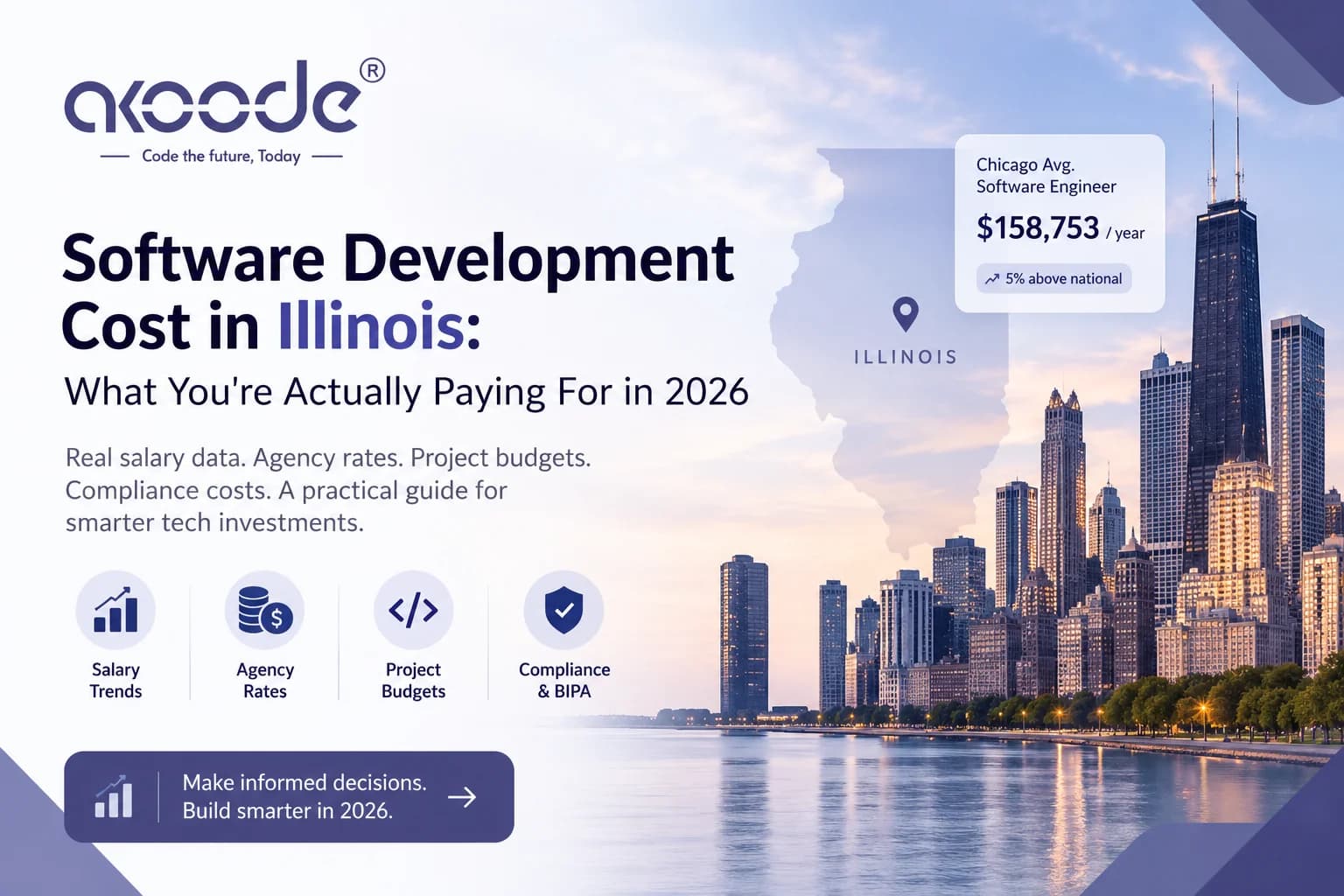
Glassdoor also reports the average Chicago software engineer at $158,753, 5% above national, drawn from 20,199 submissions as of July 2026.
Look at those sample sizes. Roughly 89% of Illinois' reported engineering salaries come from Chicago. The "statewide average" is, in practice, a Chicago average with a thin downstate tail pulling it down a few points.
That matters enormously if you're a manufacturer near Peoria, a grain cooperative in the central counties, a research-adjacent team near Batavia or Lemont, or a company anywhere in Illinois that isn't in the Loop. You are being quoted against a number that describes a different labor market than the one your vendor is actually hiring from — and depending on which direction the vendor is arguing, that works for you or against you.
This guide covers what software development actually costs in Illinois in 2026: sourced salary figures with their sample sizes, the statewide-versus-metro gap in detail, agency rate cards by role and seniority, complete project budgets, what BIPA and Illinois' new AI employment law add, and an honest framework for what to spend.
How This Guide Was Compiled
A note on method, because cost content is easy to write badly.
Every salary figure below comes from a named public source with its sample size and reporting month stated. Where sources diverge — and they diverge by more than $30,000 across Illinois — we show the spread rather than selecting the flattering number. Where a figure is older than the others, we say so.
Agency rate ranges reflect what firms in this market bill, derived from published rate cards, public procurement data, and our own delivery experience. Project cost ranges draw on 180+ completed projects across 15+ industries, including manufacturing systems, AI platforms, and multi-surface products for US clients — several referenced below because their scope is documented publicly in our case studies.
Ranges are stated as ranges because compliance exposure, integration surface, and data volume change totals by multiples. Anyone quoting a single number for "a SaaS platform" hasn't scoped a SaaS platform.
Salary data current as of August 2026 unless otherwise noted. Figures are point-in-time and shift; treat them as directional.
What Illinois Engineers Actually Earn
Statewide
Source & Date | Role | Figure | Sample / Note |
|---|---|---|---|
Glassdoor (May 2026) | Software Engineer | $138,089/yr($66/hr) | 22,665 submissions; in line with national; range $113,165–$170,869; 90th pct $205,844 |
Glassdoor (Feb 2026) | Applications Software Developer | $135,731/yr($65/hr) | 393 submissions; 1% below national; range $112,989–$165,251 |
Salary.com (Jul 2026) | Software Developer | $131,780/yr($63/hr) | Range $111,904–$153,277 |
Glassdoor (Jun 2026) | Entry Level Developer | $97,490/yr($47/hr) | 1% below national; range $82,162–$116,898 |
ZipRecruiter(Jul 2026) | Software Developer | $108,381/yr($52/hr) | Range $87,200–$126,000; 90th pct $146,807 |
Glassdoor (Jul 2025) | Software Developer | $112,820/yr($54/hr) | 9,343 submissions; 6% below national — note: 2025 data, included for the large sample |
Chicago Specifically
Source & Date | Role | Figure | Sample / Note |
|---|---|---|---|
Glassdoor (Jul 2026) | Software Engineer | $158,753/yr($76/hr) | 20,199 submissions; 5% above national; range $131,493–$195,208; 90th pct $233,733 |
Glassdoor (Mar 2026) | Software Developer | $127,531/yr($61/hr) | 7,841 submissions; 5% above national; range $104,145–$158,225 |
Glassdoor (Apr 2026) | Entry Level Developer | $101,726/yr($49/hr) | 3% above national; range $85,182–$122,778 |
The practical read: entry-level $82K–$117K, mid-level $113K–$140K, senior $170K–$205K statewide — with Chicago sitting roughly 5% above national at every tier and the rest of the state sitting somewhat below it.
The Gap Nobody Separates
Return to the sample sizes: 20,199 Chicago submissions inside a 22,665-submission statewide dataset.
This has three practical consequences that most cost content misses entirely.
First, downstate and collar-county employers compete in a genuinely different labor market. A manufacturer near Peoria, an agtech firm in the central counties, or a research-adjacent team in the Fox Valley is hiring from a pool with less bidding pressure than the Loop's financial and trading firms create. Their real cost of engineering is lower than the headline suggests — and a vendor quoting them at Chicago-derived rates is applying the wrong benchmark.
Second, the reverse mistake is equally common. A Chicago-based buyer who reads a "statewide Illinois" figure and expects that to be their rate is going to be surprised, because the market they're actually in is 5% above national rather than roughly at it.
Third — and this is the useful one — the talent isn't concentrated the way the salary data implies. Illinois' engineering pipeline runs through the University of Illinois Urbana-Champaign, Northwestern, and the University of Chicago, plus the technical workforce orbiting Fermilab in Batavia and Argonne in Lemont. That is genuinely distributed capability. The salary concentration reflects where the highest-paying employers sit, not where competent engineers live.
What this means when you read a quote:
Ask where the delivery team actually is, and benchmark against that market rather than the state average. A vendor with a downstate or distributed team quoting at Chicago rates is capturing the difference as margin. That isn't necessarily wrong — but you should know it's happening, and it should be reflected somewhere in what you get.
Illinois Agency Rate Cards by Role and Seniority
Translating salary into billing: a $138,000 engineer costs a firm roughly $180,000 fully loaded after benefits, payroll taxes, and employer costs — before facilities, project management, sales overhead, non-billable time, and margin. Standard utilization assumptions put billable hours well below total hours, which is why the salary-to-rate multiple looks large.
Role | Junior (0–2 yrs) | Mid-Level (3–5 yrs) | Senior (6+ yrs) |
|---|---|---|---|
Frontend Developer | $65–$90/hr | $90–$125/hr | $125–$165/hr |
Backend Developer | $70–$95/hr | $95–$135/hr | $135–$180/hr |
Full-Stack Developer | $70–$95/hr | $95–$130/hr | $130–$175/hr |
Mobile Developer (iOS/Android) | $75–$100/hr | $100–$140/hr | $140–$185/hr |
UI/UX Designer | $60–$80/hr | $80–$110/hr | $110–$150/hr |
DevOps / Cloud Engineer | $80–$110/hr | $110–$150/hr | $150–$195/hr |
Data / High-Throughput Engineer | $85–$115/hr | $115–$155/hr | $155–$205/hr |
MES / Industrial Integration Engineer | — | $120–$165/hr | $165–$215/hr |
Biometric & Consent Architecture | — | $125–$170/hr | $170–$220/hr |
AI / ML Engineer | $90–$125/hr | $125–$170/hr | $170–$225/hr |
QA Engineer | $50–$75/hr | $75–$105/hr | $105–$140/hr |
Technical Project Manager | $75–$105/hr | $105–$145/hr | $145–$180/hr |
Chicago-based teams typically bill at the upper end of each band; downstate and distributed teams at the lower end.
Three observations.
Illinois sits in the favorable middle of US markets — below the coastal tier, roughly level with Atlanta and Denver, with Central Time overlap that works in both directions.
Two specializations have no junior tier, and neither omission is accidental. MES and industrial integration engineering requires understanding plant-floor systems that predate the cloud — knowledge acquired on a shop floor, not in a bootcamp. Biometric and consent architecture requires knowing what BIPA's private right of action actually exposes you to, which is knowledge acquired by having architected under it.
High-throughput data engineering carries a genuine local premium driven by the research-adjacent economy around the national laboratories. If your project involves data volumes that would embarrass a typical enterprise pipeline, Illinois has real depth here.
What Complete Projects Cost
Web Applications
Project Type | Complexity | Illinois Cost | Timeline |
|---|---|---|---|
Marketing site / landing pages | Simple | $8,000–$25,000 | 3–6 weeks |
MVP / proof of concept | Simple-Medium | $30,000–$78,000 | 2–4 months |
Business web application | Medium | $78,000–$170,000 | 4–7 months |
SaaS platform | Medium-High | $115,000–$285,000 | 5–10 months |
Enterprise web platform | Complex | $245,000–$610,000+ | 9–18 months |
Mobile Applications
App Type | Illinois Cost | Notes |
|---|---|---|
Cross-platform MVP | $34,000–$78,000 | Flutter/React Native, iOS + Android |
Mid-complexity app | $78,000–$168,000 | Integrations, custom UI, backend |
Offline-first field app | $92,000–$225,000 | Sync architecture for plant floor, field, farm use |
Complex / enterprise app | $168,000–$410,000+ | Multi-role, regulated data, hardware integration |
Multi-Surface Platforms
This category deserves its own line, because surface count drives cost more predictably than feature count does — and buyers consistently underestimate it.
A platform with a customer-facing app, an operator-facing web portal, and an internal admin console isn't one product with three views. It's three products sharing a data model, each with its own authentication, permissions, state handling, testing surface, and release cadence.
Our Vallo Parking build is a working example: a Flutter app for drivers, a Next.js portal where space owners list and price their lots, and an admin console running the whole operation from one screen. Three surfaces, one system. When you scope a platform, count surfaces before you count features — it's the better predictor.
Surfaces | Typical Range |
|---|---|
Single surface (app or web) | $34,000–$170,000 |
Two surfaces | $85,000–$260,000 |
Three surfaces (app + portal + admin) | $130,000–$380,000 |
Manufacturing, Agtech, Research, and AI Systems
Project Type | Illinois Cost |
|---|---|
AI chatbot / support agent | $45,000–$125,000 |
Document / records classification pipeline | $62,000–$175,000 |
LLM-powered internal tool (RAG) | $70,000–$185,000 |
Predictive maintenance system | $92,000–$265,000 |
MES / plant-floor integration platform | $110,000–$320,000 |
Precision agriculture / yield forecasting platform | $85,000–$250,000 |
High-throughput research data pipeline | $120,000–$350,000 |
BIPA-scoped biometric platform | $95,000–$280,000 |
Enterprise AI platform | $255,000–$700,000+ |
What Actually Moves the Number
In Illinois, feature count is a weaker predictor of cost than four other factors.
1. BIPA scope — and the change most buyers haven't registered
Illinois' Biometric Information Privacy Act carries a private right of action, which is what has made it one of the most litigated privacy statutes in the country. Liquidated damages run to $1,000 or $5,000 per violation depending on the conduct.
What changed: an August 2024 amendment (Public Act 103-769) clarified that collecting or disclosing the same biometric identifier from the same person using the same method constitutes a single violation, not one per scan — reversing the Illinois Supreme Court's 2023 Cothron v. White Castle reading. And in April 2026, the Seventh Circuit held in Clay v. Union Pacific Railroad that this amendment applies retroactively to cases pending when it was enacted.
What that means for your budget: the tail risk shrank substantially. The scenario where a single employee's daily fingerprint scans compound into millions in exposure is largely off the table.
What it does not mean: that BIPA got easier to comply with. The substantive requirements are unchanged — written policy with a retention schedule, informed written consent before collection, disclosure limits, and reasonable security standards. The private right of action still exists. Per-person damages still apply. The financial ceiling came down; the engineering obligations did not.
Budget 15–25% above an equivalent unregulated build for anything touching fingerprints, facial geometry, voiceprints, or iris scans. Our BIPA engineering guide covers what that architecture actually requires.
2. The AI employment law that took effect this year
Effective January 1, 2026, House Bill 3773 amended the Illinois Human Rights Act to make it a civil rights violation for an employer to use AI that has a discriminatory effect on protected classes in employment decisions — recruitment, hiring, promotion, training selection, discharge, discipline, tenure, and terms of employment. It also prohibits using ZIP code as a proxy for protected classes, and requires notifying employees and applicants when AI is used in those decisions. The Illinois Department of Human Rights has been developing implementing rules.
Two things make this expensive to retrofit:
Liability attaches to discriminatory effect regardless of intent, which means "we didn't design it to discriminate" isn't a defense — you need to be able to demonstrate you tested for it.
And employers remain responsible for third-party AI tools. If you're building an HR platform, an ATS, a performance management system, or anything that scores or ranks people in an employment context, your customers are now carrying strict liability for what your model does. That changes what they'll require of you contractually and technically — bias testing artifacts, explainability, notice mechanisms, human review workflows.
If you're building in this space and haven't priced that in, it's coming.
3. Integration surface — MES, ERP, and field systems
Illinois' manufacturing and agricultural economy is integration-heavy by nature. Plant floor systems that predate the cloud. ERP installations with a decade of undocumented customization. Agricultural management platforms with proprietary formats. Cooperatives running spreadsheets alongside a database nobody fully mapped.
Paid integration discovery before commitment — roughly $10,000–$25,000 on a complex estate — is materially cheaper than integration archaeology in month four.
4. Real data volume versus pilot volume
Research-adjacent and agricultural workloads share a characteristic: the demo dataset and the production dataset differ by orders of magnitude. A pipeline that handles a sample harvest season falls over on a real one. A system tested against a research subset fails against the full run.
Load architecture designed for the hardest version of the scenario costs more upfront and dramatically less than rebuilding after the first peak.
Where a Budget Actually Goes
A $180,000 Illinois project distributes approximately:
Phase | Share | Amount |
|---|---|---|
Discovery & integration mapping | 8–14% | $14K–$25K |
Architecture & data modeling | 10–15% | $18K–$27K |
UI/UX design | 15–22% | $27K–$40K |
Frontend development | 22–30% | $40K–$54K |
Backend & APIs | 20–28% | $36K–$50K |
QA, load & security testing | 10–15% | $18K–$27K |
Documentation, deployment & PM | 10–15% | $18K–$27K |
QA runs higher than a standard commercial breakdown because it absorbs load testing against realistic volume — the step that separates a system which survives harvest season or a production run from one that doesn't.
The Costs That Continue After Launch
Maintenance runs 15–25% of build cost annually, billed at whatever rate structure exists at the time — $27,000–$45,000 per year on a $180,000 project, permanently. This is the most under-modeled line in software financial planning.
BIPA obligations recur. Retention schedules must actually execute. Consent records must remain retrievable. Policies must stay current. This is operational, not a launch task.
AI bias testing under HB 3773 is a cycle, not an event for anything touching employment decisions. Models drift, populations change, and a system that tested clean last year needs re-testing.
Infrastructure and third-party services scale with usage: $400–$12,000/month depending on volume, retention, and whether burst capacity runs for seasonal or research loads.
For AI systems: model API fees ($200–$18,000+/month scaling with usage), pipeline hosting, plus monitoring and retraining at 15–20% of build cost annually.
A working rule: add 20–25% to any quote for your internal planning number.
Illinois Against Other Markets
Market | Senior Rate Range |
|---|---|
San Francisco / Bay Area | $150–$250/hr |
New York City | $130–$220/hr |
Seattle | $120–$200/hr |
Boston | $110–$190/hr |
Los Angeles | $100–$175/hr |
Denver | $95–$175/hr |
Atlanta | $95–$170/hr |
Illinois (Chicago) | $95–$175/hr |
Illinois (statewide) | $85–$155/hr |
Austin | $90–$160/hr |
Houston | $85–$155/hr |
Nearshore (Latin America) | $40–$80/hr |
Offshore (India, senior teams) | $25–$55/hr |
The math on a 2,000-hour business application:
Team | Avg Rate | Total |
|---|---|---|
Coastal agency (NYC/SF tier) | $175/hr | $350,000 |
Chicago agency | $130/hr | $260,000 |
Downstate Illinois agency | $110/hr | $220,000 |
Nearshore (LatAm) | $65/hr | $130,000 |
Global (India, senior team) | $45/hr | $90,000 |
Two honest readings.
Illinois is strong domestic value — particularly for manufacturing, agtech, and high-throughput data work, where the local talent pool has genuine depth. Central Time gives overlap with both coasts, which is an underrated logistical advantage.
And the global gap remains substantial. A senior engineer produces the same architecture in Gurugram as in Champaign. What distributed delivery can't replicate is in-person presence — genuinely valuable for plant-floor observation or a research facility walkthrough, irrelevant for many builds.
The caveat we state everywhere: global delivery chosen on price alone and managed set-and-forget erodes its own savings through rework. It holds only with senior engineers owning architecture, disciplined process, and real working-hours overlap. That's a vendor-quality question, not a geography question — and it deserves equal scrutiny either way.
Akoode Technologies works with Illinois manufacturing, research-adjacent, and agtech clients on exactly this model: senior engineers owning architecture through every sprint review, Central Time standups during your working day, no subcontracting, and documentation written as decisions get made.
A Practical Budget Framework
1. Establish which market your vendor is actually hiring from. Chicago, downstate, or distributed. Benchmark against that, not the state average.
2. Count surfaces before you count features. An app plus a portal plus an admin console is three products sharing a data model.
3. Identify your compliance exposure early. BIPA for anything biometric, HB 3773 for anything touching employment decisions, HIPAA and SOC 2 where relevant.
4. Map your integration surface. MES, ERP, field systems, agricultural platforms. Even a rough inventory improves estimate accuracy materially.
5. Specify real data volume, not pilot volume, and require load testing against it.
6. Add 20–25% for what proposals omit.
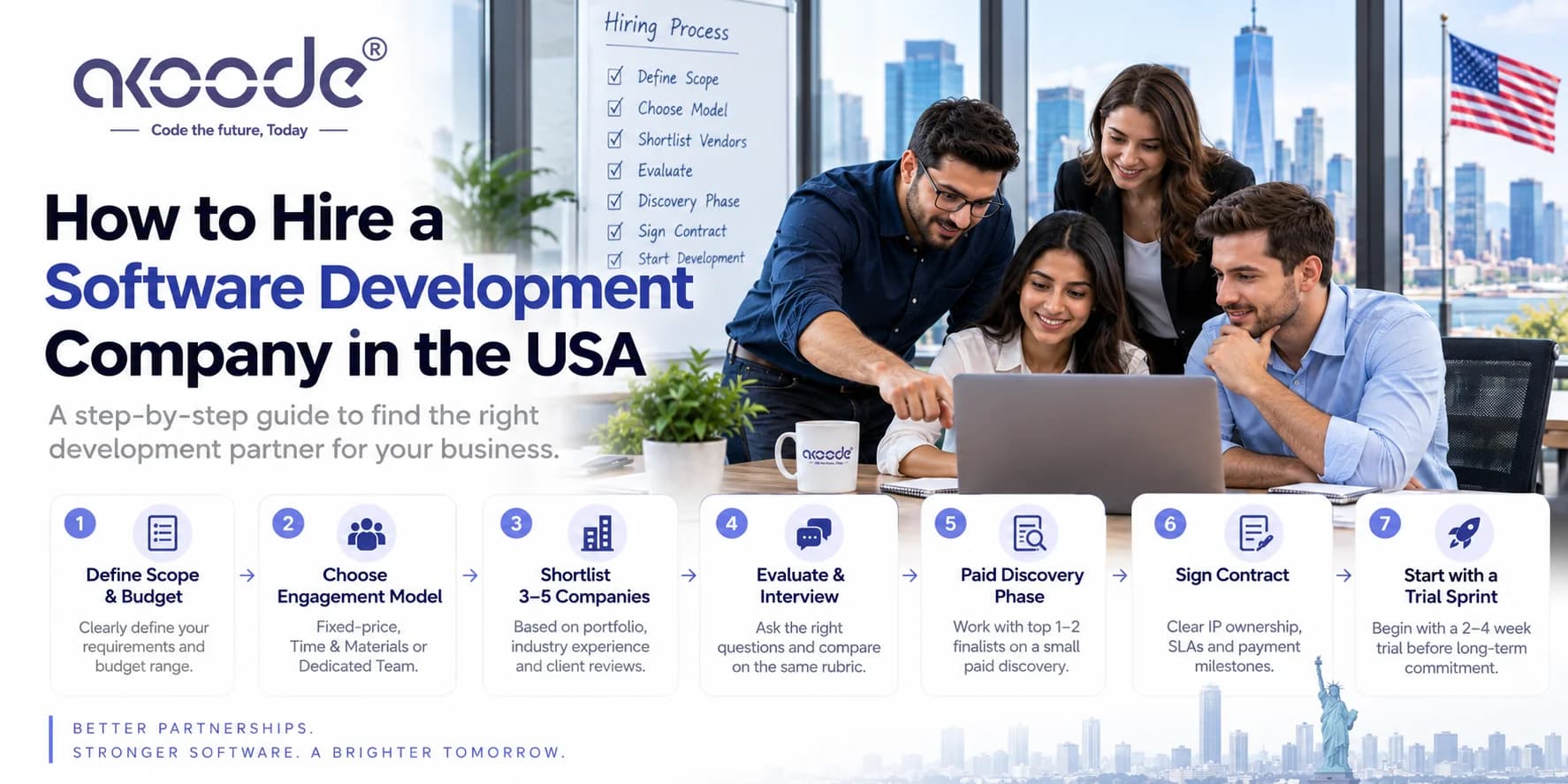
7. Get three quotes and compare scope line by line. Our Illinois hiring guide covers exactly how to run that comparison.
Frequently Asked Questions
How much does software development cost in Illinois in 2026?
Illinois agencies typically bill $85–$175/hour depending on role, seniority, and whether the team is Chicago-based or elsewhere in the state. Complete projects run $30,000–$78,000 for an MVP, $78,000–$170,000 for a business application, $115,000–$285,000 for a SaaS platform, and $245,000–$610,000+ for enterprise systems. BIPA-scoped and regulated builds carry a 15–25% premium.
What do software developers earn in Illinois?
Glassdoor's May 2026 data puts software engineers at $138,089 statewide from 22,665 submissions — in line with the national average — ranging $113,165 to $170,869. Applications software developers average $135,731. Salary.com reports $131,780 and ZipRecruiter $108,381, with the spread reflecting different methodologies and role definitions. Entry-level lands near $97,490.
Is there a difference between Chicago and statewide Illinois software rates?
Yes, and it's larger than most cost guides acknowledge. Chicago software engineers average $158,753 — 5% above national — while the statewide figure sits at $138,089. Critically, roughly 89% of the statewide sample comes from Chicago, so the "Illinois average" is largely a Chicago average with a thin downstate tail. Downstate and collar-county employers genuinely compete in a lower-cost labor market.
What does BIPA add to a software project cost?
Expect 15–25% above an equivalent unregulated build for anything touching fingerprints, facial geometry, voiceprints, or iris scans — covering consent capture and storage, retention schedule enforcement, disclosure controls, audit logging, and the written policy the statute requires. Designed in from sprint one it's a line item; retrofitted after a claim it's re-architecture under pressure.
Did the 2026 BIPA ruling make compliance cheaper?
It reduced the tail risk, not the obligations. The August 2024 amendment established that repeated collection of the same identifier from the same person by the same method is a single violation rather than one per scan, and in April 2026 the Seventh Circuit held in Clay v. Union Pacific Railroad that this applies retroactively to pending cases. The financial ceiling came down substantially. The substantive requirements — written policy, retention schedule, informed written consent, disclosure limits, security standards — are unchanged, and the private right of action remains.
What is Illinois HB 3773 and does it affect my software project?
Effective January 1, 2026, HB 3773 amended the Illinois Human Rights Act to make it a civil rights violation for employers to use AI with a discriminatory effect on protected classes in employment decisions, to use ZIP code as a proxy for protected classes, or to fail to notify employees and applicants that AI is being used. Liability attaches to effect regardless of intent, and employers remain responsible for third-party AI tools — which means if you build ATS, HR, or performance management software, your customers now carry strict liability for what your model does.
What's the biggest hidden cost in Illinois software projects?
Integration surface discovered after commitment. Illinois' manufacturing and agricultural economy runs on plant floor systems predating the cloud, ERP installations with a decade of undocumented customization, and cooperatives running spreadsheets alongside partly-mapped databases. Paid integration discovery — roughly $10,000–$25,000 on a complex estate — costs materially less than the alternative. Maintenance at 15–25% annually is second.
Why does surface count matter more than feature count for cost?
Because a platform with a customer app, an operator portal, and an admin console isn't one product with three views — it's three products sharing a data model, each with its own authentication, permissions, state handling, testing surface, and release cadence. Two surfaces typically run $85,000–$260,000 and three run $130,000–$380,000, largely independent of how many features sit inside each one.
How long do Illinois software builds take?
Most mid-size builds run 4 to 12 two-week sprints, with larger enterprise and integration-heavy work extending well beyond that. Agtech clients running production infrastructure typically add a load-testing step before launch to validate against harvest-season volume. The most common timeline extender isn't development — it's discovering what the existing plant, field, or ERP systems actually do.
Should I hire locally in Illinois or use a distributed team?
For work requiring in-person presence — plant floor observation, research facility access, on-site field validation — local has real value. For the engineering itself, integration experience and compliance fluency matter more than proximity, and Central Time makes distributed delivery straightforward in both directions. Evaluate either the same way: what have they integrated with, and what broke.
Does Illinois have a comprehensive consumer privacy law?
Not a broad omnibus consumer privacy statute comparable to California's or Colorado's. Illinois compliance work instead runs through sector-specific and targeted frameworks — BIPA for biometric data, the Personal Information Protection Act for breach notification, HB 3773 for AI in employment, the AI Video Interview Act, plus federal regimes like HIPAA where applicable. That makes scoping which frameworks apply a discovery task rather than an assumption.
The Bottom Line
Illinois cost data rewards buyers who read past the state average — because the state average is mostly a Chicago average.
If you're building in Chicago, expect to pay roughly 5% above national and budget accordingly. If you're building anywhere else in Illinois, the labor market underneath your vendor's quote is meaningfully cheaper than the headline figure implies, and it's worth asking where the delivery team actually sits.
Beyond geography, the variables that genuinely move an Illinois number are consistent: BIPA scope for anything biometric, the new AI employment obligations for anything touching hiring decisions, integration surface into systems that predate the cloud, and whether the architecture was built for real production volume or a pilot dataset.
Pay for those. Question anything priced on the state average without asking which part of the state.
Book a free consultation → calendly.com/akhil-akoode/ak
A senior engineer reviews every inbound project — not an account manager — and replies within thirty working minutes.
Explore: Software Development Company in Illinois | BIPA compliant software development guide | how to hire an Illinois development company | manufacturing | agriculture | AI development | case studies
Get In Touch Now
View More Our Blog