


 June 5, 2026
A fleet running on spreadsheets is not a fleet. It is a liability waiting to surface.
Fuel costs climb without explanation. Drivers pick the route that feels right rather than the one that is right. Maintenance waits until something breaks loudly. Compliance documentation sits in folders nobody checks until an audit forces them to.
Fleet management software was built for this exact problem. Tracking, maintenance, compliance, and optimisation all sit in one platform. The platform prevents problems rather than helping you respond to them.
The market backs this up. The global fleet management sector is heading toward $52 billion by 2030. MarketsandMarkets puts annual growth at 10.5 percent. The fastest-growing segment is custom and integrated systems. Businesses that tried generic off-the-shelf tools are discovering their limits.
This guide covers what to build, what it costs in 2026, and what separates a platform that actually runs a fleet from one that just adds a map to your operations.
What Is Fleet Management Software?
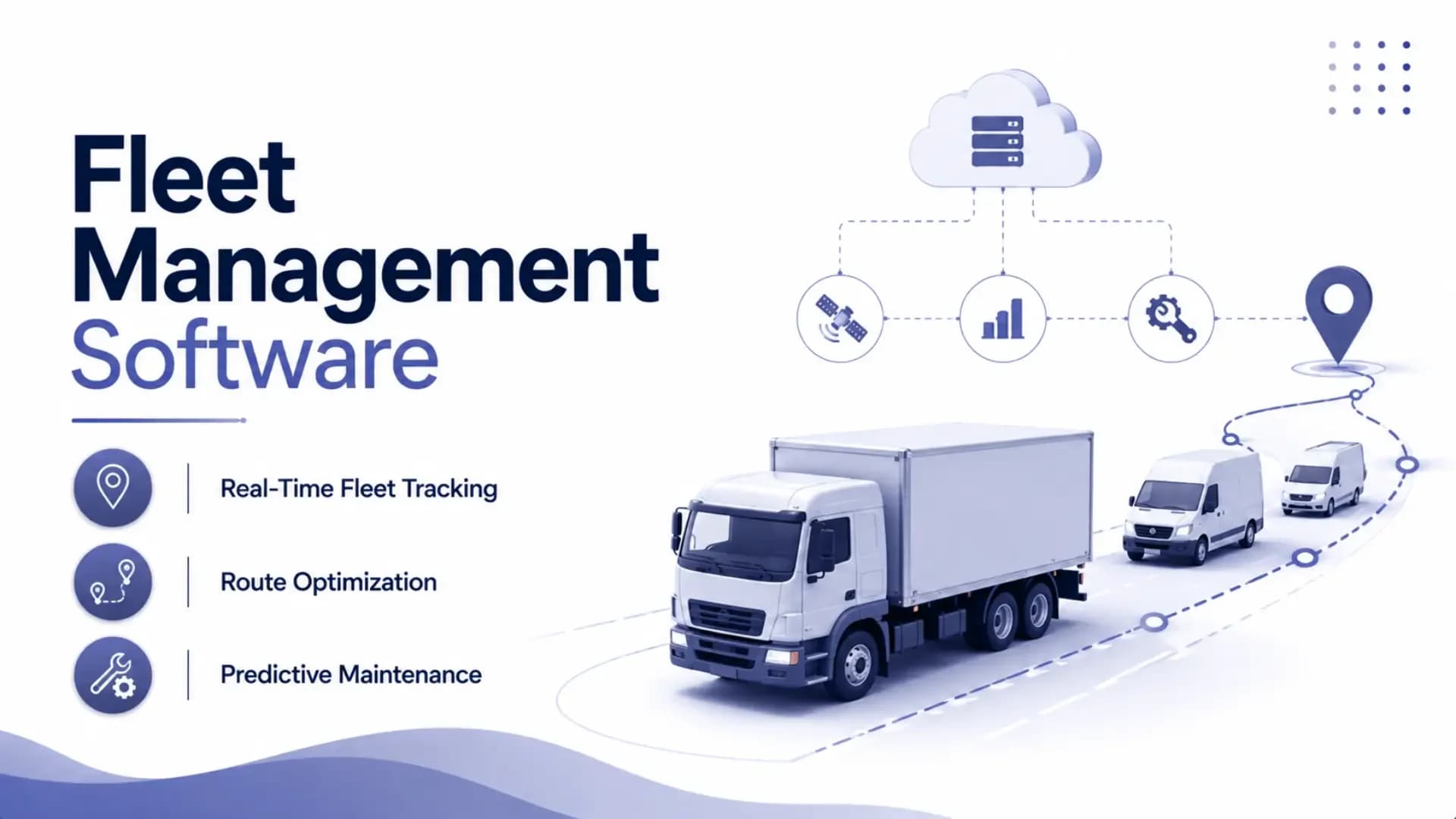
Fleet management software connects GPS hardware in each vehicle to a central operations dashboard. Managers see location, speed, and vehicle status across the entire fleet simultaneously. Trip history is recorded automatically. Maintenance scheduling runs against actual vehicle condition rather than calendar guesses. Compliance documentation generates itself.
That is the baseline. Modern platforms go further.
AI-powered predictive maintenance catches faults before drivers notice them. Route algorithms cut fuel cost by finding paths that human dispatchers would not. Driver behaviour scoring reduces accidents without requiring anyone to review dashboards manually. The analytics layer turns raw vehicle data into operational decisions.
Three very different user types interact with the same platform every day. Fleet managers see the aggregate picture. Drivers receive route guidance and job details. Maintenance teams receive fault alerts and service schedules. Getting the UX right for all three simultaneously is one of the harder design challenges in this category.
What Features Does Every Fleet Management Platform Actually Need?
Real-time GPS tracking is the foundation. Without it, nothing else works. Location refreshed every 30 seconds or faster. Geofencing alerts when vehicles cross defined boundaries. Route replay for reviewing what actually happened on completed trips. This feature is non-negotiable. Everything builds on top of it.
Route optimisation is where fuel savings come from. Traffic conditions, delivery time windows, vehicle capacity limits, and driver hours all feed into the algorithm. When conditions change, the system reroutes. For large fleets, the cumulative fuel savings from even modest route improvements are significant over a year.
Driver behaviour monitoring does two things at once. It reduces accident rates and it reduces insurance costs. Harsh braking, rapid acceleration, speeding, and phone use are all tracked and scored. Managers see patterns across the fleet. Drivers receive specific feedback rather than generic coaching. Fleets that have deployed this consistently see measurable changes within the first three months.
Predictive maintenance is the feature with the fastest payback. Service alerts based on mileage, engine hours, or diagnostic codes from OBD-II readers replace calendar-based scheduling with condition-based scheduling. A vehicle showing early signs of brake wear gets scheduled before it becomes a roadside breakdown. Reactive maintenance costs significantly more than scheduled maintenance. This feature closes that gap.
Fuel management goes beyond tracking litres consumed. Fuel card integration, per-driver consumption analysis, and anomaly detection for unusual patterns. The anomaly detection component is worth calling out specifically. Fuel theft is a real operational problem in large fleets. Unusual fill patterns and consumption spikes flag it early.
ELD compliance matters most for US markets and commercial operators. Hours of service tracking. FMCSA mandate compliance. Automated log generation that replaces paper logbooks. Operators who have managed manual ELD compliance understand exactly how much time this feature saves.
Dispatch and job management connects the office to the vehicle. Job assignments push directly to the driver's device. Two-way communication replaces phone calls. Delivery confirmation and proof of delivery capture are logged automatically. For logistics operations, this removes the coordination overhead that quietly consumes dispatcher hours every day.
Analytics and reporting is where operational intelligence lives. Cost per mile by vehicle. Maintenance cost history. Utilisation rates. Fuel efficiency trends by driver and route. Without this layer, managers have data but not insight. The difference matters.
The mobile driver app is the interface most drivers actually interact with. Navigation with job details. Hours of service logging. Pre-shift defect inspection through a guided checklist. Communication with dispatch. App quality directly affects driver adoption. A poorly designed driver app undermines an otherwise well-built platform.
How Much Does Fleet Management Software Development Cost in 2026?
Project Tier | Cost Range | What It Covers |
|---|---|---|
Basic fleet app (up to 50 vehicles) | $8,000 to $40,000 | GPS tracking, trip history, basic alerts, driver app |
Mid-level platform (50 to 200 vehicles) | $40,000 to $100,000 | Real-time tracking, route optimisation, fuel management, basic compliance |
Advanced platform (200+ vehicles) | $100,000 to $250,000 | Full feature set, predictive maintenance, AI analytics, ELD compliance |
Enterprise custom platform | $250,000 to $500,000+ | Multi-depot, custom integrations, white-label capability, enterprise security |
Multiple 2026 cost analyses, from Saigon Technology, Tactionsoft, and Appscrip, place enterprise custom fleet platforms between $100,000 and $400,000 depending on scope.
Developer rates by region:
Region | Senior Rate | Mid-Level Rate |
|---|---|---|
United States | $150 to $250/hour | $100 to $150/hour |
United Kingdom | $80 to $140/hour | $55 to $85/hour |
India | $25 to $65/hour | $18 to $35/hour |
A mid-level platform built by a US team at $150,000 costs $40,000 to $60,000 with a quality India-based partner. India's logistics and IoT engineering ecosystem is deep. The talent is genuinely experienced with real-time data platforms and telematics integrations.
What Actually Drives Cost Up?
Some cost drivers are obvious. Others show up late in the project.
Real-time data processing is the architectural challenge most first-time builders underestimate. GPS updates every 30 seconds across 500 vehicles is a high-frequency data stream. The backend that ingests, processes, and serves this at low latency requires deliberate design. Building it correctly from the start costs more upfront. Rebuilding it later costs significantly more.
Telematics hardware integration adds $15,000 to $40,000 per hardware type depending on API complexity. GPS trackers, OBD-II readers, dash cameras, and ELD devices each speak different data protocols. Each one needs its own integration layer. Platforms supporting multiple hardware vendors spend proportionally more on this.
AI and predictive analytics add roughly 25 percent to development cost according to Appscrip's 2026 analysis. Most of that cost is data preparation and model training rather than the model code itself. Teams that skip proper data infrastructure at this stage end up with models that perform well in testing and poorly in production.
Compliance requirements contribute 10 to 20 percent of the total budget. FMCSA ELD mandates, GDPR, PDPB, and industry-specific regulations each require engineering work. Treating compliance as a final-stage review rather than a development requirement consistently results in expensive rework.
Cloud infrastructure sized for scale adds $20,000 to $50,000 at the initial build stage. Underscaling to reduce upfront cost and re-architecting when the fleet grows costs more in total. This is one of the clearest cases where spending more at the start saves more later.
What Tech Stack Does Fleet Management Software Use?
Backend: Node.js or Golang for high-concurrency API services that handle continuous vehicle data streams. Python for analytics pipelines and machine learning model development.
Real-time data layer: Apache Kafka or AWS Kinesis for event streaming from vehicle telematics. Redis for caching location and status data at sub-millisecond latency.
Databases: PostgreSQL for structured operational data. TimescaleDB or InfluxDB for time-series telemetry. MongoDB for flexible document storage on trip reports and driver records.
Maps and routing: Google Maps Platform or Mapbox for geospatial features and routing. OpenStreetMap with OSRM for high-volume use cases where licensing cost at scale is a constraint.
Mobile: React Native for cross-platform driver apps. It cuts 20 to 30 percent from mobile build cost compared to separate native apps without meaningful performance trade-offs for this use case.
IoT connectivity: MQTT protocol for lightweight, low-latency vehicle-to-platform communication. AWS IoT Core or Azure IoT Hub for managed connectivity at scale.
Custom Build vs Off-the-Shelf: How to Decide
Off-the-shelf platforms like Samsara, Verizon Connect, and Geotab price at $4 to $40 per vehicle per month. According to Capterra market data, entry-level plans average $128 per month. Premium enterprise plans reach $856 per month.
Off-the-shelf is right for standard fleets with straightforward operations. Fast deployment. No development risk. Vendor-managed updates. These are real advantages.
Custom development makes sense in four specific situations.
The existing ERP, TMS, or logistics system needs tight integration. Standard fleet platforms offer limited integration flexibility. The custom integration work to bridge gaps often costs more over time than building correctly from the start.
The operation has workflows no standard product supports. Complex multi-depot operations, temperature-sensitive cargo requirements, or industry-specific compliance needs consistently expose the limits of generic platforms.
Fleet management is being built as a product to sell. A telematics company or logistics platform building for its own customers needs custom development by definition.
Per-vehicle fees become material at scale. A 500-vehicle fleet at $20 per vehicle per month spends $120,000 annually. A custom platform at $150,000 to build and $25,000 per year to maintain crosses break-even within two years.
Also check: Custom Software vs. Off-the-Shelf Software: Which Is Right for Your Business?
What Are the Hidden Costs?
Hardware: GPS trackers and OBD-II devices at $50 to $300 per unit. Installation on top. A 200-vehicle hardware rollout runs $20,000 to $60,000 before development begins.
Infrastructure: Cloud hosting and data processing at $500 to $2,000 per month for a 200-vehicle fleet. This grows with fleet size and data frequency.
Maintenance: 15 to 20 percent of initial build cost annually. Hardware firmware changes, API deprecations, regulatory updates, and new feature additions all require engineering time.
Training: Driver and manager adoption does not happen automatically. Poor training produces low adoption. Low adoption produces poor ROI from a well-built platform. Budget for structured onboarding.
Integration maintenance: Third-party APIs change. Telematics vendors update data protocols. Map providers deprecate older versions. Each change requires engineering time to maintain. This is a real recurring cost that most initial budgets ignore.
Conclusion
Fleet management software is an infrastructure investment. The returns compound over time. Lower fuel costs. Fewer breakdowns. Better compliance. Lower insurance premiums. These are measurable from the first year.
The businesses that get the most from this investment build to the right scope, design for growth from day one, and plan honestly for hardware, maintenance, and integration costs before development begins.
Akoode Technologies is a leading AI and software development company headquartered in Gurugram, India, with a US office in Oklahoma. From fleet management software development and IoT solutions to AI-powered platforms and cloud and DevOps solutions, Akoode builds logistics and mobility software for startups, SMEs, and enterprise clients across 15+ industries globally. If you are planning a fleet management platform and want accurate scoping before development begins, that conversation starts here.
Frequently Asked Questions
1. What is fleet management software?
A digital platform that tracks, manages, and optimises vehicle fleets in real time. Core capabilities include GPS tracking, route optimisation, driver behaviour monitoring, predictive maintenance, fuel management, ELD compliance, and analytics reporting.
2. How much does fleet management software development cost in 2026?
Basic fleet apps cost $8,000 to $40,000. Mid-level platforms run $40,000 to $100,000. Advanced platforms with full feature sets cost $100,000 to $250,000. Enterprise custom platforms start at $250,000. India-based teams deliver the same scope at 60 to 70% of US team rates.
3. What are the must-have features?
Real-time GPS tracking, route optimisation, driver behaviour monitoring, predictive maintenance, fuel management, ELD compliance, dispatch and job management, analytics reporting, and a mobile driver app.
4. What drives development cost up most?
Real-time data processing architecture, telematics hardware integrations at $15,000 to $40,000 per hardware type, AI and predictive analytics adding roughly 25 percent to base cost, compliance requirements contributing 10 to 20% of budget, and scalable cloud infrastructure.
5. When should a business build custom vs buy off-the-shelf?
Custom is justified when integration with existing systems is critical, when the operation has unique workflows, when building fleet management as a product to sell, or when per-vehicle subscription fees exceed custom platform ownership cost at scale.
6. What are the hidden costs?
Hardware at $50 to $300 per vehicle, monthly infrastructure at $500 to $2,000, annual maintenance at 15 to 20 percent of build cost, driver and manager training, and ongoing integration maintenance as APIs and protocols update.