


 June 5, 2026
The car has always been a technology product. For most of its history, that technology was mechanical.
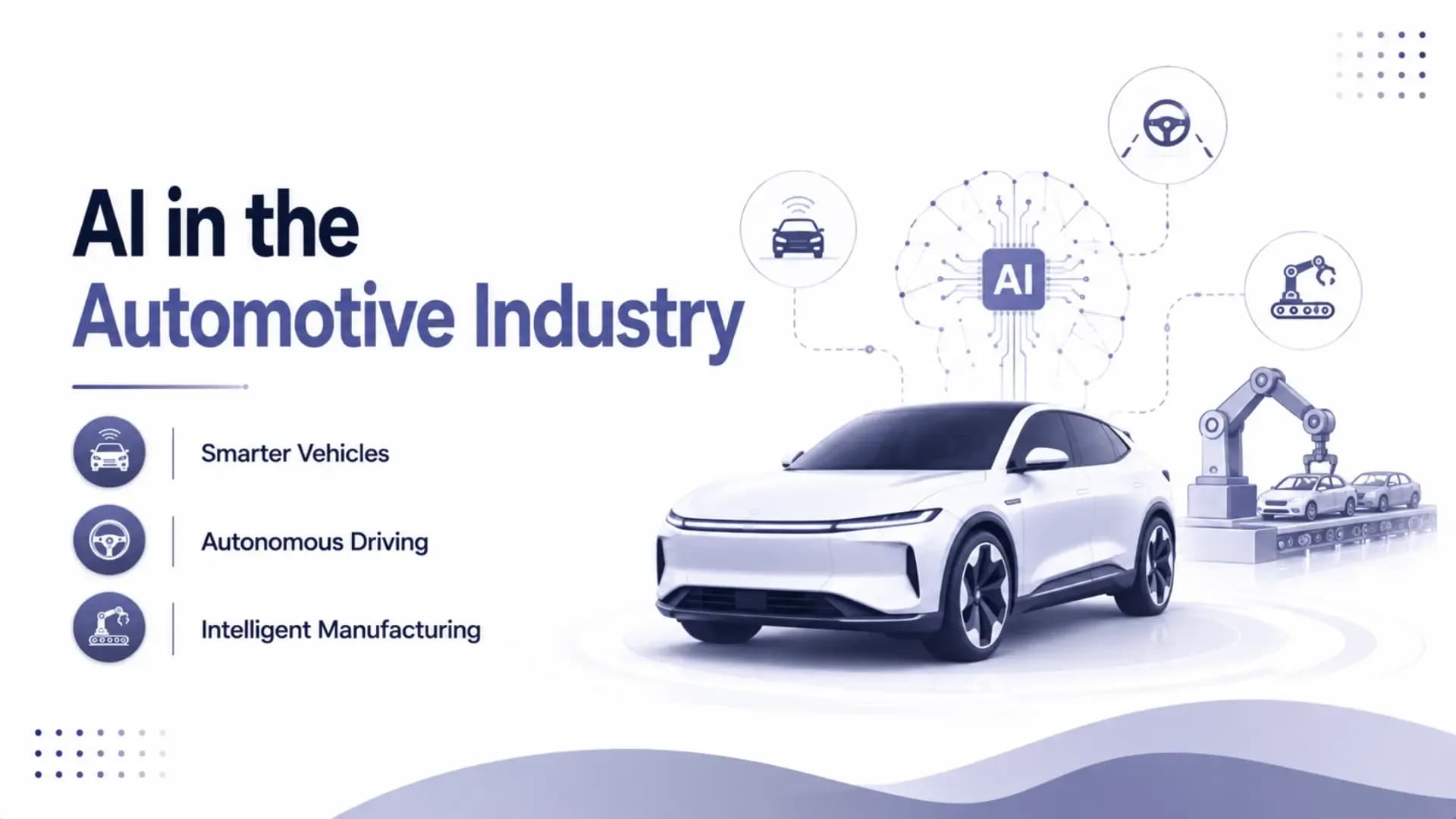
That has changed. Software now defines the driving experience. AI is reshaping how vehicles are designed, built, and operated. Few predicted how quickly this would move.
According to IBM research cited across the industry, OEM executives expect AI to increase total revenue share by 9% within three years. That is an active management expectation. Not a forecast for a distant future.
This guide covers where AI creates real, measurable value in automotive in 2026, how generative and agentic AI differ from earlier approaches, and what the next phase looks like.
What Is Driving AI Adoption in Automotive Right Now?
Three pressures are converging at once.
Software-defined vehicles are becoming the dominant product model. A modern car runs over 100 million lines of code. That number keeps growing. Updating, personalising, and adding features over the air requires AI at every layer. Design, validation, and deployment all change when the vehicle is primarily software.
Competitive pressure from Chinese OEMs is forcing acceleration. Chinese manufacturers deployed AI in design, manufacturing, and in-vehicle systems faster than most Western and Indian competitors anticipated. Buyer expectations have shifted as a result.
Data volumes outpace human capacity to process them. A connected vehicle generates up to 25 gigabytes of data per hour. A modern factory floor generates far more. No human team can analyse this in real time. AI is not an option at this data scale. It is the only workable solution.
How Is AI Changing Vehicle Design and Engineering?
Generative AI has changed the pace of automotive design.
A process that took months now takes weeks in many areas. Design teams input constraints: aerodynamic targets, material weight limits, manufacturing feasibility, and aesthetic guidelines. The system produces hundreds of variations across that parameter space. Designers evaluate and refine rather than produce from scratch.
Engineering validation is where AI has the deepest impact. ADAS systems and safety-critical control software require exhaustive testing before production approval. According to N-iX research published in late 2025, agentic AI systems analyse signals across development environments and simulations continuously. They generate edge-case test scenarios that scripted tests miss. They triage large volumes of failure logs and surface root causes faster than manual analysis allows.
This matters directly for compliance. ISO 26262 and SOTIF safety standards require high test coverage across failure scenarios. Meeting those requirements manually is expensive and slow. AI-driven testing agents maintain alignment with those standards continuously rather than in discrete validation cycles.
Virtual testing through simulation is also reducing the number of physical prototype cycles. Physics simulation, digital twin validation, and synthetic data generation allow engineering decisions to be tested in software before any hardware exists. ZF's TempAI is one documented example of AI-driven design tooling producing measurable gains in propulsion system efficiency and reliability.
How Is AI Transforming Automotive Manufacturing?
The factory floor is where AI adoption is most mature. The ROI case is most clearly documented here.
Predictive maintenance is the highest-value operational application. Sensors on manufacturing equipment generate continuous data. Temperature, vibration, current draw, acoustic signatures. AI models trained on this data identify patterns that precede failure before the failure happens. According to Deloitte research, this approach produces roughly a 20 percent increase in equipment availability and up to a 10 percent reduction in total annual maintenance costs.
Quality control has moved from sampling to continuous inspection. Computer vision systems check every unit on the production line. They identify surface defects, dimensional deviations, and assembly errors at speeds no human inspector can match. Defect rates fall. Scrap rates fall. The inspection data also feeds back into the manufacturing process itself, giving engineers visibility into which production parameters produce the most consistent output.
Supply chain management is another area producing measurable returns. Demand forecasting models reduce inventory holding costs. Supplier risk monitoring flags potential disruption before it reaches the schedule. Logistics optimisation reduces transportation costs across complex multi-tier supplier networks.
Assembly robotics are being enhanced by AI perception systems. Traditional industrial robots required fixed, precise inputs. AI-enhanced robots handle positional variation, detect damaged parts, and adjust grip force in real time. This increases line flexibility without requiring physical reconfiguration.
How Does AI Change the In-Vehicle Experience?
The vehicle cabin is becoming an AI-driven computing environment.
Voice assistants are moving beyond command-and-response. Natural language understanding lets drivers interact with navigation, entertainment, climate, and settings through conversation rather than menu navigation. According to Research and Markets analysis, AI-driven voice assistants are expected to become standard across vehicle segments by 2033.
Personalisation is now a significant product differentiator. AI systems adjust seat position, mirrors, climate, and content recommendations automatically at the start of each journey. After a few journeys, the vehicle builds an accurate picture of that driver. No configuration required.
Driver monitoring systems use computer vision to track fatigue and distraction. When impairment is detected, the system provides escalating alerts or initiates safe-stop procedures depending on severity. These systems are now a regulatory requirement in several markets and are becoming standard in new vehicle lines.
For EV platforms, AI manages battery health, charging optimisation, and degradation prediction. Drivers receive accurate range estimates based on their actual driving patterns and current conditions rather than manufacturer averages. Fleet operators use the same AI layer to schedule charging across vehicle pools and optimise costs against electricity pricing.
What Is ADAS and How Does AI Power It?
Advanced Driver Assistance Systems span the range from lane keeping assistance to automatic emergency braking.
The AI behind these systems processes sensor fusion from cameras, lidar, radar, and ultrasonic sensors simultaneously. Each sensor type has different strengths. Cameras handle visual scene understanding. Lidar provides accurate spatial geometry. Radar maintains reliability in poor weather where cameras struggle. AI models combine these inputs into a coherent environmental model that drives the vehicle's safety decisions.
Level 2 and Level 3 autonomy are commercially deployed at scale. Level 4, where the vehicle handles the full driving task in defined domains, is operational through robotaxi services in specific geographies. Level 5 full autonomy without any operational domain constraint remains an engineering and regulatory challenge rather than an imminent commercial reality.
S&P Global Automotive Insights notes that agentic AI is now enabling real-time contextual reasoning within ADAS beyond rule-based trigger logic. That shift toward reasoning-based systems is where fully autonomous capability ultimately lives.
What Is Agentic AI in the Automotive Industry?
Agentic AI is the most significant capability shift since machine learning entered vehicle systems.
Traditional automotive AI is reactive. A sensor detects something specific. The AI triggers a pre-defined response. The system responds to inputs it was explicitly trained to recognise.
Agentic AI plans and acts. It reads context, reasons about what to do next, and takes action within defined boundaries. No specific trigger required.
In an automotive development environment, an agentic system can analyse test failures across ADAS pipelines, identify which failures share the same root cause, prioritise the investigation, generate fix candidates, and initiate the next test cycle. All of this runs autonomously according to N-iX research from 2025.
Other practical applications in production environments include continuous validation monitoring that runs around the clock, factory floor agents coordinating maintenance scheduling across multiple production lines, supply chain agents modelling alternative sourcing scenarios when disruption signals appear, and in-vehicle assistants managing complex multi-step tasks like real-time route rerouting due to unexpected conditions.
The distinction from traditional automation matters. Traditional automation executes a pre-defined sequence. An agentic system decides which sequence fits the current situation. That difference in capability also creates different governance requirements under automotive safety standards.
What Are the Real Benefits of AI in Automotive?
The benefits are visible at every segment of the business.
In product development, AI shortens the time from concept to validated design. Physical prototype cycles reduce. Validation costs fall. The net result is faster product launches at lower development cost.
In manufacturing, predictive maintenance cuts unplanned downtime. Computer vision reduces defect rates. Supply chain AI reduces inventory costs. These improvements compound across the production system and are measurable in existing operations.
In the vehicle itself, AI improves safety through ADAS and driver monitoring. It improves efficiency through intelligent powertrain and battery management. It improves the user experience through personalisation and conversational interfaces. All three influence purchasing decisions.
In customer and aftersales operations, AI-powered diagnostics predict service needs before they become failures. Conversational agents handle routine customer enquiries at scale. Dynamic pricing models optimise dealer revenue. Each application reduces cost while improving the customer experience simultaneously.
What Are the Challenges Automotive Businesses Face?
Data quality and integration: AI models depend on clean, connected data. Most automotive organisations have data distributed across engineering systems, manufacturing systems, and field telematics that do not share a common structure. Building the data infrastructure that makes AI useful is often the most expensive component of an AI programme.
Safety validation: AI models influencing vehicle control must meet the same rigour as other safety-critical systems. ISO 26262 and SOTIF address functional safety and operational design. Validating AI behaviour across all operational conditions, including edge cases not seen during training, has no fully standardised solution yet.
Regulatory fragmentation: Autonomous vehicle regulations vary significantly across markets. A capability validated for one geography may require additional certification elsewhere. This increases the cost and complexity of scaling autonomous features internationally.
Talent scarcity: The combination of automotive domain expertise and AI engineering skill is genuinely rare. Organisations that build effective AI programmes typically integrate domain experts and AI engineers into shared teams rather than treating AI as a separate technology project.
Also Check: IoT in the Automotive Industry: Transforming Mobility
What Comes Next?
Software-defined vehicles will become the dominant product model across all segments. The vehicle's value will come increasingly from its software capabilities rather than hardware specifications alone.
Generative AI will become embedded across design, engineering, and manufacturing workflows rather than deployed in isolated use cases. Organisations building integrated data and AI infrastructure now will deploy these capabilities broadly. Those running disconnected pilots will face a consolidation challenge before they can scale.
Agentic AI will move from development tooling into production vehicle systems. Vehicles managing complex multi-step tasks, coordinating with external infrastructure, and adapting to unexpected situations represent the next generation of the driving experience.
For automotive businesses evaluating where to start, manufacturing operations offer the fastest ROI case. Predictive maintenance, quality inspection, and supply chain optimisation have proven returns and lower regulatory complexity than in-vehicle AI systems. Building the data foundation through those initial deployments creates the infrastructure that more advanced use cases require.
The broader AI development trends running across every industry are directly applicable here. The capability curve for foundation models, agentic systems, and generative tools is the same curve. Automotive applications are specific in their safety requirements. They are not isolated from general AI advancement.
Conclusion
AI in automotive is not a future story. It is operational now across design, manufacturing, the vehicle cabin, and business operations.
The organisations seeing the most value are not deploying the most AI projects. They are building the data infrastructure and integrated teams that allow AI to run inside real workflows rather than alongside them.
The gap between businesses that have embedded AI into operations and those still evaluating is widening every year. Decisions made now about data, talent, and deployment approach will determine competitive positioning for the decade ahead.
Akoode Technologies is a leading AI and software development company headquartered in Gurugram, India, with a US office in Oklahoma. From AI-powered software development and IoT solutions to computer vision systems and custom enterprise platforms, Akoode builds AI and software products for automotive businesses, OEMs, and technology suppliers across 15+ industries globally. If you are planning an AI programme for an automotive use case and want a team that understands both the technology and the domain, that conversation starts here.
Frequently Asked Questions
1. How is AI being used in the automotive industry in 2026?
AI is deployed across vehicle design, manufacturing, ADAS, in-cabin personalisation, battery management, predictive maintenance, quality control, supply chain optimisation, and customer operations. IBM research cited by industry analysts reports OEM executives expect AI to increase total revenue share by 9 percent within three years.
2. What is generative AI in the automotive industry?
Generative AI creates new outputs from learned patterns. In automotive, it produces design concepts from engineering constraints, generates edge-case test scenarios for ADAS validation, accelerates software development, and powers conversational in-vehicle assistants.
3. What is agentic AI in the automotive industry?
Agentic AI reads context, reasons about what action to take, and acts within defined boundaries without waiting for a specific trigger. In automotive development, agentic systems monitor ADAS test pipelines, identify shared root causes across failure clusters, and initiate fix cycles autonomously according to N-iX 2025 research.
4. How does AI improve automotive manufacturing?
Predictive maintenance produces roughly a 20 percent increase in equipment availability and up to a 10 percent reduction in annual maintenance costs according to Deloitte research. Computer vision quality control inspects every production unit continuously. Supply chain AI reduces inventory costs and identifies supplier disruption risk before it reaches the production schedule.
5. What is ADAS and how does AI power it?
ADAS covers capabilities from lane keeping to automatic emergency braking. AI fuses inputs from cameras, lidar, radar, and ultrasonic sensors into a coherent environmental model. The vehicle's safety decisions derive from that model. Agentic AI is enabling contextual reasoning within ADAS beyond rule-based trigger responses, per S&P Global Automotive Insights.
6. What are the biggest challenges of AI adoption in automotive?
Data quality and integration across fragmented systems, safety validation against ISO 26262 and SOTIF requirements, regulatory fragmentation across geographies for autonomous capabilities, and talent scarcity at the intersection of automotive domain knowledge and AI engineering expertise.