


 October 3, 2026
Quick answer:
Most business apps in India cost ₹4,00,000 to ₹12,00,000 (about $4,160 to $12,490 at ₹96 to the dollar). Simple apps start near ₹1,50,000 and enterprise platforms run ₹30 lakh to ₹1 crore or more. The price depends on features, backend, platforms, team seniority and compliance. Running costs after launch add roughly 20% to 30% in the first year. Updated 3 October 2026.
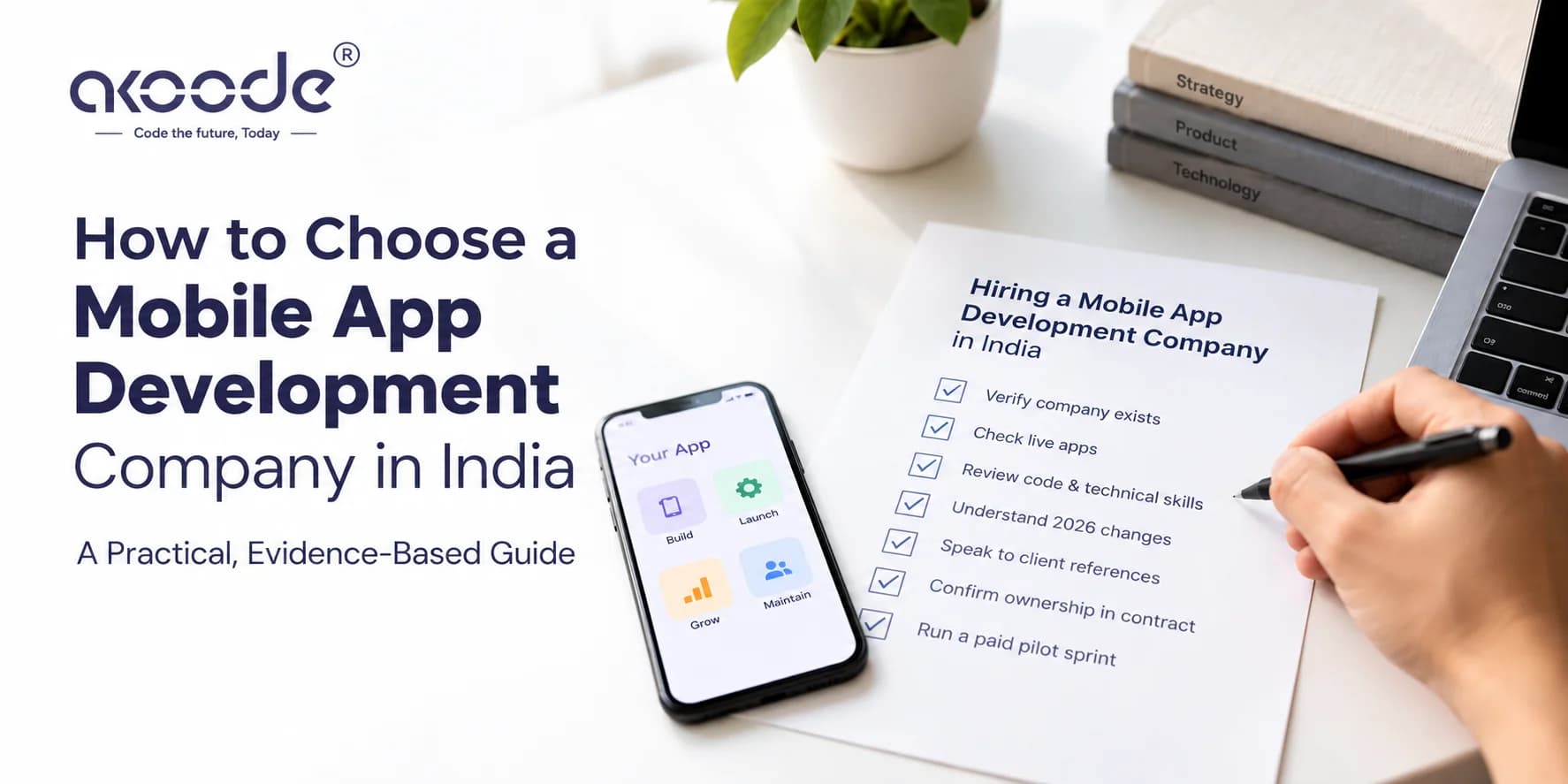
You ask three agencies for a quote on the same app.
One says ₹2 lakhs. Another says ₹12 lakhs. The third mentions something like $45,000. None of them are lying. That is actually the problem.
Mobile app development cost in India varies this much because no two apps are the same project, even when they sound identical in a brief. A five-screen booking app and a real-time marketplace with dual user roles are completely different builds. They just both get called "an app."
This guide breaks down the real numbers for 2026. By app type. By platform. By what actually drives costs up. And with honest INR and USD ranges for both Indian businesses and international clients evaluating India as a development partner.
What Does Mobile App Development Actually Cost in India?
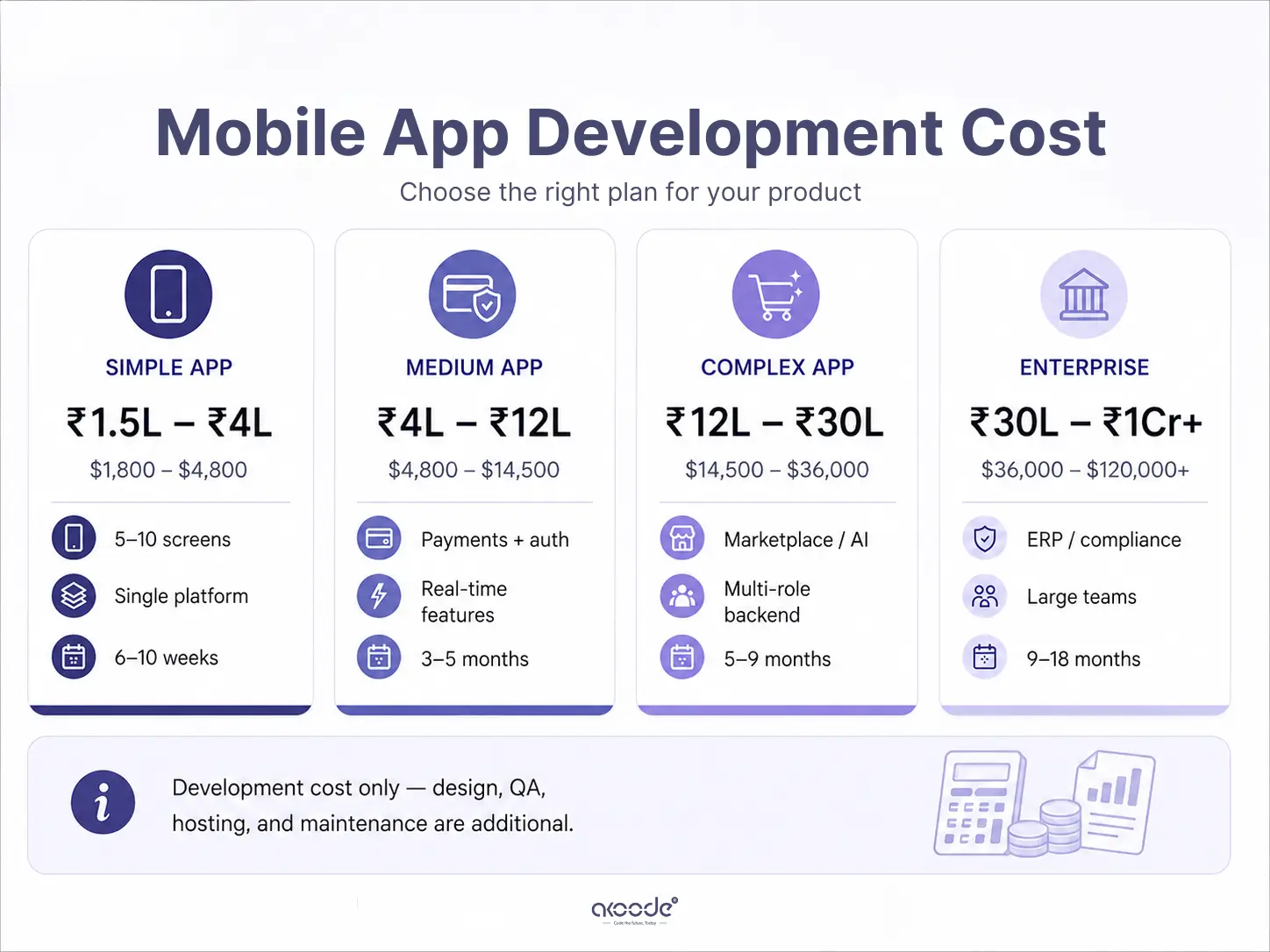
The short answer: anywhere from ₹1.5 lakhs to ₹1 crore or more.
That range is not a cop-out. It reflects the actual spread of projects being built in India right now — from simple single-screen utilities to full enterprise platforms with compliance requirements, multi-role backends, and real-time data pipelines.
Here is a practical overview by complexity.
App Type | Cost (INR) | Cost (USD) | Timeline |
|---|---|---|---|
Simple App | ₹1,50,000 – ₹4,00,000 | $1,560 – $4,160 | 6 – 10 weeks |
Medium Complexity App | ₹4,00,000 – ₹12,00,000 | $4,160 – $12,490 | 3 – 5 months |
Complex App | ₹12,00,000 – ₹30,00,000 | $12,490 – $31,220 | 5 – 9 months |
Enterprise Platform | ₹30,00,000 – ₹1,00,00,000+ | $31,220 – $104,060+ | 9 – 18 months |
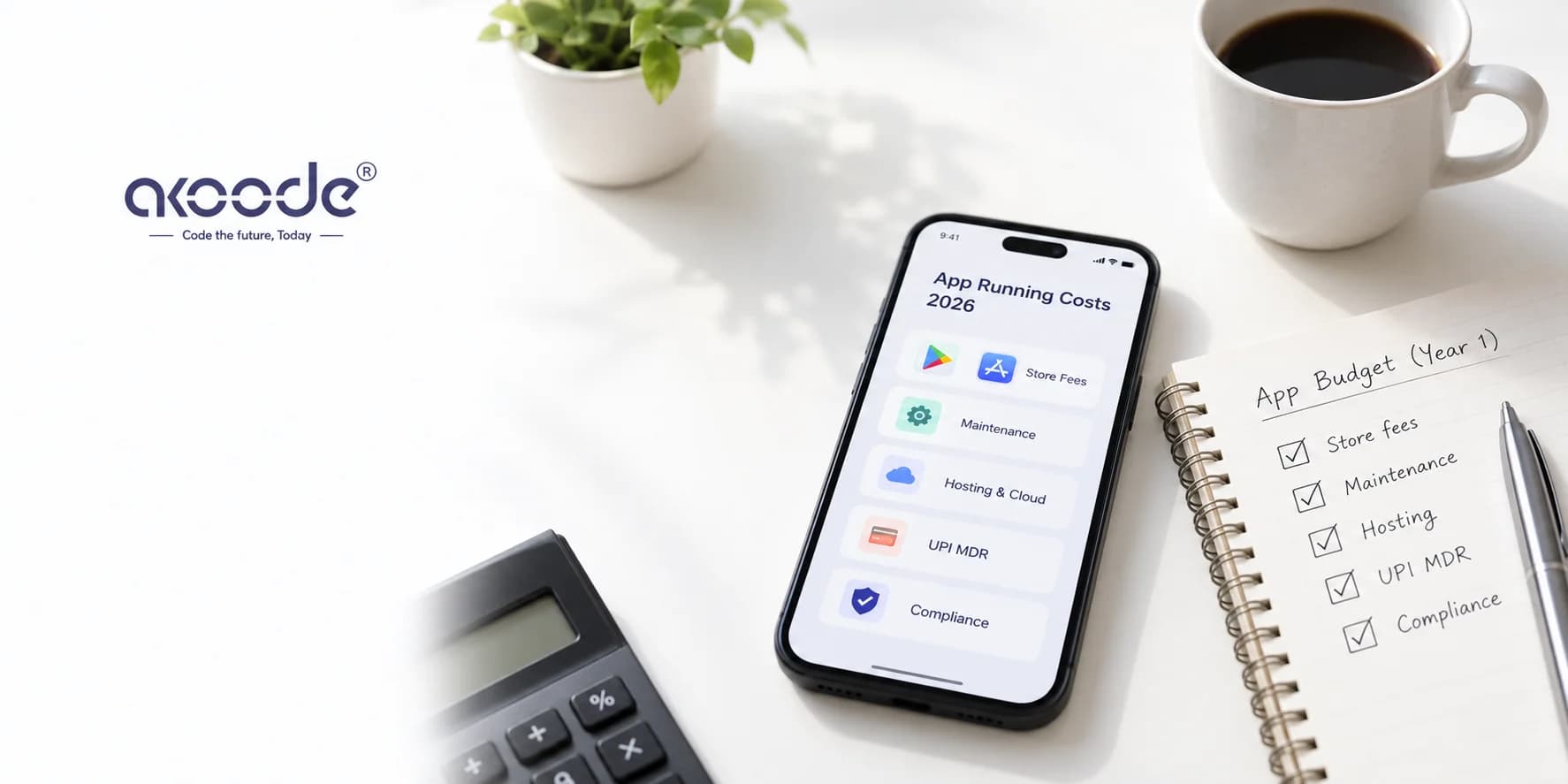
These are development-only figures. Design, QA, infrastructure and post-launch maintenance sit on top, and we cover the running side in our guide to what an app costs to run after launch. Dollar figures use ₹96 to the US dollar, the rate on 3 October 2026. Rupee prices are the reference, so the dollar value moves with the exchange rate."
What Kind of App Are You Actually Building?
Before any number makes sense, you need to know which category your app falls into. Most cost confusion comes from founders assuming their app is "medium" when the requirements actually push it into complex territory.
Simple apps have 5 to 10 screens, one platform, basic navigation, no complex backend. Think digital brochures, basic booking tools, or single-purpose utilities. This budget does not accommodate payment integration, user accounts, or real-time features. Trying to build those within this range results in half a product.
Medium complexity apps are where most growing businesses land. User accounts, payment gateways, push notifications, search and filter, booking workflows, and social logins all sit here. The backend starts to matter — you need reliable servers, databases, and APIs. E-commerce apps, appointment platforms, and EdTech tools typically fall in this range.
Complex apps involve real-time features. Live tracking, chat systems, multi-vendor logic, video streaming, AI-powered recommendations, advanced analytics. These demand serious backend architecture. A poorly designed system at this complexity level fails under load — not in testing, but when real users show up in large numbers.
Enterprise platforms are a different conversation entirely. Multiple user roles. ERP and CRM integrations. HIPAA, RBI, DPDP Act or GDPR compliance. High-concurrency infrastructure. Custom admin dashboards. Multi-language support. These are product engineering engagements, not app projects.
How Much Does a Mobile App Developer Cost in India Per Hour?
Understanding hourly rates helps you validate any quote you receive. It also helps international clients understand exactly where India's cost advantage sits.
Developer Level | Hourly Rate (INR) | Hourly Rate (USD) |
|---|---|---|
Junior Developer | ₹800 – ₹1,500 | $8 – $16 |
Mid-Level Developer | ₹1,500 – ₹3,000 | $16 – $31 |
Senior Developer | ₹3,000 – ₹5,000 | $31 – $52 |
Tech Lead / Architect | ₹5,000 – ₹8,000 | $52 – $83 |
AI / ML Specialist | ₹6,000 – ₹10,000 | $62 – $104 |
For US and UK clients: a senior Indian developer at $31 to $52 per hour compares against $120 to $200 per hour for equivalent talent in the West. On a 1,000-hour project, that gap runs to roughly $68,000 to $169,000 saved, before accounting for agency overheads. The rupee has also weakened about 8% against the dollar in the past year, which makes rupee-priced contracts cheaper in dollar terms."
Published regional rate surveys disagree with each other, and Clutch's public pricing table shows odd figures. For example, it lists the US at $25 to $49 an hour and India under $25. I'd keep your numbers anchored to your own rate card and not cite Clutch's regional table.
That cost advantage is why India continues to be the top destination for mobile app development outsourcing in 2026.
Native vs Cross-Platform: Which One Should You Choose?
This decision is made early and changes everything — cost, timeline, and long-term maintenance.
Native development means building separate apps for Android (Kotlin) and iOS (Swift). Better performance at extreme scale. But you are paying for two development streams. Cost increases by 30 to 50 percent over a single platform build.
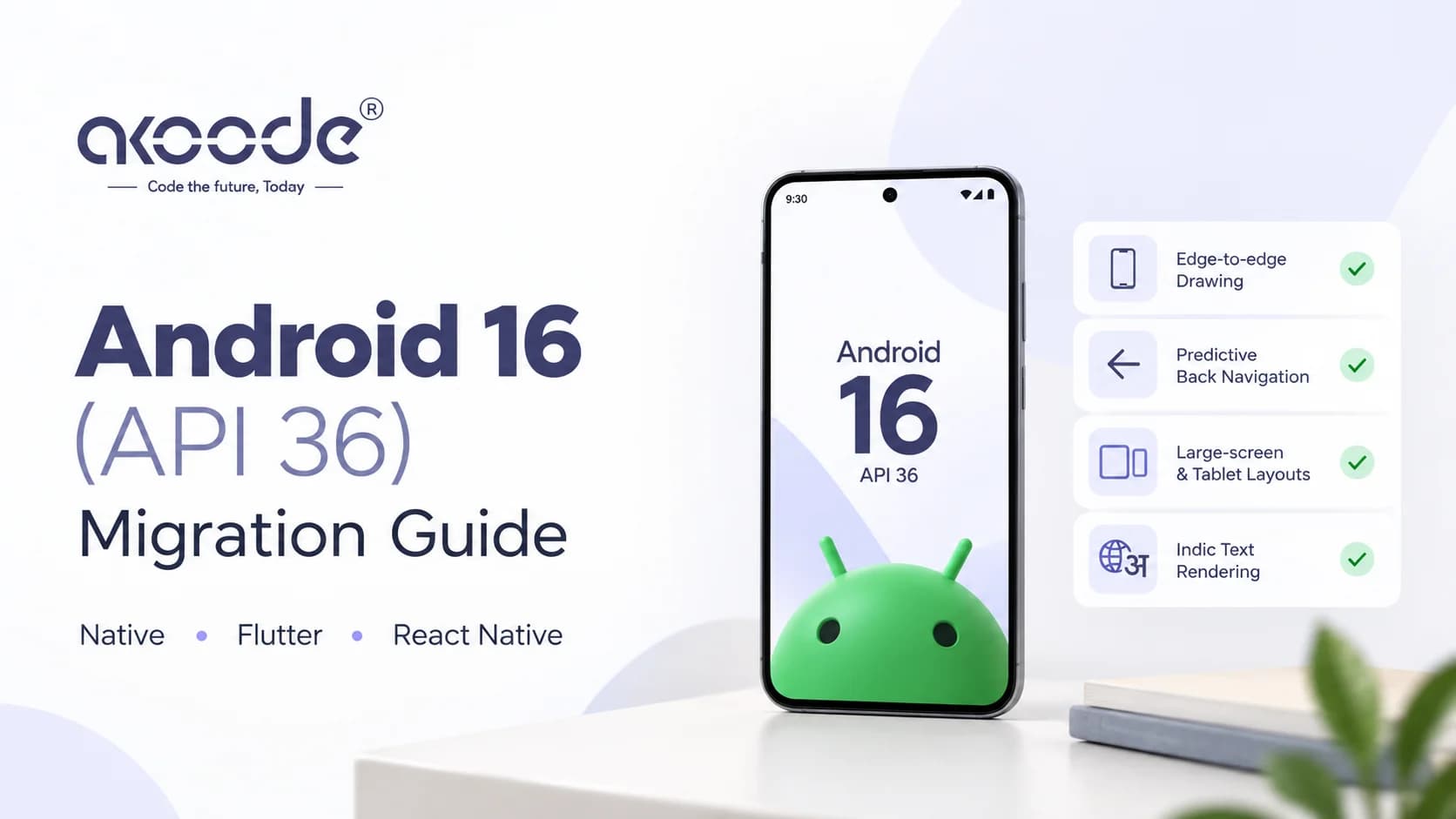
Cross-platform development using Flutter or React Native writes one codebase that runs on both platforms. Saves 25 to 40 percent on build cost. Performance is comparable for most business apps. This is the right call for most startups and mid-size businesses in 2026. One 2026 note: cross-platform does not mean platform changes skip you. Google Play now requires Android 16 (API 36) for new apps and updates, which forces edge-to-edge screens and changes back-button handling in Flutter, React Native and native apps alike. Budget a platform-update pass each year. Our API 36 migration guide shows what that involves.
Progressive Web Apps (PWAs) are browser-based experiences that behave like apps. No app store required. Lowest build cost. Best suited for businesses testing an idea or needing a lightweight mobile presence before committing to a full native build.
Most businesses in 2026 start with cross-platform. They move to native only when scale or performance requirements genuinely demand it — not because someone told them native is "more professional."
Also Check: Native vs Hybrid vs Cross-Platform Apps: Which One Should You Choose?
What Actually Drives the Cost of Mobile App Development Up?
Two apps can have identical briefs and quotes that are ₹5 lakhs apart. Here is why.
1. Feature complexity
Every feature has a surface cost and a depth cost. A login button is simple. A full authentication system with OTP, biometric login, SSO, session management, and role-based access is not. Most founders budget for the surface. Most developers quote for the depth.
2. Backend architecture
Simple apps run on Firebase. Apps with real-time data, multiple user roles, or traffic spikes need custom Node.js or Python backends with proper database design, caching layers, and load balancing. This is where cost jumps most significantly — and where skimping creates the most expensive problems later.
3.Third-party integrations
Payment gateways (Razorpay, Stripe), maps (Google Maps API), SMS services, push notifications, CRM connections: each one adds scoping, development and testing time. UPI deserves a special mention. Since February 2026, UPI payments on Android run through Intent (and QR on desktop) instead of typed UPI IDs, and from 15 October 2026 merchants pay a 0.4% fee on UPI payments above ₹2,000. A checkout built on the old flow needs rework, and settlement reconciliation changes. See our UPI MDR guide for app teams. Budget ₹20,000 to ₹80,000 per major integration, not per app.
4. UI/UX design depth
Template-based design is faster and cheaper. A fully custom UX process with wireframes, user research, prototyping, and brand-specific visual design costs ₹1,00,000 to ₹5,00,000 on top of development. For apps where retention drives revenue, this investment compounds significantly.
5. AI and ML features
Adding recommendation engines, NLP chatbots, computer vision, or predictive analytics increases project cost by 30 to 100 percent depending on complexity. Hosted AI APIs (OpenAI, Google Vision) are now accessible enough for startups. Custom model training is a different budget conversation.
6. Team seniority
Senior developers cost more per hour but ship faster with fewer bugs. Junior-heavy teams cost less upfront and produce more rework. Total cost often lands similarly — the senior team gets you there with fewer surprises.
7. Compliance and security
Apps in healthcare, fintech or education handling sensitive data need additional security architecture, encryption standards and compliance engineering. In 2026 there's a new baseline for almost every app: India's Digital Personal Data Protection Rules, notified in November 2025, apply their main duties from around 13 May 2027. They cover consent records, withdrawal, deletion, breach reporting within 72 hours, and verifiable parental consent for users under 18. Building that into the app from the start is far cheaper than retrofitting it. A light-data app should plan a dedicated consent and data-rights module, covered in the feature table below. This adds 20 to 30 percent to the base build for regulated sectors. Skipping it does not reduce cost, it transfers it to a much more expensive problem later.
What Does Each Feature Actually Cost?
Individual features have individual costs. Here is a practical breakdown for common app features in India in 2026 (approx).
Feature | Estimated Cost (INR) |
|---|---|
User Registration and Login | ₹20,000 – ₹50,000 |
Social Login (Google, Facebook) | ₹10,000 – ₹20,000 |
Payment Gateway Integration | ₹20,000 – ₹60,000 |
Push Notifications | ₹15,000 – ₹30,000 |
GPS and Location Tracking | ₹30,000 – ₹80,000 |
In-App Chat / Messaging | ₹80,000 – ₹2,00,000 |
Video Streaming | ₹1,00,000 – ₹3,00,000 |
AI Recommendation Engine | ₹2,00,000 – ₹8,00,000 |
Admin Dashboard | ₹50,000 – ₹2,00,000 |
Multi-language Support | ₹30,000 – ₹80,000 |
DPDP Consent and Data-Rights Module | ₹60,000 – ₹2,00,000+ |
Use this table when reviewing itemised proposals. If a quote charges significantly more or less than these ranges for a standard feature, ask why before signing anything.
What Costs Are Most Businesses Missing When They Budget?
Development cost is line one. These are the lines most founders skip until after launch.
Cost Item | Estimated Cost (INR) |
|---|---|
Google Play Registration | ₹2,400 (one-time, US$25) |
Apple Developer Account | ₹9,500 per year (US$99) |
Cloud Hosting (monthly) | ₹3,000 – ₹20,000/month |
SSL Certificate | ₹2,500 – ₹10,000/year |
App Maintenance | ₹15,000 – ₹80,000/month |
App Store Optimisation | ₹10,000 – ₹40,000 |
UPI MDR (from 15 Oct 2026) | 0.4% of UPI payments above ₹2,000, ₹300 cap per payment. Scales with sales |
DPDP readiness | ₹60,000 – ₹2,00,000+ (one-time, light-data app) |
Annual Android target-API update | 40 to 80 developer hours, if outside your retainer |
A realistic first-year total adds 20 to 30 percent on top of the development quote, plus a one-time DPDP readiness sprint if your app collects personal data. UPI MDR is separate again, because it scales with your sales instead of your app. Plan for all of it before the project starts. Discovering these costs mid-launch never goes well. Our guide to what an app costs to run after launch has a worked first-year budget.
How Does India Compare to the US and UK for App Development Cost?
For international clients, the numbers make the case better than any pitch.
Region | Average Dev Rate (USD/hr) | Cost for 1,000-hr Project |
|---|---|---|
India | $16 – $52 | $16,000 – $52,000 |
Eastern Europe | $40 – $80 | $40,000 – $80,000 |
United States | $100 – $200 | $100,000 – $200,000 |
United Kingdom | $80 – $150 | $80,000 – $150,000 |
India's cost advantage over US rates now runs at roughly 65 to 80 percent, helped by a rupee that has weakened about 8% against the dollar in a year. It is not just about lower salaries. It reflects a deep engineering talent pool combined with mature delivery processes and over two decades of international project experience.
The businesses that benefit most from Indian development are not the ones looking for the cheapest option. They are the ones who want senior engineering talent at a cost structure that lets them invest the savings back into the product.
Should You Start With an MVP?
For most startups — yes. And not for the reasons most people think.
An MVP is not a cheaper version of the full app. It is the smallest version that delivers real value to real users. The difference matters. A cheaper full app is just an incomplete product. An MVP built well tests whether users actually want what you are building before you invest in everything else.
Starting with an MVP cuts initial cost by 40 to 60 percent. It gets you to market in weeks rather than months. Most importantly, it replaces assumptions with evidence. Features that seem essential during planning often turn out to be unused. An MVP surfaces that before you have spent your entire budget building them.
The pattern that works: build the core, validate with real users, then invest in the full product with actual data behind every decision.
How Do You Read a Mobile App Development Quote Without Getting Misled?
Most businesses compare quotes by looking at the bottom-line number. That is the wrong place to start.
Ask for a line-by-line breakdown. What features are included? How many developers? At what seniority? Is QA included or billed separately? What does post-launch support look like and what does it cost?
A ₹10 lakh quote that includes a senior developer, dedicated QA engineer, project manager, and three months of post-launch support is a fundamentally different proposition from an ₹8 lakh quote covering development only.
Ask specifically about scope changes. What happens when requirements shift mid-project? Does the quote hold, or does every change become a change order? A transparent development partner answers that question immediately and clearly. One that hedges usually means changes will be expensive.
The cheapest quote is almost never the cheapest outcome. A ₹10,000 app built without proper structure will need a complete rebuild within a year. That is more expensive in total than getting it right the first time.
Conclusion
Mobile app development cost in India in 2026 ranges from ₹1.5 lakhs for a focused simple app to ₹1 crore or more for a full enterprise platform. In dollar terms — $1,800 to $120,000 and beyond.
The right number for your project depends entirely on what you are actually building. Not what you describe in one sentence, but what the full feature set, backend requirements, platform choice, and compliance needs add up to.
Define the scope first. Then find a partner who can price it honestly and build it properly.
Akoode Technologies builds mobile apps, AI products and custom software from Gurugram, India, with a US presence in Jenks, Oklahoma. Clients rate us 4.9 on Google from 126 reviews and 5.0 out of 5 on GoodFirms. If you're comparing quotes, we'll give you an honest assessment of scope and cost before you commit to a budget. See our mobile app development services, or if you're searching for a mobile app development company in India, book a call with Akhil.
We also have pages for teams in Gurgaon, Delhi NCR, Noida, Mumbai, Pune, Bangalore, Hyderabad, Chennai, Kolkata, Ahmedabad, Jaipur and Lucknow. If you're a company in the US, UK, Canada or UAE building for Indian users, see our mobile pages for the USA, UK, Canada and UAE. Related reading: our mobile app security checklist and mobile app development trends.
Also Check: Mobile App Development Strategy: What Businesses Should Know
Frequently Asked Questions
1. What is the average mobile app development cost in India in 2026?
Most business apps in India cost between ₹4,00,000 and ₹12,00,000 ($4,800 – $14,500). Simple apps start at ₹1.5 lakhs. Complex platforms and enterprise apps run ₹30 lakhs to ₹1 crore or more.
2. How much does it cost to make an app in India for a startup?
A well-built MVP typically costs ₹3,00,000 to ₹8,00,000 in India. Starting lean reduces initial investment by 40 to 60 percent and gets you to real users faster. Build core functionality first. Validate. Then invest in the full product.
3. Is it cheaper to build an app in India than in the US or UK?
Significantly. Indian development rates offer a 60 to 75 percent cost advantage. A project costing $100,000 to $150,000 at US agency rates can often be delivered for $16,000 to $52,000 at Indian rates, which is a 1,000-hour project at $16 to $52 an hour.
4. What is the cost difference between native and cross-platform app development?
Cross-platform apps built with Flutter or React Native cost 25 to 40 percent less than two separate native builds. For most business apps in 2026, cross-platform delivers comparable performance at meaningfully lower cost.
5. What factors affect mobile application development cost the most?
Feature complexity and scope, backend architecture requirements, platform choice, UI/UX design depth, third-party integrations, team seniority, and compliance or security requirements. Feature complexity and backend architecture have the biggest individual impact.
6. What ongoing costs should I plan for after app launch?
Expect ₹15,000 to ₹80,000 per month for maintenance, plus cloud hosting, store fees (about ₹9,500 a year for Apple, ₹2,400 once for Google Play) and third-party API costs. In 2026, also plan for UPI MDR if you take UPI payments above ₹2,000, a one-time DPDP readiness sprint if you collect personal data, and the yearly Android target-API update. A realistic first-year total adds 20 to 30 percent on top of the development cost, plus those items.
7. Does the UPI fee change affect app development cost?
From 15 October 2026, merchants pay a 0.4% fee on UPI payments above ₹2,000, capped at ₹300 per payment, and some categories pay a flat ₹5. Customers pay nothing and merchants can't pass it on. It doesn't change the build price much, but it does affect your margins, your settlement reconciliation work and your reports.
8. How does the DPDP Act affect app development cost?
Apps that collect personal data need consent records, withdrawal, deletion and retention handling, breach logging and, for users under 18, parental consent. The main duties apply from around 13 May 2027. For a light-data app, we plan roughly 40 to 80 developer hours, and more for health, finance or children's data.
9. Has the weaker rupee made apps cheaper for US and UK buyers?
"On rupee-priced contracts, yes. The rupee has moved from about ₹88.7 to about ₹96 per dollar in a year, so the same work costs roughly 8% fewer dollars. On dollar-priced contracts nothing changes. Ask which currency your invoice is in."
Get In Touch Now
View More Our Blog