


 May 11, 2026
Every founder asks the same question early on. How much will this cost?
The honest answer is: it depends. But that answer is only useful if you understand what it depends on. This guide breaks down MVP development cost clearly, phase by phase, so you can budget with confidence rather than guess.
Why Does MVP Development Cost Vary So Much?
Two founders can describe similar products and receive quotes that differ by $80,000. That gap is not random. It reflects real differences in scope, team location, platform choices, and post-launch planning.
MVP development cost in 2026 typically falls between $10,000 and $150,000. A basic app with minimal features and a no-code or low-code approach sits at the lower end. A custom-built product with AI features, complex workflows, and enterprise requirements sits at the higher end.
The number that matters most to your business is not the cheapest quote. It is the budget that delivers a testable product in the shortest time without creating architecture problems that cost more to fix later.
What Does MVP Development Cost by Type?
Here is a realistic breakdown by complexity tier in 2026:
MVP Type | Cost Range | Timeline | What It Covers |
|---|---|---|---|
No-code / Low-code MVP | $15,000 to $35,000 | 4 to 8 weeks | Simple SaaS, landing page with core feature, basic marketplace |
Standard custom MVP | $35,000 to $80,000 | 8 to 14 weeks | Web app, user authentication, core workflows, third-party integrations |
Complex custom MVP | $80,000 to $150,000 | 14 to 24 weeks | Multi-role platforms, advanced data handling, custom business logic |
AI-powered MVP | $60,000 to $200,000+ | 12 to 24 weeks | LLM integration, RAG pipelines, recommendation engines, AI copilots |
AI-powered MVPs are the fastest-growing category in 2026. Generative AI features add roughly 15 to 30 percent to a standard build budget. This reflects the cost of data preparation, model evaluation, and engineering the guardrails that make AI features safe to deploy.
How Does Team Location Affect MVP Development Cost?
Location is one of the strongest cost variables in any MVP budget.
Region | Mid-Level Developer | Senior Developer |
|---|---|---|
India | $30 to $50/hour | $50 to $75/hour |
Eastern Europe | $45 to $65/hour | $65 to $100/hour |
United Kingdom | $80 to $120/hour | $120 to $160/hour |
United States | $120 to $160/hour | $160 to $220/hour |
A standard MVP that costs $120,000 with a US-based team can be delivered for $35,000 to $55,000 with a quality India-based team. That is not a compromise on output. It reflects a genuine labour cost difference in a mature offshore engineering market.
India has a deep pool of experienced MVP developers. Many have built products for US and European startups across SaaS, fintech, healthtech, and marketplace categories. The key is not finding the lowest hourly rate. It is finding the right combination of technical seniority, communication quality, and architectural thinking for your specific product.
AI-assisted development tools have also compressed timelines by 40 to 60 percent for well-equipped teams. A focused India-based agency in 2026 can deliver faster than benchmarks from two years ago, without inflating the cost to match.
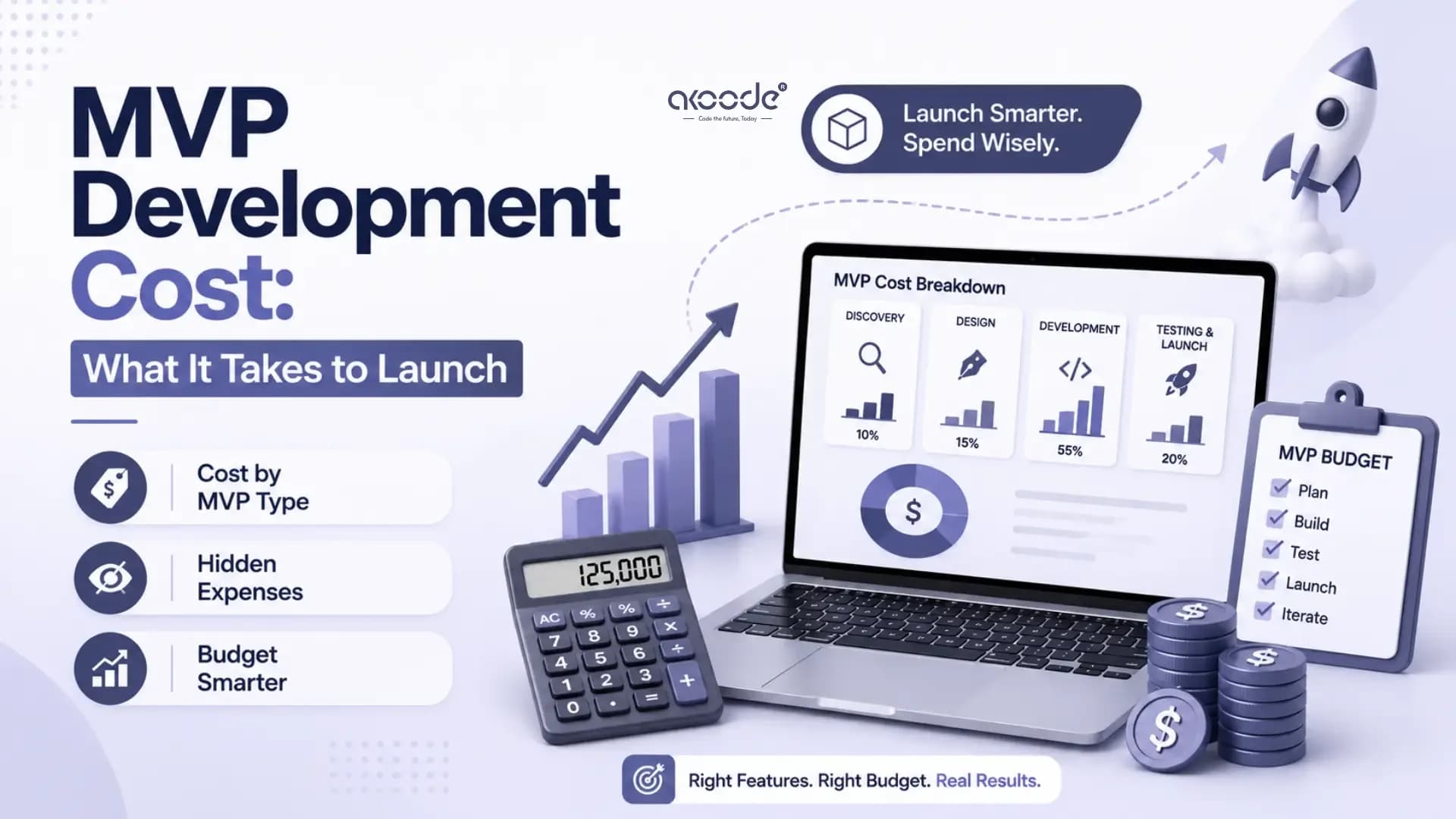
What Is the Phase-by-Phase MVP Cost Breakdown?
Most founders only plan for the build. That is where budget problems begin. Here is where the money actually goes across the full MVP lifecycle.
Discovery and Requirements: $3,000 to $15,000
This phase covers requirement mapping, user journey definition, feature prioritisation, and technical architecture planning. Teams that invest properly in discovery build the right product faster and with less rework. Skipping it saves money on paper and costs more in practice.
UI/UX Design and Prototyping: $6,000 to $30,000
Design covers wireframes, user flows, and high-fidelity screens. The complexity of your user journeys determines the cost. A simple two-flow product costs far less to design than a multi-role platform with complex interaction patterns. Design is not decoration. It is one of the most direct drivers of user adoption.
Development: $20,000 to $90,000
Development is the largest single cost line. It covers frontend, backend, database, API integrations, and core feature engineering. Building on web first and validating before adding mobile reduces cost by 30 to 50 percent for most products. Every additional platform adds roughly 25 to 40 percent to the total build cost.
Quality Assurance and Testing: $4,000 to $15,000
QA covers functional testing, edge case handling, performance checks, and cross-device compatibility. MVPs that skip QA launch with bugs that damage user trust in the first 48 hours. That first impression rarely gets a second chance.
Deployment and Launch Infrastructure: $2,000 to $8,000
This covers server setup, cloud hosting configuration, CI/CD pipeline setup, domain and SSL, and initial security configuration. These costs are one-time but essential.
Also Check: Software Development Cost in India 2026 | Complete Pricing
What Are the Hidden Costs of MVP Development?
These are the costs that do not appear in most initial quotes. Plan for all of them before committing to a budget.
Post-launch maintenance. Plan for 15 to 20 percent of your build cost annually. Software without maintenance degrades. Bugs surface under real user load. Compatibility issues emerge with third-party tool updates.
Cloud hosting and infrastructure. AWS, Google Cloud, and Azure costs grow with user scale. Budget $50 to $500 per month at MVP stage depending on traffic and data volume.
Third-party tools and APIs. Payment gateways, email services, analytics platforms, mapping tools, and authentication services all carry monthly fees. These add $200 to $2,000 per month for a typical MVP depending on usage.
Post-launch iteration. The MVP launch is not the finish line. Investors want traction signals. Early users reveal what needs to change. The iteration budget that follows launch is rarely included in initial proposals. Founders who do not plan for it run out of runway before reaching the traction level investors require.
A practical rule: set aside an additional 40 percent of your build budget for the first six months post-launch. This covers maintenance, hosting, tools, and the first iteration cycle based on real user feedback.
How Should You Allocate an MVP Budget?
Most founders spend 100 percent of the budget on the build and nothing on validation. That is the wrong ratio.
A smarter allocation looks like this:
30 percent on the core build
20 percent on discovery, design, and architecture
20 percent on QA and launch preparation
30 percent reserved for post-launch iteration and testing
This structure keeps the team focused on validation rather than feature completeness. It also ensures you have runway to respond to what real users tell you after launch.
For scope discipline, use the MoSCoW method. Must Have features get built. Everything else waits until you have user evidence to justify it. Every feature added before validation increases cost and delays the learning that the MVP is supposed to generate.
Should You Hire Freelancers, an Agency, or Build In-House?
Each model has a different cost profile and a different risk profile.
Freelancers carry the lowest hourly rate. Offshore freelancers typically run $20 to $60 per hour. The cost of coordination falls entirely on you. This model works when requirements are fully documented and you have the technical fluency to evaluate code quality. It breaks down quickly when scope changes or multiple developers need to work together without a project manager.
Agencies cost more per hour but bring a coordinated team. A project manager, designer, two to three developers, and a QA engineer working in two-week sprints with structured delivery reduces execution risk significantly. For most first-time founders, the agency premium is worth paying because the cost of a failed build exceeds the cost of the premium itself.
In-house teams make sense after product-market fit, not before. Building a permanent engineering team before validation locks in fixed cost against an uncertain outcome. Most successful startups begin with an external MVP development partner and bring development in-house once the product direction is confirmed.
For startups in India and internationally, a quality India-based agency represents the strongest balance of cost, technical depth, and delivery structure for most MVP projects in 2026.
What Is a Realistic MVP Budget for a Startup in 2026?
Here is how to think about the numbers by stage.
A bootstrapped founder with a tight budget and a simple concept should plan for $20,000 to $40,000 for a focused, web-first MVP with a no-code or light custom stack. This is achievable with an India-based team in eight to twelve weeks.
A seed-stage startup with a validated problem and investor backing should plan for $50,000 to $100,000 for a properly designed, custom-built MVP with real architecture, clean code, and a post-launch iteration budget included.
An enterprise or regulated-market MVP with compliance requirements, multi-tenant architecture, or AI integration should plan for $100,000 to $200,000 and above.
In all cases, the timeline should be one to three months for a focused MVP. If the build is taking longer, the scope is too broad. An MVP that takes six months to build is not minimal.
Conclusion
MVP development cost is not a fixed number. It is the result of decisions: scope, platform, team location, technical approach, and how much of the budget is reserved for post-launch learning rather than initial build.
The founders who get the most from their MVP budget are not the ones who spend the least. They are the ones who plan honestly for every phase, choose the right team for their stage, and build only what is needed to validate the one question that matters most.
For a detailed look at the step-by-step process of building an MVP before you plan the budget, the how to build an MVP guide covers the full methodology from problem definition to post-launch iteration.
Akoode Technologies is a leading AI and software development company headquartered in Gurugram, India, with a US office in Oklahoma. From MVP development for startups and custom web development to full stack development and AI-powered web applications, Akoode helps startups, SMEs, and enterprises across 15+ industries globally build validated products with the right architecture from day one. If you are ready to build your MVP without the guesswork, that conversation starts here.
Frequently Asked Questions
1. How much does MVP development cost in 2026?
MVP development cost ranges from $15,000 for a simple no-code build to $150,000 or more for a complex custom product with AI features. The final number depends on scope, platform choices, team location, and whether post-launch iteration is included in the budget.
2. What is the cheapest way to build an MVP?
Using no-code or low-code tools like Bubble, Webflow, or Retool for simple web-based products keeps costs between $15,000 and $35,000. Launching on web before mobile reduces cost by 30 to 50 percent. Working with an India-based development team reduces hourly rates by 60 to 70 percent compared to US-based teams.
3. How long does MVP development take?
A focused MVP should take one to three months. Simple no-code builds take four to eight weeks. Standard custom builds take eight to fourteen weeks. If the build is taking longer, the scope is too broad for an MVP.
4. What hidden costs should I plan for in my MVP budget?
Post-launch maintenance runs 15 to 20 percent of build cost annually. Cloud hosting costs $50 to $500 per month. Third-party APIs and tools add $200 to $2,000 per month. Post-launch iteration based on user feedback requires its own budget. Plan for an additional 40 percent of your build cost for the first six months after launch.
5. Should I hire a freelancer or an agency for MVP development?
Freelancers cost less per hour but shift all coordination risk to you. Agencies cost more but deliver structured execution, consistent quality, and post-launch support. For most first-time founders, a quality agency is the safer investment because the cost of a failed or poorly built MVP exceeds the agency premium.
6. How much does MVP development cost in India?
Mid-level developers in India charge $30 to $50 per hour. Senior developers charge $50 to $75 per hour. A standard MVP that costs $100,000 to $120,000 with a US-based team can be delivered for $35,000 to $55,000 by a quality India-based team, with no compromise on technical output.