


 May 8, 2026
Most failed startups did not run out of money first. They ran out of market.
They built a full product, spent months in development, and launched to discover that real users did not want what they built. The problem was not execution. It was the absence of validation before building.
A minimum viable product exists to prevent exactly this. It is the fastest, cheapest way to test whether your idea solves a real problem before you commit serious time and money to building the full version.
This guide walks through what an MVP is, why it matters, and exactly how to build one in 2026.
What Is a Minimum Viable Product?
A minimum viable product, or MVP, is the simplest version of your product that delivers enough core value for real users to test and give feedback on.
It is not a broken or incomplete product. It is a focused one. It solves one specific problem for one specific user. Nothing more.
The meaning of minimum viable product comes from lean startup methodology, introduced by Eric Ries. The concept is straightforward. Test your core assumption with the least effort possible. Learn from real users. Build the next version based on evidence, not guesses.
An MVP in software could be a single-screen app, a basic web platform, or even a manual process wrapped in a simple interface. What matters is not how polished it looks. What matters is whether it validates the core idea.
Spotify launched in 2006 with one function: music streaming. No podcasts, no social features, no playlists. Just streaming. That MVP gave them the user signal to build one of the most valuable media products in the world.
Airbnb started with two founders renting out their apartment to test whether strangers would pay to stay in someone else's home. The product was a basic website with photos. The entire business model was validated before a single line of scalable infrastructure was written.
Both examples share the same principle. Start small. Learn fast. Build on what works.
Why Does Building an MVP Matter for Founders?
The case for building an MVP is not philosophical. It is financial.
IT projects built without an MVP approach run an average of 45 percent over budget and deliver 56 percent less value than originally expected. The cost of building the wrong thing is consistently higher than the cost of validating first.
An MVP does several things at once. It validates demand before a large investment. It reveals what users actually need rather than what founders assumed they need. It generates early traction that makes investor conversations far more productive. And it forces disciplined prioritisation. You cannot include everything in an MVP. That constraint alone produces better thinking.
The founders who struggle most with MVPs are those who confuse minimum with low quality. A minimum viable product must be viable. Users need to get real value from it. It does not need to be comprehensive. But it does need to work well enough that someone would genuinely use it and pay for it.
Also Check: Custom Software Development: A Complete Guide for Growing Businesses
How Do You Define the Problem Before Building an MVP?
This step happens before any design or development begins. It is the step most founders rush through.
Start with one question: what specific problem are you solving for a specific group of people? The more precise the answer, the stronger the MVP.
Vague problem statements produce unfocused products. "People need better project tools" is not a problem statement. "Remote teams of five to fifteen people waste eight hours per week on status update meetings because their tools do not sync" is a problem statement. One of these leads to a clear MVP scope. The other leads to feature bloat.
Validate the problem before writing a line of code. Talk to fifteen to twenty potential users directly. Not surveys. Actual conversations. Ask about their current workflow, where they lose time, what they have already tried, and whether they would pay to fix the problem. The answers will tell you more than any amount of internal planning.
At this stage, you are not selling the product. You are confirming that the problem is real and worth solving.
How Do You Plan an MVP: Feature Selection and Scope?
Once the problem is validated, the next step is deciding what to build.
The most practical tool here is the MoSCoW method. Sort every potential feature into four groups: Must Have, Should Have, Could Have, and Won't Have. For an MVP, the Must Have list should be brutally short. One to three core actions that directly solve the validated problem.
Everything else goes into the backlog. Not because it is unimportant. Because building it now means spending budget on things users have not yet confirmed they want.
A useful test for each feature: if you remove this feature, does the MVP still solve the core problem? If yes, cut it. If no, keep it.
Map the user journey before anything is designed. Identify the two to three paths a user will take through the product. The onboarding flow. The core action they repeat. The point where they get the primary value. Every screen and interaction should serve one of these paths. If it does not serve the core journey, it does not belong in version one.
How Do You Build a Minimum Viable Product Step by Step?
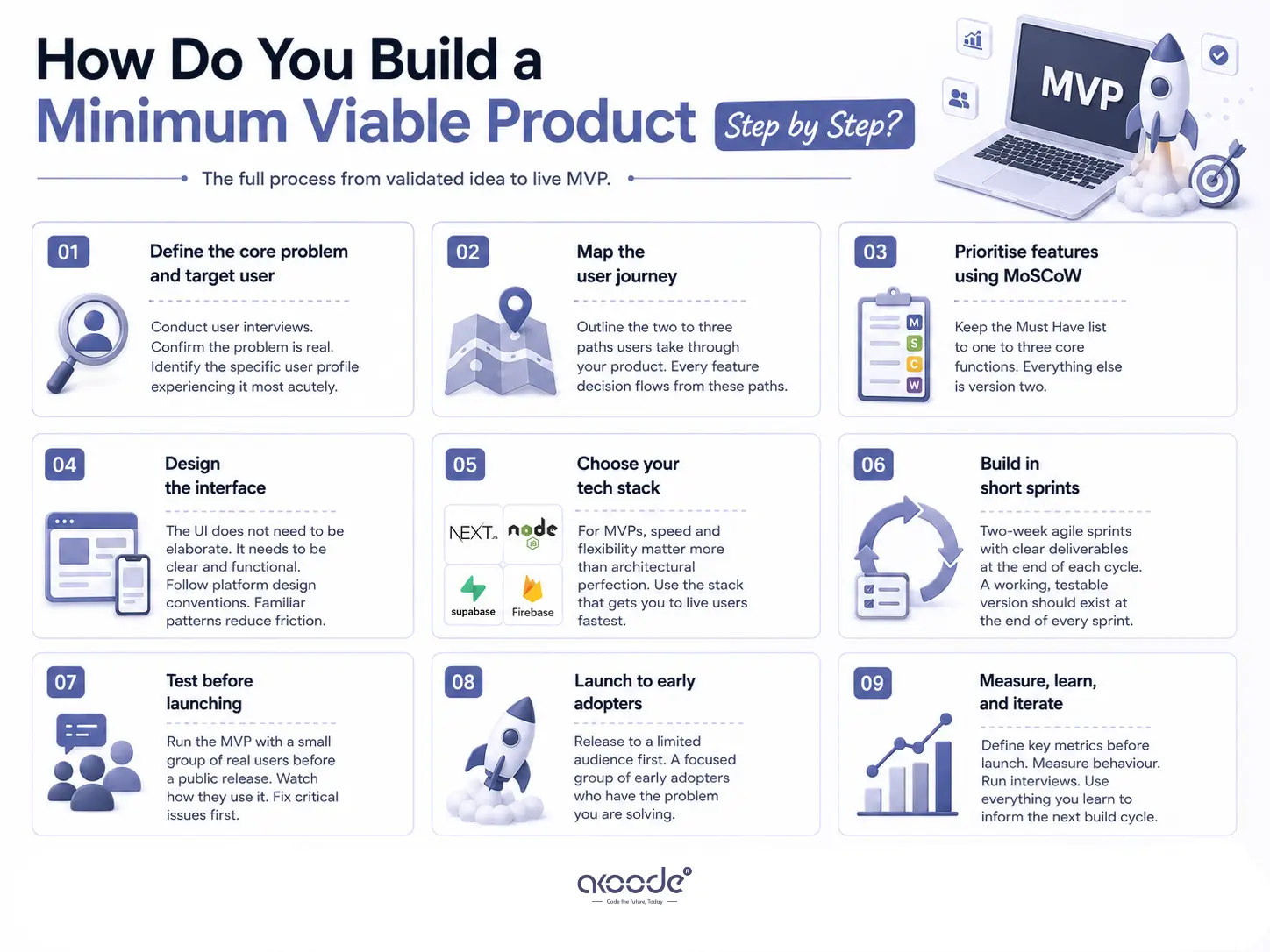
Here is the full process from validated idea to live MVP.
Step 1: Define the core problem and target user
Conduct user interviews. Confirm the problem is real. Identify the specific user profile experiencing it most acutely.
Step 2: Map the user journey
Outline the two to three paths users take through your product. Every feature decision flows from these paths.
Step 3: Prioritise features using MoSCoW
Keep the Must Have list to one to three core functions. Everything else is version two.
Step 4: Design the interface
The UI does not need to be elaborate. It needs to be clear and functional. Users should understand what to do without instruction. Follow platform design conventions. Familiar patterns reduce friction. Custom interactions increase cognitive load.
Step 5: Choose your tech stack
For MVPs, speed and flexibility matter more than architectural perfection. Common choices in 2026 include Next.js for frontend, Node.js or Python for backend, and Supabase or Firebase for faster database setup. No-code tools like Bubble or Webflow are legitimate options for non-technical founders building simple web-based MVPs. The rule is simple: use the stack that gets you to live users fastest.
Step 6: Build in short sprints
Two-week agile sprints with clear deliverables at the end of each cycle. A working, testable version of the product should exist at the end of every sprint. This prevents months of invisible development with no user feedback.
Step 7: Test before launching
Run the MVP with a small group of real users before a public release. Five to ten users who match your target profile. Watch how they use it. Note where they get confused. Note what they skip. Fix critical issues before opening to a wider audience.
Step 8: Launch to early adopters
Release to a limited audience first. Not the whole market. A focused group of early adopters who have the problem you are solving and are motivated to give honest feedback.
Step 9: Measure, learn, and iterate
Define your key metrics before launch. Activation rate, retention, and task completion rate are the three most informative early-stage metrics. Measure user behaviour. Run interviews to understand the why behind the numbers. Use everything you learn to inform the next build cycle.
How Much Does It Cost to Build an MVP in 2026?
MVP development cost in 2026 falls into three broad ranges.
A no-code or low-code MVP using tools like Bubble, Webflow, or Retool typically costs between $15,000 and $35,000. This suits simple marketplace or SaaS dashboard concepts where standard functionality covers the core use case.
A custom-coded MVP with a dedicated engineering team typically costs between $50,000 and $120,000. This is the right approach when the product requires proprietary logic, unique data handling, or performance that no-code tools cannot support.
An enterprise-grade MVP with security, compliance, and multi-tenant architecture requirements typically costs $150,000 and above.
Timeline follows a similar pattern. A focused MVP with a clear scope should take one to three months. If the timeline is longer, the scope is almost certainly too broad.
One important budget principle: spend roughly 30 percent on the build and 70 percent on validation, user research, and iteration. Many founders invert this ratio and spend everything on development, leaving nothing for the testing and learning that the MVP is supposed to produce.
What Are the Most Common MVP Mistakes Founders Make?
Building too much
The most common error. Every feature added before validation increases cost, delays launch, and reduces the signal quality from early users.
Validating with the wrong people
Testing with friends and family produces biased feedback. Test with people who have the problem and no prior relationship with you.
Skipping the problem validation step
Building a great MVP for a problem nobody actually has is still a failure. The discovery phase is not optional.
Treating launch as the finish line
The MVP is the start of the learning cycle, not the end of the build process. Post-launch iteration based on real data is where the real product development begins.
Confusing a prototype with an MVP
A prototype is an internal design tool for testing usability. An MVP is a live product that real users interact with and derive value from.
Conclusion
Building an MVP is not about cutting corners. It is about cutting waste. It is a disciplined approach to product development that puts user evidence before engineering investment.
The founders who build successful products are not the ones with the best ideas at the start. They are the ones who validated assumptions early, learned from real users quickly, and iterated their way to a product the market actually wanted.
The MVP is where that journey begins.
Akoode Technologies is a leading AI and software development company headquartered in Gurugram, India, with a US office in Oklahoma. From MVP development and custom web development to full stack development and AI-powered web applications, Akoode helps startups, SMEs, and enterprises across 15+ industries globally turn validated ideas into scalable products. If you have a product idea and want to build the right thing from day one, that conversation starts here.
Frequently Asked Questions
1. What is a minimum viable product in simple terms?
A minimum viable product is the simplest version of your product that solves one specific problem for real users well enough to get genuine feedback. It is not an incomplete product. It is a focused one designed to validate your core assumption before a larger investment.
2. How do you build an MVP step by step?
Define the problem through user interviews. Map the core user journey. Prioritise features using MoSCoW. Design a clear, functional interface. Build in two-week sprints. Test with real users before launch. Release to early adopters. Measure behaviour and iterate based on what you learn.
3. How much does it cost to build an MVP in 2026?
A no-code MVP typically costs $15,000 to $35,000. A custom-coded MVP costs $50,000 to $120,000. Enterprise-grade MVPs with compliance requirements cost $150,000 and above. A timeline for a focused MVP should be one to three months.
4. What is the difference between an MVP and a prototype?
A prototype is an internal design tool used to test usability before development. An MVP is a functional, live product that real users interact with and get value from. An MVP is market-facing. A prototype is not.
5. What features should an MVP include?
Only the features that directly solve the core problem for the core user. The MoSCoW method helps. Must Have features are the only ones that belong in version one. Everything else is a distraction until you have real user data to guide the next build.
6. When should a startup move beyond its MVP?
When you have confirmed product-market fit through consistent user retention, validated willingness to pay, and a clear pattern of which features drive engagement. Move beyond the MVP when you have evidence, not when you have assumptions.