


 July 14, 2026
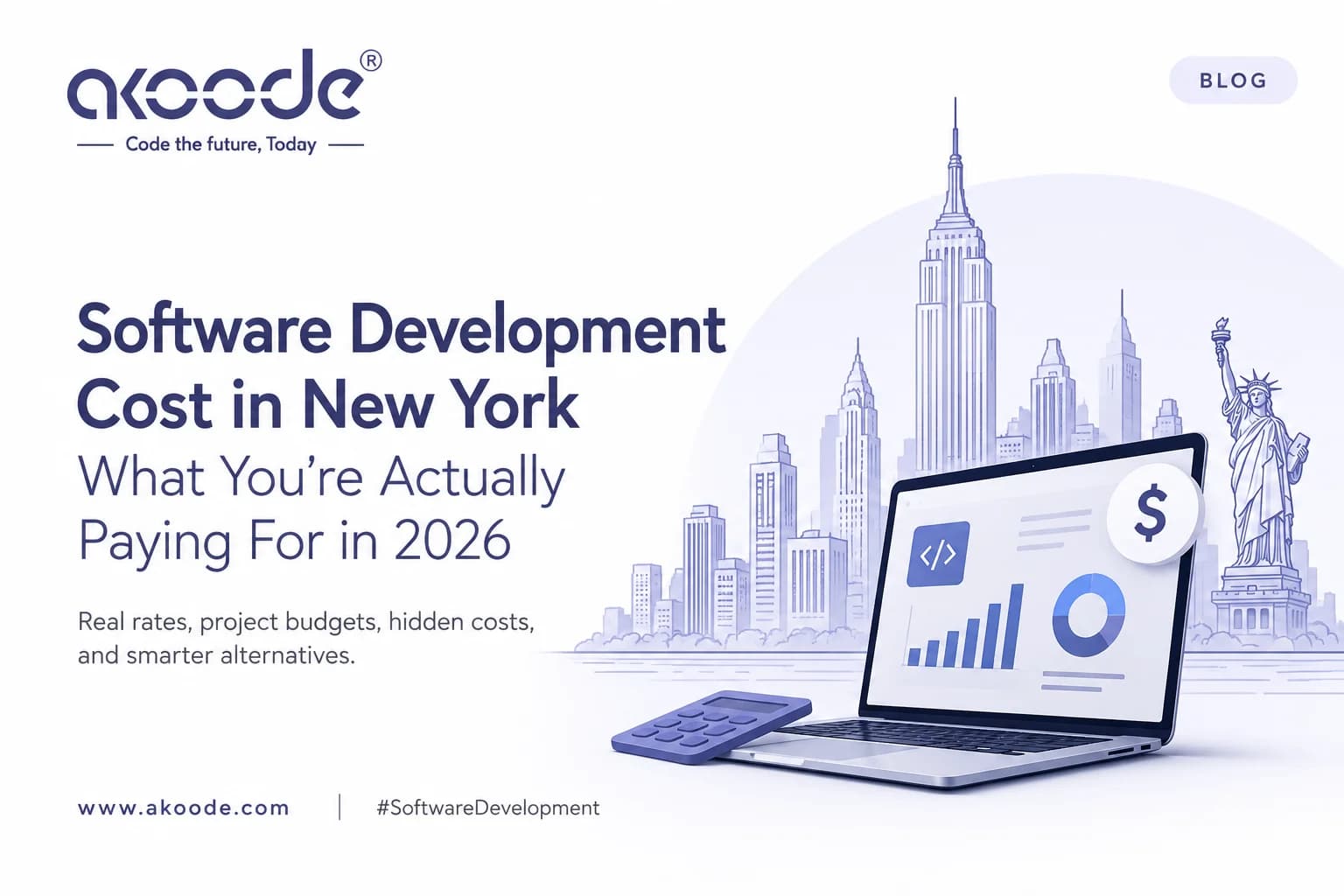
Software Development Cost in New York: What You're Actually Paying For in 2026
New York is one of the most expensive places in the world to hire software developers. That's not a complaint — it's just the reality of the market, and any business planning a software project in or for the New York market needs to understand it clearly before they start talking to vendors.
New York City developers bill between $130 and $220 per hour in 2026 — second only to San Francisco on the US cost spectrum. A mid-complexity web application that takes 1,500 hours of development time will cost you $195,000–$330,000 with a local NYC agency. The same project with an equally qualified team based in India runs $40,000–$90,000.
That gap deserves a straight conversation, not a sales pitch in either direction.
This guide gives you the actual numbers — hourly rates by role, project cost by type, what the hidden costs are that most vendors don't mention upfront, and a clear-eyed look at when paying NYC rates makes sense versus when it doesn't.
Why Software Development Costs So Much in New York
Before getting into the numbers, it helps to understand what you're actually paying for when you hire a New York development team.
The cost of living in New York City is among the highest in the United States. A senior software engineer in Manhattan can't survive on $80,000 a year — the market knows this, and developer salaries reflect it. The average software developer salary in New York as of 2026 is $122,362 per year, or roughly $58.83 per hour in base salary alone. Factor in benefits, employer taxes, office space, project management overhead, and agency margin, and you quickly see how client-facing rates land in the $150–$220 range.
There's also simple supply and demand. New York's financial sector, media industry, healthcare organisations, law firms, and the city's dense startup ecosystem all compete for the same pool of senior engineers. That competition pushes rates up continuously.
None of this makes New York development automatically overpriced — it makes it expensive. Whether it's worth that expense depends on your project.
Developer Hourly Rates in New York: Role by Role
New York developers command some of the highest hourly rates in the country. A senior mobile engineer in NYC in 2026 typically bills between $150 and $250 per hour. A full-stack developer with mobile experience runs $120–$180. A dedicated UX/UI designer who understands mobile patterns costs $100–$160 per hour.
Here's a fuller breakdown by role and experience level:
Role | Junior (0–2 years) | Mid-Level (3–5 years) | Senior (6+ years) |
|---|---|---|---|
Frontend Developer | $80–$110/hr | $110–$150/hr | $150–$200/hr |
Backend Developer | $90–$120/hr | $120–$160/hr | $160–$220/hr |
Full-Stack Developer | $85–$115/hr | $115–$155/hr | $155–$210/hr |
Mobile Developer (iOS/Android) | $90–$130/hr | $130–$170/hr | $170–$250/hr |
UI/UX Designer | $75–$100/hr | $100–$140/hr | $140–$180/hr |
DevOps / Cloud Engineer | $100–$130/hr | $130–$175/hr | $175–$230/hr |
AI / ML Engineer | $120–$160/hr | $160–$210/hr | $210–$300/hr |
QA Engineer | $65–$90/hr | $90–$120/hr | $120–$160/hr |
Technical Project Manager | $100–$130/hr | $130–$160/hr | $160–$200/hr |
A few things worth noting here.
AI and ML engineers sit at a significant premium over general developers. AI/ML development typically commands a 30–50% premium over standard web development rates — and in New York, that premium stacks on top of an already elevated baseline.
Junior developers are cheaper, but the math often doesn't work in your favour. A junior developer at $90/hour who takes three times as long and produces code that requires senior review and rework is not actually saving you money. For anything beyond simple, well-defined tasks, mid-level and senior engineers consistently deliver better total value.
What Complete Software Projects Cost in New York
Hourly rates only tell half the story. What you actually care about is total project cost — and that depends on scope, team composition, timeline, and complexity.
Here are realistic project budget ranges for New York-based development teams in 2026.
Web Application Development
Project Type | Complexity | Cost Range | Timeline |
|---|---|---|---|
Landing page + basic web presence | Simple | $8,000–$20,000 | 3–6 weeks |
MVP / proof of concept web app | Simple | $25,000–$60,000 | 6–12 weeks |
Business web application | Medium | $60,000–$150,000 | 3–6 months |
SaaS platform | Medium-High | $120,000–$300,000 | 5–10 months |
Enterprise web platform | Complex | $250,000–$600,000+ | 8–18 months |
Mobile App Development
Mobile app development in New York in 2026 falls into three main investment tiers reflecting scope and complexity.
App Type | Cost Range | Notes |
|---|---|---|
Simple / single-platform MVP | $25,000–$60,000 | Core features only, iOS or Android |
Mid-complexity app | $60,000–$150,000 | Cross-platform integrations, custom UI |
Complex / enterprise app | $150,000–$400,000+ | Advanced security, real-time data, multi-role |
Custom Software and Enterprise Systems
Project Type | Cost Range |
|---|---|
CRM or internal operations tool | $40,000–$120,000 |
Custom ERP system | $150,000–$500,000+ |
Healthcare platform (HIPAA-compliant) | $100,000–$400,000 |
Fintech application (PCI-DSS) | $120,000–$450,000 |
AI-integrated business application | $80,000–$350,000 |
Compliance requirements consistently add 20–30% to base development costs. HIPAA compliance alone adds approximately 20% to base development cost due to security audits, encryption requirements, and documentation obligations.
Where the Budget Actually Goes
One of the most consistent patterns in software projects is that founders and business owners underestimate how much of the total cost sits outside of "writing code". Understanding the full budget breakdown prevents the kind of scope shock that derails projects mid-build.
A mid-tier project – around $120,000 – typically distributes across phases like this: Discovery and strategy takes 8–12%, covering stakeholder interviews, competitive analysis, user journey mapping, and technical architecture planning. UX research and UI design takes 18–25%, covering wireframes, interactive prototypes, user testing, and final design systems. Frontend development takes 30–40% — the UI implementation, animations, state management, and device optimisation. Backend development and APIs consume 20–30%, covering server infrastructure, database architecture, authentication systems, and third-party integrations.
That leaves roughly 10–15% for QA, testing, deployment, and project management.
The implication is worth sitting with: for a $150,000 project, you're spending $27,000–$37,000 on design and $30,000–$45,000 on backend infrastructure — before you've built a single screen that a user will ever see. These aren't optional budget lines. Skipping them produces products that don't work, don't scale, or don't get used.
The Hidden Costs New York Vendors Rarely Mention Upfront
This is where projects consistently go over budget — not from dishonesty, but from scope items that don't make it into the initial proposal.
Third-party service fees. Twilio for SMS/voice, Stripe for payments, SendGrid for email, AWS or GCP for infrastructure, and Mapbox for mapping. These aren't one-time expenses — they're recurring monthly costs that scale with your user base. Depending on your application, these can add $500–$10,000/month from day one.
App store fees and review cycles. Apple's App Store review takes 1–7 days and can reject your submission for policy violations. Each rejection and resubmission adds time. Apple's annual developer fee is $99; Google Play is $25 one-time. These are small numbers — but the time cost of a rejection cycle during a tight launch window is not.
Post-launch maintenance. Annual maintenance typically runs 15–20% of your original development cost. For a $200,000 application, that's $30,000–$40,000 per year in updates, bug fixes, dependency management, and OS compatibility work. This expense starts from day one of launch and never stops.
Performance and security audits. For applications handling sensitive data — financial, medical, legal — third-party security audits are not optional if you want to sign enterprise clients or pass procurement reviews. A serious penetration test with a reputable firm costs $10,000–$30,000 per engagement.
Discovery phase (often quoted separately or skipped). Some agencies bury discovery costs in their project quote. Others quote development-only and skip discovery entirely. A structured discovery phase — where requirements are validated, architecture is designed, and scope is locked — costs $8,000–$20,000 and prevents scope errors that cost ten times more during development. If your vendor isn't quoting a discovery phase, ask why.
New York vs. Other Markets: The Honest Cost Comparison
Software development hourly rates range from $25–$50/hour offshore in India and Asia, $50–$100/hour nearshore in Latin America and Eastern Europe, and $150–$400/hour in San Francisco and New York.
That is a significant spread. Let's put it in project terms.
Say you're building a mid-complexity SaaS platform that requires 2,000 hours of development work.
Team Location | Hourly Rate | Total Cost |
|---|---|---|
New York City agency | $160/hr avg | $320,000 |
US-based remote team | $120/hr avg | $240,000 |
Eastern Europe / Latin America | $65/hr avg | $130,000 |
India — senior team | $45/hr avg | $90,000 |
The India figure is not a misprint. Offshore developers in South Asia charge $25–$55 per hour for equivalent technical work. A quality India-based development company — with senior engineers, proper project management, and an established delivery track record — produces work that is functionally indistinguishable from New York output on most project types.
That does not mean every offshore team is equal or that price is the only variable worth evaluating. Communication, time zone alignment, project management quality, and cultural understanding of your target market all matter. But the cost difference is real, and pretending it isn't serves no one.
When New York Rates Are Worth Paying
There are genuine reasons to work with a New York-based development team, and they deserve honest articulation.
When in-person collaboration is essential. For highly regulated industries, products involving sensitive user research, or complex stakeholder environments where face-to-face working sessions drive better outcomes, local presence has real value. Some enterprise clients require it.
When speed of communication outweighs cost. A development partner in the same city, same time zone, and accessible for a same-day meeting compresses certain types of decision cycles. For projects where rapid iteration depends on immediate feedback loops, the premium can pay for itself.
When local market knowledge is the product. A consumer app targeting New York City specifically — local delivery, neighbourhood-specific services, and NYC-specific regulatory compliance — benefits from a team embedded in that market.
When your enterprise clients require it. Some Fortune 500 procurement processes mandate US-based vendors or on-shore data handling. If your contracts depend on it, your development partner needs to meet that requirement.
When your project is genuinely short and well-defined. For a 6–8 week, clearly scoped project, the management overhead of coordinating across time zones can eat into the cost savings. A local team's friction-free communication may deliver the project faster, making the total cost more competitive.
When It Doesn't Make Sense to Pay NYC Rates
Be direct about this too.
If your project is clearly defined, the technology is standard, your codebase doesn't require specialist knowledge specific to the New York market, and you have 3–4 months to manage an offshore engagement properly — you are paying a significant premium for geography.
A $300,000 New York agency project and a $90,000 India-based project can produce identical outputs. The difference in outcome is almost entirely determined by the quality of your requirements documentation and your ability to run a structured, communicative project process — not by where the engineers are located.
The companies that have bad experiences with offshore development almost always have one of two problems: they chose a vendor based on price alone without evaluating quality, or they treated it like a set-and-forget arrangement without active project management. Neither of those problems is geographic.
How to Evaluate Any Software Development Vendor — NYC or Otherwise
Whether you're working with a New York agency or a global partner like Akoode Technologies, the evaluation criteria are the same.
Ask to see production work, not portfolio slides. Polished case study PDFs tell you nothing about code quality, missed deadlines, or post-launch performance. Ask for a live product you can test, and ask what the development timeline looked like against the original estimate.
Understand who is actually working on your project. Sales conversations at New York agencies are often conducted by account managers. The engineers doing the work may be offshore anyway — at a much lower cost than the rate card suggests. Ask directly: where is the development team located, and can you meet them?
Require a structured discovery phase. Any vendor who wants to jump straight to development without a proper discovery and scoping phase is either confident you won't hold them accountable for scope drift, or they haven't thought seriously about how to de-risk your project.
Verify post-launch support commitments. Ask specifically: what is your process when we find a bug three months after launch? What does your support engagement look like, and what does it cost?
Check references from similar-scale projects. A vendor with 50 impressive case studies, all featuring Fortune 500 logos, may be structurally unsuitable for an $80,000 startup project. Match the reference scale to your own.
What the Same Budget Buys With an Offshore Partner
This deserves concrete illustration.
A New York fintech startup budgets $200,000 for a customer-facing investment tracking application. With a NYC agency at $170/hour average, that's roughly 1,175 development hours — maybe 6 months for a 4-person team, enough to deliver a solid MVP.
With a senior-led, India-based development team at a $45/hour average, $200,000 buys approximately 4,400 hours. That's a fundamentally different project — a fully featured v1 product with a proper backend, comprehensive QA, compliance architecture, performance testing, and enough runway left over for a significant post-launch iteration cycle.
Same budget. Different outcomes. The offshore option isn't cheaper for the same project — it's a larger, more complete project for the same investment.
At Akoode Technologies, we've built SaaS platforms, AI-powered applications, and enterprise systems for US and UK clients at a fraction of what comparable New York agencies quote. Our clients in New York and across the US retain more development budget for product iteration — the stage of a product's life where competitive advantage is actually built.
A Practical Budget Planning Framework
Before you talk to any vendor, run this exercise.
Step 1: Categorise your project honestly.
Is this an MVP to test an idea, a production system replacing something that already exists, or a net-new enterprise platform? Each has a different cost floor and a different risk profile if you underinvest.
Step 2: List your must-have features and your nice-to-have features.
Most software projects can be meaningfully descoped at the MVP stage without affecting the product's ability to validate its core hypothesis. What does your product absolutely need to do on day one to be useful? Build that. Build the rest in v2.
Step 3: Add 20% for hidden costs.
Whatever your vendor quotes for development, add 20% to your internal budget for third-party services, post-launch fixes, App Store review friction, and the scope items that emerge during development that nobody anticipated.
Step 4: Budget for maintenance from day one.
15–20% of your initial build cost annually is a recurring expense that starts the day you launch. Factor it into your financial model before you start spending on development.
Step 5: Get three quotes and compare scope, not price.
Two quotes for the same project that differ by $80,000 are almost never quoting the same scope. Ask each vendor to itemise exactly what is and isn't included, and compare at the component level before drawing any conclusions from the headline numbers.
Frequently Asked Questions
How much does a basic website cost in New York in 2026?
A simple marketing website with 5–8 pages, standard design, and basic CMS costs $8,000–$25,000 with a NYC agency. An AI-powered website with custom design, personalisation features, and CMS integration runs $25,000–$60,000. For clients who don't require local presence, Akoode's web development team delivers comparable quality at significantly lower cost.
What does a mobile app cost to build in New York?
A basic mobile application in New York with limited functionality and a straightforward user flow represents the lower end of the budget range, typically suited for early-stage business validation or internal tools. Realistically, a production-ready MVP for a single platform starts at $40,000–$70,000 with an NYC agency. Full-featured consumer apps run $120,000–$300,000 or more. Akoode's mobile app development team builds equivalent products for 50–65% less.
Is it cheaper to hire a freelance developer in New York versus an agency?
On an hourly basis, yes — freelancers typically charge $80–$150/hour versus $130–$220/hour for agencies. But freelancers don't include project management, QA, design, or code review. A solo developer delivering a product without these functions around them produces a different — and typically riskier — outcome than an integrated team. For anything beyond a simple prototype, the agency model delivers more reliable results.
Does New York have specific software compliance requirements?
New York has specific regulations relevant to software projects. The SHIELD Act requires businesses handling New Yorkers' private information to implement reasonable cybersecurity programmes. Financial services companies operating in New York fall under DFS Cybersecurity Regulation (23 NYCRR 500), which has specific requirements for software systems handling financial data. Healthcare applications follow federal HIPAA requirements. Any serious software project in a regulated New York industry needs legal and compliance review before architecture decisions are finalised.
What is the cheapest way to build software without sacrificing quality?
The most effective cost-reduction strategy is scope discipline, not price negotiation. A well-scoped MVP that does three things very well costs significantly less than a sprawling product attempting to do twelve things adequately. After scope, team location is the second-largest lever — quality India-based development teams produce equivalent technical output at 50–70% lower cost than NYC agencies. The third lever is the engagement model: a dedicated team for a long-running product costs less over 12 months than multiple fixed-price project engagements with ramp-up costs each time.
How long does software development take in New York?
Timelines depend on scope, not geography. A simple web application MVP takes 8–14 weeks regardless of where it's built. A complex enterprise platform takes 8–18 months. The New York market doesn't make development faster — it makes it more expensive. A well-managed offshore team in a compatible time zone delivers on equivalent timelines.
What questions should I ask a New York software development company before signing?
Ask to see two or three production applications they built in the last 18 months — not screenshots, actual live products. Ask what their average project runs over the original estimate and why. Ask who specifically will be working on your project and where they're located. Ask what happens if the project goes over budget and what their change order process looks like. Ask what post-launch support costs and what's included. The answers to these questions will tell you far more than any sales presentation.
Can a software development company outside New York build products for New York clients?
Absolutely — and many of the best software products serving New York businesses were built by teams nowhere near Manhattan. Technology is location-agnostic. What matters is communication quality, project management discipline, and technical competence. Akoode Technologies works with clients across New York and the broader US market from our base in Gurugram, India, delivering enterprise software, AI applications, and digital products at a fraction of local agency rates with no compromise on quality.
Also read related articles - AI Software Development Company in New York
and https://www.akoode.com/blog/how-to-hire-software-development-company-new-york
The Bottom Line
Software development in New York is expensive because New York is expensive. The rates are not arbitrary — they reflect real market conditions, high developer salaries, and legitimate business costs.
But expensive doesn't mean it's always the right choice. For most software projects, technical quality is a function of the team's experience, process discipline, and communication clarity — not their zip code.
If you're building for a New York market, need in-person collaboration, or your enterprise contracts require US-based vendors, local teams make sense. If you're building a product that needs to work well and your budget could go twice as far with the right offshore partner, the geography premium deserves serious scrutiny.
The best investment before committing to any budget is a proper discovery conversation — with realistic scope, honest vendor evaluation, and a clear understanding of what the total cost of ownership actually looks like, not just the development quote.
That's the conversation we're happy to have with any New York business evaluating its software development options.
Book a free consultation → calendly.com/akhil-akoode/ak
Explore our work at akoode.com — including our AI development, custom software, mobile apps, and digital transformation services for US clients.
© 2026 Akoode Technologies | akoode.com | Book a consultation: calendly.com/akhil-akoode/ak
Get In Touch Now
View More Our Blog