


 May 25, 2026
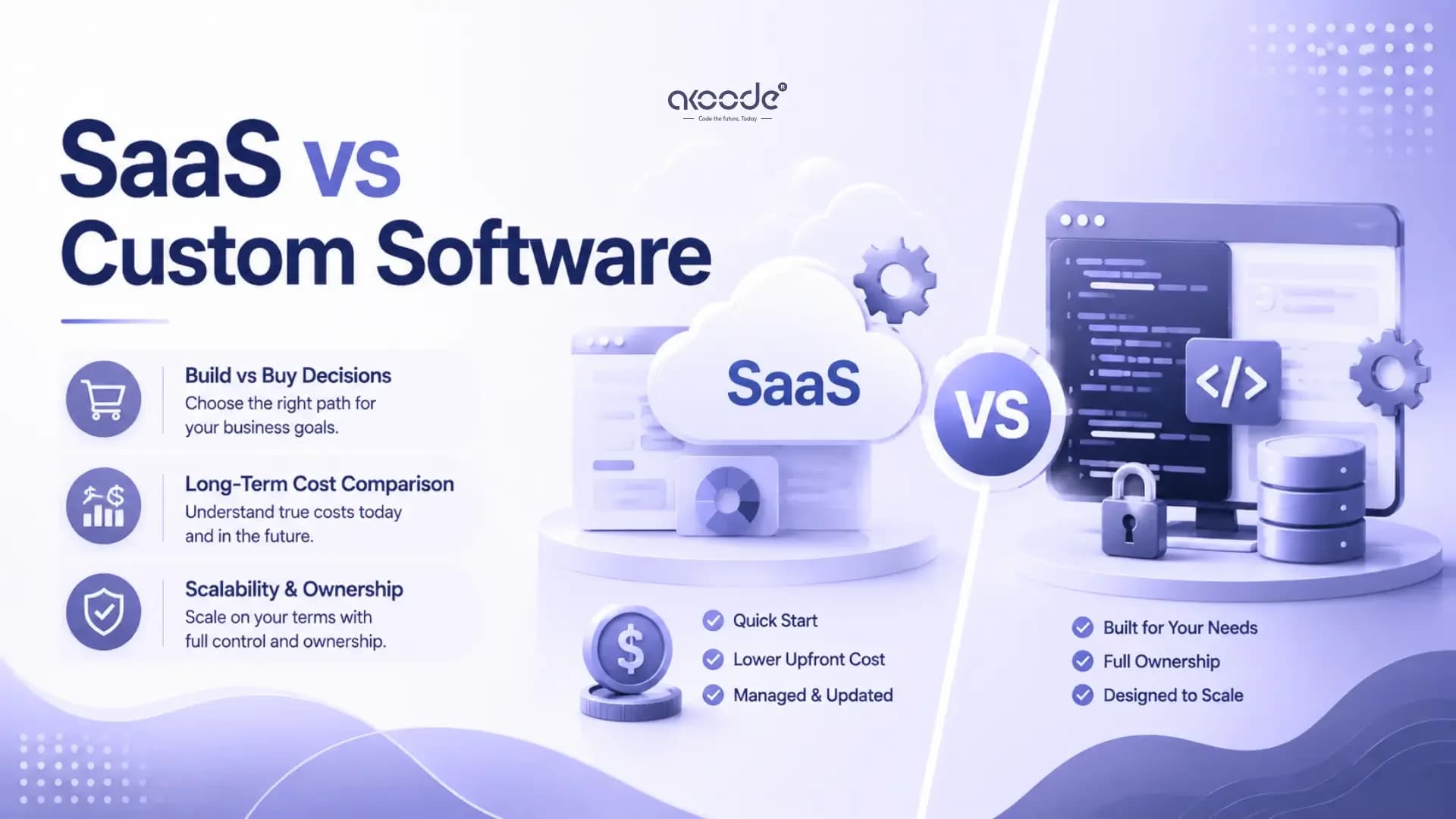
Every growing business eventually faces the same crossroads. Keep paying monthly for software that almost fits. Or build something that fits exactly.
On paper the SaaS path looks obvious. Fast to deploy. Low upfront cost. No engineering team required on day one. In practice, the decision is far more complex than the first-month invoice suggests. And founders who default to one approach without running the real numbers often discover the cost at exactly the wrong moment.
This guide gives you a clear, honest framework for choosing between SaaS and custom software at the stage you are actually at right now.
What Is the Actual Difference Between SaaS and Custom Software?
SaaS is pre-built software delivered over the internet through a subscription. You pay monthly or annually. The vendor hosts it, maintains it, updates it, and controls the roadmap. You configure it within the boundaries they allow. Common examples are Salesforce, HubSpot, Slack, Shopify, and Notion.
Custom software is purpose-built for one organisation. You define the features. A development partner or internal team builds it. You own the code, the data, and the architecture. You control the roadmap. Nothing is shared with other businesses. Nothing is constrained by a vendor's product vision.
The clearest way to frame the difference: SaaS is renting. Custom software is ownership. Both have legitimate use cases. The question is which one serves your specific situation at your specific stage.
Why Has This Decision Become More Complex in 2026?
The SaaS market reached $374 billion globally in 2026. Meanwhile, custom software development is growing at a 22.6 percent compound annual growth rate, driven by businesses discovering that SaaS cost advantages erode quickly as they scale.
Three things have changed the calculation in the last two years.
SaaS prices are rising faster than inflation. Vendors who built their user bases on low introductory pricing are now increasing fees, removing features from lower tiers, and requiring enterprise contracts for capabilities that were previously standard. Businesses that built operations around a $500 per month tool are now paying $5,000 per month for the same functionality.
AI-assisted development has reduced custom build timelines. Modern agentic coding tools and experienced development partners can now deliver a working MVP in six to eight weeks that would have taken four to six months three years ago. The time-cost disadvantage of custom development has narrowed significantly.
The total cost of ownership gap is closing. When you calculate five-year TCO honestly, including SaaS price increases, per-seat fees, integration costs, and the operational friction of working around platform constraints, custom software crosses the break-even point faster than most founders expect.
None of this means custom is always right. It means the decision requires more analysis than it used to.
How Do the Real Costs Compare?
Most people compare the wrong numbers. They compare the first month of a SaaS subscription against the full upfront cost of a custom build. That comparison is misleading in both directions.
Here is what a more honest comparison looks like over five years.
SaaS total cost of ownership:
A business using five SaaS tools at an average of $400 per user per month across a ten-person team pays $4,000 per month or $48,000 per year. As the team grows to thirty people, that becomes $144,000 per year. Over five years with modest price increases, the cumulative spend reaches $700,000 to $900,000, often for tools that still do not quite match the business's actual workflow.
The hidden costs compound this further. Integration work to connect disconnected SaaS tools. Internal time spent on workarounds. Lost productivity from features that are close but not right. Migration costs if a vendor changes pricing or discontinues a product. These costs are real but rarely appear in the initial subscription comparison.
Custom software total cost of ownership:
A custom build costs $50,000 to $150,000 upfront for a well-scoped startup product. Annual maintenance runs 15 to 20 percent of the build cost, typically $10,000 to $30,000 per year. There are no per-seat fees. No vendor price increases. The same system serves three users or three hundred without the cost growing proportionally.
Over five years, the total spend on a $100,000 custom build is approximately $175,000 to $250,000. A $100,000 custom build that replaces $60,000 per year in SaaS costs pays for itself in under two years. After the break-even point, every year is savings.
The math does not always favour custom. A $300,000 custom build replacing a $500 per month SaaS subscription takes decades to justify. The decision is always about the specific numbers in your specific situation.
SaaS vs Custom Software: Side-by-Side Comparison
Factor | SaaS | Custom Software |
|---|---|---|
Upfront cost | Low | Higher |
Time to start | Days | Weeks to months |
Five-year TCO | Often higher at scale | Lower after break-even |
Fit to your workflow | Partial | Exact |
Scalability | Limited by vendor roadmap | Built to your requirements |
Data ownership | Vendor-dependent | Full ownership |
Competitive advantage | None, competitors use same tools | High, proprietary capability |
Customisation | Within vendor limits | Unlimited |
Maintenance | Vendor-managed | Your responsibility |
Vendor dependency risk | High | None |
IP ownership | None | Full |
Best stage | Early validation, standard needs | Post-validation, differentiated needs |
When Does SaaS Make More Sense Than Building Custom?
SaaS is the right choice in several well-defined situations. Getting these right saves founders from expensive custom builds that were not yet justified.
You have not validated the business model yet.
If you have not confirmed that customers will pay for your solution, build on SaaS. The goal at this stage is learning, not building. Use off-the-shelf tools to run your operation, test your assumptions, and validate that the problem is real. Build custom only when the SaaS tools are clearly constraining your ability to serve customers or create a competitive edge.
Your workflows match what the market already solves.
If the process you are trying to support is well-understood, the SaaS market probably has a tool that covers it. Project management, CRM, email marketing, invoicing, and HR functions are all served by mature, capable platforms. Building custom here is expensive and unlikely to produce a better outcome than what already exists.
Speed is the most critical variable right now.
A SaaS tool can be live in a day. A custom build takes weeks at minimum. If getting to market first is the primary constraint and the workflow is standard, SaaS wins on time to value.
You are a startup with under fifteen employees running standard operations.
At this scale, SaaS delivers speed and cash flow preservation. Both matter more than perfect workflow fit at the very early stage.
When Does Custom Software Outperform SaaS?
Custom software delivers its strongest results in situations where standard tools create real constraints, not just minor inconveniences.
Your workflow is genuinely unique.
If the way your business operates cannot be accurately modelled by any existing SaaS tool, you are spending engineering time building workarounds rather than building the product. Custom software removes those workarounds permanently.
You are building a product to sell, not just to run operations.
If software is your product, SaaS tools cannot become your offering. A platform you sell to customers must be built. There is no substitute here. The how to build a SaaS product guide covers exactly how to approach this build from day one.
Your SaaS bill has outgrown your development budget.
When the annual cost of your current SaaS stack exceeds what a custom build would cost to maintain annually, the economics have already shifted. Run the five-year number before renewing contracts.
Data sovereignty or compliance requirements demand it.
Regulated industries including healthcare, finance, and legal services often require data to stay within specific environments. SaaS tools rarely offer the level of data architecture control that compliance frameworks demand. Custom software built with the right architecture handles these requirements from day one.
You need competitive differentiation through your software.
If your operations are powered by the same tools as your competitors, no feature inside those tools will set you apart. Custom software, and specifically bespoke software development, lets you build capabilities others cannot replicate.
You are growing fast and per-seat costs are compounding.
The cost curve of SaaS flips against you as team size grows. Custom software does not charge per seat. At the right scale, this difference is material.
The Hybrid Model: When You Need Both
The SaaS vs custom software decision is not always binary. Many businesses run a deliberate hybrid. SaaS for standard, non-core functions. Custom software for the processes where differentiation matters.
A practical example: an e-commerce company uses Shopify for the storefront, a SaaS CRM for sales management, and custom-built order fulfilment and inventory logic that reflects their unique multi-warehouse operations. The SaaS tools handle standard work quickly and cheaply. The custom layer handles the operations that actually differentiate the business.
This model works when the boundaries are clear. SaaS for commodity functions. Custom for competitive functions. Confusion arises when businesses try to customise SaaS tools beyond their intended limits rather than building the custom capability directly.
A Decision Test: Five Questions Before You Choose
Run through these five questions before committing to either path.
1. Have you validated that customers will pay for this?
If no, use SaaS. Validate first. Build custom when the model is confirmed.
2. Does any existing SaaS tool solve this accurately enough?
If yes, buy it. Custom builds are only justified when standard tools genuinely cannot serve the requirement.
3. Is this software your product or your operations?
If it is your product, you must build it. If it is operations, SaaS might be sufficient.
4 What does the five-year total cost look like?
Calculate the full SaaS cost including price increases, per-seat growth, and integration overhead. Compare against a realistic custom build and maintenance cost. The answer often surprises founders.
5. Do you have the internal capacity to manage a custom build?
A custom project requires product ownership, clear requirements, and consistent stakeholder involvement. Without that capacity, even the best development partner will struggle to deliver the right outcome.
If you reach question five and custom software is the right direction, the MVP development cost guide gives you realistic numbers to plan against, and the how to build an MVP guide covers the step-by-step build process from validated idea to first live version.
What About the Cost of Building Custom in India?
One factor that has made custom software more accessible for startups globally is the quality and cost of development talent in India. A custom build that costs $150,000 with a US-based team can be delivered for $40,000 to $60,000 with a quality India-based engineering partner without compromising on architecture or output quality.
For startups outside India evaluating custom development for the first time, the software development cost in India guide breaks down current market rates and what factors drive the final number up or down.
Conclusion
SaaS is not going away. It is the right starting point for most early-stage businesses and the permanent right choice for non-core functions at every stage. The mistake is not using SaaS. The mistake is defaulting to it past the point where it constrains growth, compounds cost, and limits competitive differentiation.
Custom software is not always expensive. With the right scope, the right partner, and a realistic view of five-year total cost of ownership, it is often the cheaper and smarter long-term investment for businesses past early-stage validation.
The question is never which model is better in the abstract. It is which model serves the specific decision in front of you right now.
Akoode Technologies is a leading AI and software development company headquartered in Gurugram, India, with a US office in Oklahoma. From custom software development and SaaS product builds to full stack development and AI-powered web applications, Akoode builds software for startups, SMEs, and enterprises across 15+ industries globally. If you are at the crossroads between SaaS and building custom and want an honest scoping conversation, that conversation starts here.
Frequently Asked Questions
1. What is the main difference between SaaS and custom software?
SaaS is pre-built software you subscribe to and configure within vendor limits. Custom software is purpose-built for your specific needs, owned outright, with no per-seat fees or vendor constraints. The core difference is ownership and fit.
2. Which is cheaper: SaaS or custom software development?
SaaS has lower upfront cost. Custom software often has lower five-year total cost of ownership once per-seat fees, price increases, and integration overhead compound against SaaS. A custom build replacing $60,000 per year in SaaS costs typically breaks even in under two years.
3. When should a startup choose custom software over SaaS?
When the workflow is genuinely unique, when software is the product being sold, when data sovereignty requirements rule out SaaS, when competitive advantage depends on proprietary capability, or when the cumulative SaaS bill has grown past what a custom build would cost to maintain annually.
4. Can a business use both SaaS and custom software?
Yes. Many businesses run a deliberate hybrid model. SaaS for standard, non-core functions. Custom software for the operations that create competitive differentiation. The key is keeping the boundaries clear between what is commoditised and what is proprietary.
5. How long does custom software development take compared to SaaS deployment?
SaaS tools can be live in a day. A focused custom MVP built with modern development tools and an experienced team typically takes six to twelve weeks in 2026. AI-assisted development has compressed timelines significantly compared to benchmarks from two to three years ago.
6. What is the biggest mistake founders make in the SaaS vs custom software decision?
Comparing the wrong numbers. Founders often compare the first month of a SaaS subscription against the full upfront cost of a custom build. The correct comparison is five-year total cost of ownership for both options, including SaaS price increases, integration work, and per-seat scaling costs against custom build plus annual maintenance.
Get In Touch Now
View More Our Blog