




 May 12, 2026
The global SaaS market hits $375 billion in 2026. It is one of the most accessible business models ever built. No inventory, no logistics, no distribution problem. Build once. Sell monthly. Scale without linear cost growth.
And yet 90 percent of SaaS startups still fail.
Not because the market is too crowded. Not because funding is hard to find. They fail because founders build products nobody wants, run out of money before finding product-market fit, and spend months perfecting features before talking to a single paying customer.
This guide covers exactly how to build a SaaS product from scratch in 2026. Step by step. With real numbers and no filler.
What Is a SaaS Product and Why Does the Model Work?
SaaS stands for Software as a Service. It is software that runs entirely in the cloud. Users log in through a browser or app. No installation required. No local maintenance. Everything updates automatically.
The business model is built around recurring revenue. Customers pay monthly or annually. You control pricing, features, and roadmap from one place. As the user base grows, revenue compounds. Infrastructure costs do not grow at the same rate as customers. That asymmetry is what makes SaaS so powerful as a business.
Popular SaaS products include Slack, Zoom, Notion, HubSpot, and Stripe. Each one solved a specific problem for a specific user and built a subscription engine on top of that solution.
How Do You Validate a SaaS Idea Before Building Anything?
This is the step most founders skip. It is also the most important one.
Before writing a single line of code, confirm that real people have the problem you are planning to solve and that they would pay to fix it.
The right validation checklist looks like this. The problem happens frequently, weekly or daily, not once a year. At least ten people outside your immediate network are willing to pay for a solution. Existing tools are expensive, clunky, or underserve a specific niche. You can reach your target users without paid ads in the early months.
Talk to twenty to thirty potential users directly. Not surveys. Actual conversations. Ask about their current workflow, where they lose time, and what they have already tried. Ask whether they would pay for a better solution and how much. The answers tell you more than any amount of planning or assumption-building.
A practical test: can you name one person who would pay for this today? If you cannot, the validation work is not done.
How Do You Scope an MVP for a SaaS Startup?
Once the problem is validated, define the smallest version of the product that lets real users test your core hypothesis.
Write down every feature you want to build. Cut the list in half. Cut it again. The founders who ship fastest are the most ruthless about what version one does not include.
Focus the MVP on one user segment, one use case, and one core workflow. If users do not engage with the core value, adding more features will not fix it. If they do engage, you have a clear signal for what to build next.
The MVP is not a prototype. It is a live product that real users interact with and get genuine value from. It needs to work reliably. It does not need to be comprehensive.
What Tech Stack Should You Use to Build a SaaS Product in 2026?
Use the stack your team already knows. Speed and maintainability matter far more than picking the most sophisticated tools.
The battle-tested SaaS stack in 2026 looks like this:
Frontend: Next.js or Remix for full-stack React applications. Webflow for marketing pages. No point custom-coding a landing page when you have a product to build.
Backend: Node.js with TypeScript or Python with FastAPI. Python is the pragmatic choice for AI-heavy products given the ecosystem depth.
Database: PostgreSQL. It handles most SaaS workloads reliably. Add Redis for caching and real-time features when you need them.
Authentication: Clerk, Auth0, or Supabase Auth. Never build authentication from scratch. It is a solved problem and a dangerous one to get wrong.
Payments: Stripe. It handles subscriptions, usage-based billing, invoicing, and most payment edge cases you will encounter.
Infrastructure: Start managed. Vercel, Railway, or Render for app hosting. Move to AWS or GCP when you need more control. Do not over-engineer infrastructure before product-market fit.
Monitoring: Sentry for error tracking, PostHog or Mixpanel for product analytics, and Datadog or Better Uptime for infrastructure monitoring.
How Do You Build an AI SaaS Product in 2026?
Almost every new SaaS product launched in 2026 includes AI as a core capability. This is not optional differentiation anymore. It is a baseline expectation in most categories.
Building an AI SaaS product adds specific requirements to your architecture. Here is what changes.
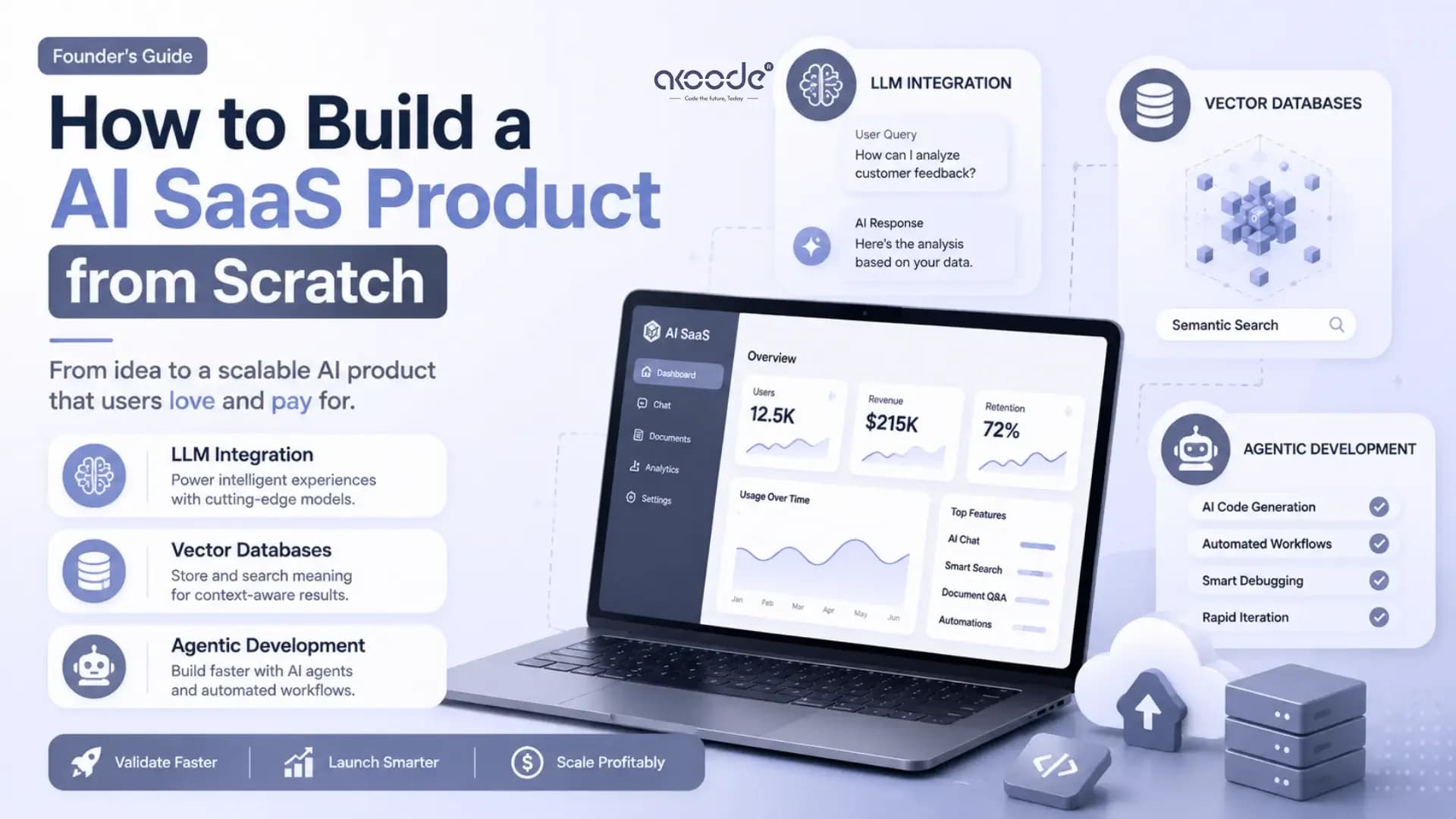
LLM integration. Most AI SaaS products use an external model API from Anthropic, OpenAI, or Google rather than training their own models. The integration itself is straightforward. The harder work is prompt engineering, output validation, and managing the cost and latency of inference at scale.
Vector database for retrieval. If your product needs to search your users' data by meaning, retrieve context from documents, or power a knowledge assistant, a vector database is a required infrastructure layer. Pinecone, Qdrant, and pgvector are the most commonly used options in 2026.
AI feature layer cost. Budget an additional $25,000 to $75,000 on top of your base build cost if your SaaS requires LLM-powered features, intelligent search, or workflow automation. This covers vector database setup, prompt management, output validation logic, and the engineering time those require.
Agentic capabilities. In 2026, the fastest teams use AI coding agents like Claude Code and Cursor to build the SaaS product itself. Akoode's engineering team cut repetitive coding time by approximately 40 percent using agentic tools. The AI handles boilerplate, standard flows, and test writing. Engineers focus on architecture, complex logic, and product decisions.
A functional SaaS MVP with agentic AI assistance is now achievable in one to two weeks of focused work. That timeline does not apply to complex products with multi-tenant architecture or compliance requirements. But for a validated idea with a clear scope, the build-to-launch window has compressed dramatically.
How Much Does It Cost to Build a SaaS Platform in 2026?
Cost depends on complexity, team location, and how much AI capability you are building in. Here is a realistic breakdown.
SaaS Type | Cost Range | Timeline |
|---|---|---|
Simple no-code or low-code SaaS | $15,000 to $35,000 | 4 to 8 weeks |
Standard custom SaaS MVP | $35,000 to $80,000 | 8 to 14 weeks |
AI-powered SaaS MVP | $60,000 to $150,000 | 12 to 20 weeks |
Enterprise SaaS with compliance | $150,000 to $300,000+ | 20 to 36 weeks |
By team location:
Region | Mid-Level Developer | Senior Developer |
|---|---|---|
India | $30 to $50/hour | $50 to $75/hour |
Eastern Europe | $45 to $65/hour | $65 to $100/hour |
United States | $120 to $160/hour | $160 to $220/hour |
A standard AI SaaS MVP that costs $150,000 with a US-based team can be delivered for $50,000 to $70,000 by a quality India-based development team. The engineering talent pool in India for SaaS and AI development is deep and experienced.
Ongoing costs to plan for: cloud hosting runs $100 to $1,000 per month at MVP stage. Third-party APIs and tools add $300 to $3,000 per month depending on your integrations. LLM inference costs scale with usage and need their own budget line from launch.
Also check: MVP Development Cost: What It Actually Takes to Launch
How Should You Price a SaaS Product?
Pricing is where most founders make their most expensive early mistake. They underprice out of fear rather than evidence.
Low prices attract price-sensitive customers. Price-sensitive customers churn faster and demand more support. They are the hardest customers to serve and the least valuable to retain.
A practical pricing framework: calculate the value your product delivers. If your tool saves five hours per week for a user billing at $100 per hour, the value delivered is $2,000 per month. Price at ten to twenty percent of that value. That puts your price at $200 to $400 per month for this user. Most first-time founders would instinctively price it at $29 per month. That instinct is expensive.
The dominant SaaS pricing structures in 2026 are usage-based, seat-based, and hybrid. Usage-based pricing suits AI products where compute costs scale with consumption. Seat-based pricing suits collaboration tools where value grows with team size. Hybrid models, a base subscription plus usage-based components, are increasingly common and often the best structural fit.
Start with three tiers. A free or low-cost entry plan to reduce friction. A core mid-tier for your primary customer. A growth tier for larger teams. It is far easier to lower prices later than to raise them.
How Do You Build a SaaS Brand and Acquire Early Users?
Do not try to reach everyone at launch. Trying to reach everyone is a reliable way to reach no one.
Pick one acquisition channel and own it before expanding. The most effective early channels in 2026 are content and SEO for compounding organic growth, communities where your target users already spend time, direct outreach to the twenty to thirty people you spoke to during validation, and product-led growth if your core feature has a natural sharing or collaboration loop.
Building a SaaS brand at the early stage is less about visual identity and more about positioning. What specific problem do you solve? For whom? Why you and not the existing alternatives? A clear, specific answer to these three questions is the foundation of everything that follows in marketing, sales, and content.
Vertical SaaS, software built for a specific industry rather than a broad horizontal market, is the strongest category in 2026. Products that go deep into healthcare, legal, construction, logistics, or finance build stickier relationships, face less direct competition, and attract users with higher willingness to pay.
Conclusion
Building a SaaS product in 2026 is faster and cheaper than it has ever been. AI tools have compressed timelines. India-based engineering teams have made quality development accessible at a fraction of US rates. No-code and low-code tools have lowered the floor for early validation.
What has not changed is the fundamental sequence. Validate before building. Scope tightly. Ship fast. Talk to users constantly. Price confidently. Iterate based on evidence, not assumption.
The SaaS founders who succeed are not the ones with the biggest budgets or the most sophisticated technology. They are the ones who stay closest to the problem and their users throughout every stage of the build.
Akoode Technologies is a leading AI and software development company headquartered in Gurugram, India, with a US office in Oklahoma. From SaaS MVP development and AI-powered web applications to full stack development and custom enterprise platforms, Akoode builds SaaS products for startups, SMEs, and enterprises across 15+ industries globally. If you have a validated SaaS idea and want to build it with the right architecture from day one, that conversation starts here.
Frequently Asked Questions
1. How do you build a SaaS product from scratch in 2026?
Start by validating the problem with real users before writing code. Define a tight MVP scope around one user, one use case, and one core workflow. Choose a proven tech stack. Build in two-week sprints. Launch to early adopters. Measure behaviour and iterate based on what you learn. The sequence matters more than the technology.
2. How much does it cost to build a SaaS platform in 2026?
A standard custom SaaS MVP costs $35,000 to $80,000. An AI-powered SaaS MVP costs $60,000 to $150,000. Enterprise SaaS with compliance requirements costs $150,000 to $300,000 and above. Working with an India-based development team reduces costs by 60 to 70 percent compared to US-based teams.
3. How do you build an AI SaaS product?
Integrate an LLM API from Anthropic, OpenAI, or Google for intelligent features. Add a vector database like Pinecone or pgvector for retrieval and memory. Budget an additional $25,000 to $75,000 on top of your base build for the AI infrastructure layer. Use agentic coding tools to accelerate development and reduce repetitive engineering work.
4. How long does it take to build a SaaS MVP?
A simple no-code SaaS takes four to eight weeks. A standard custom SaaS MVP takes eight to fourteen weeks. An AI-powered SaaS takes twelve to twenty weeks. With modern agentic development tools, a focused MVP on a well-defined scope can be delivered faster than those benchmarks from two years ago.
5. How should a SaaS startup price its product?
Calculate the value your product delivers to the user and price at ten to twenty percent of that value. Start with three tiers. Avoid underpricing out of fear. Price-sensitive customers churn faster and cost more to support. Usage-based, seat-based, and hybrid pricing are the dominant models in 2026.
6. How do you build a SaaS brand as a startup?
Own one acquisition channel before expanding to others. Position around a specific problem for a specific user. Vertical SaaS, built for one industry, builds stickier products and faces less direct competition than horizontal tools. Start writing SEO content before you launch. Communities and direct outreach are the most effective early acquisition channels before organic search compounds.