


 May 4, 2026
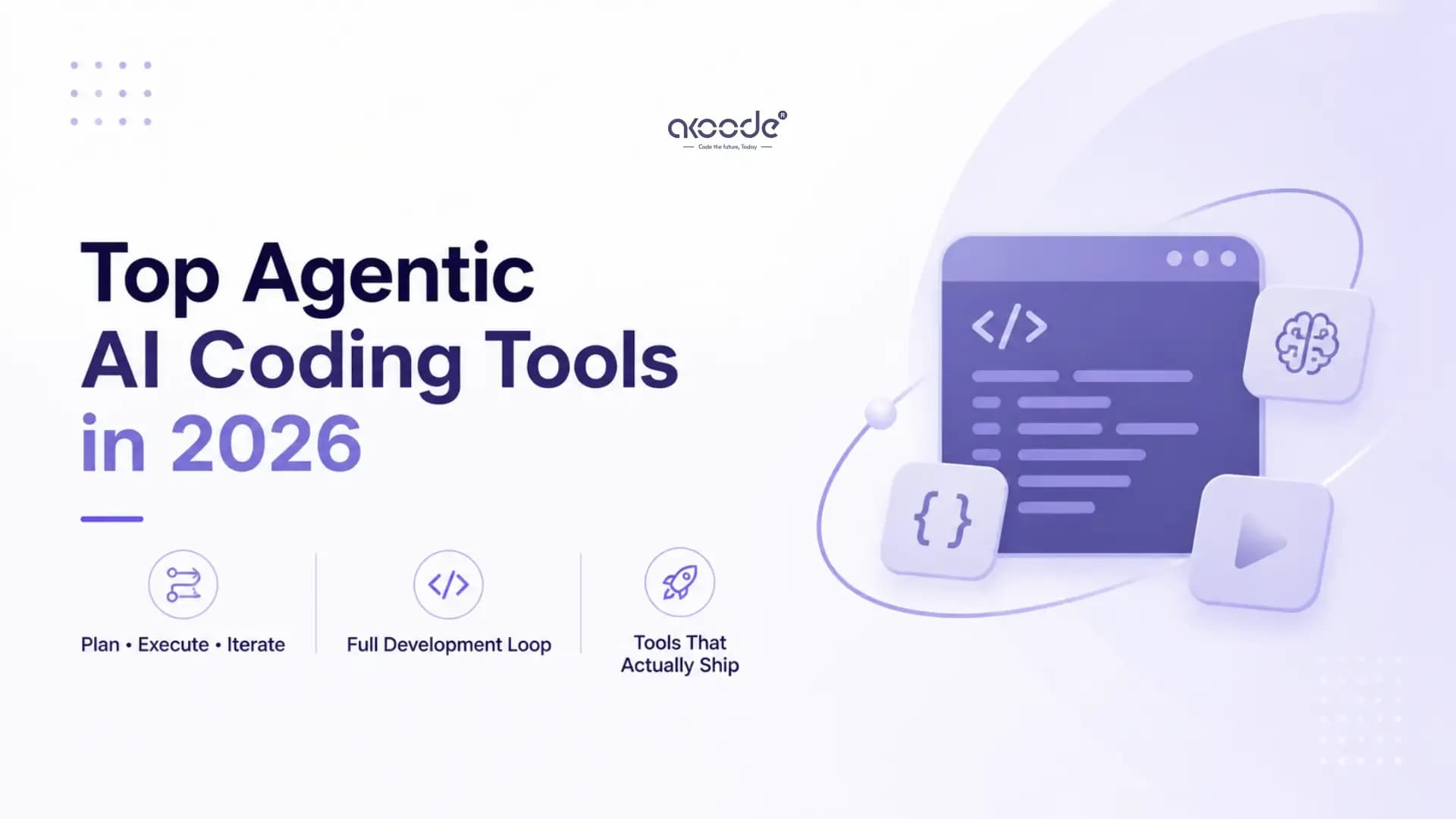
Software development has a new category of tool. It is moving faster than most teams can track.
Agentic AI tools do not just suggest code. They plan tasks. They write code. They run tests and fix bugs. The best ones handle the full execution loop on their own.
By 2026, seven serious agentic coding tools compete at the top of the market. Each has a different approach, different pricing, and different strengths. The wrong choice costs time and money. The right one changes how fast your team ships.
This guide covers what agentic AI is, how it works, and which tools matter most in 2026.
What Is Agentic AI in Simple Terms?
Agentic AI is artificial intelligence that does not just respond to a prompt. It plans, acts, and improves on its own.
A standard AI tool answers questions when you ask. An agentic AI takes a goal. It breaks that goal into steps. It executes those steps using available tools. Then it checks its own work and continues until the task is done.
Think of the difference this way. A standard AI is like a very fast typist. An agentic AI is like a developer who reads your ticket, writes the code, runs the tests, fixes what breaks, and submits the pull request. All without waiting for instructions at each step.
In software development, this changes the entire workflow. Repetitive coding, test writing, bug fixing, and deployment tasks now happen autonomously. Engineers focus on architecture, product decisions, and review. They spend less time on execution.
What Is an Agentic AI Framework and How Does It Work?
An agentic AI framework is the system that lets an AI model use tools, take actions, and loop through tasks until a goal is reached.
Most frameworks work through the same core structure. The AI receives a goal. It plans the steps needed. It calls external tools like a code editor, a terminal, or a browser. It checks the results. It adjusts if something went wrong. It continues until the task is complete.
What separates a real agentic framework from a chatbot is the tool-use loop. The AI is not just generating text. It is taking real actions in real environments. It responds to the outcomes of those actions.
The most capable tools can plan and execute entire features on their own. They run terminal commands. They test their own code. They iterate through failures without waiting for a human to step in.
For development teams, this shifts the developer role. Less time writing boilerplate. More time reviewing, deciding, and guiding. The engineer becomes the architect and quality gate.
What Are Real Examples of Agentic AI in Software Development?
The clearest way to understand agentic AI is through what it actually does.
A developer describes a new feature in plain language. The agentic tool reads the existing codebase for context. It writes the feature code across multiple files. It creates relevant tests and runs them. It identifies failures and rewrites the broken sections. Then it submits a pull request for review.
Another example is bug fixing. A bug is reported. The agent reads the error log. It traces the issue through the codebase and identifies the root cause. It writes a fix. It verifies the fix does not break other tests. Then it flags the result for developer approval.
These are not theoretical. They happen inside production codebases today. Akoode's own engineering team cut repetitive coding time by approximately 40% using Cursor Agent. Developers now spend more time on architecture, complex logic, and product quality.
Every major coding tool is racing toward full agentic capability. GitHub Copilot added Agent Mode. Cursor shipped Background Agents. Antigravity launched with multi-agent orchestration from day one. OpenAI shipped Codex as a standalone cloud agent. The category is no longer emerging. It is mainstream.
What Are the Top Agentic AI Coding Tools in 2026?
Here is a breakdown of the five tools your team needs to understand. Each section covers what the tool does best and where it fits.
1. Cursor
Category: AI-first IDE Best for: Professional developers who want deep agent integration in a familiar editor Pricing: Free tier available. Pro at $20/month. Business at $40/user/month
Cursor is the gold standard AI IDE for professional developers in 2026. It is built on VS Code. Developers keep the interface they already know. AI capabilities are added at every level. That includes inline suggestions, full-file rewrites, and multi-file agent tasks.
What makes Cursor stand out is context depth. It indexes your entire codebase. It understands relationships between files, functions, and dependencies. When an agent task runs, it knows the full project. It is not working on an isolated snippet.
Cursor supports up to 8 parallel agents. Its ecosystem is the largest of any dedicated AI IDE. It also supports multiple underlying models including Claude Sonnet, GPT-4o, and Gemini. Teams can switch models based on the task at hand.
For teams that already live in VS Code and want serious agentic capability, Cursor is the natural starting point.
Ideal workflow: Daily feature development, multi-file refactoring, teams that want to stay in VS Code.
2. Qoder
Category: Dedicated AI IDE Best for: Teams that want a purpose-built agentic development environment Pricing: Available on request
Qoder is a dedicated AI-first IDE built from the ground up for agent-assisted development. Unlike Cursor, which extends VS Code, Qoder is its own environment. Agentic workflows are at the center. They are not added on top.
The tool handles multi-step task execution. It reasons across codebases. It manages iterative debugging within a tightly controlled workflow. This structure reduces noise when running agents on complex projects.
Qoder is well suited for teams building web applications or enterprise platforms. It gives a clean separation between AI-assisted development and general-purpose editing. For teams that want that boundary clearly defined, Qoder fits well.
Ideal workflow: Teams that want a dedicated agentic environment separate from their general code editor.
3. OpenAI Codex
Category: Cloud-native agentic coding agent and open-source CLI Best for: Speed, high-volume tasks, and teams who want open-source flexibility Pricing: Bundled with ChatGPT Plus at $20/month. Standalone CLI is free and open source
The 2026 version of Codex is not the old autocomplete model from 2021. It is a cloud-native agentic coding agent. It runs in a secure cloud sandbox. It writes files, runs servers, and pushes to GitHub. All of this happens without any local setup.
Codex CLI is fast. Very fast. At 240 tokens per second, it leads on throughput. It scores highest on Terminal-Bench performance tests. It is the right tool when speed matters more than deep reasoning.
Codex now supports a full IDE extension, a web app, and Slack integration. You can assign a coding task directly from a Slack thread. It also supports multi-agent workflows and image inputs including wireframes and screenshots.
Many developers use Codex and Claude Code together. Codex handles volume and speed. Claude Code handles complexity and depth. The two tools complement each other well.
Ideal workflow: High-volume tasks, code review, open-source teams, developers already using ChatGPT.
4. Claude Code
Category: Terminal-native agentic coding agent Best for: Engineers working on complex systems who need deep reasoning and full configuration control Pricing: Included with Claude Pro and Max plans. Max plan from $100/month flat rate for heavy use
Claude Code is built for the hardest engineering problems. It has the deepest reasoning of any tool in this category. Developers use it as their escalation path when other tools fail. The 200K context window handles large, complex codebases without losing track.
Claude Code works from the terminal. It does not replace your existing editor. It integrates with whatever workflow you already use. Any team, any stack, any environment can adopt it without restructuring their setup.
Claude Code also has mature computer use capabilities. It can interact with a browser. It can pull information from web dashboards, verify staging deployments, and check form submissions. All of this happens inside a single agentic loop. No need to hand off to a separate automation tool.
The configuration depth is unmatched. Sub-agents, custom hooks, slash commands, and detailed settings give engineering teams full control over how agentic workflows run.
One developer tracked 10 billion tokens over 8 months at $100 per month on the flat-rate Max plan. The same usage on per-token API pricing would have cost around $15,000. For teams doing serious agentic work, the economics are very clear.
Ideal workflow: Complex feature builds, architectural work, engineering teams that need the deepest reasoning and full configuration control.
5. Antigravity
Category: Agentic full-stack app builder and AI-powered IDE Best for: Developers and technical founders generating complete applications from natural language Pricing: Free preview available. Pro at $20/month. Pricing model still evolving
Antigravity is one of the most exciting new tools in 2026. You describe what you want to build in plain language. The platform generates a complete, deployable application. That includes frontend, backend, database schema, and API routes. No manual coding required.
It launched with multi-agent orchestration from day one. Multiple agents work on different parts of a codebase at the same time. It leads the dedicated IDE category for parallel agentic workflows.
Antigravity generates React or Next.js frontends. It creates Node.js or Python backends. It sets up PostgreSQL or Supabase databases. All from a single prompt. For technical founders validating an idea fast, this removes weeks of setup work.
One honest limitation worth knowing: the token budget has seen reductions since launch. There is also a large gap between the $20 Pro plan and the $250 Ultra plan with nothing in between. Teams forecasting usage costs should factor this in before committing.
Ideal workflow: Full-stack app generation, rapid prototyping, technical founders building MVPs, teams that need parallel multi-agent execution.
6. GitHub Copilot
Category: IDE extension and agentic assistant Best for: Developers who want the cheapest entry into agentic coding Pricing: Free tier available. Pro at $10/month. Business at $19/user/month
GitHub Copilot is the most widely adopted AI coding tool in the world. It started as an autocomplete tool. It has grown into a serious agentic assistant with Agent Mode now shipping as default.
Copilot works inside VS Code, JetBrains, Neovim, and most major editors. You do not switch environments. The AI comes to wherever you already work. That low friction is one of its biggest advantages.
At $10 per month, Copilot Pro is the cheapest entry into agentic coding available. No other tool with real agentic capability comes close on price. For individual developers or small teams testing the waters, it is the logical first step.
The honest limitation is depth. Developers who need serious multi-file agentic work typically move to Cursor or Claude Code. But many never outgrow Copilot. For everyday coding assistance and lighter agentic tasks, it delivers strong value at a price that is hard to argue with.
Ideal workflow: Developers new to agentic coding, teams that want AI assistance across multiple editors at minimal cost.
7. Devin
Category: Autonomous cloud coding agent Best for: Teams that want to fully delegate well-scoped tasks and review only the end result Pricing: Core at $20/month plus $2.25 per Agent Compute Unit
Devin is the most autonomous coding agent on the market. You assign a task. Devin plans it, writes the code, runs tests, and submits a pull request. You review the finished result. You are not involved in the middle.
Devin runs in a fully sandboxed cloud environment. It has its own IDE, browser, terminal, and shell. Nothing runs locally. The isolation means it can work on tasks in parallel with your team without touching your live environment.
Devin 2.0 introduced two important capabilities. Interactive Planning lets you shape the approach before Devin starts executing. Devin Wiki automatically indexes your repository and generates architecture documentation. Both features reduce the risk of Devin making wrong assumptions on complex projects.
The autonomy level is the highest of any tool on this list. That is also its main risk. Teams need strong review discipline and clear rollback processes before delegating significant tasks. For well-scoped work where end-state review is sufficient, Devin changes what a small team can ship.
Ideal workflow: Delegating well-defined, self-contained tasks. Teams comfortable with async agent execution and structured review processes.
8. Windsurf
Category: Agentic AI-first IDE Best for: Developers who want strong agentic IDE capability at the best price-to-performance ratio Pricing: Free tier available. Pro at $15/month
Windsurf is built by Codeium and positions itself as the best value agentic IDE in 2026. At $15 per month, it sits between Copilot and Cursor on price. On agentic capability, it punches well above that price point.
The core feature is Cascade. It is Windsurf's fully agentic engine. Cascade understands your full codebase context. It plans multi-step tasks, edits across files, runs terminal commands, and iterates on its own output. It became fully agentic in late 2025 and has been updated consistently since.
Windsurf was acquired by OpenAI in 2025. Post-acquisition, it primarily uses GPT-4o and the o-series reasoning models. For teams already invested in the OpenAI ecosystem, this integration makes Windsurf a natural fit.
For developers who want a polished agentic IDE experience without paying Cursor's higher tier pricing, Windsurf is consistently the strongest alternative. Many teams run Windsurf as their primary agentic IDE and reach for Claude Code only on the most complex engineering challenges.
Ideal workflow: Developers wanting strong agentic IDE capability at a lower price point. Teams in the OpenAI ecosystem looking for an agentic coding environment.
How Do These Tools Compare Side by Side?
Tool | Category | Best For | Autonomy Level | Pricing From |
|---|---|---|---|---|
Cursor | AI-first IDE | Daily dev, multi-file work | Medium to high | $20/month |
Qoder | Dedicated IDE | Purpose-built agentic workflows | Medium to high | On request |
OpenAI Codex | Cloud agent and CLI | Speed, volume, open-source | High | Free CLI / $20/month |
Claude Code | Terminal-native agent | Complex systems, deep reasoning | High | Included in Claude plans |
Antigravity | Full-stack app builder | End-to-end generation, MVPs | Very high | Free / $20/month |
GitHub Copilot | IDE extension | Budget-friendly entry point | Medium | $10/month |
Devin | Autonomous cloud agent | Delegating complete tasks | Very high | $20/month base |
Windsurf | Agentic IDE | Value-focused agentic IDE | High | $15/month |
What Are the Risks of Agentic AI Tools?
Agentic AI is powerful. It is not without risk. Three problems come up consistently across teams using these tools in production.
Hallucinations on complex tasks. When an agent hits a genuinely ambiguous problem, it can produce confident-looking code that is logically wrong. The code compiles. The tests pass. But the logic fails in production. Human review is not optional.
Security gaps. AI-generated code can introduce vulnerabilities. Authentication logic, input validation, and access controls are the most common weak points. These flaws often pass basic tests. They surface later when real users interact with real data.
Over-reliance weakens engineering skills. Developers who hand every task to an agent and never review the output gradually lose the judgment needed to catch errors. The most effective teams use agents to accelerate work. They do not use them to replace the thinking that makes code trustworthy.
The rule that governs all three risks is simple. Always review AI output before it reaches production. Agents are fast. They are not infallible.
For a deeper look at how agentic tools fit within the broader debate between AI-assisted and traditional development, the Vibe Coding vs Traditional Development guide covers the risks, limitations, and hybrid approaches serious engineering teams are using right now.
What Does This Mean for Founders and Non-Technical Leaders?
If you are evaluating a software development partner, this shift has a direct implication for you.
The best engineering teams in 2026 are not just the ones using agentic AI tools. They are the ones using them responsibly. Speed at the generation stage means nothing if the code that reaches production has security gaps or no clear human owner who understands what was built.
Ask any development partner two direct questions. What is your process for reviewing AI-generated code before it ships? Who owns the long-term architecture of what gets built?
The answers tell you whether you are working with a team that uses AI to go faster without cutting corners, or a team that has outsourced judgment to a tool that cannot fully replace it.
Also check: Free AI Tools for Coding Developers Should Try
Conclusion
Agentic AI tools have moved from experiment to essential in less than two years. The best ones are already changing how software gets planned, written, and shipped.
The choice between tools is not about picking the most powerful one. It is about matching the right tool to the right workflow. It is about knowing the right level of human oversight for your team and your product.
Engineers using agents effectively deliver meaningfully more output. The key is knowing when to trust the agent, when to review its work, and when to step in entirely.
Akoode Technologies is a leading AI and software development company headquartered in Gurugram, India, with a US office in Oklahoma. From custom web development and full stack development to AI-powered web applications and enterprise software, Akoode builds products for startups, SMEs, and enterprises across 15+ industries globally. If your team is ready to build faster without sacrificing quality or security, the conversation starts here.
Also read: AI Use Cases in Healthcare: Top Applications in 2026
Frequently Asked Questions
1. What is agentic AI in simple terms?
Agentic AI is AI that takes a goal and figures out how to achieve it on its own. It plans, takes actions using available tools, checks its results, and continues until the task is done. It does not just respond to prompts. It executes multi-step workflows without constant human input.
2. What is an agentic AI framework?
It is the system that allows an AI model to use external tools, take actions in real environments, and loop through tasks until a goal is completed. It enables the AI to call APIs, run code, browse the web, and respond to the outcomes of its own actions.
3. What are the best agentic AI coding tools in 2026?
The top eight tools are Cursor for IDE-first development, Claude Code for deep reasoning, OpenAI Codex for speed and open-source flexibility, Qoder for purpose-built agentic workflows, Antigravity for full-stack app generation, GitHub Copilot for budget-friendly entry, Devin for autonomous task delegation, and Windsurf for strong agentic IDE capability at a competitive price.
4. What are examples of agentic AI in software development?
An agent reads a bug report, traces it through the codebase, writes a fix, runs tests to verify it, and submits a pull request. Or an agent receives a feature description, writes the code across multiple files, creates tests, and iterates through failures until the feature passes review.
5. What are the risks of agentic AI coding tools?
The main risks are hallucinations on complex tasks, security vulnerabilities in generated code, and over-reliance that weakens core engineering judgment over time. All three are manageable with a consistent human review process before AI-generated code reaches production.
6. How much faster do engineers work with agentic AI tools?
Engineers using agentic tools consistently report three to five times more output compared to teams not using them. The biggest gains come from removing repetitive coding, test writing, and boilerplate work. The developer's time shifts toward architecture, review, and quality decisions.
Get In Touch Now
View More Our Blog