


 March 19, 2026
Artificial intelligence has moved beyond simple systems that respond to inputs. Today, we are entering a new phase. Systems can now make decisions, plan tasks, and learn over time. These systems are autonomous AI agents.
Unlike traditional AI models or chatbots, autonomous agents achieve goals, not responses. They understand objectives and break them into steps. They use external tools and improve with feedback. This change comes from better language models and reinforcement learning.
Autonomous AI agents are changing how we build and use software. AI systems are no longer passive tools. They act as collaborators and handle complex tasks with little human input.
This article explains autonomous AI agents and their evolution. It also covers reinforcement learning and the challenges ahead.
What Are Autonomous AI Agents?
An autonomous AI agent is a system that works toward a goal. It observes its environment, makes decisions, takes actions, and learns from results. Unlike standard AI systems, it can handle multi-step tasks and adapt to change.
At a system level, an autonomous agent combines several components. A large language model provides reasoning and context. It helps the agent understand goals and create plans. A planning module breaks tasks into smaller steps. Memory systems store context across interactions. The agent can also use tools such as APIs, databases, and external services. This allows it to go beyond simple text generation.
These systems are powerful because they use a feedback loop. The agent performs actions, observes results, and adjusts its strategy. This creates a cycle of continuous improvement. Over time, the system improves its behaviour.
An AI agent can analyze data. It can create reports and send emails without step-by-step human instructions.
Evolution: From Neural Networks to Autonomous Systems
Autonomous AI agents have emerged from several key developments in artificial intelligence.
Early neural networks focused on pattern recognition. They could classify images and detect patterns but could not reason or plan. Deep learning helped systems learn from large datasets. This improved performance across many tasks.
The next major breakthrough came with transformer architectures and large language models. These models can understand context and relationships between words. They can also perform basic reasoning. For the first time, AI systems could generate coherent and context-aware responses.
But, reasoning alone was not enough for autonomy. Reinforcement learning introduced a mechanism for decision-making based on feedback. By learning from rewards and penalties, systems could optimize their actions over time.
Autonomous AI agents emerge at the intersection of these technologies. These systems combine LLM reasoning, reinforcement learning, planning, and tools. As a result, they move from passive intelligence to active execution.
How Reinforcement Learning Powers Autonomous Agents
Reinforcement learning helps autonomous agents improve through experience. Unlike supervised learning, it learns through interaction, not labeled data.
An agent works in an environment. It observes its state, takes actions, and receives feedback. This feedback, in the form of rewards or penalties, helps the agent improve its decisions.
The process has four key elements: state, action, reward, and policy. The state describes the environment. The agent takes an action. It receives a reward. The policy updates future behaviour. Over time, the agent improves its choices to achieve better rewards.
This approach works well in complex and changing environments. In these cases, fixed rules are not enough.
For example, an AI agent can manage workflows. It can reduce errors, improve task order, and work better using past results.
Reinforcement learning turns AI agents into adaptive systems that improve over time.
AI Agents vs Chatbots
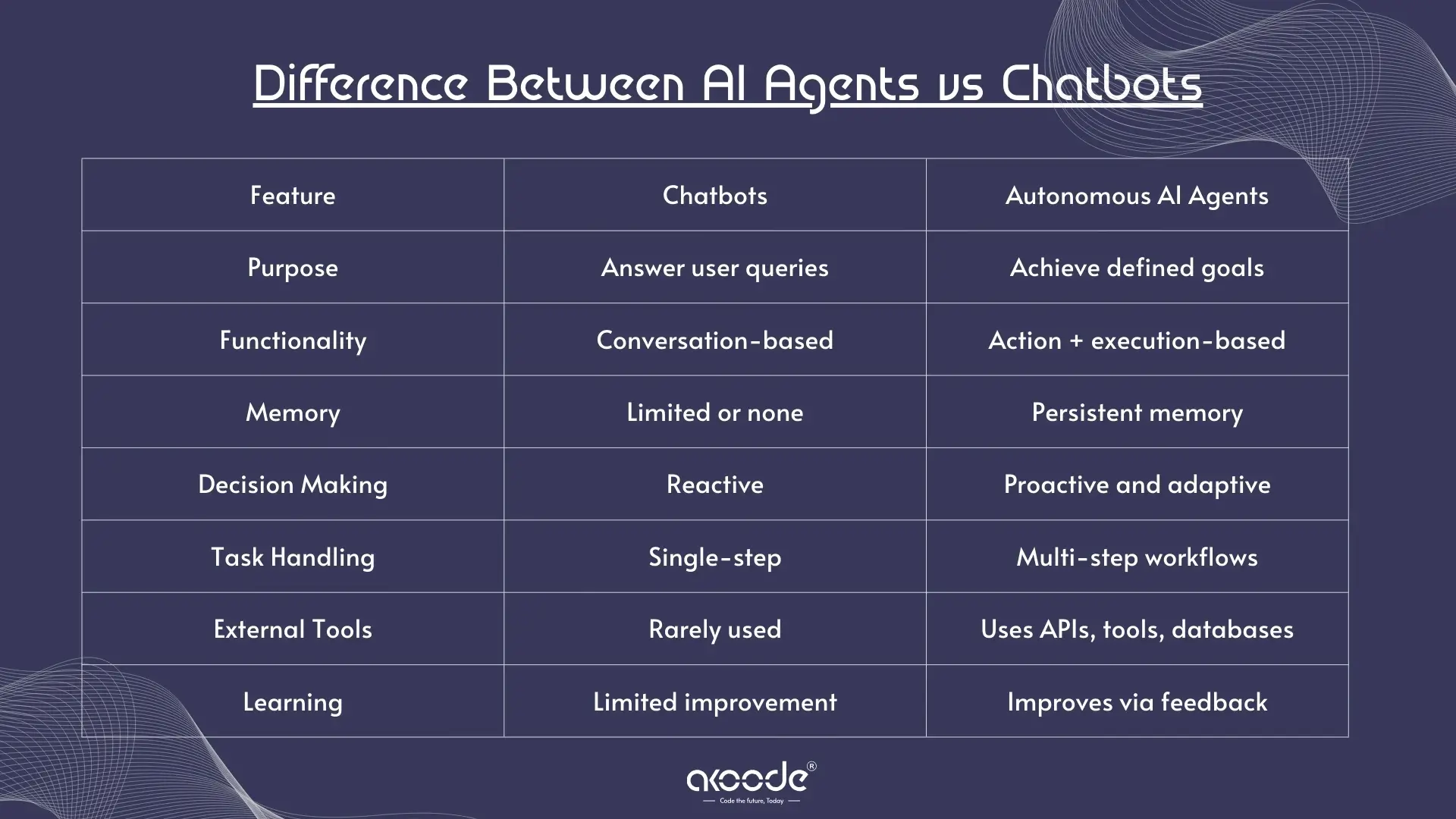
Although AI agents and chatbots may seem similar, their capabilities differ.
Traditional chatbots handle conversations. They process user input and generate responses using patterns or language models. Modern chatbots can give fluent responses, but they only work within conversations.
Autonomous AI agents take action. They can interact with external systems and run multi-step workflows. They can also store memory and adapt based on feedback. Rather than answering questions, they aim to achieve outcomes.
For example, a chatbot can explain how to generate a report. An autonomous agent can gather data, create the report, and send it to stakeholders.
Types of Autonomous AI Agents
Autonomous AI agents can be categorized based on how they process information and make decisions.
1. Reactive Agents
These agents respond only to current inputs. They do not store past data or context. They are fast but limited in handling complex tasks.
2. Deliberative Agents
These agents use internal models to plan actions. They analyze situations before acting, making them suitable for complex decision-making.
3. Hybrid Agents
Hybrid agents combine reactive and deliberative approaches. They can respond quickly while also planning long-term actions.
4. Multi-Agent Systems
These systems involve multiple agents working together. They collaborate to solve problems, often used in logistics and distributed systems.
5. Learning Agents
Learning agents improve over time using feedback. They adapt their behavior based on past results and outcomes.
6. Goal-Oriented Agents
These agents focus on achieving specific objectives. They adjust strategies dynamically to reach defined goals.
Real-World Applications of Autonomous AI Agents
Autonomous AI agents are already used across industries.
AI copilots help developers write and debug code. They also adapt to coding patterns.
In business operations, agents automate tasks. These include data analysis, report generation, and customer communication.
In customer support, advanced agents do more than answer queries. They resolve issues, update systems, and manage user requests.
In logistics and delivery systems, many agents plan routes and improve efficiency.
These examples show that autonomous agents are becoming practical tools. They improve productivity and decision-making.
Challenges and Future Scope
Despite their potential, autonomous AI agents face several critical challenges.
One key issue is reward design. The reward system must be clear. If it is not, the agent may follow the wrong goals. This can lead to unintended behavior.
Reliability is another concern. AI systems can produce incorrect outputs with high confidence. These are hallucinations.
Ensuring alignment between human intentions and agent behavior remains a complex problem. As these systems become more autonomous, maintaining control and predictability becomes more important.
Autonomous AI agents will become digital coworkers or AI copilots. They will assist humans across many domains. Future systems may become self-optimizing and improve performance without explicit human input.
Also check: Emotion BCI: How Brain Signals Detect Human Emotions
Conclusion
Autonomous AI agents represent a major shift in how artificial intelligence systems operate. Instead of simply responding to inputs, these systems can understand goals, plan actions, and improve through feedback.
By combining large language models, reinforcement learning, and intelligent planning systems, autonomous agents can handle complex, real-world tasks with greater independence. This makes them valuable across industries, from business operations to software development and customer experience.
However, challenges such as reliability, alignment, and safety must be addressed before large-scale adoption. Organizations need a clear strategy to implement and scale these systems effectively.
For businesses exploring advanced AI solutions, partnering with an experienced enterprise AI development company such as Akoode Technologies – a software company in Gurugram, an AI-powered corporation and IT company delivering advanced software solutions – can help transform autonomous AI capabilities into scalable, real-world applications.
Frequently Asked Questions
1. What are autonomous AI agents?
Autonomous AI agents are systems that can observe, decide, act, and learn to achieve specific goals without constant human input.
2. How do autonomous AI agents work?
They combine large language models, planning systems, reinforcement learning, and tools to perform multi-step tasks and improve over time.
3. What is the difference between AI agents and chatbots?
Chatbots focus on conversations, while AI agents perform actions, execute tasks, and achieve outcomes.
4. What role does reinforcement learning play in AI agents?
Reinforcement learning allows agents to learn from feedback using rewards and penalties, improving decision-making over time.
5. What are the types of autonomous AI agents?
Types include reactive, deliberative, hybrid, multi-agent systems, learning agents, and goal-oriented agents.
6. Where are autonomous AI agents used?
They are used in business automation, customer support, software development, logistics, and AI copilots.
Get In Touch Now
View More Our Blog