


 May 11, 2026
Most AI applications have a memory problem.
A large language model can generate impressive answers. But it has no memory of your business, your documents, or your users. Every conversation starts fresh. Every query is answered from training data alone.
Vector databases solve this problem. They give AI the ability to remember, retrieve, and reason over your specific data in real time.
Over 68 percent of enterprise AI applications now use vector databases to manage the embeddings generated by their language models, vision systems, and recommendation engines. The global vector database market has crossed four billion dollars. Understanding what a vector database is has moved from a nice-to-have to a core skill for anyone building AI products in 2026.
What Is a Vector Database?
A vector database is a specialised system built to store and search high-dimensional numerical data, called vectors or embeddings.
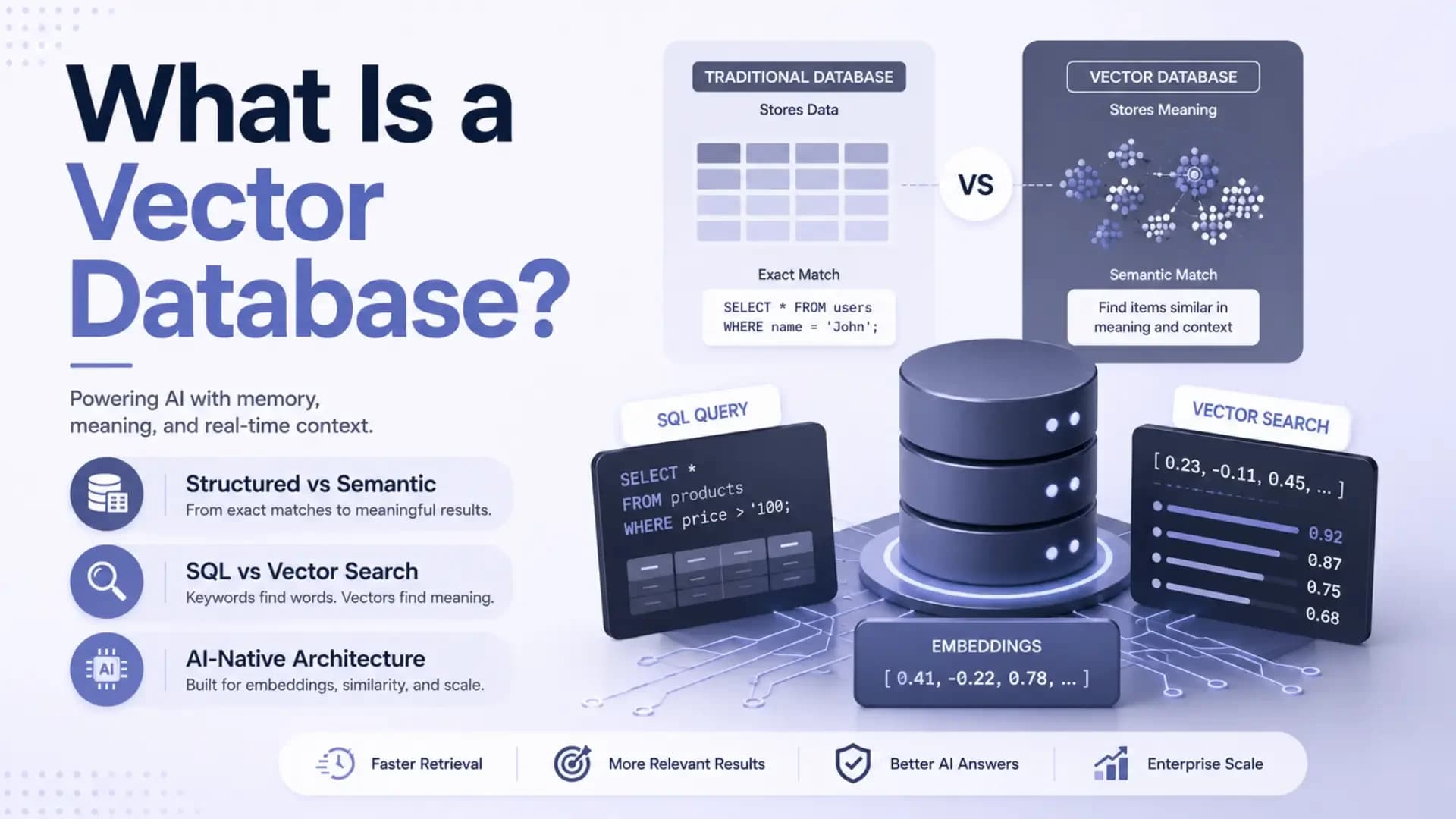
A traditional database stores rows, columns, and exact values. It answers the question: does this record match exactly? A vector database stores meaning. It answers a different question: which records are most similar to this query?
Here is how that works in practice. When an AI model processes a piece of text, an image, or an audio clip, it converts that content into an array of numbers. These numbers capture the semantic meaning of the content in mathematical space. Text about cats and text about kittens will produce vectors that sit close together in that space, even if they share no exact keywords.
A vector database stores these numerical representations. When a user sends a query, the database converts that query into a vector using the same model. It then searches for the stored vectors that are mathematically closest to the query vector. The results are semantically relevant, not just keyword-matched.
This capability is the foundation of modern AI retrieval. Without it, AI applications cannot access your data, your documents, or your users' history in any meaningful way.
How Does a Vector Database Work?
The process runs through four steps. Each step is straightforward. Together they enable AI applications to retrieve relevant context at speed.
Step 1: Embedding generation
Raw content, text, images, audio, or documents, passes through an embedding model. The model converts it into a vector. Modern embedding models produce vectors with 384 to 1,536 dimensions. Each dimension captures a different aspect of meaning.
Step 2: Storage
The vector, along with its original content and any associated metadata, is stored in the vector database. The database builds a specialised index that allows fast similarity search across millions or billions of stored vectors.
Step 3: Query processing
When a user sends a query, it passes through the same embedding model. The result is a query vector in the same dimensional space as the stored vectors.
Step 4: Similarity search
The database compares the query vector against stored vectors using a distance measure. Cosine similarity and Euclidean distance are the most common. The lower the distance between two vectors, the more semantically related they are. The database returns the top matching results in milliseconds.
Vector databases achieve this speed through Approximate Nearest Neighbor search algorithms. These algorithms trade a small amount of accuracy for massive gains in search speed, making real-time retrieval across millions of vectors practical.
Check our case study: Real-Time Exercise Form Analysis System
Why Do AI Applications Need a Vector Database?
Without a vector database, an AI application has no persistent memory of anything outside its training data.
Ask it a question about your internal documentation. It cannot access it. Ask it to remember what a user said three sessions ago. It cannot. Ask it to find products similar to one a customer viewed. It has no mechanism to do so.
Vector databases give AI applications three capabilities that training data alone cannot provide.
Contextual retrieval. The AI can pull relevant information from your own data sources at inference time. Your product catalogue, your documentation, your customer records. All of this becomes accessible.
Semantic memory. Previous conversations, user preferences, and interaction history can be stored as vectors and retrieved by meaning rather than exact session ID. The AI builds a coherent understanding of the user over time.
Accurate grounding. This is where Retrieval-Augmented Generation enters. RAG is one of the most important AI architectures in 2026. It combines a large language model with real-time retrieval from a vector database. The result is an AI that generates answers grounded in your specific data rather than hallucinated from training patterns.
What Is a Vector Database for RAG and Why Does It Matter?
RAG stands for Retrieval-Augmented Generation. It is the architecture that powers most serious enterprise AI applications today.
The workflow is as follows. A user asks a question. The question is converted into a vector. The vector database searches your knowledge base and returns the most semantically relevant documents or chunks. Those documents are passed to the language model as context. The model generates an answer grounded in that retrieved evidence.
This architecture directly addresses the hallucination problem. Language models produce incorrect answers when they lack relevant context. RAG solves this by supplying that context from a trusted source before generation happens.
The vector database is the retrieval engine that makes RAG work. Without it, the language model has no mechanism to access your data in real time. With it, the AI can answer questions about your product documentation, your legal contracts, your customer support history, or any other data you store.
For enterprise AI applications, RAG with vector search is no longer experimental. It is production infrastructure deployed by companies across healthcare, finance, legal, and customer operations.
Also Check: AI Use Cases in Healthcare: Top Applications in 2026
What Are the Best Vector Databases for RAG in 2026?
The tool landscape has matured significantly. Here is a clear comparison of the leading vector databases, including their best fit and key tradeoffs.
Database | Type | Best For | Key Strength | Pricing Model |
|---|---|---|---|---|
Pinecone | Managed cloud | Enterprise teams wanting fast setup | Operational simplicity at scale | Usage-based, paid plans from $70/month |
Weaviate | Open source / cloud | Knowledge graphs, hybrid search | Schema-aware, AI-native | Open source free, cloud pricing available |
pgvector | PostgreSQL extension | Teams already on PostgreSQL | No new infrastructure needed | Free, pay only for Postgres hosting |
Chroma | Open source | Local development, prototyping | Lightweight, fast setup | Free and open source |
Qdrant | Open source / cloud | High-performance filtering | Speed and filtering accuracy | Open source free, cloud from $25/month |
Milvus | Open source / cloud | Massive-scale workloads | Billions of vectors, distributed | Open source free, cloud pricing available |
Azure AI Search | Managed cloud | Microsoft and Azure ecosystem teams | Native Azure integration | Pay-per-use, part of Azure pricing |
What Are the Vector Database Options on AWS?
AWS offers several options for teams building vector search into their infrastructure.
Amazon OpenSearch Service supports vector search as a native capability. It suits teams already using OpenSearch for logging or search who want to add semantic retrieval without a separate database.
Amazon RDS with pgvector brings vector search directly into PostgreSQL running on AWS managed infrastructure. For teams already on RDS, this is the lowest-friction path to vector capability.
Amazon Aurora also supports pgvector, making it available for teams on Aurora PostgreSQL with no architectural change.
Amazon Bedrock Knowledge Bases handles the entire RAG pipeline as a managed service. It embeds your documents, stores the vectors in a connected vector database, and retrieves context when your application queries it. This option requires the least engineering setup for teams building RAG on AWS.
The right AWS vector database choice depends on your existing infrastructure. Teams on PostgreSQL should start with pgvector. Teams building a new AI application with no prior data infrastructure should evaluate Bedrock Knowledge Bases or a standalone managed service like Pinecone running alongside AWS.
How Does a Vector Database Differ from a Traditional Database?
The distinction is worth making precise because teams evaluating architecture sometimes ask whether they can simply use their existing database.
Traditional relational databases store structured data in tables. They retrieve it by matching exact values. A query for user ID 12345 returns exactly that record. Fast, precise, and built for transactional workloads.
Vector databases store high-dimensional numerical representations. They retrieve data by similarity. A query for content similar to a given input returns the closest matches by semantic distance. Built for unstructured data and meaning-based retrieval.
A traditional database can store a vector as a column of numbers. But it cannot search across those vectors efficiently. Running a similarity search across millions of vectors in a SQL table would be unusably slow. Vector databases use specialised indexing algorithms, primarily HNSW and IVF approaches, to make that search fast at scale. Milliseconds per query rather than minutes.
The practical rule: use a traditional database for structured, transactional data. Use a vector database for unstructured content that needs to be retrieved by meaning. Most AI applications in production use both.
What Vector Database Trends Are Shaping 2026?
The market has moved from hype to infrastructure. Four shifts define the current landscape.
Hybrid search is the new standard. Pure vector search is giving way to hybrid approaches that combine semantic vector search with keyword matching and metadata filtering. Most production RAG systems need all three. A query might need semantic relevance, a date range filter, and a department tag to return the right result.
pgvector adoption keeps rising. Teams that already run PostgreSQL are adopting pgvector rather than introducing a separate database. The familiarity, the existing operational tooling, and the zero additional infrastructure cost make it the pragmatic choice for a large segment of the market.
Managed serverless platforms are maturing. Self-hosting a vector database used to require significant DevOps investment. Managed and serverless options have improved substantially. Lower cost, faster scaling, and better latency have made them viable for production workloads that would previously have required dedicated infrastructure.
Specialised databases are emerging. LanceDB is gaining traction for embedded AI applications where the vector store lives inside the application rather than as a separate service. TiDB is bridging SQL and RAG systems for teams that need both transactional and vector capabilities in one system.
Conclusion
A vector database is not a niche tool for advanced research teams. It is the retrieval layer that makes AI applications accurate, context-aware, and genuinely useful with real data.
LLMs generate answers. Vector databases provide the memory and retrieval that make those answers relevant to your specific users, your specific data, and your specific business context.
The architecture decision you make here matters. Choosing the right vector database for your use case, whether that is Pinecone for managed simplicity, pgvector for PostgreSQL teams, Qdrant for filtering-heavy RAG, or Weaviate for knowledge graph applications, shapes how your AI product performs at scale.
Akoode Technologies is a leading AI and software development company headquartered in Gurugram, India, with a US office in Oklahoma. From AI-powered web applications and RAG system development to full stack development and custom enterprise platforms, Akoode builds AI products with the right retrieval and memory architecture from the start. They serve startups, SMEs, and enterprises across 15+ industries globally. If you are building an AI product and want the infrastructure designed correctly before it scales, that conversation starts here.
Frequently Asked Questions
1. What is a vector database in simple terms?
A vector database stores numerical representations of content, called embeddings, and retrieves them by semantic similarity rather than exact keyword match. It lets AI applications search data by meaning, enabling smarter retrieval for chatbots, recommendation engines, and RAG systems.
2. What is a vector database used for?
The main use cases are RAG chatbots that retrieve context from your documents before generating answers, semantic search that finds content by meaning rather than keywords, recommendation engines that match by intent, image similarity search, fraud detection, and enterprise knowledge assistants.
3. What is the best vector database for RAG in 2026?
For managed simplicity at scale, Pinecone is the most widely used choice. For teams on PostgreSQL, pgvector adds vector capability with no new infrastructure. For high-performance filtering, Qdrant is a strong open-source option. For teams in the Azure ecosystem, Azure AI Search integrates natively.
4. What vector database options are available on AWS?
AWS supports vector search through Amazon OpenSearch Service, RDS with pgvector, Aurora with pgvector, and Amazon Bedrock Knowledge Bases for fully managed RAG pipelines. The right choice depends on your existing AWS infrastructure and how much engineering effort you want to invest in setup and maintenance.
5. How does a vector database differ from a traditional database?
Traditional databases store structured data and retrieve it by exact match. Vector databases store high-dimensional numerical representations and retrieve data by semantic similarity. Traditional databases cannot efficiently search across millions of vectors. Vector databases are built specifically for that workload using specialised indexing algorithms.
6. Are vector databases open source?
Several leading vector databases are fully open source, including Chroma, Qdrant, Milvus, and Weaviate. pgvector is a free open-source extension for PostgreSQL. Pinecone and Azure AI Search are proprietary managed services. Most open-source options also offer managed cloud versions for teams that want the capabilities without the operational overhead of self-hosting.
Get In Touch Now
View More Our Blog