


 May 9, 2026
There is no shortage of advice on how to choose a software development company in India. Most of it reads like a brochure. This guide does not.
What follows is a honest look at how the Indian software industry actually works in 2026, what makes certain firms consistently deliver and others consistently disappoint, what custom and bespoke software development genuinely involve, and how to evaluate a partner before you commit. Along the way, we will look at real projects — the kind with specific problems, specific engineering decisions, and specific outcomes — not vague client success stories.
Why global businesses keep choosing India for software development
India crossed $250 billion in annual technology exports in 2024. That number gets cited a lot. What it obscures is the more interesting story: the country's best software firms have quietly moved from being execution vendors to being genuine engineering partners.
The cost advantage is still real — senior engineers in India typically cost 40 to 70 percent less than equivalent talent in the US or UK, and that gap is structural, not a cycle. But buyers who choose India only for cost tend to get cost-grade outcomes. The ones who choose India for talent, at cost-effective rates, get something categorically different.
The practical advantages for international clients come down to four things. The talent pipeline is enormous — India produces over 1.5 million engineering graduates annually, and the top cohort is internationally competitive. English is the professional working language, so communication friction is lower than with many other offshore destinations. Time zones work in your favour — Indian teams overlap with European mornings and US afternoons, enabling daily collaboration rather than asynchronous email chains. And the process maturity at established firms — agile delivery, DevOps practices, structured project management — is now comparable to Western counterparts.
What none of this tells you is whether a specific firm will do good work for your specific project. That requires a different lens.
What actually separates good software companies from bad ones
The hardest part of evaluating a software development company is that almost everything looks the same from the outside. Every firm has a technology list, a client logo grid, and a testimonials section. The real differences only become visible through the right questions.
How do they handle the discovery phase? A firm that jumps straight to estimates without deeply understanding your problem is building what they imagine you need, not what you actually need. The discovery phase — where requirements get unpacked, edge cases get surfaced, and architecture decisions get made deliberately — is where projects succeed or fail. Ask any firm you evaluate to walk you through this in detail.
Do they have domain knowledge or just technical skills? A team that has shipped healthcare software before understands HIPAA requirements, clinical workflow constraints, and the trust dynamics between a system and its users. A team that built a generic CRUD application and calls it healthcare experience is a different thing entirely. Domain knowledge shortens projects, reduces rework, and produces software that fits the industry context.
Can they point to verifiable outcomes? Not just client names — actual project outcomes. What was the problem? What was built? What happened after launch? Firms that have nothing specific to say here should be treated with caution.
What do third-party reviewers say? Platforms like Clutch, GoodFirms, and Google Reviews aggregate client feedback that the firm itself cannot control. These ratings matter — not as marketing, but as the closest thing to ground truth available before you sign a contract.
Custom software development: what it is and when it makes sense
Custom software development means building software designed specifically for your requirements, rather than configuring an existing product. It is not inherently better than off-the-shelf — it is the right choice in specific circumstances.
Those circumstances are: when your workflows are non-standard enough that generic tools create friction rather than reducing it; when you need integrations that packaged software cannot support; when you are building a product that needs to serve your users in a way that no existing tool does; or when software is central to your competitive position and you cannot afford for a vendor's architecture decisions to constrain yours.
The ROI case for custom software typically plays out over three to five years. The upfront investment is higher. The ongoing cost — no licensing fees, no seat-based pricing, no being held hostage to a vendor's roadmap — is lower. And the compounding benefit of software that fits your processes precisely, rather than software your processes have to work around, grows over time.
The risk with custom software is the execution. A poorly scoped project, a team that cannot handle complexity, or a discovery phase that produces the wrong requirements will cost more than the off-the-shelf alternative ever would have. This is why the quality of the partner matters so much.
Bespoke software development: when custom is not enough
Bespoke software development is a term that gets used loosely. It means something specific.
Where custom software addresses your functional requirements — it does what you need it to do — bespoke software is designed from first principles around your organisation specifically. The architecture reflects your infrastructure, your compliance requirements, your data volumes, your security posture. The user experience is designed around your users' mental models, not adapted from a template. The feature set contains exactly what your use case demands, nothing more.
This matters most for companies building products that sit at the centre of their business model — a SaaS platform, a proprietary operations tool, a client-facing application that represents your brand. When the software is the product, or when it is load-bearing for how your organisation functions, the difference between software built to a spec and software built around your organisation becomes commercially significant.
Akoode's software development practice handles both. The right approach depends on the project — and that question gets answered properly in a structured discovery phase, not in a sales call.
What software services India's best firms actually deliver
India's technology ecosystem covers the full stack of modern software services. What is worth knowing is what these services look like in practice, as opposed to what they look like in a capabilities brochure.
Artificial intelligence and machine learning is the service category most prone to overpromising. The honest version: AI delivers real value when it is applied to a specific problem with appropriate data, the right model architecture, and rigorous validation. It does not deliver value when it is added to a project because the brief asked for it.
Web development covers an enormous range — from a marketing site to a distributed enterprise platform processing millions of transactions. The difference between firms becomes visible in how they approach security, performance under load, and the architecture decisions that determine whether a system can scale.
Cloud and DevOps services have become table stakes for serious software organisations. Continuous deployment, infrastructure as code, automated testing pipelines — these are not differentiators anymore. What differs is how well they are implemented and how much they contribute to actual delivery speed rather than existing as checkbox items.
Big data and analytics is where a lot of organisations discover they have a data strategy problem, not a data technology problem. The value is not in the pipeline — it is in the insight. Firms that understand this build analytics systems that produce decisions, not dashboards.
Staff augmentation is useful when you need specific engineering capabilities that are hard to hire for, or when a project has a defined scope that does not justify a permanent hire. It works well when the augmented engineers are high-quality and integrate into your processes; it creates friction when they are not.
Digital transformation is a phrase that means everything and nothing. In practice, it means replacing legacy systems and manual processes with software that works — without destroying the organisation in the process. The firms that do this well are the ones that understand the human side of the change, not just the technical side.
Three real projects, and what they tell you
The most useful thing a software firm can show you is not its technology list. It is what happened when engineering met a real-world problem with real constraints.
Healthcare: AI diagnostic system with 99% accuracy and 41ms inference
A healthcare client needed to address something specific: radiologists were overwhelmed by imaging volume, and the window for detecting critical conditions — spinal fractures, early-stage pneumonia — was narrowing as workloads grew.
The system Akoode built analysed spine and chest radiographs in real time, with inference taking approximately 41 milliseconds per image. Accuracy landed at 99%, with explainability built in through visual heatmaps that show clinicians exactly where and why the model flagged an abnormality. The explainability component was not cosmetic — clinicians will not trust a system that produces outputs they cannot interrogate. Without it, adoption fails regardless of accuracy.
The engineering challenge here was threefold: achieving near-perfect detection rates on conditions where misses have severe consequences, delivering inference fast enough for real clinical workflows, and building transparency into a deep learning model architecture that naturally resists it. The project required custom model architecture combining spatial and temporal imaging data, trained on large-scale medical datasets with specific fine-tuning strategies.
Full case study: AI-Powered Medical Diagnostic System for Real-Time Clinical Decision Support
Retail: AI catalogue generation reducing creative production time by 10x
A retail and e-commerce client had a creative production problem. Marketing teams were spending significant time on manual ad design — creating variations for Instagram, banners, marketplace listings, and email campaigns. The process was slow, expensive, and produced inconsistent outputs.
The solution was a multi-modal AI platform that takes a product image as input and produces production-ready advertisement creatives as output — maintaining brand consistency, applying reusable design templates, and generating structured marketing copy. The rendering was deterministic: HTML and CSS templates rendered by Puppeteer, producing PNG and PDF outputs that are predictable and editable. This was a deliberate architectural choice. Fully generative image outputs would have been faster to build but would have produced inconsistent results unsuitable for production use.
The outcome: creative production speed improved by 10x, with 98% on-time delivery maintained throughout the project.
Full case study: AI-Powered Advertisement Catalogue Generator
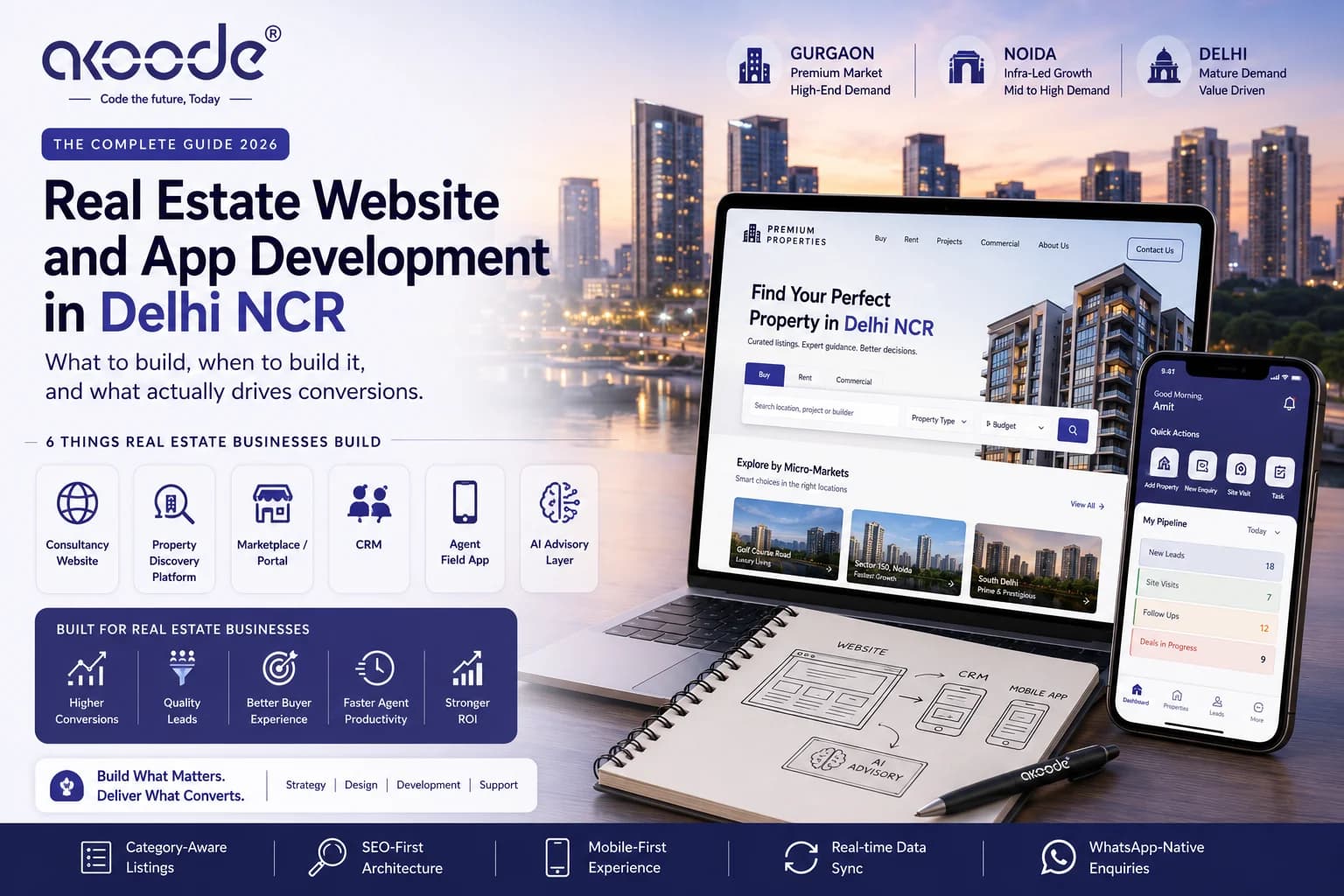
Real estate: data-driven property platform replacing broken search
Traditional property platforms were building their UX around listing volume. The problem was that users were not being served by volume — they were being overwhelmed by it. Unstructured listings, no access to meaningful contextual data, and search experiences that produced quantity rather than relevance.
The platform Akoode built restructured discovery around data — giving buyers structured property intelligence, neighbourhood context, and search results that matched intent rather than just keywords. The project required significant data architecture work alongside the application layer.
Full case study: Real Estate Platform Development for Data-Driven Property Discovery
These three projects span healthcare, retail, and real estate. They involve AI, data architecture, and platform development. What they have in common is that the engineering decisions were driven by the specific problem — not by a stack preference or a template that happened to be available.
On ratings and what they actually represent
Third-party ratings are worth taking seriously precisely because firms cannot control them.
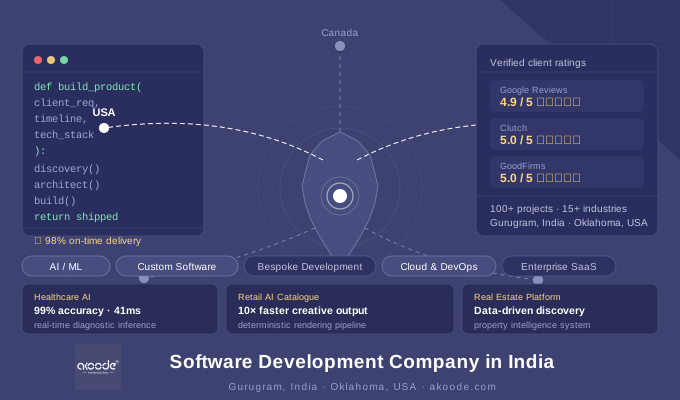
Akoode holds a 4.9/5 on Google, 5/5 on Clutch, and 5/5 on GoodFirms. These are not the same thing. Google reviews represent a general client population. Clutch and GoodFirms are B2B-specific platforms where clients submit structured reviews covering quality, scheduling, cost, and willingness to refer — and reviewers go through a verification process. A 5/5 on Clutch from verified enterprise clients is a different signal than a star rating on a general platform.
What the ratings reflect, across 100+ completed projects, is consistent delivery — not perfect projects, because no complex software project is without challenges, but consistent resolution of those challenges and consistent client outcomes. That pattern is hard to fake across verified reviews on multiple independent platforms.
How to evaluate any software development firm, including this one
If you are shortlisting firms, here is what actually moves the needle in evaluation:
Send them a real brief — not a vague inquiry, but a genuine description of the problem you are trying to solve. Watch how they respond. Do they ask questions that demonstrate they understood what you sent? Do they challenge assumptions? Do they propose alternatives you had not considered? Or do they send back a template proposal within 24 hours that does not reference anything specific in your brief?
Ask for references from projects that match your context. Not just any projects — projects in your industry, at your scale, with your type of complexity. Call those references. Ask specifically what went wrong on the project and how the firm handled it.
Test communication before you sign anything. Send an email at an unusual hour. See how long it takes to get a substantive response. Communication quality during the sales process is a leading indicator of communication quality during delivery.
Start with a discovery phase. A structured 2–4 week discovery engagement produces specific requirements, architecture recommendations, and a reliable estimate — and it validates whether the working relationship has the foundation for a longer project. Any firm worth working with will support this. Any firm that resists it is telling you something.
Industries where this work gets done
The industries that benefit most from custom software development are the ones where generic tools consistently fail to meet specific operational requirements.
Healthcare needs software that handles clinical workflows, integrates with existing diagnostic infrastructure, and meets compliance requirements that standard enterprise software was never designed for. Finance needs security and auditability built into architecture, not bolted on. Logistics needs real-time data and integration with physical operations at a granularity that off-the-shelf tools do not provide. Manufacturing needs IoT-connected systems that bridge the gap between physical production and digital oversight.
Akoode has delivered production systems across healthcare, finance and banking, retail and e-commerce, logistics and supply chain, manufacturing, education, real estate, energy and utilities, travel and hospitality, media, and the public sector. That breadth matters because domain knowledge shortens projects — a team that has already solved regulatory data handling in healthcare does not need to discover the constraints on your project.
What the process looks like, from first conversation to launch
The projects that go well share a common structure, regardless of the industry or technology involved.
The first conversation is about the business problem, not the technology solution. What are you trying to achieve? Who are the users? What does the current situation look like? What does success mean? The answers to these questions shape everything that follows.
Discovery produces requirements that are specific, testable, and owned by both sides. Not a document that gets filed after sign-off, but a living reference that the engineering team works from and updates when reality diverges from the plan.
Development happens iteratively, with regular sprint reviews that give stakeholders visibility into actual progress rather than status update documents. Issues surface early, when they are cheap to address. Scope changes get evaluated against the original problem statement, not against the original estimate.
Deployment uses the same infrastructure and process discipline that made development reliable. Post-launch is not the end of the engagement — it is the beginning of the maintenance and evolution phase.
If any of this sounds like it should be obvious — it should. The firms that do not operate this way account for a significant portion of the industry's project failures.
Frequently asked questions
What is a software development company in India?
A software development company in India designs, builds, and maintains software products for clients in India and internationally. The industry ranges from individual freelancers to large enterprises with thousands of engineers. Quality varies enormously. The firms at the top of the market deliver engineering work that competes with anything produced in the US, UK, or Europe — at structurally lower cost.
How much does custom software development cost in India?
Rates for experienced engineers typically range from $25–75 per hour depending on seniority and specialisation. A focused web application might cost $15,000–50,000. An enterprise platform or AI system can run $100,000–500,000 or more. The most reliable path to an accurate estimate is a structured discovery phase — ballpark figures given before requirements are understood are almost always wrong in both directions.
What is the difference between custom and bespoke software?
Custom software is built to your functional requirements rather than using an off-the-shelf product. Bespoke software goes further — architecture, UX, integrations, and roadmap are all designed specifically around your organisation, from first principles. Most projects fall into the custom category; bespoke is appropriate when the software is central to your competitive position and generic approaches would introduce structural constraints.
How does working across time zones actually function in practice?
Indian development teams overlap with US East Coast mornings (approximately 9am–1pm EST) and European afternoons (approximately 2pm–6pm CET). This enables daily sprint reviews, real-time Slack communication during shared hours, and async progress during the remaining hours. Dedicated project managers handle the coordination layer — translating between business requirements and engineering decisions, and escalating issues before they become problems.
Is Akoode right for startups, or only enterprises?
Both. The approach differs — a startup building its first product needs lean, iterative development optimised for speed and learning; an enterprise modernising a legacy system needs governance, compliance, and integration with complex existing infrastructure. Akoode has delivered both. The right fit depends on the project, not the company size.
How do I get started?
The most useful first step is a direct conversation about your specific situation. Reach the team at akoode.com/contact-us, at info@akoode.com, or by phone at +91-9899300017 (India) or +1-712-214-1784 (USA). A first call typically takes 30–45 minutes and focuses on understanding the problem before discussing any solution.
Related reading:
Get In Touch Now
View More Our Blog