


 April 8, 2026
Online selling has changed. Customers today do not just want a product page and a checkout button. They expect speed. They expect relevance. They expect the same smooth experience on their phone as on their laptop.
That is a tall order — and meeting it requires serious e-commerce software development.
It does not matter if you are launching a first store or rebuilding a legacy platform. The way you build your ecommerce software will shape your conversions, your operations, and your ability to grow.
This guide walks you through everything. Types of ecommerce platforms, key features, the development process step by step, the right tech stack, and what is actually changing.
What Is E-commerce Software Development?
At its core, e-commerce software development is the process of building digital platforms where people buy and sell things online.
But it is more than a storefront. A properly built ecommerce platform connects product management, payments, order processing, inventory, logistics, and customer data — all in one place, working without friction.
Every platform has two sides:
Front-end is what the customer sees. Product pages, search, filters, cart, checkout. It needs to be fast, clear, and built to convert.
Back-end is what runs underneath. Orders, payments, inventory, user data, and integrations with third-party tools. This is the engine.
Custom ecommerce software development gives businesses control over both sides. You are not locked into someone else's template or feature limits.
Types of E-commerce Platforms
Picking the right platform model early saves a lot of pain later. Each type has different technical requirements and a different user experience to design for.
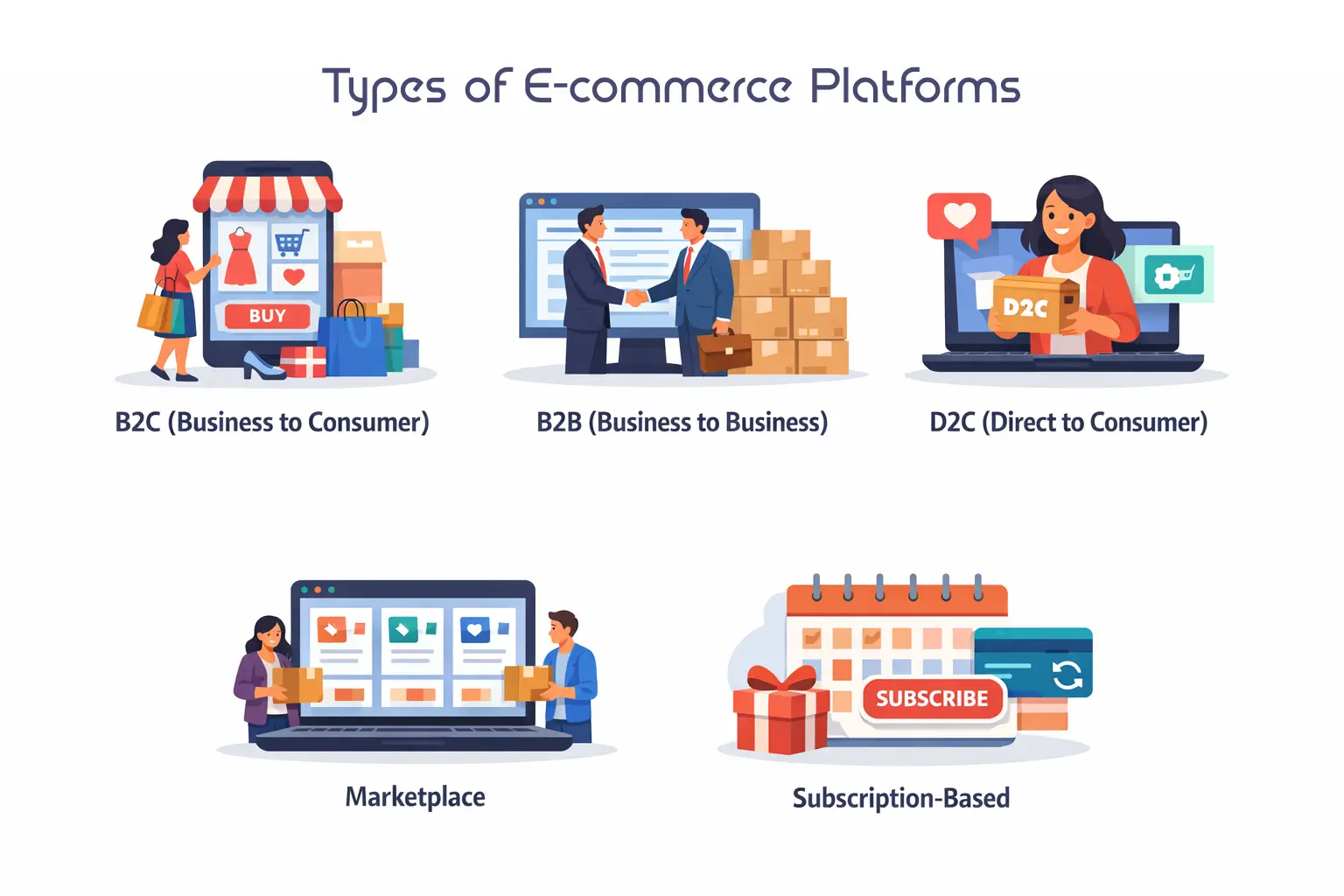
1. B2C (Business to Consumer)
A brand sells directly to individual shoppers. This is the most common model — retail, fashion, electronics, food. The priority is product discovery, mobile experience, and fast checkout.
2. B2B (Business to Business)
One business sells to another. These platforms need bulk ordering, account-based pricing, and approval workflows. The interface is built for efficiency over impulse.
3. D2C (Direct to Consumer)
Brands skip the middleman and sell straight to their customers. D2C ecommerce application development usually includes subscription options, loyalty programs, and strong brand storytelling built into the platform.
4. Marketplace
Multiple sellers, one platform. Think of the complexity behind an Amazon or a Meesho at a smaller scale. Vendor onboarding, commission logic, payout flows, and dispute management all have to work on top of the standard shopping experience.
5. Subscription-Based
Products or services billed on a recurring cycle. These platforms need automated billing, plan management, and tools to reduce churn built directly into the ecommerce software solutions development.
Must-Have Features in E-commerce Software
Features make or break the experience. The right ones increase conversions. The wrong ones or missing ones push customers away.
What Customers Need
Fast, Filterable Product Search: Shoppers who cannot find what they want leave immediately. Product search needs to be fast, accurate, and smart enough to handle typos and synonyms.
AI-Driven Recommendations: Showing the right product at the right time is one of the highest-ROI moves in ecommerce app development. It increases average order value without adding a single extra step to the journey.
Simple Checkout: Every extra step in checkout costs conversions. Guest checkout, saved addresses, and multiple payment options are not nice-to-haves. They are essentials.
Secure Payments: Cards, UPI, wallets, BNPL — customers expect options. PCI-DSS compliance is non-negotiable. For ecommerce mobile app development, one-tap payment methods matter even more.
Order Tracking: Customers who can track their orders place fewer support tickets and trust the brand more. Real-time tracking reduces anxiety after purchase.
Mobile-First Experience: More than 70 percent of purchases happen on mobile. A responsive website is a minimum. A dedicated ecommerce mobile app is the stronger play for serious volume.
What the Business Needs
Inventory Management: Real-time stock levels, low-stock alerts, and multi-location tracking. Getting this wrong means overselling and losing customer trust fast.
Admin Dashboard: One place to manage products, pricing, orders, returns, and promotions. A cluttered or slow admin panel makes daily operations painful.
Analytics and Reporting: Sales data, funnel drop-off, customer behavior. Good reporting helps you make decisions based on facts, not guesses.
CRM and Marketing Integrations: Email tools, loyalty programs, push notifications, retargeting. These integrations turn a store into an actual growth engine rather than just a catalog.
How to Create an E-commerce App: Step by Step
This is where most projects go wrong. Each phase builds on the previous one. Rushing early stages creates expensive problems later.
Step 1 — Discovery and Strategy
Define what you are building before a single line of code is written. Who is the customer? What problem does the platform solve? What does success look like in six months?
This phase shapes every decision that follows. Skipping it is the single biggest reason ecommerce projects run over budget or launch the wrong product.
Step 2 — Choose Your Development Approach
There are three real options for ecommerce platform development:
SaaS Platforms like Shopify or BigCommerce are fast to launch and have low upfront cost. The trade-off is limited flexibility and platform lock-in.
Open Source like WooCommerce or Magento gives more control. It needs more technical management to run well.
Custom Ecommerce Software Development is built from scratch for your exact needs. Higher initial investment, but you own everything — the UX, the logic, the data, and the roadmap.
For businesses with standard needs and a tight timeline, SaaS works early on. For businesses with a unique model or real scaling ambitions, custom is the stronger long-term bet.
Also check: eCcommerce Website Development Cost in India: Full Pricing Guide
Step 3 — UX and Design
Map the key user flows before designing anything. How does a user find a product? What happens after they add it to cart? Where do people drop off?
Good UX design is not about aesthetics. It is about removing friction between the customer and a completed purchase.
Step 4 — Front-End and Back-End Development
This is where the platform gets built.
Front-end focuses on speed, responsiveness, and conversion. Back-end handles orders, inventory, payments, and integrations.
In most custom ecommerce software development projects, front-end is built with React, Vue, or Next.js. Back-end uses Node.js, Python, or Java. APIs connect the two halves — and connect the platform to payment gateways, logistics tools, and analytics.
Step 5 — Integrations
Payment gateways. Shipping providers. CRMs. ERPs. Marketing platforms. Each integration takes scoping, building, and testing time on top of the core build. This is where timelines get underestimated most often.
Step 6 — Testing
Test before launch, not after.
Performance testing to handle traffic spikes. Security testing to protect payment and user data. Usability testing to make sure the checkout flow actually makes sense to a real person. Cross-device testing for consistency.
Step 7 — Launch and Iteration
Going live is not the end. The ecommerce platforms that grow are the ones that improve after launch. Monitor behavior, collect feedback, and ship updates regularly.
Also Read: Shopify vs WooCommerce vs Magento: Which Platform Is Right for You?
Technology Stack for E-commerce Software Development
The tech stack is a long-term decision. The wrong choice creates debt that slows everything down as you scale.
Front-End: React.js, Next.js, Vue.js — fast, component-based, SEO-friendly.
Back-End: Node.js, Python, Java — scalable, secure, and integration-ready.
Database: PostgreSQL or MySQL for structured data. MongoDB for flexible product catalogs.
Cloud: AWS, Google Cloud, or Azure for hosting, CDN, and auto-scaling.
Payments: Stripe, Razorpay, PayPal — with PCI-DSS compliance included.
Search: Algolia or Elasticsearch for fast, intelligent product search.
Mobile: React Native or Flutter for cross-platform ecommerce mobile app development.
The most competitive platforms in 2026 run on headless architecture. Front-end and back-end are decoupled. This lets teams update the storefront independently, serve multiple channels — web, app, voice, social — and swap tools without rebuilding from zero.
E-commerce Application Development Trends in 2026
The platforms winning today are built for where customer expectations are heading — not just where they are right now.
AI Personalization: Product recommendations, dynamic pricing, personalized homepages, and smart search are now AI-driven in every competitive platform. Businesses that personalize well convert more and retain longer.
Headless Commerce: Decoupling front-end from back-end lets brands serve customers across web, mobile, voice, and social from a single system. It is becoming the default architecture for ecommerce application development at scale.
Ecommerce Mobile App Development: Mobile is the dominant shopping channel. A dedicated app delivers faster load times, push notifications, biometric login, and one-tap checkout. For any business serious about mobile revenue, a native or cross-platform app is no longer optional.
Progressive Web Apps: PWAs offer app-like speed and behavior directly through the browser. No app store needed. A solid middle-ground option for businesses not ready to invest in full ecommerce mobile app development yet.
Conversational Commerce: Customers are buying through AI chat and voice interfaces. Platforms that support this — through smart chatbots or voice search — are seeing stronger engagement from mobile-first users.
Custom vs Off-the-Shelf: Which Should You Choose?
Factor | Custom Development | SaaS Platform |
|---|---|---|
Flexibility | Full control | Limited by platform |
Launch Speed | Slower | Faster |
Scalability | Built to your needs | Platform-dependent |
Data Ownership | Complete | Shared |
Long-Term Cost | Lower at scale | Fees grow with revenue |
Unique Features | Fully possible | Often unavailable |
No single answer fits every business. If your requirements are standard and speed matters, start with SaaS. If your business model is unique, your growth plans are serious, or you need complete data ownership — custom ecommerce software development is the right call.
Also Read: Custom Software vs. Off-the-Shelf Software
Conclusion
E-commerce software development is not a one-time build. It is an ongoing investment in how your business sells, operates, and grows online.
The platforms that win are not always the ones with the most products. They are the ones with the fastest checkout, the smartest recommendations, and the most reliable experience across every device.
Whether you are figuring out how to make an ecommerce app from scratch or rebuilding an existing platform for scale — the partner you build with matters as much as the platform itself.
Akoode Technologies - an AI powered corporation and IT company delivering advanced software solutions headquartered in Gurugram – delivers end-to-end custom ecommerce software development for businesses in India and globally. From AI-powered personalization and ecommerce mobile app development to headless commerce architecture and full ecommerce platform development — Akoode builds platforms that are designed to perform from day one and scale without limits.
Frequently Asked Questions
1. What is e-commerce software development?
It is the process of building digital platforms that enable online selling — including the storefront, payments, inventory, order management, and all the systems that keep it running.
2. What is the difference between custom and SaaS ecommerce development?
Custom gives you full control over features, design, and data. SaaS is faster to launch but limits customization and charges recurring fees that grow as your revenue grows.
3. How do you create an ecommerce app?
Start with strategy and user research. Then design flows, build front-end and back-end, integrate third-party tools, test across devices, and launch with a plan for ongoing improvement.
4. How long does ecommerce application development take?
A basic store can go live in 4 to 8 weeks. A custom ecommerce platform with full features typically takes 3 to 6 months depending on complexity and integrations.
5. Why does ecommerce mobile app development matter?
Over 70 percent of purchases happen on mobile. A dedicated app delivers faster performance, one-tap checkout, and push notifications — all of which directly lift conversion rates.
6. What tech stack works best for ecommerce software development?
React or Next.js for front-end, Node.js or Python for back-end, PostgreSQL for the database, AWS or Google Cloud for hosting, and React Native or Flutter for mobile. Headless architecture is the standard for 2026 builds.
Get In Touch Now
View More Our Blog