


 April 17, 2026
Every business shopping for an ecommerce platform hits the same wall.
Shopify looks easy. WooCommerce looks flexible. Magento looks powerful. BigCommerce looks like it sits somewhere in between. And everyone online has a strong opinion about which one is best.
Here is the honest truth — there is no single best platform. There is only the right one for your business.
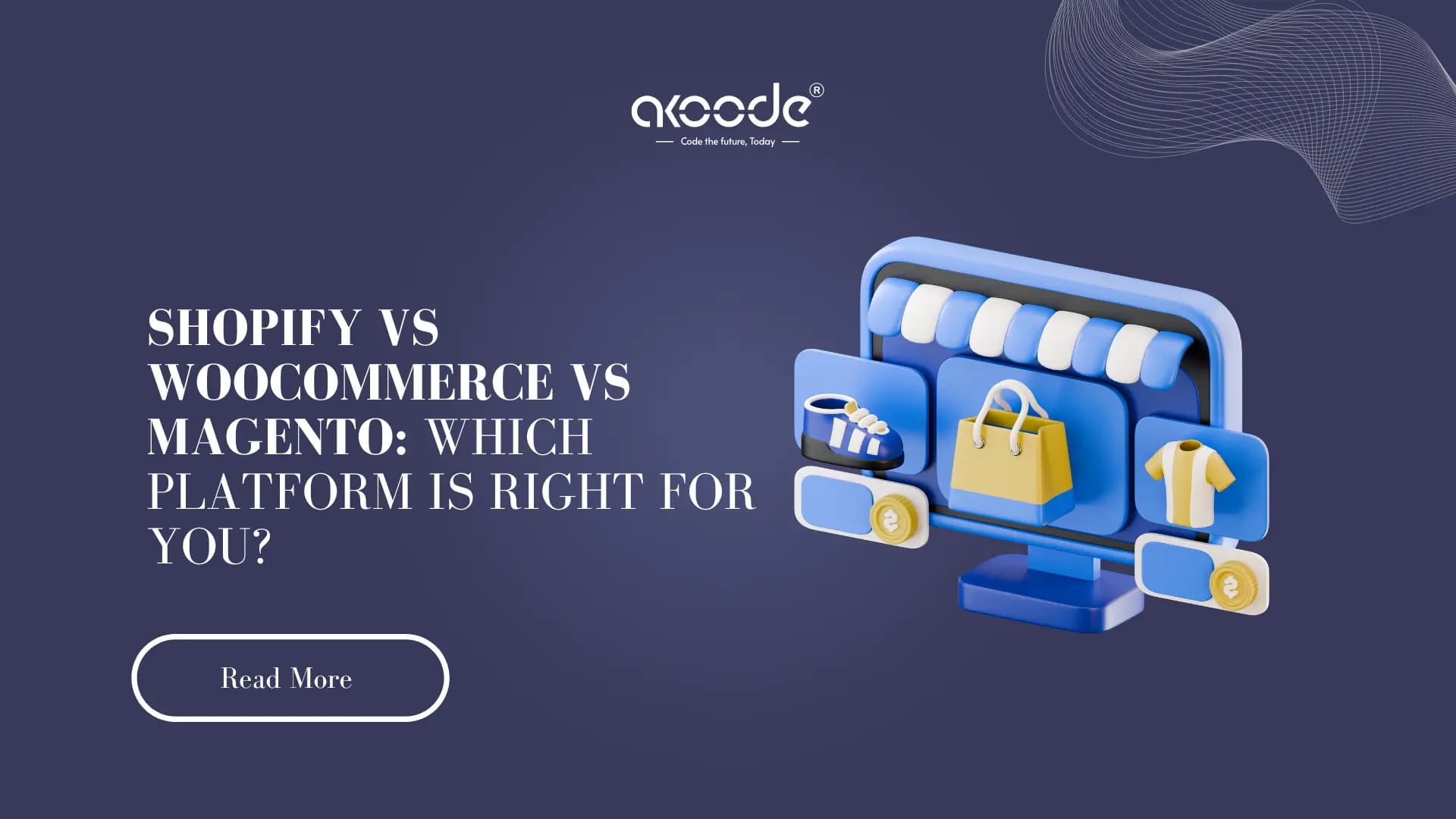
Shopify vs WooCommerce vs Magento is not a question with one answer. It depends on your team's technical ability, your budget, how complex your catalog is, and how fast you plan to grow.
This guide breaks each platform down clearly — what it does well, where it falls short, and what kind of business it actually suits. We also bring BigCommerce into the comparison because it comes up often and deserves a straight assessment.
Quick Comparison: Shopify vs WooCommerce vs Magento vs BigCommerce
Factor | Shopify | WooCommerce | Magento | BigCommerce |
|---|---|---|---|---|
Type | Hosted SaaS | Self-hosted (WordPress) | Self-hosted / Cloud | Hosted SaaS |
Ease of Use | Very easy | Moderate | Hard | Moderate |
Monthly Cost | $39 – $2,300+ | Free (hosting extra) | Free / $22K+/yr | $39 – $299+ |
Customisation | Moderate | High | Maximum | High |
Technical Skill Needed | Low | Medium | High | Low–Medium |
Best For | SMBs, D2C | Content-led, WordPress users | Enterprise, complex builds | Mid-market, B2B |
Transaction Fees | Yes (unless Shopify Payments) | No | No | No |
Scalability | Strong | Good with right hosting | Enterprise-grade | Strong |
Shopify: Built for Speed and Simplicity
Shopify is the most popular ecommerce platform in the world for a reason. It takes the technical complexity out of running an online store. You do not need to worry about hosting, security, server updates, or payment compliance. Shopify handles all of it.
You can build a fully working store in a weekend. Seriously.
The app store has over 8,000 apps covering everything from abandoned cart recovery to loyalty programs to advanced analytics. For most small to mid-size businesses, there is an app for whatever you need — and you do not have to write a line of code.
Where Shopify wins: Speed to launch. Reliability. Ease of daily use. The checkout conversion rate on Shopify is among the highest in the industry.
Where it falls short: Customisation has a ceiling. If you need deep back-end logic, custom checkout flows, or features the app store does not cover — you hit walls. Every app adds a monthly fee. Those stack up fast.
On cost: Shopify starts at $39/month. Shopify Plus — the enterprise tier — starts at roughly $2,300/month. Add app costs, theme costs, and the transaction fee (if you are not using Shopify Payments), and the monthly total climbs.
Read full guide on shopify website development cost
Shopify is right for you if: You are a founder, small business, or growing D2C brand that wants to focus on selling — not managing infrastructure.
WooCommerce: Maximum Flexibility, With a Trade-Off
WooCommerce websites is not a standalone platform. It is a plugin that turns a WordPress website into an ecommerce store. That distinction matters.
Because it lives inside WordPress, WooCommerce inherits the world's largest CMS ecosystem. Thousands of plugins, themes, and developers. You can build almost anything with it.
The platform itself is free. That is attractive. But you pay for hosting, domain, SSL, premium plugins, and developer time when you need customisation. The total cost of ownership is often higher than it first appears.
WooCommerce also demands more from you operationally. Security updates, plugin conflicts, server performance, database optimisation — these are your responsibility. For a technical team, that is fine. For a non-technical business owner managing everything alone, it becomes a time drain.
Where WooCommerce wins: Full control over design and functionality. Outstanding for content-heavy stores where SEO and blogging matter. No transaction fees. The lowest entry cost if you manage it well.
Where it falls short: Performance under high traffic needs careful management. Plugin conflicts can break things unexpectedly. Scaling requires technical investment in hosting and architecture.
On cost: WooCommerce itself is free. Add hosting (₹5,000–₹60,000/year), premium plugins (varies), SSL, and developer time — and a well-running WooCommerce store realistically costs ₹30,000–₹1,50,000+ per year to run properly.
WooCommerce is right for you if: You already use WordPress, have a technical team or developer partner, and want full ownership of your store without recurring platform fees.
Shopify vs WooCommerce: Which Is Better?
This is one of the most searched comparisons, and the answer genuinely depends on your situation.
If you want to launch fast, manage simply, and have someone else handle the technical infrastructure choose Shopify
If you want full control, are building a content-first brand, and have technical support available choose WooCommerce.
Shopify costs more monthly but saves time. WooCommerce costs less monthly but demands more technical investment. Neither is objectively better. They serve different operators.
One clear advantage Shopify has: the checkout. Shopify's native checkout is optimised for conversion and handles edge cases — international currencies, address validation, one-tap payments — that WooCommerce requires plugins to replicate.
One clear advantage WooCommerce has: content. If SEO and blogging are central to your acquisition strategy, WooCommerce sitting inside WordPress gives you a structural advantage Shopify cannot fully match.
Magento (Adobe Commerce): For Businesses That Need Total Control
Magento is now Adobe Commerce, is in a different league from Shopify and WooCommerce. It is built for complexity.
Large product catalogs. Multi-store management. Multi-language, multi-currency. B2B pricing by customer segment. Deep ERP and CRM integrations. Custom checkout logic. These are things Magento handles natively that other platforms struggle with.
The open-source Community Edition is free to use. But do not let that fool you. Running Magento well requires dedicated hosting (₹15,000–₹60,000/month for enterprise-grade infrastructure), experienced Magento developers (rare and expensive), and a serious maintenance budget.
Adobe Commerce — the enterprise cloud version — carries licensing costs in the range of $22,000 to $125,000 per year. This is not a platform for small businesses.
Where Magento wins: Unmatched flexibility. Built for enterprise-scale operations. Best-in-class SEO control. Handles complex B2B workflows natively.
Where it falls short: Everything costs more and takes longer. Launch timelines stretch. Development is expensive. Non-technical teams struggle to manage it daily.
On cost: Open-source Magento — free to download, ₹2,00,000–₹12,00,000+ to build and launch properly. Adobe Commerce — add $22,000+ annually in licensing on top of build cost.
Magento is right for you if: You are a mid-to-large enterprise with a dedicated development team, a complex product catalog, or B2B operations that off-the-shelf platforms cannot handle.
Shopify vs. Magento: How They Really Differ
The core difference is control vs convenience.
Shopify manages everything for you. Magento gives you control over everything — but you have to manage it yourself.
Shopify launches in days. A properly built Magento store takes months.
Shopify's costs are predictable and recurring. Magento's costs are front-loaded and high but level off at scale.
For most businesses, Shopify is the pragmatic choice. For businesses with genuinely complex requirements — think multi-warehouse operations, custom B2B pricing, or a 50,000-SKU catalog with complex variant logic — Magento pays for itself over time.
BigCommerce: The Underrated Middle Ground
BigCommerce sits between Shopify's simplicity and Magento's power. It is a hosted SaaS platform — so no server management — but it ships with significantly more native features than Shopify.
Multi-currency, B2B quoting, advanced product variants, multi-storefront management — these come built-in on BigCommerce. On Shopify, most of these require paid apps.
BigCommerce also charges no transaction fees regardless of which payment gateway you use. That is a meaningful difference at volume.
The downside: the admin interface is more complex than Shopify's. Beginners find it less intuitive. The app marketplace is smaller. And pricing scales with your annual revenue — if your store has a strong year, you might find yourself pushed into a higher tier automatically.
Where BigCommerce wins: Native feature depth. No transaction fees. Strong B2B capabilities. Better SEO control than Shopify out of the box.
Where it falls short: Steeper learning curve. Smaller developer community. Revenue-based pricing can surprise fast-growing businesses.
On cost: Plans start at $39/month. Enterprise pricing varies. No transaction fees on any plan.
BigCommerce is right for you if: You are a growing mid-market brand, run B2B and B2C from the same store, and want Shopify-like hosting with more built-in functionality and no transaction fees.
Feature-by-Feature Breakdown
1. Ease of Use
Shopify is the easiest. You can set up a store without developer help. BigCommerce is next — manageable, but slightly more involved. WooCommerce requires some WordPress knowledge. Magento requires a developer — full stop.
2. Customisation
Magento gives you the most control. WooCommerce is close behind. BigCommerce offers solid flexibility within its SaaS boundaries. Shopify is the most restricted at standard tiers — Shopify Plus opens more doors but at a significant cost jump.
3. SEO
WooCommerce wins here, largely because it runs on WordPress. Full control over URLs, content structure, schema, and technical SEO. Magento is also strong. Shopify has good basic SEO but some structural limitations around URL patterns. BigCommerce has strong native SEO controls — better than most people realise.
4. Security
Shopify and BigCommerce handle PCI compliance, SSL, and security patches for you. WooCommerce and Magento are your responsibility — you manage updates, SSL, and server security. For businesses without a technical team, this is a real operational overhead.
5. Scalability
Magento is the most scalable for truly large operations. Shopify Plus scales well for high-volume D2C. BigCommerce scales without the infrastructure headaches. WooCommerce can scale — but it needs proper hosting and technical management to do so reliably.
Platform Pricing Summary (2026)
Platform | Starting Monthly Cost | Enterprise Cost | Transaction Fees |
|---|---|---|---|
Shopify | $39/month | $2,300+/month (Plus) | Yes (unless using Shopify Payments) |
WooCommerce | Free (hosting extra) | Scales with hosting/plugins | No |
Magento Open Source | Free (hosting/dev extra) | $22K–$125K+/year (Adobe) | No |
BigCommerce | $39/month | Custom pricing | No |
Also Read: eCcommerce Website Development Cost in India: Full Pricing Guide
Which Platform Should You Choose?
Choose Shopify if you want to launch fast, manage easily, and are building a D2C brand where reliability and conversion matter more than deep customisation.
Choose WooCommerce if you are content-driven, already on WordPress, have technical support available, and want full ownership of your store without monthly platform fees.
Choose Magento if you are a mid-to-large enterprise with complex catalog requirements, B2B workflows, or multi-store operations that need a developer-grade platform.
Choose BigCommerce if you want SaaS simplicity with more built-in power than Shopify offers — especially for B2B/B2C hybrid operations or when transaction fees are a real cost concern.
Conclusion
Shopify vs WooCommerce vs Magento is one of the most asked questions in ecommerce — and it does not have one answer. Each platform is built for a different kind of business.
The wrong choice costs more in the long run than picking the slightly more expensive right one from the start. Platform migrations are painful, time-consuming, and expensive. Getting this decision right now matters.
Not sure which platform fits your requirements? That is exactly the kind of decision where a technical partner adds real value.
Akoode Technologies – a software company in Gurugram, an AI powered corporation and IT company delivering advanced software solutions headquartered in Gurugram – works with businesses across India, the US, and the UK to build ecommerce platforms on Shopify, WooCommerce, Magento, and custom stacks. Whether you are starting from scratch or migrating from a platform that no longer fits your growth, Akoode brings the experience to make the right technical call — and then build it properly.
Also Check: A Complete Guide to E-commerce Software Development
Frequently Asked Questions
1. Which is better — Shopify vs WooCommerce vs Magento?
There is no single best platform. Shopify suits businesses that want ease and speed. WooCommerce suits those who want full control and own a WordPress site. Magento suits enterprises with complex, large-scale requirements.
2. Shopify vs WooCommerce — which is better for small businesses?
Shopify is easier to manage and better for non-technical founders. WooCommerce offers more flexibility and lower platform cost, but requires more technical input to run well.
3. Is Magento better than Shopify?
For enterprise businesses with complex requirements — yes. For most small to mid-size businesses, Shopify is more practical, faster to launch, and easier to manage.
4. What is BigCommerce good for?
BigCommerce is a strong choice for mid-market brands, B2B sellers, and businesses that want SaaS hosting with more built-in features than Shopify — without paying transaction fees.
5. Which ecommerce platform is best for SEO?
WooCommerce (on WordPress) gives the most SEO control. Magento is also strong. Shopify is adequate for most needs. BigCommerce has better native SEO settings than most people expect.
6. Can I switch from one platform to another later?
Yes, but platform migrations are complex and expensive. It is worth choosing the right platform from the start rather than planning to migrate once you outgrow your initial choice.