


 April 20, 2026
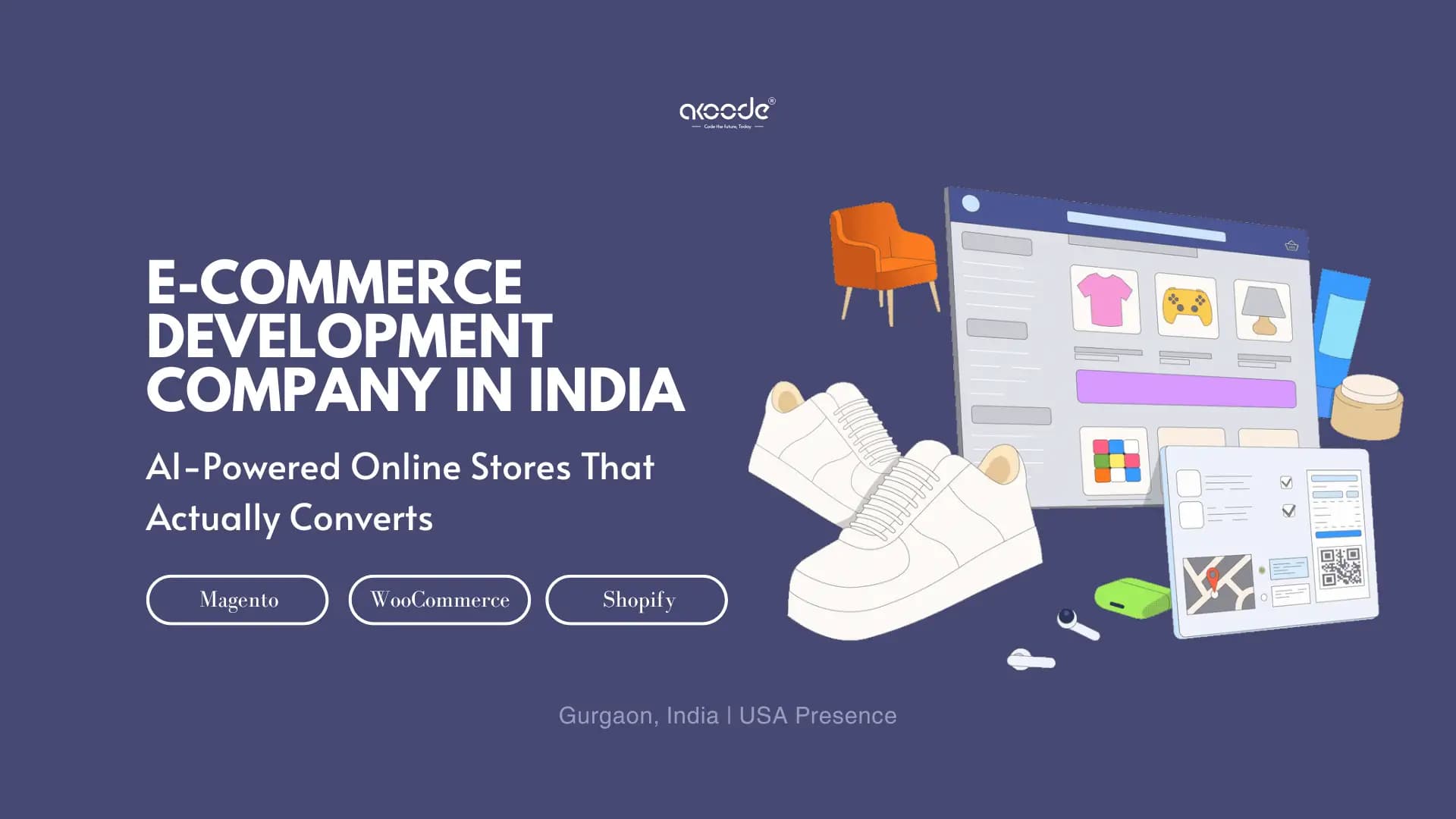
India's e-commerce boom is no longer a future bet — it is a present reality reshaping every sector from fashion and electronics to groceries and furniture. At the centre of this transformation, a cluster of specialised e-commerce development companies in Gurgaon is quietly building the digital infrastructure that powers some of India's most successful online stores.
Why Gurgaon Has Become India's E-Commerce Engineering Capital
Walk through the tech parks of Sector 49 and Sector 62 on any morning and you will find teams debating conversion funnels, arguing over checkout UX, and stress-testing payment gateways against Black Friday-scale traffic simulations. This is what serious e-commerce development looks like from the inside — and Gurgaon has become the city where it happens at the highest level.
Over the past five years, a cluster of e-commerce development companies in Gurgaon has quietly accumulated the kind of client roster that once belonged exclusively to Bangalore and Mumbai. Fortune 500 procurement teams, European retail scaleups, and D2C founders across India are routing their e-commerce projects to Gurugram — not because it is cheaper, but because the output quality, communication bandwidth, and post-launch commercial results have proven consistently superior.
₹8.5 Lakh Crore — India's projected e-commerce GMV by 2030 (IBEF) 500 Million+ — Active online shoppers in India today 42% — Year-on-year growth in D2C e-commerce orders
The Geography of E-Commerce Excellence
Location still matters enormously in software, and nowhere is this more true than in e-commerce. Gurgaon's proximity to India's largest concentration of retail and consumer goods headquarters — from fashion conglomerates in DLF Cyber City to D2C startups along NH-48 — creates an unusually short feedback loop between business requirement and engineering execution. Discovery workshops happen over coffee in Sector 29. Sprint reviews happen in glass-walled boardrooms three kilometres from the development studio.
The result is a fundamentally different engagement model — one where client vision and engineering execution stay tightly coupled throughout the entire build cycle. For startups validating a product idea quickly, and for established retailers replatforming their entire digital estate, that closeness is not a nice-to-have. It is the difference between a store that launches and one that stalls.
"The difference between a functional online store and one that genuinely converts is the difference between a development team that understands technology and one that understands commerce. Gurgaon's best studios understand both." — Head of Digital, Major Indian Retail Group (speaking anonymously)
What Separates Great E-Commerce Development from the Ordinary
India produces thousands of web developers annually. But the gap between a developer who can install a Shopify theme and an engineering team that can architect a high-conversion, scalable, AI-powered e-commerce platform is vast. The best e-commerce development companies in India close that gap through three capabilities in particular.
1. AI-Native Personalisation
The e-commerce platforms that gain traction in 2026 are not simply digital catalogues. They are intelligent commerce ecosystems that learn from user behaviour, surface contextual recommendations, and automate pricing and inventory decisions that previously required constant human intervention. Companies like Akoode Technologies have built their entire e-commerce practice around an AI-first philosophy — embedding machine learning pipelines, recommendation engines, and behavioural analytics into the core architecture rather than bolting them on as afterthoughts. This is what separates a genuinely intelligent online store from one that merely claims to use AI.
2. Full-Lifecycle Ownership
One of the most persistent failure modes in e-commerce development is the handoff problem — the moment a development partner declares the build complete and steps away, leaving the brand to manage a platform they do not fully understand. The leading e-commerce development companies in Gurgaon have moved decisively toward end-to-end engagement models. From discovery workshops and UX research through development, testing, deployment, and continuous conversion optimisation — the best firms remain embedded commercial partners rather than contractors.
3. Performance-First Architecture
In Indian e-commerce, performance is not a technical aspiration — it is a commercial necessity. A one-second delay in page load time reduces conversions by 7%. Mid-range Android devices on 4G connections are where the majority of India's online shoppers browse and buy. The best e-commerce development companies in India build for this reality from the first line of code — not as an afterthought before launch.
E-Commerce Platform Landscape: Which Technology Is Right for Your Business?
One of the most consequential decisions any e-commerce business makes is platform selection. The best e-commerce development companies in Gurgaon do not push a single solution — they match the platform to the business model, the team's capabilities, and the growth trajectory.
Shopify / Shopify Plus Best for D2C brands, fast-growing startups, and international sellers. The hosted SaaS model delivers speed to market, an ecosystem of proven integrations, and battle-tested scalability. Typical build timeline: 4–10 weeks.
WooCommerce Best for SMEs, content-led commerce, and WordPress publishers who need deep customisation at a cost-effective price point. Strong SEO foundations make it particularly suitable for brands building long-term organic traffic. Typical build timeline: 3–8 weeks.
Magento / Adobe Commerce Best for large catalogues, enterprise B2B operations, and businesses with complex pricing, multi-store, or multi-currency requirements. Unmatched flexibility at the cost of higher development investment. Typical build timeline: 12–24 weeks.
Headless Commerce Best for performance-obsessed brands, omnichannel retailers, and global businesses that need maximum design freedom and lightning-fast storefronts decoupled from backend complexity. Typical build timeline: 16–32 weeks.
Custom Build Best for unique business models, marketplace platforms, and vertical SaaS products where off-the-shelf solutions create unacceptable compromises. Full IP ownership and zero platform dependency. Typical build timeline: 20–40 weeks.
Industries Being Transformed by Gurgaon's E-Commerce Builders
Fashion and Lifestyle D2C
India's D2C fashion wave has moved beyond early adopters into the mainstream. Brands now require e-commerce platforms with AI-powered size recommendation, virtual try-on integration, real-time inventory visibility across manufacturing and retail partners, and ultra-fast mobile checkout flows designed for India's predominantly Android user base. Gurgaon's studios have shipped dozens of such platforms — and the commercial playbook is well established.
Electronics and Consumer Durables
High-consideration purchases require a fundamentally different e-commerce experience than impulse or fashion buys. Detailed comparison engines, EMI and BNPL integration, technical specification filtering, and rich media product pages are non-negotiable. The e-commerce development companies in India that serve this vertical have developed sophisticated product information management systems and comparison architectures that guide buyers from awareness to confident purchase.
Grocery and Quick Commerce
India's quick commerce revolution — 10-minute delivery as a baseline expectation — has placed extraordinary demands on underlying e-commerce infrastructure. Hyperlocal inventory management, dynamic slot allocation, real-time delivery tracking, and AI-driven demand forecasting are now foundational requirements. Gurgaon's proximity to the NCR's most competitive quick commerce market has given local studios a practical laboratory that few other cities can replicate.
B2B Wholesale and Manufacturing
India's manufacturing sector is digitising its sales and procurement functions at an accelerating pace. B2B e-commerce platforms require tiered pricing architectures, credit-based ordering workflows, GST-compliant invoicing automation, and integration with ERPs like SAP and Oracle. The best e-commerce solution providers in India have built dedicated B2B commerce practice areas — recognising that B2B complexity demands specialist knowledge that consumer-focused studios rarely possess.
Health, Wellness and Pharma
Post-pandemic, the health and wellness e-commerce category has seen structural demand growth that shows no signs of reversing. Regulatory compliance — Schedule H drug restrictions, age verification, prescription upload and validation — must be baked into the platform architecture from the start. Gurgaon's studios serving this vertical have developed compliance-native e-commerce frameworks that satisfy both the regulator and the customer within the same transaction flow.
Akoode Technologies: Building Gurgaon's Most Consequential E-Commerce Platforms
Among the companies that embody Gurgaon's e-commerce development story, Akoode Technologies provides an instructive case. Operating from Tower B4 in the Spaze iTech Park complex in Sector 49, the company has built its e-commerce practice around a single conviction: that the online stores which win in India's competitive market are not the prettiest ones, but the ones architecturally optimised for conversion, performance, and intelligent personalisation.
Akoode's e-commerce development services span the full spectrum — from rapid Shopify deployments for D2C brands validating their first product lines to custom headless commerce architectures for established retailers managing catalogues of tens of thousands of SKUs. Their approach integrates AI at the platform level: recommendation engines trained on real behavioural data, search algorithms that understand purchase intent rather than keyword matches, and dynamic pricing models that respond to inventory levels, demand signals, and competitive pricing in real time.
"We don't build online stores that happen to use AI. We build AI-powered commerce ecosystems that express themselves as online stores. The distinction is everything when you are competing for the attention of half a billion Indian shoppers." — Akoode Technologies, Company Philosophy
The company serves clients across the United States, Europe, and India, with a service range that includes full-stack e-commerce development, UI/UX design for commerce, payment gateway integration, ERP and logistics API connectivity, and 360-degree digital marketing to drive traffic and revenue from the first day of launch. Their recognition from Clutch as one of India's top-rated technology companies reflects the commercial outcomes they have delivered — not just the technical quality of the code.
The Process Behind a World-Class E-Commerce Build
Step 1 — Commerce Discovery and Strategy
Before a single wireframe is drawn, the development partner works with the business to map target customers, catalogue structure, pricing architecture, fulfilment model, and competitive positioning. The insights from this phase regularly reshape the platform choice, feature prioritisation, and sometimes the fundamental business model assumptions. Getting this right is worth ten times the cost of getting it wrong at launch.
Step 2 — UX Design and Conversion Architecture
Research-driven wireframes and clickable prototypes tested against real target customers before development begins. The focus is not on aesthetics but on conversion — every UI decision is evaluated against its expected impact on add-to-cart rate, checkout completion rate, and repeat purchase intent. This is where the gap between an average and an exceptional e-commerce development company becomes most visible.
Step 3 — Agile Development in Commerce Sprints
Iterative two-week development cycles with working deliverables at the end of each sprint. Payment integration, product catalogue, and checkout flow are built and tested in parallel rather than sequentially — compressing timelines without compromising quality.
Step 4 — Performance Engineering and QA
Load testing to 10x expected peak traffic. Core Web Vitals optimisation. Mobile performance validated on mid-range Android devices — because that is where the majority of India's online shoppers browse and buy. Quality assurance is embedded throughout, not applied as a final gate.
Step 5 — Launch, Analytics and Continuous Optimisation
Post-launch is not the end of the engagement — it is the beginning of the most commercially valuable phase. Conversion rate optimisation, A/B testing, funnel analysis, and feature iteration driven by real user behaviour data. The stores that win in India's e-commerce market treat launch as iteration zero, not final delivery.
Also check: eCcommerce Website Development Cost in India: Full Pricing Guide
How to Evaluate an E-Commerce Development Company in Gurgaon
For any business beginning a serious e-commerce project, choosing the right partner requires navigating a market that ranges from exceptional to unreliable. These criteria reflect what experienced technology procurement professionals consistently apply:
Commerce portfolio depth:Can they show live, revenue-generating stores in your category — not just pretty mockups?
Platform expertise: Do they hold genuine depth across Shopify, WooCommerce, Magento, and headless architectures — or are they locked into a single stack?
AI integration capability:Can they embed recommendation engines, intelligent search, and dynamic pricing natively into your platform?
Indian payment ecosystem mastery: Do they have production experience with Razorpay, PayU, UPI, PhonePe, and BNPL providers?
Performance track record: Can they demonstrate Core Web Vitals scores and mobile load time data from live stores they have built?
Post-launch engagement model: Do they offer CRO, A/B testing, and ongoing optimisation — or does the engagement end at delivery?
ERP and logistics integration:Have they connected e-commerce platforms to SAP, Tally, Unicommerce, and Shiprocket in production environments?
Compliance knowledge: Do they understand DPDP Act requirements, GST invoicing automation, and PCI-DSS standards?
The Road Ahead: Indian E-Commerce Through 2030
Three macro forces will shape the next chapter of e-commerce development in India.
The first is the continued smartphone and data penetration into Tier-2 and Tier-3 cities. The next 200 million Indian online shoppers will arrive on mid-range Android devices, expecting experiences that are fast, frictionless, and — increasingly — available in their native language. The e-commerce platforms built to serve this cohort will capture the largest market opportunity in Indian retail history.
The second is the maturation of AI-native commerce. Recommendation engines, conversational shopping assistants, dynamic pricing, and visual search are moving from premium differentiators to baseline expectations. The e-commerce development companies in India that have spent years building AI capabilities into their core practice will not need to retrain from scratch. Companies like Akoode, which have built AI-first development into their company philosophy from day one, are positioned to deliver the next generation of intelligent commerce experiences.
The third is the rise of ONDC — India's Open Network for Digital Commerce. As this government-backed protocol matures, it will fundamentally reshape the e-commerce distribution landscape, enabling small retailers to reach national audiences without platform dependency. Gurgaon's leading studios are already building ONDC-compatible commerce infrastructure, positioning their clients at the front of this structural shift rather than scrambling to adapt after the fact.
For any business serious about e-commerce in India — whether a D2C brand building its first store or an established retailer replatforming its entire digital estate — the conversation starts with finding the right development partner. Increasingly, that conversation is starting in Gurgaon.
Start Your E-Commerce Project with Akoode Technologies
Akoode Technologies is a leading e-commerce development company in Gurgaon, India, specialising in Shopify, WooCommerce, Magento, headless commerce, and custom AI-powered online store development. We serve D2C brands, enterprises, and global businesses across fashion, electronics, grocery, B2B, and healthcare.