 October 23, 2026
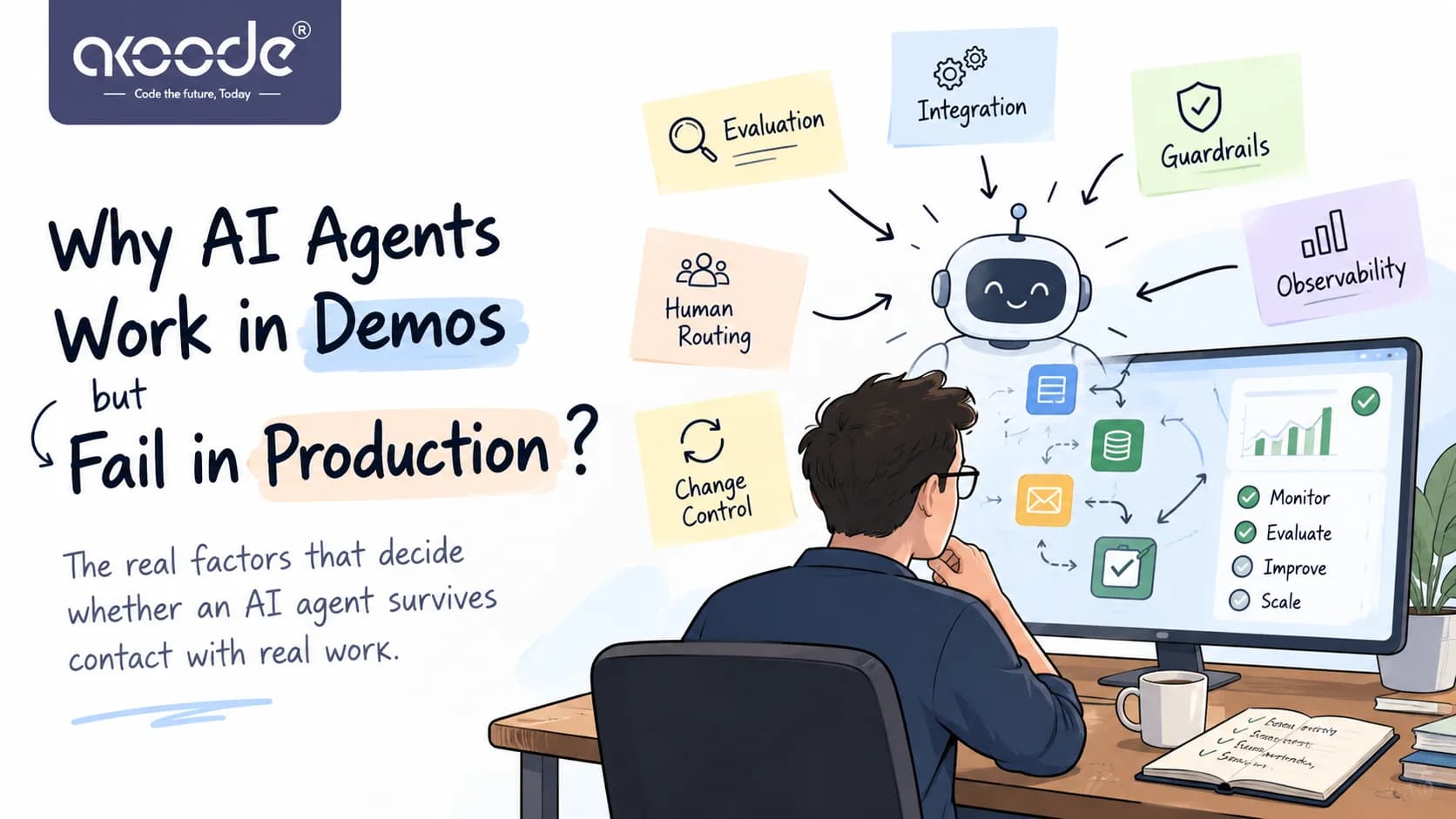
Most writing about AI agents stops at launch day. The demo works, the pilot passes, the dashboard goes green, and the article ends. That is where the real work starts, because an agent is not a finished product. It sits between a model you do not control, systems that keep changing and a business that keeps moving, and every one of those three shifts under it.
This guide covers what happens after go-live in 2027: what support to expect, why agents quietly get worse, what to do when one breaks, how to survive model updates, and how to scale from one agent to several without losing control. It introduces four tools you can use immediately: the Five Drifts, the Autonomy Dial, the Agent Incident Ladder and the Two-Key Model Swap.
Akoode Technologies is led by a team with more than a decade of experience in AI consulting and technology development, and has delivered 180+ software projects across 15+ industries. Our developers are in house, qualified and certified, and everything we design is built and tested inside the company. If you are earlier in the journey, start with our complete guide to AI agent development and our AI agent project roadmap.
What Happens After You Hire an AI Developer: Maintenance and Support?
Quick answer: After launch, a good provider monitors the agent, fixes defects, tunes accuracy, handles model and tool updates, and reviews results with you on a regular schedule. Ongoing costs come from model usage, hosting, monitoring, tuning and human review time. Agree the support process in writing before launch, not after the first problem.
Support for an agent is different from support for ordinary software. A normal application behaves the same way tomorrow as it does today until someone changes the code. An agent can change behaviour without anyone touching it, because the model underneath is updated, the data it reads changes, or the world it describes moves on. That is why maintenance is part of the product, not an add-on.
Agree these points before go-live:
Who watches the agent. A named person on each side, with defined hours and an escalation route.
What counts as an incident. Use the Agent Incident Ladder below so both sides use the same words.
How fast each level gets a response. Written commitments, not goodwill.
Who may change what. Prompts, rules, permissions and models should change only through a recorded, tested process.
What the running costs are made of. Model usage, hosting, monitoring, tuning and the human time spent reviewing exceptions. Our guide to AI agent development cost explains how each part behaves.
Then set a review rhythm. This is the Agent Health Check we recommend:
How often | What to review | Who |
|---|---|---|
Daily (automated) | Errors, failed actions, escalation volume, unusual spikes | Monitoring, with alerts to the support owner |
Weekly | A sample of real cases reviewed by a person; new exception types; reviewer feedback | Process owner and support engineer |
Monthly | Accuracy against the evaluation set; success measure against baseline; cost per completed task | Process owner and provider |
Quarterly | Autonomy line review; permissions audit; model and tool versions; roadmap for the next workflow | Leadership, process owner, provider |
Why Do AI Agents Quietly Get Worse After Launch?
Quick answer: Agents degrade because the things around them change: the inputs, the connected tools, the business rules, the underlying model and the knowledge they draw on. We call these the Five Drifts. None of them triggers an error message, which is why agents often get worse for weeks before anyone notices.
Drift | What changes | How it shows up | How to catch it |
|---|---|---|---|
Input drift | Customers, documents or requests start looking different from the training and test cases | More escalations, more corrections by reviewers | Track escalation rate and review a weekly sample |
Tool drift | An API, field or system the agent uses changes or breaks | Failed actions, silent partial updates | Monitor action success rate per tool, test integrations after every system release |
Policy drift | Business rules, prices, approvals or regulations change, but the agent still follows the old ones | Confident answers that are out of date | Keep rules in one maintained source and review them quarterly |
Model drift | The provider updates the model, and behaviour shifts | Different tone, new failure patterns, accuracy changes | Pin model versions and run the evaluation set before any change |
Knowledge drift | Documents or data the agent retrieves go stale, get duplicated or contradict each other | Wrong or conflicting answers from retrieval | Set owners and refresh dates for every knowledge source |
The pattern behind all five is the same: the agent was tested against the world as it was on launch day. Keep that test set alive and growing, and every drift becomes detectable. Let it freeze, and you are flying blind. This is why evaluation is an asset, not a launch checklist item. For systems built on retrieval, see how we approach RAG applications, where knowledge drift is the main risk.
What Happens If Your AI Agent Breaks or Malfunctions?
Quick answer: Contain first, diagnose second. Turn down the agent's autonomy so a person reviews every action, stop the damage, then trace what happened using the logs and fix the cause. A good provider gives you a kill switch, a rollback and a written incident process before launch, not during the crisis.
Two tools make this manageable. The first is the Autonomy Dial, a control that lets you reduce what the agent may do without switching it off entirely:
Full autonomy. The agent acts alone within its approved scope.
Propose only. The agent drafts every action and a person approves it.
Read only. The agent can look up and summarise but cannot change anything.
Off. Cases go straight to people, and the agent is paused.
Build the dial into the design from the start. Turning an agent down by one notch during an incident is far better than a binary on or off, because the business keeps running while you investigate.
The second tool is the Agent Incident Ladder, a shared severity scale:
Level | Meaning | First response |
|---|---|---|
S1 | The agent took a wrong action in a live system, or exposed data it should not have | Dial to off, protect data, alert owners, begin rollback of affected records |
S2 | The agent is giving wrong answers or decisions to customers at scale | Dial to propose only, communicate with affected customers, start diagnosis |
S3 | Accuracy has dropped or errors have risen, but the impact is contained | Increase review sampling, compare with the evaluation set, schedule a fix |
S4 | A minor defect or a cosmetic problem | Log it and handle it in the normal release cycle |
For the first fifteen minutes of any S1 or S2 incident, we recommend this order: contain with the dial, preserve logs, identify which cases were affected, tell the people who need to know, and only then look for the cause. Fixing before containing is the most common mistake, and it usually makes the evidence harder to read.
None of this is possible without good logging. Our enterprise AI agent architecture guide covers the traces and audit trails that make post-incident diagnosis fast.
How Do You Troubleshoot Common AI Agent Problems?
Quick answer: Start from the symptom, then check the cheapest cause first. Most agent problems trace back to retrieval, tools, instructions or a recent change, and rarely to the model itself. Compare the failing case with your evaluation set and ask what changed since the last time it passed.
Symptom | Likely cause | First check |
|---|---|---|
Confident but wrong answers | Stale or conflicting knowledge, weak retrieval | Which source did the agent retrieve, and is it current? |
Agent loops or repeats a step | Unclear stop condition, tool returning an unexpected result | Read the trace for the repeated step and the tool response |
Actions fail or only partly complete | API change, expired credentials, rate limit | Tool-level error logs and recent system releases |
Accuracy dropped after an update | Model or prompt change | Run the evaluation set on the previous and current versions |
Too many escalations | Input drift, rules too strict, missing cases in design | Group escalations by reason and look for a new pattern |
Too few escalations | Autonomy line too loose, overconfident behaviour | Review a sample of unescalated cases for errors |
Duplicate actions | Retries without safeguards, no record that the action already happened | Check idempotency handling and retry logic |
Slow responses | Long context, too many tool calls, provider latency | Time each step in the trace and find the slowest one |
Inconsistent tone or format | Prompt drift, mixed instructions, model change | Compare the current instructions with the approved version |
One discipline makes this table far more useful: every fix should add a case to the evaluation set. A bug that is fixed but not captured as a test will come back. Over time the evaluation set becomes the most valuable asset in the project, more valuable than the prompts.
What Happens to Your AI Agent When Technology Updates?
Quick answer: Models, tools and platforms change on their own schedule, and an agent has to be tested against every change before it reaches production. Pin model versions, run your evaluation set on any candidate update, release it to a small share of cases first, and keep the previous version ready for rollback.
Model providers update, retire and rename models regularly, and each change can alter behaviour. Handle it with a repeatable protocol. We call it the Two-Key Model Swap, because nothing goes live until two checks both pass:
Key one: the evaluation set. Run the new model or prompt against the full evaluation set and compare it with the current version, case by case. Look at the cases that got worse, not just the average.
Key two: shadow or canary. Run the new version on real traffic without acting, or on a small share of cases, and compare the results with the live version.
Release in stages. A small share first, then more, with monitoring on the metrics that matter.
Keep rollback ready. The previous version stays deployable until the new one has proved itself.
Record the change. Version, date, test results and who approved it.
Design choices make this far easier. Keep the model behind an abstraction layer so you can swap it without rewriting the agent. Keep prompts and rules in version control, not in a dashboard nobody tracks. Pin versions where the provider allows it. These are small decisions during the build that save weeks later, and they belong in the architecture from the start. Our cloud and DevOps solutions team handles the deployment and release pipeline side of this.
How Do You Scale an AI Agent as Your Business Grows?
Quick answer: Scale in two directions: volume, meaning more cases through the same agent, and breadth, meaning more workflows or departments. Volume needs capacity planning, queueing, rate-limit handling and cost tracking per task. Breadth needs shared services such as identity, logging and a common evaluation library, so each new agent does not start from zero.
Treat the two directions separately, because they fail differently.
Scaling volume exposes limits you never saw in the pilot:
Rate limits and quotas on models and connected systems.
Queueing and prioritisation, so urgent cases do not wait behind bulk work.
Cost per completed task, tracked monthly, since usage-based costs move with volume.
Reviewer capacity. If escalations rise with volume, the people reviewing them become the bottleneck before the agent does.
Infrastructure headroom and monitoring that still works at ten times the traffic.
Scaling breadth is mostly an engineering and governance task. Build shared foundations once: one identity and permission model, one logging standard, one place for evaluation sets, one release process. Our enterprise AI integration work focuses on exactly this kind of shared base. Industries with heavy, steady volume, such as telecommunication and logistics, are likely to hit the volume side first, which is worth planning for before the pilot ends.
When Should You Move From One AI Agent to Multiple Agents?
Quick answer: Split into several agents when one agent's instructions have become too long to test, when different tasks need different permissions, or when one workflow is blocking another. Do not add agents for their own sake. Each additional agent adds handoffs, and handoffs are where quality is lost.
We call these the three Split Triggers:
The instruction trigger. The agent's rules and prompts are so long and tangled that you cannot test it or predict it. Splitting into specialists makes each one testable.
The permission trigger. One part of the work needs access to sensitive data or powerful actions, and the rest does not. Separate agents let you apply least privilege properly.
The speed trigger. A slow, deep task is holding up fast, simple ones. Separate agents let each run at its own pace.
If none of the three applies, keep one agent. When you do split, design the handoffs deliberately, test each one on its own, and put an orchestrator or clear routing rule above them. Our AI-powered advertisement catalogue generator is a working example of chained steps where the handoffs decide the quality, and agentic AI orchestrationcovers coordination patterns in detail.
How Do You Future-Proof an AI Agent Investment?
You cannot predict the next model. You can build so that a new one is a small change, not a rebuild. Five design habits do most of the work:
Keep the model replaceable. An abstraction layer between your logic and the provider.
Treat the evaluation set as the core asset. It outlives every model, prompt and vendor.
Keep everything in version control. Prompts, rules, configuration, tool definitions and test cases.
Separate business rules from the model. Rules live in a maintained source, so a policy change is an edit, not a retraining.
Document for handover. Architecture notes, a runbook and an evaluation guide, so a new team can take over without guesswork.
These habits also protect you if you change providers, bring the work in house or add a second vendor. Our post on AI hiring models explains how to structure that handover from the start.
Why Does Life After Launch Favour an In-House Team?
After launch, the people who understand the system are the most valuable part of it. When everything is designed, built and tested inside one company, there is no subcontracting chain between you and the engineers who know how the agent behaves. At Akoode, our developers are qualified, certified and in house, which keeps knowledge of your system inside one team. Akoode holds a 4.9 rating on Google from 126 reviews and a 5.0 out of 5 on GoodFirms.
If you want a team that will stay with the agent after go-live, see our AI agent development services and our wider artificial intelligence services. For teams that want to add engineers to their own operations group, staff augmentation is the alternative.
What Should You Read Next?
Frequently Asked Questions
What support do I get after hiring an AI developer?
A good provider monitors the agent, fixes defects, tunes accuracy, handles model and tool updates, and reviews results with you on a schedule. Agree the support process in writing before launch, including who watches the agent, what counts as an incident, how fast each level gets a response, and who may change prompts, rules and permissions.
Why do AI agents get worse over time?
The things around them change: the inputs, the connected tools, the business rules, the underlying model and the knowledge they retrieve. We call these the Five Drifts. None of them triggers an error, so agents often degrade for weeks before anyone notices. A living evaluation set and a weekly review of real cases catch them early.
What should I do if my AI agent breaks?
Contain first, diagnose second. Turn down the agent's autonomy so a person reviews every action, stop any damage, preserve the logs, identify the affected cases, tell the people who need to know, then trace the cause and fix it. Providers should supply a kill switch, a rollback and a written incident process before launch.
What happens to my AI agent when the AI model is updated?
An update can change behaviour without any change to your code. Pin model versions where possible, run your evaluation set on the new version, test it on a small share of real cases, release in stages and keep the previous version ready for rollback. Nothing should go live until both the evaluation and the live test pass.
How do I scale an AI agent as my business grows?
Scale volume and breadth separately. Volume needs capacity planning, queueing, rate-limit handling, cost tracking per task and enough human reviewers. Breadth needs shared foundations such as one permission model, one logging standard and a common evaluation library, so each new workflow builds on the last instead of starting over.
When should I move from one AI agent to multiple agents?
Split when the agent's instructions have become too tangled to test, when different tasks need different permissions, or when a slow task is blocking fast ones. Do not add agents for their own sake, because each one adds handoffs, and handoffs are where quality is lost. If none of those triggers applies, keep one agent.
How do I future-proof an AI agent?
Keep the model replaceable behind an abstraction layer, treat the evaluation set as your core asset, keep prompts and rules in version control, separate business rules from the model, and document everything for handover. These habits make the next model a small change instead of a rebuild.
Plan Support Before You Launch
Tell us about the agent you run or plan to run. We will review how it is monitored, what its autonomy line and incident process look like, and where drift is most likely to hit you first.
Book a call with Akhil Verma, Founder and CEO of Akoode Technologies, or explore our AI agent development services.
Written by the Akoode Technologies team. Akoode is headquartered in Gurugram, India, with a presence in Jenks, Oklahoma, and serves clients across India, UK ,Canada, Dubai and the USA.
Get In Touch Now
View More Our Blog