AI-Powered Advertisement Catalogue Generator for Multi-Channel Marketing Teams
Built to turn a single product image into production-ready ad catalogues across social, email, marketplace, and B2B sales channels.
Ad Templates
6 Formats
Style Options
9 Tones
Export Formats
PNG + PDF
When Marketing Teams Were Spending More Time Making Ads Than Running Them
Brands selling across multiple channels face a production problem that gets worse as the catalogue grows. The same product needs an Instagram post, a story, a banner, a marketplace card, an email header, and a B2B sales sheet. Each format has different dimensions, different copy requirements, and different audience expectations. A small marketing team handling fifty SKUs is not doing creative work. They are doing repetitive production work, and most of it looks inconsistent by the time it ships.
The brief came from the need to solve a problem Akoode's team had observed across ecommerce and B2B marketing clients: the bottleneck between a product image and a usable ad creative was too wide, too slow, and too dependent on individual designers and copywriters keeping everything on-brand. The solution needed to be deterministic, not generative. Marketing teams cannot review and approve outputs that look different every time. They need layouts they can trust, edit, and send without second-guessing the result.
Akoode built a modular AI pipeline that takes a product image or demo SKU, analyses it using Vision AI, retrieves relevant copy frameworks through a RAG system, generates structured marketing content through a prompt engine, injects it into HTML/CSS templates, and renders downloadable PNG and PDF catalogue assets using Puppeteer. The output is always structured, always reviewable, and always on-format.
6
Production-Ready Templates
Instagram Post, Story, Banner, Marketplace Card, Email Header, and B2B Product Sheet all supported out of the box.
9
Visual Style Tones
Modern, Premium, Bold, Playful, Minimal, Luxury, Eco, Sporty, and Classic applied to every template format.
PNG + PDF
Export Formats Live
Every generated catalogue renders to downloadable PNG and PDF for immediate use across digital and print channels.
Deterministic
Rendering Architecture
HTML/CSS templates rendered by Puppeteer produce the same layout every time, making outputs reviewable and repeatable.
Project Info
Client
Confidential, India
Industry
eCommerce
Use Case
AI-Powered Ad Catalogue Generation
Solution
Artificial Intelligence and Generative AI Platform
Engagement
Fixed Cost
What Challenges Do Marketing Teams Face in Scaling Product Advertisement Production?
The creative production bottleneck in ecommerce and B2B marketing is not a talent problem. It is a process problem. Every product needs multiple ad formats. Every format needs channel-appropriate copy. Every piece of copy needs to stay on-brand across a growing catalogue. When that work is done manually, it does not scale, it does not stay consistent, and it cannot be reviewed efficiently when the output looks different every time a different person touched it.
Multiple Ad Formats Needed for Every Product
One product needs Instagram posts, stories, banners, marketplace cards, email headers, and sales sheets. Producing all six formats manually for a large catalogue is a production bottleneck that most small teams cannot clear without significant resource investment.
Creative Inconsistency Across Channels and Team Members
When ads are produced manually by different people at different times, tone, structure, CTA phrasing, and brand alignment drift. The same product looks different on Instagram than it does in a marketplace card, and neither may match the email header sent last week.
AI Image Generation Too Unpredictable for Business Review
Generative image tools produce different outputs every run. Marketing teams cannot build an approval and review workflow around outputs that cannot be reproduced, edited precisely, or matched against brand guidelines consistently.
No Scalable System for Bulk Catalogue Production
Ecommerce brands and B2B sales teams managing large product catalogues have no tool that handles image ingestion, copy generation, template selection, and asset export in a single workflow without manual intervention at each stage.
A marketing team that spends four hours producing six ad formats for one product is not a creative team. They are a production line. The AI layer needs to handle the production so the team can focus on the decisions that actually require human judgement.
What We Set Out to Build
The brief required a modular AI pipeline that could take a product image, understand what it was selling and to whom, generate structured marketing copy across multiple formats, and render downloadable catalogue assets that looked the same every time. Deterministic output was non-negotiable. The system needed to produce layouts a marketing team could review, approve, and send without visual surprises or format inconsistencies between runs.
Build Vision AI Product Analysis
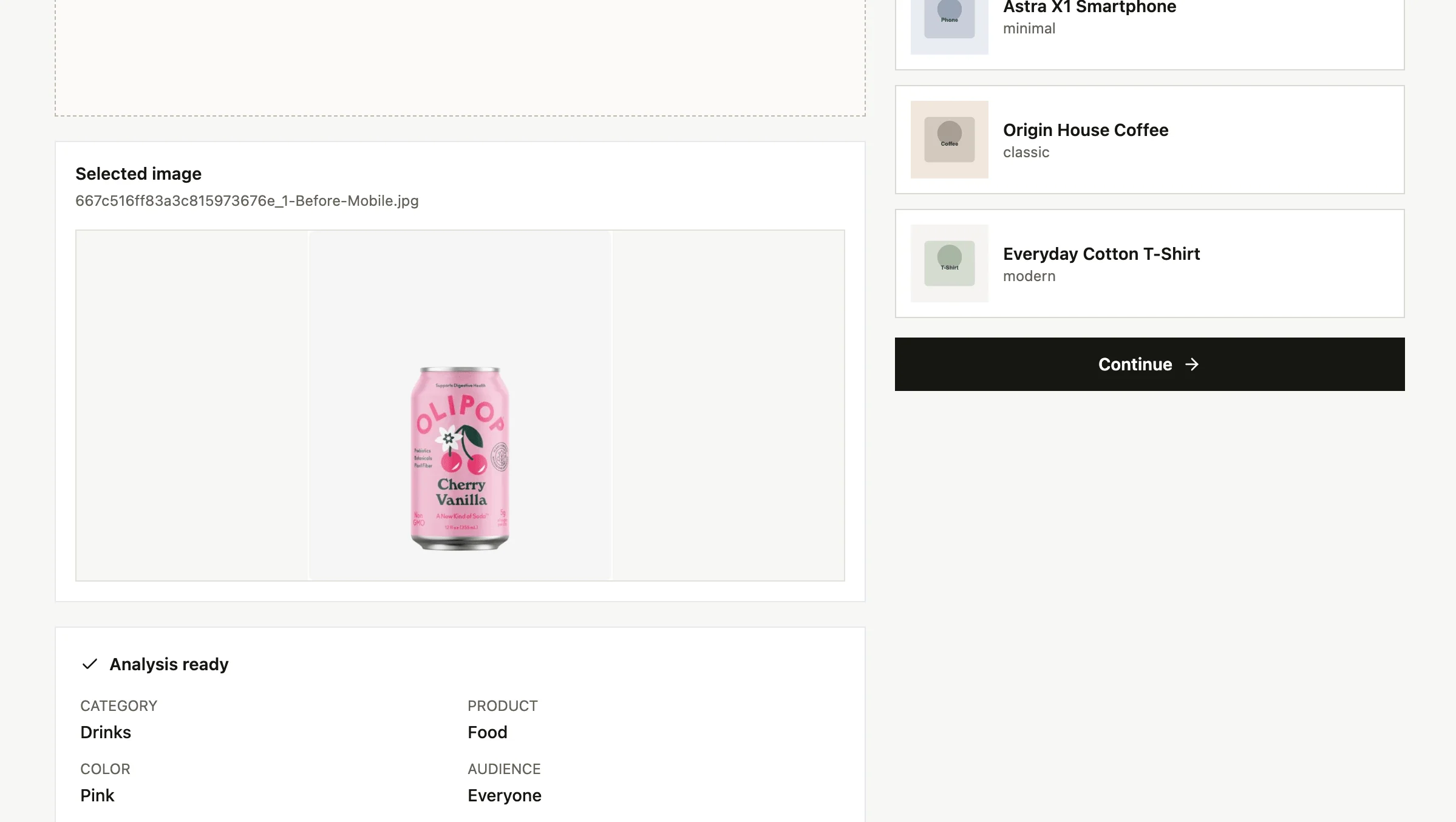
Develop a vision analysis layer that extracts product category, type, colour, visual style, and target audience from uploaded images, providing the structured input that drives every downstream copy and template decision.
Implement RAG-Based Copy Retrieval
Build a retrieval system that uses product analysis outputs to surface relevant headlines, taglines, CTAs, style guidelines, and template suggestions from a structured knowledge base rather than generating copy from scratch every time.
Deliver Deterministic HTML/CSS Template Rendering
Create a template engine using reusable HTML/CSS layouts with structured placeholders, rendered to PNG and PDF by Puppeteer, producing the same format output reliably regardless of how many times the same product is processed.
Support Six Ad Formats Across Four Channel Types
Build and validate production-ready templates for Instagram Post, Story, Banner, Marketplace Card, Email Header, and B2B Product Sheet, covering social, web, email, and sales channel requirements in a single platform.
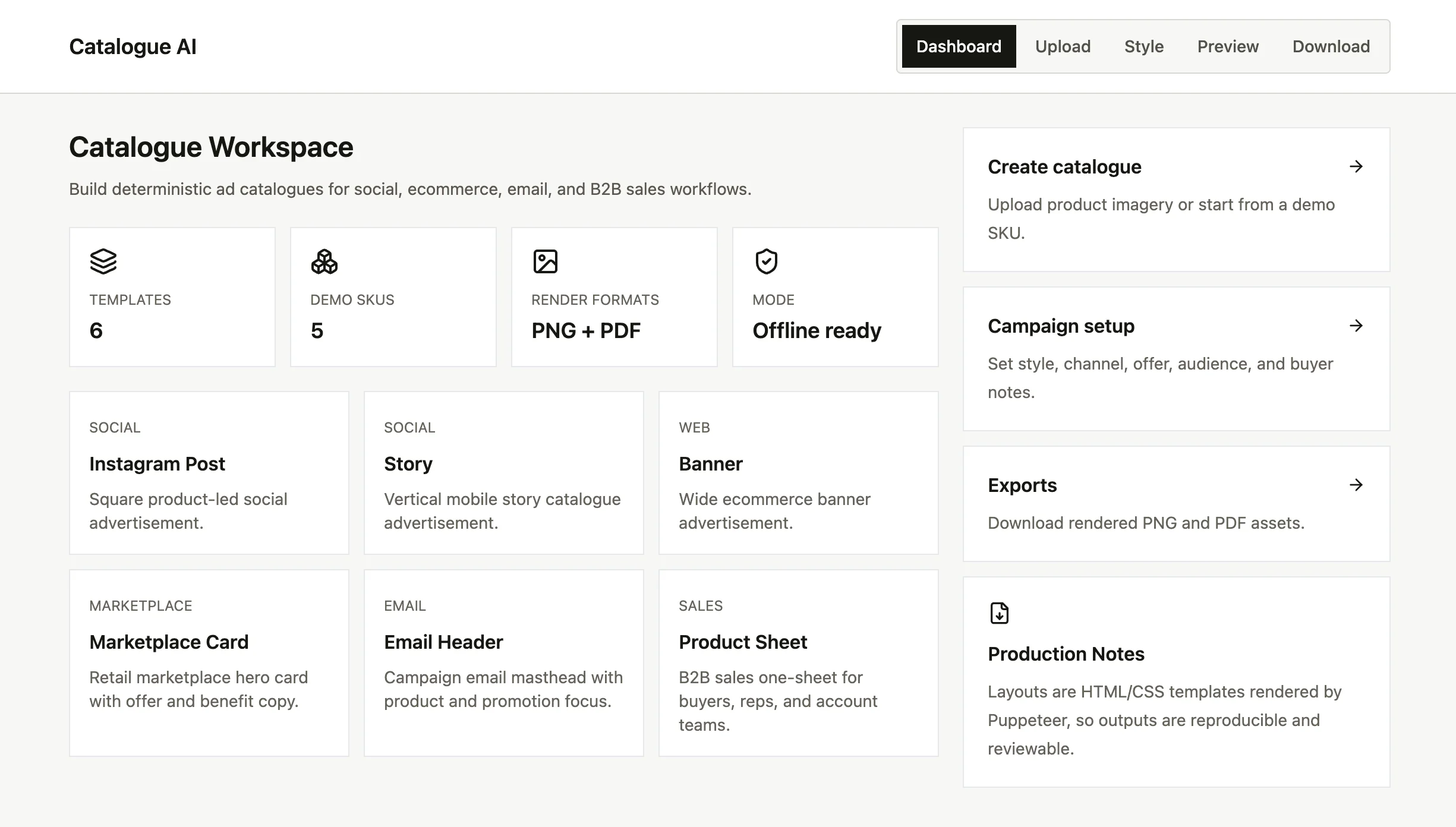
Design a Complete Business User Workflow
Deliver a full front-end workflow from Dashboard through Upload, Style selection, Preview, and Download so non-technical marketing users can generate and export professional ad catalogue assets without any development involvement.
Turning a Single Product Image into a Full Multi-Channel Ad Catalogue
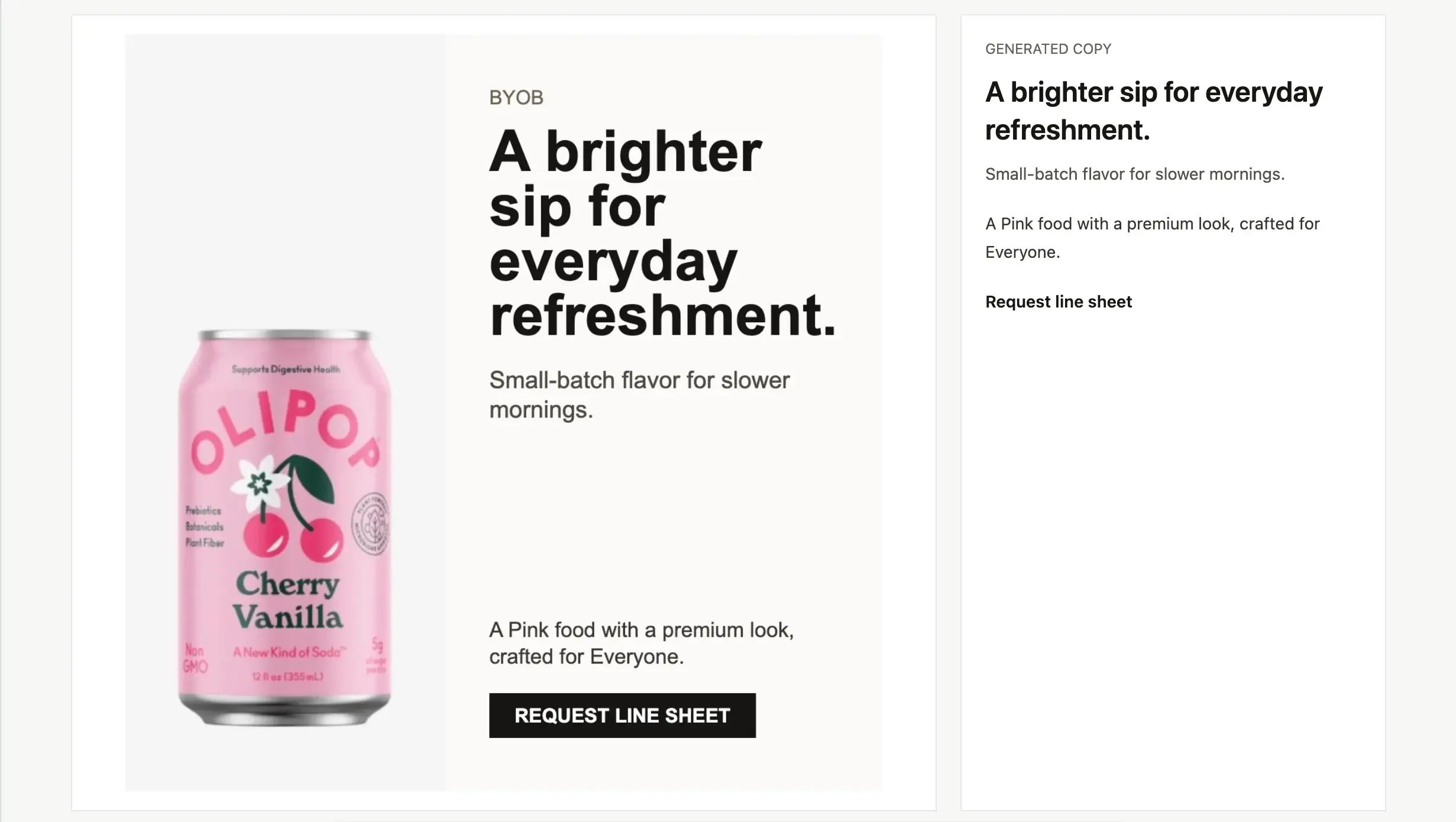
Akoode built a modular AI pipeline that processes product images through five sequential stages: Vision analysis extracts product data, RAG retrieval surfaces relevant copy frameworks, a prompt engine generates structured marketing content, a template engine injects it into HTML layouts, and Puppeteer renders the final PNG and PDF outputs. The result is a deterministic catalogue generator that produces consistent, reviewable, production-safe ad assets across six formats and nine style tones.
Image Upload and Vision Analysis
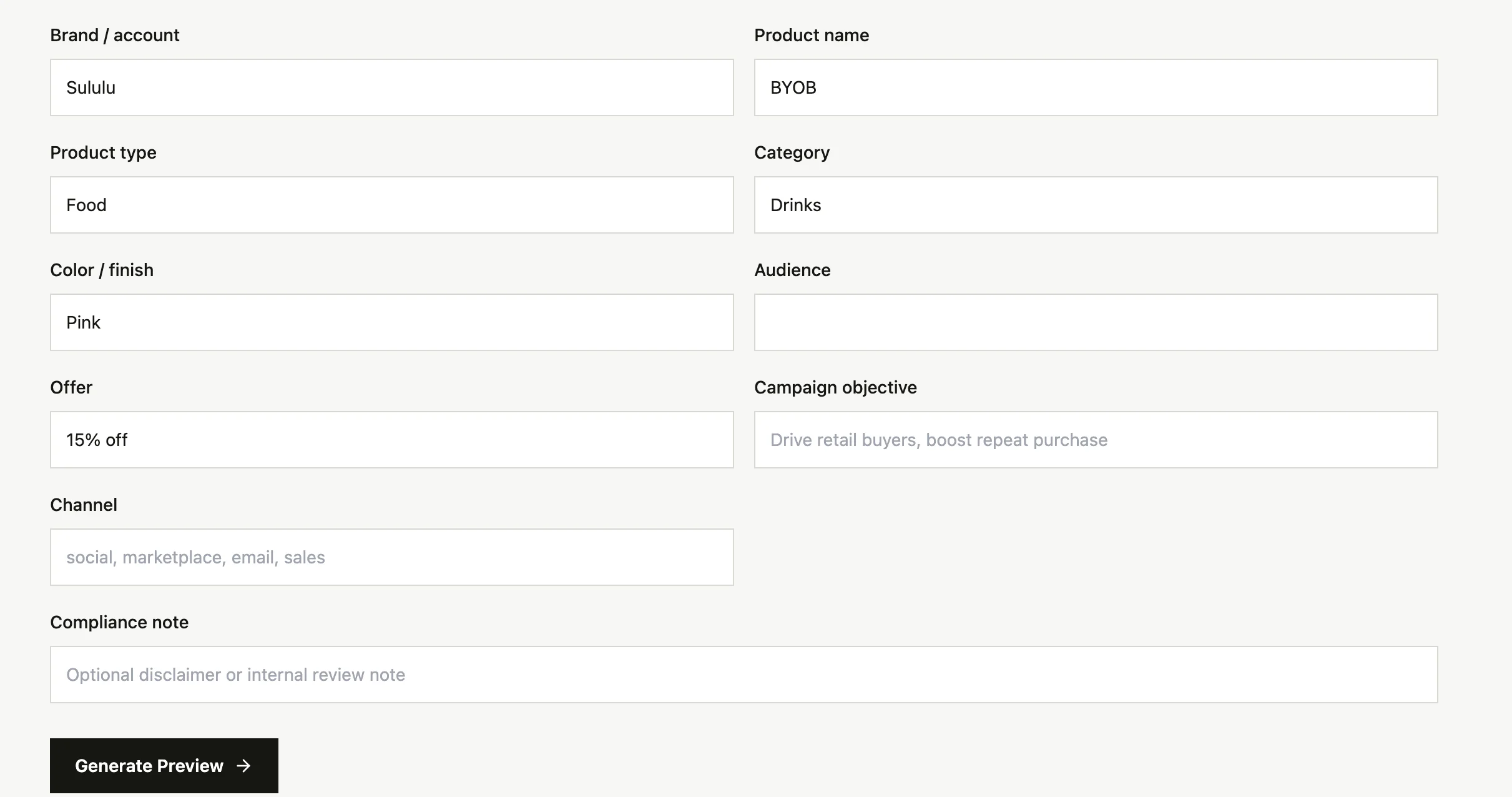
The user uploads a product image or selects a demo SKU. The Vision AI layer analyses the image and extracts product category, type, colour, visual style, and target audience. This structured data is the input for every downstream step in the pipeline.
RAG Retrieval
The extracted product data triggers a retrieval pass through the RAG system. Relevant headlines, taglines, CTAs, style guidelines, and template suggestions are retrieved based on category, style tone, and audience, pulling from a structured knowledge base rather than generating from scratch.
Style and Campaign Setup
The user selects visual style tone, ad template format, target channel, offer, campaign objective, audience, and any compliance notes. These inputs combine with the retrieved copy framework to feed the prompt engine with complete campaign context.
AI Copy Generation and Template Injection
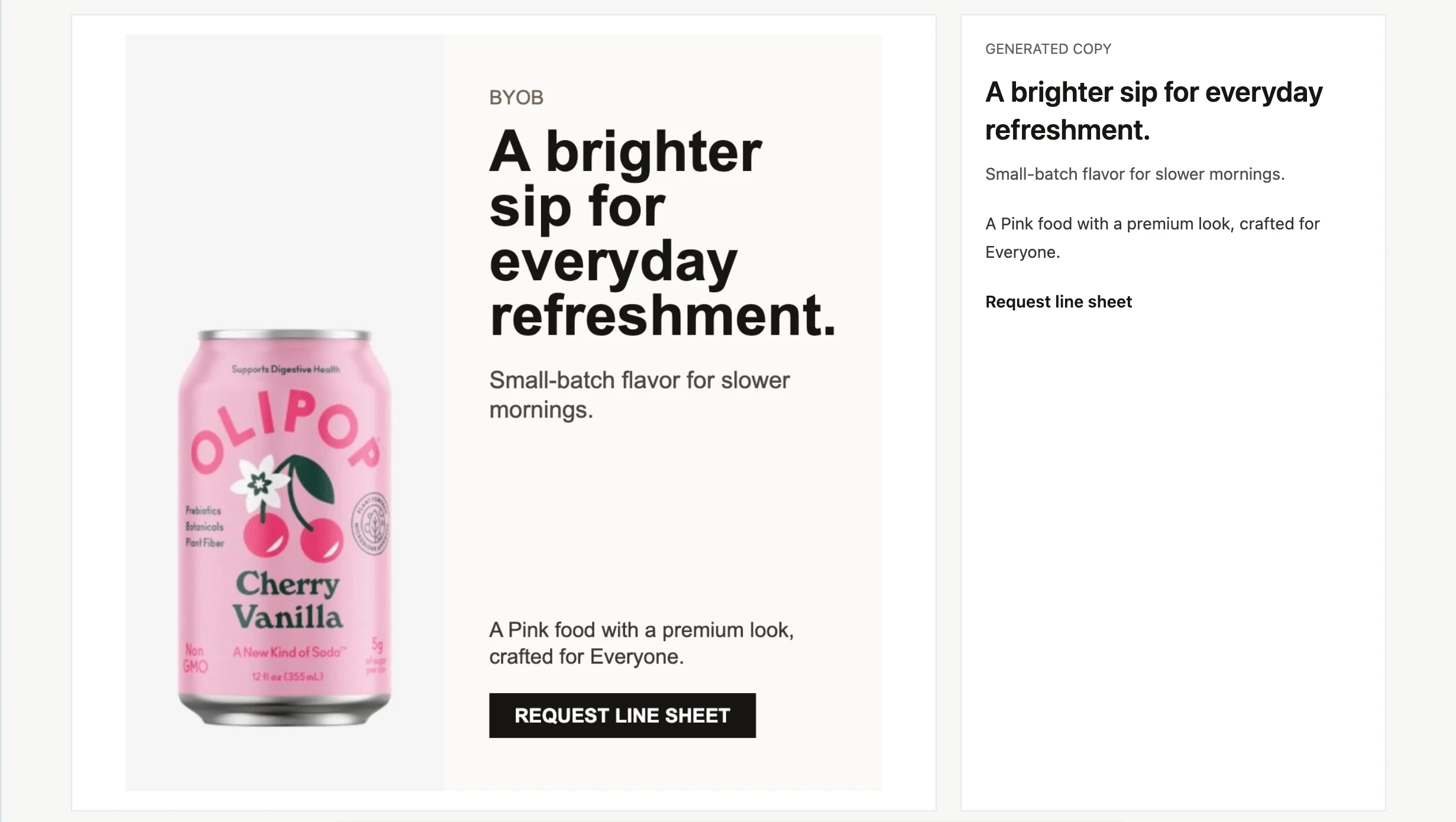
The prompt engine generates a complete set of marketing content: product name, headline, tagline, description, CTA, offer text, and sales angle. This structured content is injected into the selected HTML/CSS template with precise field-level placement.
Puppeteer Rendering and Export
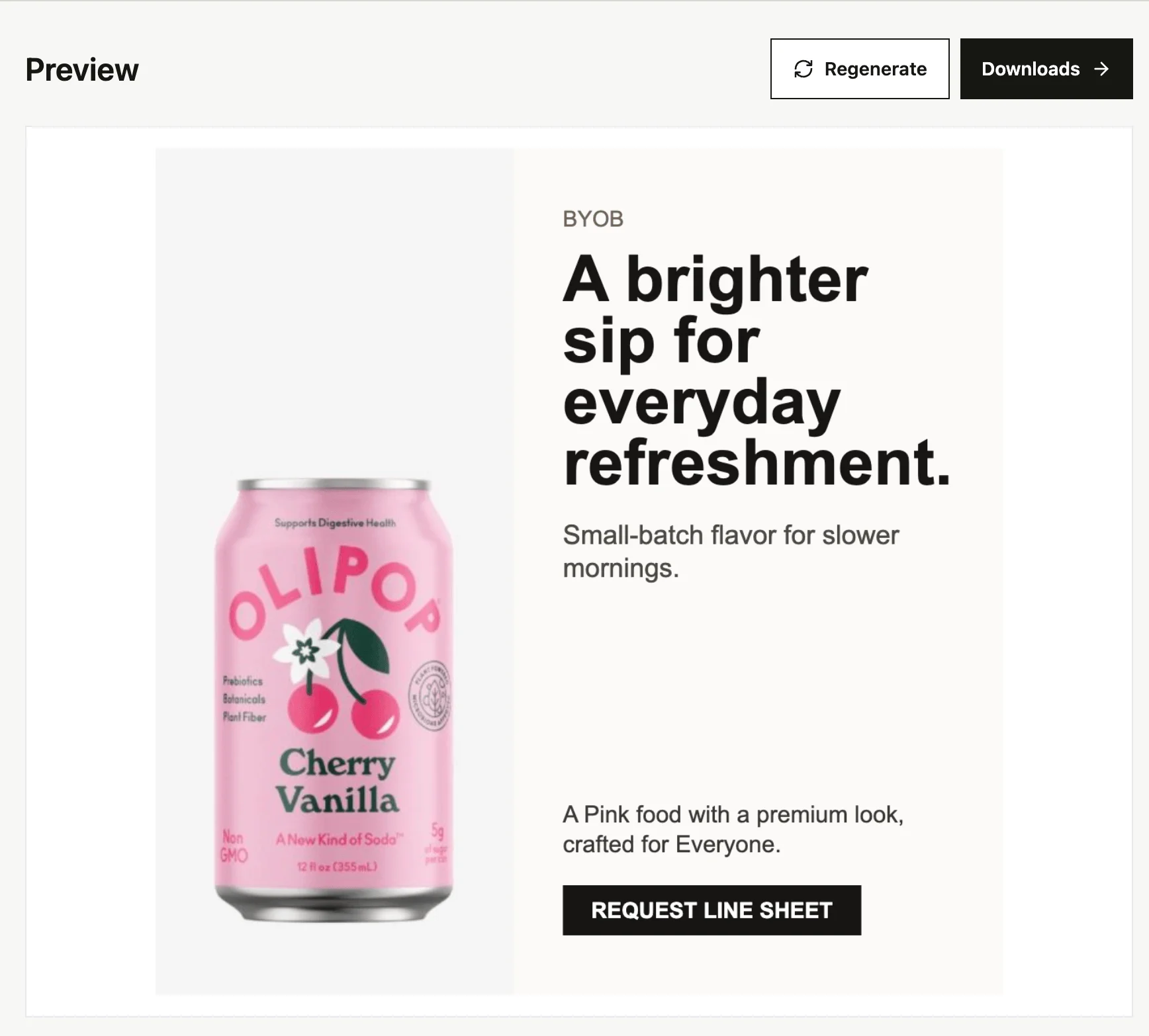
The completed HTML template is rendered by Puppeteer into a final ad layout. The user previews the output, can regenerate with different parameters, and downloads the finished catalogue asset as PNG or PDF for immediate deployment.
What Makes This System Powerful
Highlight 01
Vision AI Product Analysis for Automated Creative Briefing
Instead of generating copy from scratch every time, the system retrieves relevant headlines, taglines, CTAs, and style guidelines from a structured knowledge base using LangChain-style retrieval patterns. That means copy outputs are grounded in proven frameworks for the product category and audience, not entirely novel generations that vary unpredictably between runs.
- Retrieves headlines, taglines, CTAs, and style guidance per product context
- LangChain-style retrieval with local vector abstraction and Pinecone integration
- Grounded copy reduces brand drift across bulk catalogue production
Highlight 02
RAG-Based Copy Retrieval for Brand-Consistent Marketing Content
Instead of generating copy from scratch every time, the system retrieves relevant headlines, taglines, CTAs, and style guidelines from a structured knowledge base using LangChain-style retrieval patterns. That means copy outputs are grounded in proven frameworks for the product category and audience, not entirely novel generations that vary unpredictably between runs.
- Retrieves headlines, taglines, CTAs, and style guidance per product context
- LangChain-style retrieval with local vector abstraction and Pinecone integration
- Grounded copy reduces brand drift across bulk catalogue production
Highlight 03
Deterministic HTML/CSS Template Rendering via Puppeteer
Every ad format on the platform is a structured HTML/CSS template with defined placeholders for each content field. Puppeteer renders these templates into PNG and PDF outputs that look identical every time the same inputs are used. Marketing teams can review, approve, and edit outputs without encountering layout surprises between sessions or between team members running the same product.
- Six production-ready templates across social, web, email, and B2B sales
- Puppeteer rendering produces identical output for identical inputs every run
- PNG and PDF exports ready for immediate deployment across all channels
Highlight 04
Multi-Style Catalogue Workspace With Campaign Context Controls
Before generating, users set the full campaign context: visual style tone from nine options, target channel, offer, audience, campaign objective, and optional compliance notes. These inputs combine with the AI-generated copy to shape the final output for the specific channel and buyer type. A Premium Instagram Post for a B2B audience and a Playful Marketplace Card for a consumer audience use the same product image but produce appropriately different outputs.
- Nine visual style tones applied across all six template formats
- Campaign objective, audience, channel, and offer fields shape copy output
- Compliance note field supports regulated product categories
Key Challenges in Building a Deterministic AI Advertisement Catalogue Platform
Most AI content tools trade predictability for flexibility. This platform could not do that. Marketing teams need to review, approve, and reproduce outputs. Building a pipeline that used AI for understanding and copy while keeping layout rendering completely deterministic required solving conflicts between the generative and the structured at every stage of the build.
Making AI Output Deterministic Enough for Business Review
Generative AI produces different outputs on repeated runs. A marketing approval workflow breaks down if the same product generates a different layout every time.
Our Approach
The rendering layer was fully decoupled from the AI layer. Puppeteer renders structured HTML/CSS templates with defined field positions, so layout is always predictable regardless of what the AI layer generated for copy.
Extracting Reliable Product Data From Varied Image Inputs
Product images vary in background, lighting, angle, and composition. Inconsistent image inputs produce inconsistent vision analysis outputs that cascade into poor copy and wrong template selection.
Our Approach
Frontend image optimisation was added before storage and rendering, standardising inputs before they reach the Vision AI layer. Base64 image handling was also extended to support larger payload sizes without timeout failures.
Persisting Generated Content Across Preview and Download Steps
Users needed to preview a generated catalogue and then download the exact same output without the system regenerating it. Early builds were re-running the pipeline on download, producing different results.
Our Approach
Generated content and rendered outputs were persisted across the preview and download steps so the asset a user approves in preview is the exact file they receive on download, with no regeneration between steps.
Supporting Six Template Formats With Consistent Copy Structure
Each template format has different dimensions, different content field requirements, and different channel conventions. Copy that works for an Instagram Post does not work for a B2B Product Sheet.
Our Approach
The prompt engine was built to generate channel-specific copy variants from the same product analysis, with the template engine mapping the right content fields to the right placeholders for each of the six format types.
What Changed After Implementation
Before this platform, producing six ad formats for a single product meant briefing a designer, writing copy separately, checking brand alignment by hand, and repeating the process for every SKU in the catalogue. Each output looked slightly different depending on who made it and when. After deployment, a marketing user uploads a product image, sets campaign context, and downloads production-ready PNG and PDF assets across all six formats in a single workflow. The layout is the same every time. The copy is structured, channel-appropriate, and grounded in a retrieval framework rather than improvised on the spot.
Six Ad Formats Required Manual Production Each Time
Every product needed separate design and copy work for each channel format, with no shared workflow connecting them.
Copy Inconsistency Across Channels and Campaigns
Tone, CTA phrasing, and structure drifted between formats and team members with no system to enforce consistency.
No Repeatable Output for Marketing Review Workflows
Manually produced or generative AI outputs could not be reliably reproduced, making review and approval processes unreliable.
No Scalable Path for Large Product Catalogues
Brands with large SKU counts had no tool to handle image ingestion, copy generation, and asset export in one automated workflow.
Modular AI Pipeline From Image to Exported Asset
Vision analysis, RAG retrieval, prompt generation, template injection, and Puppeteer rendering connected in a single five-stage pipeline.
RAG-Grounded Copy for Consistent Channel Output
Retrieval-based copy framework keeps headline, tagline, and CTA patterns consistent across repeated runs and product categories.
Deterministic HTML/CSS Rendering via Puppeteer
Structured templates produce identical layout output for identical inputs, making every generated asset reviewable and reproducible.
Six-Format Template Library With Nine Style Tones
Social, web, email, marketplace, and B2B sales formats all covered, with nine visual style options applied per template selection.
Six Ad Formats Generated From One Image Upload
A single product image produces six channel-appropriate catalogue assets in one workflow session without separate design or copy work.
Consistent Copy and Layout Across Every Output
RAG-grounded copy and deterministic rendering mean every output matches the brand framework and the approved layout structure.
Preview-to-Download Consistency Guaranteed
The asset previewed before approval is the exact file downloaded, with no regeneration or variation between steps.
Scalable Architecture Ready for Bulk SKU Processing
The modular pipeline supports extension to bulk catalogue production for ecommerce and B2B teams managing large product inventories.
6Ad Format Templates Live
Instagram Post, Story, Banner, Marketplace Card, Email Header, and B2B Product Sheet all production-ready.
9Visual Style Tones Supported
Modern, Premium, Bold, Playful, Minimal, Luxury, Eco, Sporty, and Classic available across all six template formats.
PNG + PDFExport Formats Available
Every generated catalogue asset downloadable in PNG for digital use and PDF for print and sales workflows.
Use Cases of AI Catalogue Generation in eCommerce and B2B Marketing
The modular pipeline, deterministic rendering, and multi-format template system built for this platform applies to any brand, agency, or marketplace seller that needs to produce consistent advertising assets across multiple channels at scale. The same architecture works for consumer product brands, wholesale suppliers, retail distributors, and marketing agencies managing multiple client catalogues simultaneously.
eCommerce Brand Multi-Channel Ad Production
Direct-to-consumer brands selling across Instagram, marketplaces, and email that need consistent ad assets for every SKU without a dedicated design team for each channel.
B2B Wholesale Catalogue Generation
Wholesale suppliers and distributors producing product sheets for buyers, reps, and account teams across large SKU catalogues where manual design is not feasible at scale.
Marketing Agency Bulk Client Asset Production
Agencies managing multiple brand clients that need a repeatable, reviewable pipeline for producing on-brand ad creatives across social, email, and marketplace channels simultaneously.
Retail Marketplace Seller Listing Optimisation
Marketplace sellers on Amazon, Flipkart, or Meesho that need optimised product imagery and copy structured specifically for marketplace card formats and category conventions.
New Product Launch Ad Kit Generation
Brands launching new products that need a full set of channel-ready ad assets from day one without the lead time of a traditional creative production process.
SaaS Marketing Platform Integration
Software platforms serving marketing teams that want to embed AI-powered catalogue generation as a feature within their own product using the modular pipeline as an API-accessible backend service.
Why Businesses Choose Akoode Technologies for Artificial Intelligence Development
Akoode builds AI platforms for marketing, ecommerce, and enterprise organisations where output quality, consistency, and production-readiness are non-negotiable requirements. The team handles the full build scope from AI pipeline architecture and model integration through frontend application development, rendering engine implementation, and deployment. Projects span AI content tools, computer vision applications, and multi-modal AI systems across India and international markets.
AI Architecture Designed Around Business Constraints, Not Demos
The deterministic rendering requirement on this project ruled out the most obvious AI approach. Akoode built around the constraint rather than ignoring it, choosing a pipeline where AI handles understanding and copy while HTML/CSS and Puppeteer handle layout. That decision made the platform usable in a real marketing review workflow, not just impressive in a demo.
Modular Pipeline Engineering That Supports Future Extension
Each stage of the catalogue pipeline, vision, RAG, prompt, template, render, is a separate service. That architecture means new template formats, new style tones, new AI models, or bulk SKU processing can be added without rebuilding the core system. Akoode builds for the product roadmap, not just the current brief.
Multi-Modal AI Integration Across Vision, Retrieval, and Generation
This platform required three separate AI capabilities to work together: Vision AI for image understanding, RAG for copy retrieval, and a prompt engine for content generation. Akoode managed all three within a single coherent pipeline, not as separate tools stitched together after the fact.
Production-Ready Delivery, Not Prototype Handoff
The platform shipped with six validated templates, nine style tones, PNG and PDF export, frontend image optimisation, corrected base64 payload handling, and persistent preview-to-download consistency. Production readiness is part of the definition of done, not a phase that comes after.