


 September 8, 2026
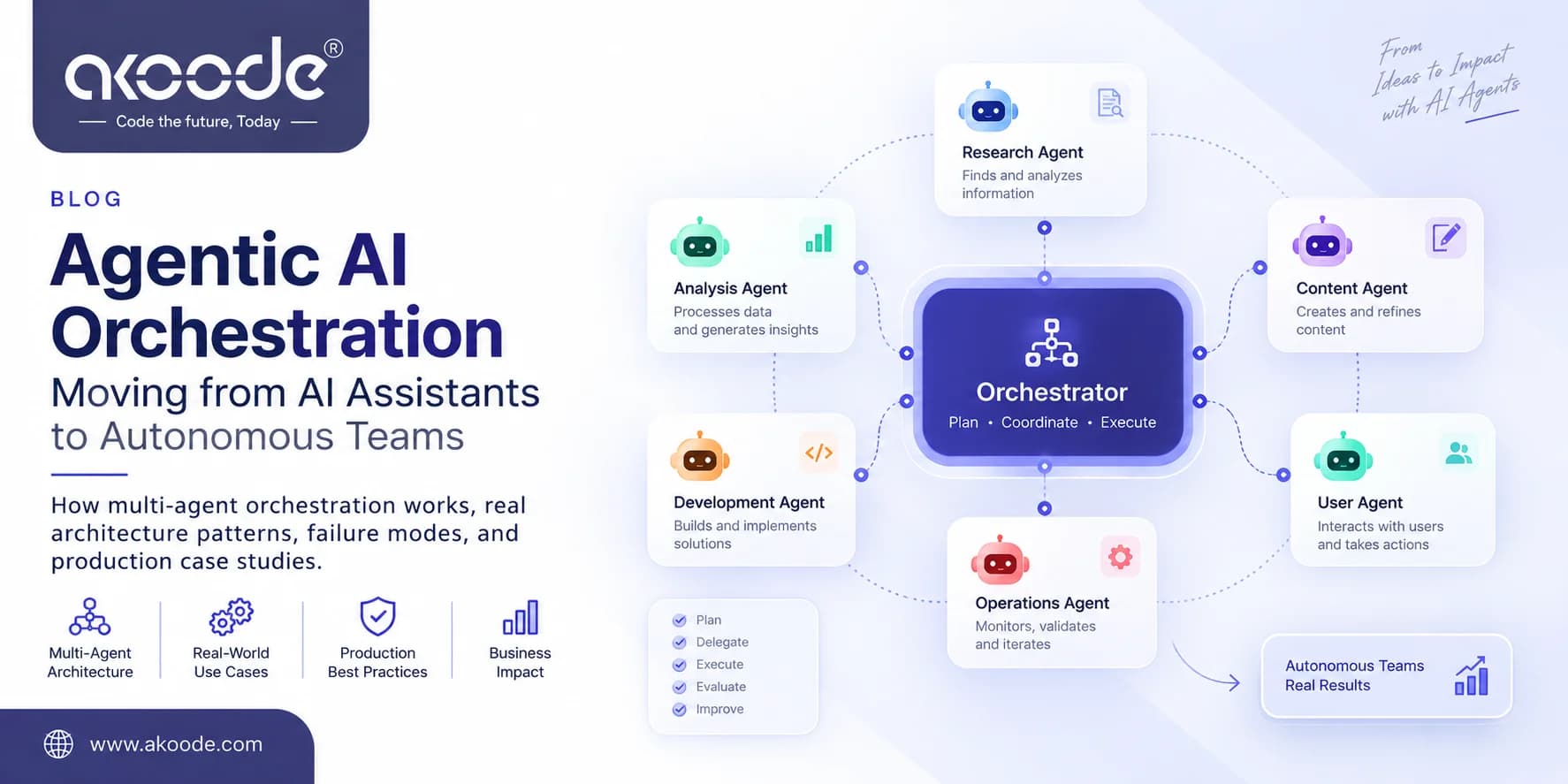
Agentic AI orchestration is the discipline of coordinating multiple specialised AI agents — each with its own tools, memory and scope — so they complete a task together instead of one generalist agent attempting the whole thing alone. It replaces a single large prompt with a structured system: a planner that decomposes the task, specialist agents that execute distinct parts of it, and a coordination layer that manages handoffs, shared state, error recovery and human checkpoints. Done well, it produces higher accuracy on complex multi-step work than any single agent achieves alone. Done without discipline, it produces cascading failures, runaway cost, and a system nobody can debug.
This article covers how orchestration actually works: the five coordination patterns in production use, the protocol layer that is standardising how agents talk to each other and to tools, a reference architecture, two concrete workflows, the failure modes specific to multi-agent systems, and what we have actually shipped at the specialist-node level in production.
1. From assistant to agent to orchestrated team: the real distinctions
These three terms get used interchangeably in vendor marketing, and the imprecision costs buyers real money, because each one implies a different architecture and a different failure surface.
An AI assistant responds to a request and stops. It may call a tool, but a person initiates every step and reviews every output before the next one happens. This is a copilot, not an agent — it depends on continuous human input.
A single AI agent receives a goal, plans a sequence of steps, calls tools and APIs to execute them, evaluates the results, and either completes the task or escalates. It operates with some autonomy across multiple steps without a person driving each one. Our companion article, enterprise AI agent architecture, covers what production-grade reliability, security and scalability look like for a single agent, and that groundwork is a prerequisite for everything in this article — an unreliable single agent does not become reliable by adding four more of them.
An orchestrated multi-agent system — what this article calls an autonomous team — coordinates several specialised agents toward one outcome. A planner or supervisor agent decomposes the task, routes subtasks to specialist agents with narrower scope and different tools, manages the handoffs and shared state between them, and either delivers a completed result or escalates a specific failure point to a person.
The distinction that matters operationally: a single agent fails in one place. A multi-agent system fails in the interactions between agents — a handoff that loses context, two agents that reach contradictory conclusions, a specialist that returns a plausible but wrong result that the next agent trusts without checking. Section 8 covers these failure modes in depth, because they are the primary reason orchestration projects struggle in production even when every individual agent works fine in isolation.
Why move to orchestration at all, then, if it is harder? Because some tasks are genuinely multi-disciplinary in a way one agent handles poorly even with a large context window and every tool available. A contract review that requires legal clause classification, financial term extraction and a compliance check against a specific jurisdiction is three different reasoning tasks with three different failure tolerances. A single generalist agent tends to under-perform on all three; three specialists, each evaluated and tuned against their own narrower task, tend to outperform it — provided the coordination layer between them is engineered with the same rigour as each agent itself.
2. Why orchestration is happening now
Three things converged in 2025 and 2026 to make multi-agent orchestration a production concern rather than a research topic.
Adoption is moving faster than almost any prior enterprise software category. Gartner's August 2025 forecast projected that 40% of enterprise applications would embed task-specific AI agents by the end of 2026, up from under 5% in 2025 — an eightfold increase in a single year, faster than the adoption curves of cloud computing or mobile-first interfaces. The same research line projects that by 2027, roughly a third of agentic AI implementations will combine agents with different skills to manage complex tasks — which is a direct forecast that orchestration, not single-agent deployment, becomes the dominant pattern within the next two years.
The protocol layer has started to standardise. Until recently, every agent-to-tool and agent-to-agent connection was custom-built, which made orchestration expensive to engineer and brittle to maintain. That is changing — covered in detail in section 4.
The industry has accumulated enough failed pilots to know what breaks. Teradata and Wakefield Research's 2026 survey found that 78% of enterprises have at least one AI agent pilot running, but only 14% have scaled one to organisation-wide use. Gartner separately expects more than 40% of agentic AI projects to be cancelled by 2027. Read together, these numbers describe an industry that has proven agents can work in a demo and is now discovering, expensively, what production coordination actually requires. This article is written from the discovery side of that gap rather than the demo side of it.
The honest caveat. None of this means every organisation needs multi-agent orchestration now, or ever. Section 13 covers when a single well-built agent — or no agent at all — is the correct answer. The adoption curve above describes what enterprises are building, not what your specific problem requires.
3. Five orchestration patterns, compared
[ORIGINAL ASSET 2 — pattern decision matrix]
Every multi-agent system in production today uses some combination of five coordination patterns. Understanding them is the difference between designing an architecture and assembling a demo.
Sequential (pipeline)
Agents execute in a fixed order, each consuming the previous agent's output. Agent A extracts data, Agent B validates it, Agent C generates the final output. This is the simplest pattern to reason about, debug and monitor, because the failure surface is linear — you can always identify which stage broke by checking outputs at each boundary.
Best for: tasks with a natural pipeline structure and no need for agents to revisit earlier steps. Document processing, structured extraction-then-generation workflows, and most compliance-review tasks fit here.
Limitation: no error recovery without an explicit retry or escalation step built in. If stage two fails silently, stage three inherits garbage.
Concurrent (parallel)
Multiple agents work on independent subtasks simultaneously, and a final agent aggregates their outputs. A research task might dispatch one agent to search internal documents, one to query a database, and one to check external sources, then merge the three.
Best for: tasks that decompose into genuinely independent subtasks where speed matters more than sequencing.
Limitation: aggregation is harder than it looks. If two agents return conflicting information, something has to adjudicate, and that adjudication logic is exactly the kind of thing that gets under-designed in a rush to ship.
Hierarchical (supervisor)
A supervisor agent owns the plan and delegates subtasks to specialist agents, reviewing and potentially re-routing their outputs before deciding the task is complete. This is the pattern most enterprise "autonomous team" marketing describes.
Best for: complex, multi-step tasks where the right sequence of subtasks is not known in advance and needs to be decided dynamically based on intermediate results.
Limitation: the supervisor becomes a single point of failure and a cost multiplier — every specialist's output round-trips through the supervisor's own reasoning, which means the supervisor's token cost scales with the whole task, not just its own share of it.
Handoff (routing)
One agent evaluates an incoming request and hands it entirely to the specialist best suited to handle it, which then owns the task to completion. Customer support triage that routes a billing question to a billing agent and a technical question to a technical agent is the canonical example.
Best for: tasks that belong entirely to one specialism once correctly classified, with no need for multiple agents to collaborate on the same task.
Limitation: misclassification at the handoff point sends the entire task to the wrong specialist with no correction mechanism unless one is explicitly built.
Group chat / debate
Multiple agents with different perspectives or roles converse over several turns, sometimes challenging each other's outputs, before a moderator or majority process settles on a final answer. Used for tasks where checking a single agent's reasoning against another's materially improves quality — code review, where one agent proposes a change and another critiques it, is the most common production use.
Best for: tasks where output quality benefits more from adversarial review than from decomposition — catching a plausible-but-wrong output rather than dividing labour.
Limitation: the most expensive pattern per task, in both tokens and latency, since it involves multiple full reasoning passes rather than one. Recent field data from BCG-documented case studies on reviewer-overlay designs — one agent produces, another critiques before human review — reports meaningfully reduced human-in-the-loop rates versus single-agent baselines, at the cost of materially higher evaluation complexity. That trade-off is worth naming plainly: this pattern buys accuracy and spends complexity to do it.
Decision matrix
Pattern | Latency | Cost | Failure containment | Implementation complexity | Best fit |
|---|---|---|---|---|---|
Sequential | Low | Low | High — failure isolated to one stage | Low | Fixed-order pipelines |
Concurrent | Low | Medium | Medium — aggregation errors possible | Medium | Independent subtasks, speed-sensitive |
Hierarchical | High | High | Medium — supervisor is a single point of failure | High | Dynamic, multi-step planning |
Handoff | Low | Low | Low — no correction after misroute | Low | Cleanly separable specialisms |
Group chat / debate | Highest | Highest | High — errors get challenged before finalising | High | Quality-critical, review-heavy tasks |
Most production systems combine two patterns rather than committing to one: a handoff layer to route the task, then a sequential or hierarchical pattern inside the chosen specialism. Treating this as a single architectural choice, rather than a per-subtask decision, is one of the most common design mistakes in early orchestration projects.
4. The protocol layer: MCP, A2A, and why standardisation matters
Before 2024, every connection between an agent and a tool, and every connection between two agents, was a custom integration. That made orchestration expensive to build and brittle to extend — adding a new tool meant writing new integration code for every agent that needed it.
Model Context Protocol (MCP) standardises how an agent connects to tools, data sources and external systems: a common interface for exposing a capability so any MCP-compatible agent can use it without a bespoke integration. Adoption has moved quickly through 2026, with published server counts in the thousands and first-party support from major SaaS and infrastructure platforms. For orchestration specifically, MCP matters because it means the tool layer for your specialist agents can be built once and reused across every agent that needs it, rather than rebuilt per agent.
Agent-to-Agent protocol (A2A) addresses a different problem: how one agent discovers, calls and exchanges structured results with another agent, potentially one built by a different team or vendor. This is the layer that makes cross-team and cross-vendor orchestration realistic — a customer service agent built by one team can hand off to a billing agent built by another without a custom point-to-point integration, provided both speak the same protocol.
What this means practically for a build decision. Before this standardisation, an orchestration project spent a large share of its engineering budget on integration plumbing between agents and tools. That cost is falling as MCP and A2A adoption spreads, which is part of why 2026 project timelines and architectures look different from 2024 ones. It does not eliminate the harder problems this article covers — coordination logic, error recovery, evaluation — but it removes a real tax that used to sit in front of them.
5. Framework landscape: LangGraph, CrewAI, AutoGen, OpenAI Agents SDK
Frameworks encode a default orchestration pattern. Choosing one is partly a choice of which pattern you want to default into.
Framework | Default coordination model | Strongest for | Trade-off |
|---|---|---|---|
LangGraph | Explicit state graph — you define nodes and edges, including conditional branching and cycles | Fine-grained control over sequential and hierarchical flows, and systems that need to revisit earlier steps | More upfront design work than frameworks with a default supervisor pattern |
CrewAI | Role-based crews with a defined process (sequential or hierarchical) | Fast setup for hierarchical and sequential patterns with clear role definitions | Less flexible for irregular, dynamically decided flows |
AutoGen | Conversational agents exchanging messages, including group-chat patterns | Debate and reviewer-overlay patterns, research-style multi-turn collaboration | Conversation-based coordination can be harder to make deterministic and auditable |
OpenAI Agents SDK | Handoff-centric, agents can transfer a conversation to another agent | Handoff and routing patterns, especially where each agent maps to a distinct assistant persona | Tighter coupling to a single model provider's ecosystem |
The choice that actually matters more than the framework: whichever you pick, decide up front how state is shared between agents (a common data store versus passed-message context), how failures propagate (does a failed specialist retry, escalate, or silently degrade the final output), and how every step is logged for replay. Frameworks give you scaffolding for the coordination pattern. They do not give you observability, evaluation or governance — those are built on top regardless of framework choice, and section 9 covers what that build looks like.
6. A production reference architecture
[ORIGINAL ASSET 1 — reference architecture diagram]
A production orchestration system has six components, and skipping any of them is where demos stop being demos and start failing in ways nobody can diagnose.
Orchestrator / supervisor. Owns the task plan, decides which specialist handles which subtask, and decides when the overall task is complete or needs escalation. In hierarchical and handoff patterns this is an explicit component; in sequential patterns it can be a lightweight controller rather than a reasoning agent in its own right.
Specialist agent nodes. Each with a narrowly defined tool set, a system prompt scoped to its specific task, and — critically — its own evaluation criteria, separate from the system-level evaluation. A specialist that is individually 95% accurate on its narrow task is a known, measurable quantity. A generalist agent doing five things at 80% aggregate accuracy on each is not measurable in the same way, and you cannot improve what you cannot isolate.
Shared state store. The mechanism by which agents pass context to each other beyond a single message — task history, intermediate results, accumulated evidence. This is where context loss during handoffs actually happens in practice: an agent summarises its output for the next agent, and the summary drops a detail the next agent needed. Design the state store to carry structured data, not prose summaries, wherever the downstream agent needs to act on specific values rather than general context.
Tool registry with per-agent permission scoping. Every tool a specialist can call should be explicitly granted, not inherited from a shared pool. An agent that only needs to read a customer's order history should not have write access to billing, even if the platform's API technically allows it. This is the same principle from single-agent security, applied per node — and it matters more here, because a compromised or malfunctioning specialist in a multi-agent system has a smaller blast radius if its tool access was scoped tightly to begin with.
Message bus / event log. The record of every message passed between agents, every tool call, every decision point. This is not optional instrumentation added later — it is the only way to answer "why did the system produce this output" after the fact, and it is what makes a multi-agent failure debuggable rather than mysterious.
Human approval gates. Placed at the points where an agent's action would be costly to reverse: a write to a system of record, an external communication, a financial transaction. The gate should specify exactly what a human is approving — the proposed action and its inputs, not a request to "review the task," which nobody can meaningfully evaluate under time pressure.
This is, in outline, custom software engineering wrapped around a set of model calls — the orchestrator, state store, tool registry and message bus are conventional distributed-systems components, and building them well draws on the same software engineering discipline as any other production system, deployed on the same cloud and DevOpsfoundations. Teams that treat orchestration as purely a prompting problem consistently under-invest in this layer, and it is where most production failures originate.
7. Two concrete orchestrated workflows
Abstract architecture is easier to evaluate against real examples. Two workflows below show the patterns from section 3 applied to tasks enterprises are actually building in 2026.
Workflow A: multi-agent code review
Pattern used: group chat / debate, with a sequential gate at the end.
A pull request triggers the workflow. A static analysis agent runs linting and security scanning tools and produces a structured findings list — this agent uses tools, not open-ended reasoning, and is evaluated on precision and recall against known issue classes. A logic review agent reads the diff against the surrounding codebase and proposes concerns about correctness, edge cases and architectural fit. A critique agent — configured with a different system prompt and, ideally, checked against a different model or a higher-capability tier than the proposing agent — challenges the logic review agent's findings, flagging speculative or low-confidence claims. A synthesis step merges all three outputs into a single prioritised comment set, distinguishing confirmed issues (from static analysis) from judgment calls (from the reviewing agents), and posts it for a human reviewer.
Where this fails without careful design: if the critique agent uses the same model and prompt family as the logic review agent, it tends to agree with itself rather than genuinely challenge the finding — the reviewer-overlay pattern only adds value when the two agents have a genuine chance of disagreeing. Model or configuration diversity between the propose and critique steps is not a nice-to-have; it is the mechanism that makes the pattern work at all.
What a human reviewer sees: a triaged list with confidence levels and the reasoning chain behind each flagged issue, not a wall of agent commentary. The orchestration layer's job is to reduce the human's cognitive load, and a design that produces more text for a person to read has not achieved that regardless of how sophisticated the underlying coordination is.
Workflow B: multi-agent support triage and resolution
Pattern used: handoff, with a concurrent sub-step.
An incoming support ticket reaches a classification agent, which determines category (billing, technical, account, escalation-worthy) and hands the ticket to the matching specialist. The billing specialist, for example, has tools scoped to read (not write) payment history and subscription status, and concurrently — while formulating a response — a separate sentiment and risk agent scores the ticket for churn risk or complaint severity in parallel, so the response can be adjusted in tone or escalated without blocking on a sequential check. If the billing specialist's confidence in its proposed resolution falls below a threshold, or the risk agent flags high severity, the ticket routes to a human agent with full context attached rather than a case number and a blank slate.
Where this fails without careful design: the classification agent is a single point of failure for the entire remaining pipeline. A ticket misclassified as "billing" when it is actually a data-privacy complaint sends a serious issue to an agent with the wrong tools and the wrong escalation thresholds. Production systems mitigate this with a secondary, cheaper classification check — not a second full agent, but a lightweight confidence check that flags low-confidence classifications for a human to route manually rather than trusting the first pass unconditionally.
The information-gain point worth taking from both workflows: the interesting engineering is almost never inside a single agent's reasoning. It is in the boundary conditions — what happens when the critique agent disagrees, what happens when classification confidence is low, what the human sees when something needs their attention. Teams that spend their design effort on individual agent prompts and treat these boundaries as an afterthought are building the version of this system that appears in the failure statistics in section 2.
8. Failure modes unique to multi-agent systems
A single agent fails in ways that are, by now, reasonably well understood: hallucination, poor retrieval, tool misuse, insufficient context. Multi-agent systems inherit all of those and add several failure modes that only exist because more than one agent is involved.
Cascading errors. An error in an early-stage agent does not stay contained — it propagates through every downstream agent that trusts the earlier output without verification. A classification agent that misroutes a task sends it to a specialist that has no way of knowing the routing was wrong. Mitigation is structural, not aspirational: confidence scoring at each handoff, and validation checks between stages rather than blind trust in the previous agent's output.
Cost multiplication. Each additional agent in a workflow adds its own token cost, and coordination patterns that involve multiple full reasoning passes — hierarchical supervision, group chat — multiply that cost further, since the supervisor or moderator effectively re-processes context that specialist agents already processed. A five-agent hierarchical system does not cost five times a single agent; depending on how much context round-trips through the supervisor, it can cost considerably more. This connects directly to AI agent development cost — orchestration is where the "why did the bill grow faster than usage" pattern from single-agent systems compounds, and it needs model routing (cheaper models for classification and validation steps, higher-capability models reserved for the steps that need them) designed in from the start rather than retrofitted after the first invoice.
Deadlock and livelock. In group-chat or debate patterns without a hard turn limit, two agents can reach a stable disagreement and continue exchanging turns without converging, or worse, oscillate between two positions indefinitely. Every debate or negotiation pattern needs an explicit maximum turn count and a deterministic tie-breaking rule — a designated agent whose judgment is final, or escalation to a human — because "let the agents work it out" is not a termination condition.
Attribution difficulty. When an orchestrated system produces a wrong output, determining which agent's contribution caused the failure is materially harder than debugging a single agent, particularly in patterns where agents' outputs are merged or synthesised rather than passed through unchanged. This is precisely why the message bus and event log in section 6 is not optional instrumentation — without a full record of what each agent received, produced and passed on, a multi-agent failure is close to undiagnosable after the fact.
Emergent misalignment between agents. Two agents, each individually well-designed and behaving correctly according to their own instructions, can produce a jointly incorrect or unsafe outcome because neither has visibility into the other's constraints. A billing agent authorised to offer a discount and a retention agent authorised to offer a different discount, operating on the same customer without shared awareness, can produce an outcome neither agent's designer intended. This failure mode is specific to multi-agent systems and has no single-agent analogue — it is a coordination problem, not a reasoning problem, and it is why the shared state store in section 6 needs to carry not just task context but the constraints each agent is operating under.
9. Evaluating and monitoring an orchestrated system
Evaluating a multi-agent system requires measurement at three levels, and skipping any one of them leaves a blind spot that shows up in production rather than in testing.
Per-agent evaluation. Each specialist agent needs its own labelled evaluation set and accuracy threshold, scored on its specific subtask in isolation from the rest of the pipeline. This is what makes a specialist genuinely a specialist rather than a generalist wearing a narrower job title — it can be measured, improved and regression-tested independently.
End-to-end task evaluation. Individually accurate agents do not guarantee a correct final outcome — the coordination logic between them is exactly where the failure modes in section 8 live. End-to-end evaluation runs the full pipeline against realistic multi-step tasks and measures whether the overall task was completed correctly, independent of whether each individual agent's output looked reasonable in isolation.
Cost and latency per completed task, not per agent call. The metric that matters commercially is what it costs and how long it takes to get one task fully and correctly resolved — a system with cheap individual agent calls but a high retry or escalation rate can cost more per successful task than a system with more expensive but more reliable individual steps.
Full trace replay. Every production incident review starts from the message bus and event log described in section 6: what did each agent receive, what did it produce, what did it pass to the next agent, and at what point did the outcome diverge from correct. Systems built without this instrumentation from day one are systems where "we're not sure why it did that" becomes the standard incident postmortem, which is not an acceptable position to be in once the system is handling real customer or financial data.
10. Governance and human oversight
Governance requirements scale with autonomy, and a multi-agent system has more decision points than a single agent, which means more places governance needs to be designed in rather than bolted on.
Approval gates scoped by consequence, not by agent. The question is not "does this agent need approval" but "does this specific action need approval" — a billing specialist reading account history needs none; the same agent issuing a refund needs one. Gate placement should follow the action's reversibility and cost, mapped in section 6.
Full audit trails, retained per your policy. Every agent decision, every handoff, every tool call, with enough detail to reconstruct exactly what happened for as long as your retention and regulatory requirements demand.
Regulatory alignment for EU and UK operations. Under the EU AI Act's risk-based framework, an orchestrated system making or materially influencing decisions about people — credit, employment, insurance, benefits — is more likely to fall into a higher-obligation category than a single low-stakes assistant, precisely because it is doing more autonomous work across more of the decision. Architecting the audit trail, human-oversight gates and documented intended use from the start is meaningfully cheaper than retrofitting them once a regulator asks for evidence.
A published position on AI use. Worth stating plainly to clients and partners: Akoode's own AI usage policy describes how we use AI internally, which is the kind of transparency worth asking any vendor building agentic systems for you to demonstrate about their own practice, not just yours.
11. What we have actually built: production evidence
Genuinely autonomous multi-agent orchestration in the sense described throughout this article — several independent agents negotiating and coordinating with minimal supervision — is still an emerging production pattern industry-wide, and we are direct about where our own delivered work sits against it rather than overstating it.
The clearest example of orchestration discipline we have shipped is a generative AI pipeline we built for advertisement catalogue generation. It is a modular system that interprets a product image, generates structured marketing copy across multiple formats, and renders downloadable assets deterministically — meaning the same input produces the same output every time, across six production templates and nine visual style tones. That determinism requirement is the interesting engineering decision: a creative generation pipeline that behaves like software rather than like a chat session, with each stage's output validated before the next stage consumes it. That is orchestration in the sequential-pipeline sense covered in section 3, built and running in production, not a demo.
The specialist-node evidence comes from four other systems, each of which proves out a discipline that a well-built orchestrated system depends on at every individual node, even though none of the four is itself a multi-agent architecture — and we want to be precise about that distinction rather than imply otherwise.
A dual-stream diagnostic model detects cervical spine fractures at individual vertebra level and classifies chest pathologies from X-rays, reaching 99.1% and 98.4% accuracy respectively with visual explainability clinicians can act on and each study processed in under two seconds. This is what a specialist node needs to look like when it sits inside a system where a wrong output has real consequences: measured accuracy, interpretable reasoning, low latency.
An on-device pose estimation system delivers biomechanical feedback with a maximum latency of 300 milliseconds, running entirely on-device with a JSON-configurable rule engine. This demonstrates the latency and offline-operation discipline a specialist agent needs when it cannot depend on a round trip to a cloud model for every decision.
A real-time performance tracking system analyses athletic movement across speed, acceleration and angle metrics in real time — proof of a specialist reasoning node built to operate under a hard latency constraint rather than an offline batch process.
An offline quantity takeoff platform for construction estimation runs with zero cloud dependency, built for a client whose drawings could not leave their environment — direct evidence of building a specialist agent's tool and data access under a strict isolation constraint, which is exactly the discipline section 6's per-agent permission scoping depends on.
What this evidence supports, stated plainly: we have the applied engineering discipline — deterministic pipeline orchestration, specialist-grade accuracy under real-time constraints, tool and data isolation, on-device operation — that a production multi-agent system is built from. We have not yet published a case study of a fully autonomous multi-agent negotiation system, because that pattern is still maturing industry-wide, as the adoption statistics in section 2 show. Browse our full case studies for the complete picture.
12. A four-stage maturity model
Most organisations do not move from AI assistant to autonomous multi-agent team in one project. Use this to place your current state and plan the next step rather than the final one.
Stage | Characteristics | Typical failure risk if skipped |
|---|---|---|
1. Assisted | Human-driven, AI suggests, human decides every step | None — but limited to individual productivity gains |
2. Single autonomous agent | One agent plans and executes a bounded task with defined tool access and escalation rules | Building this unreliably and adding more agents on top compounds the unreliability |
3. Coordinated specialists | Two or three agents in a sequential or handoff pattern, each narrowly scoped, orchestrated by explicit logic | Skipping straight to hierarchical or debate patterns before proving simpler coordination works reliably |
4. Orchestrated autonomous team | Multiple specialists coordinated hierarchically or through debate, with full observability, evaluation and governance built in | Attempting this stage without stages 2 and 3 already proven in production is the single most common cause of the failure statistics in section 2 |
The organisations in the 14% that Teradata and Wakefield found had scaled an agent to organisation-wide use overwhelmingly did not start at stage 4. They proved stage 2 reliably, added coordination incrementally, and treated each stage transition as a discrete engineering milestone with its own evaluation gate — not as a bigger version of the same demo.
13. When not to orchestrate multiple agents
The single most valuable piece of information-gain in this article may be this section, because almost nothing published on this topic argues against the thing it is explaining.
If a single well-scoped agent handles the task reliably, adding more agents adds cost and failure surface without adding capability. Multi-agent orchestration solves a coordination problem. If your problem is not actually a coordination problem — if one agent with the right tools and a well-designed prompt already gets the job done — orchestration is solving a problem you do not have.
If the task's steps are stable and known in advance, deterministic automation with a model at one or two decision points beats an orchestrated agent team. This is the same argument our companion articles make about single agents versus conventional automation, one level up: an orchestrated system that could be replaced by a fixed pipeline with one model call is not agentic AI, it is an expensive way to build a pipeline.
If you cannot yet reliably evaluate a single agent, you are not ready to evaluate a system of them. Section 9's per-agent evaluation is a prerequisite, not an optional enhancement. Teams that skip straight to a multi-agent architecture because it sounds more capable, without first proving they can measure one agent's accuracy, inherit every single-agent evaluation problem multiplied by however many agents they added.
If the cost of a wrong outcome is high and irreversible, keep the human closer, not further away. Orchestration increases the distance between a human and the individual decision that led to an outcome. That is an acceptable trade for tasks where errors are cheap to catch and correct. It is not an acceptable trade for tasks where they are not, regardless of how sophisticated the coordination logic is.
14. Cost, security and common mistakes
Cost. Orchestration's largest hidden cost is the multiplication effect covered in section 8 — cost scales with pattern choice as much as with task volume, and hierarchical and debate patterns cost meaningfully more per task than sequential or handoff patterns for the same underlying work. Rather than publish generic price ranges here, the honest guidance is to model cost per completed task for your specific workflow and pattern choice before committing to an architecture — the AI agent development cost article covers the underlying cost drivers in depth, and we're glad to model this against your specific use case directly.
Security. Every principle from single-agent security applies per node, with one addition specific to orchestration: the handoff points between agents are an attack surface in their own right. If an attacker can influence the output of one agent, and a downstream agent trusts that output without validation, the exploit propagates exactly like the cascading-error failure mode in section 8, except with malicious intent behind it rather than an honest mistake. Treat every inter-agent handoff with the same scepticism you would apply to untrusted external input, because in an adversarial scenario, that is precisely what it is.
Common mistakes, in the order we see them:
Choosing a coordination pattern because a framework defaults to it, rather than because the task structure calls for it
Building the group-chat / debate pattern with two agents on the same model and prompt family, which produces agreement rather than genuine critique
Treating the orchestrator or supervisor as free, when it is often the most expensive component in the system
Skipping per-agent evaluation because end-to-end task success looks acceptable in early testing, only to discover in production that one specialist is compensating for another's consistent errors in a way that will not hold at scale
No maximum turn count on debate or negotiation patterns, leading to the deadlock failure mode
Building the full six-component architecture in section 6 for a task that a single agent, or no agent at all, would have handled
FAQs
What is the difference between an AI agent and agentic AI orchestration?
An AI agent is one system that plans and executes a task using tools. Agentic AI orchestration coordinates several agents, each handling a distinct part of a larger task, through an explicit coordination pattern such as sequential, hierarchical or handoff.
Do I need a multi-agent system, or is one agent enough?
Start with one well-scoped, well-evaluated agent. Move to multiple agents only when a single agent's accuracy or reliability is limited by genuine task diversity — distinct subtasks that benefit from separate evaluation and separate tooling — rather than by prompt engineering that has not yet been tried.
What is the Model Context Protocol, and do I need to use it?
MCP standardises how an agent connects to tools and data sources, so a tool built once can be used by any MCP-compatible agent rather than requiring a custom integration per agent. It is not mandatory for building an orchestrated system, but adopting an open standard rather than a bespoke integration layer reduces the engineering cost of adding agents or tools later.
Which orchestration pattern should I start with?
Sequential, if your task decomposes into a fixed order of steps. It is the easiest pattern to debug, monitor and reason about, and most production orchestration systems that later add hierarchical or debate elements started by proving a sequential version worked.
How do you stop multi-agent systems from becoming too expensive to run?
Model routing by task difficulty — cheaper, faster models for classification and validation steps, higher-capability models reserved for the steps that genuinely need them — plus a hard cap on turns in any conversational or debate pattern, and cost-per-completed-task monitoring rather than cost-per-call monitoring, which hides the multiplication effect.
Can agents built by different teams or vendors work together?
Increasingly, yes, through emerging agent-to-agent protocols designed for exactly this — one agent discovering and calling another without a custom point-to-point integration. This is early relative to the maturity of tool-calling protocols like MCP, and worth piloting on a bounded use case before depending on it for a critical workflow.
What is the biggest risk specific to multi-agent systems that doesn't exist with a single agent?
Cascading and emergent failures at the coordination boundaries — one agent's error or blind spot propagating through others that trust its output, or two individually correct agents producing a jointly wrong outcome because neither has visibility into the other's constraints. Both are covered in section 8, and both require deliberate architecture, not just careful prompting, to prevent.
How do you evaluate a system with more than one agent in it?
At three levels simultaneously: each specialist agent against its own narrow evaluation set, the full pipeline against end-to-end task success on realistic multi-step scenarios, and cost and latency measured per completed task rather than per individual agent call.
Conclusion
Orchestration is not a bigger version of a single agent. It is a different engineering discipline, with its own failure modes, its own evaluation requirements, and its own cost structure — and the adoption data suggests most enterprises attempting it are discovering that the hard way, in production, after the pilot looked fine. The pattern that separates the systems that scale from the 86% still stuck in pilot mode is not a better model or a cleverer prompt. It is treating coordination — the handoffs, the shared state, the failure containment, the evaluation at every level — as the primary engineering problem, because it is.
If you are evaluating whether your next AI initiative needs one well-built agent or a coordinated team of them, that is exactly the kind of architecture decision worth working through before committing engineering budget to either. Explore Akoode's AI development capabilities for how we approach agent and orchestration architecture, grounded in the production discipline described above rather than a framework default.
CTA — Talk to an AI Engineer About Your Orchestration Architecture A working session on your specific multi-step task: whether it needs one agent or several, which coordination pattern fits, and what the cost and failure-containment trade-offs actually look like for your case.
Talk to an AI engineer · Book a call: calendly.com/akhil-akoode/ak
Get In Touch Now
View More Our Blog