


 July 28, 2026
Fixed Cost vs Dedicated Team vs Staff Augmentation: How to Choose a Software Engagement Model
A CTO called me last year, about ten weeks into a build with another vendor. The product was a claims workflow tool. The scope had been signed off in January, and by March her compliance team had come back with a data residency requirement that changed where three services could run.
She wanted to know whether she was being unreasonable. The vendor had quoted the change at six weeks and a number she described as "not small."
She was not being unreasonable. The vendor was not gouging her either. Both of them were behaving exactly the way a fixed-cost contract makes people behave when the requirements move. She had bought certainty on a project that could not deliver certainty, and now every improvement to the product was going to arrive as an invoice.
That is what this decision actually is. Not a procurement formality. The engagement model determines who pays when reality intrudes, how quickly you can change your mind, and whether the people building your software have a financial reason to argue with you.
Three models cover almost everything. Here is how each one really works, what it costs, and how to tell which one your project needs.
The short version
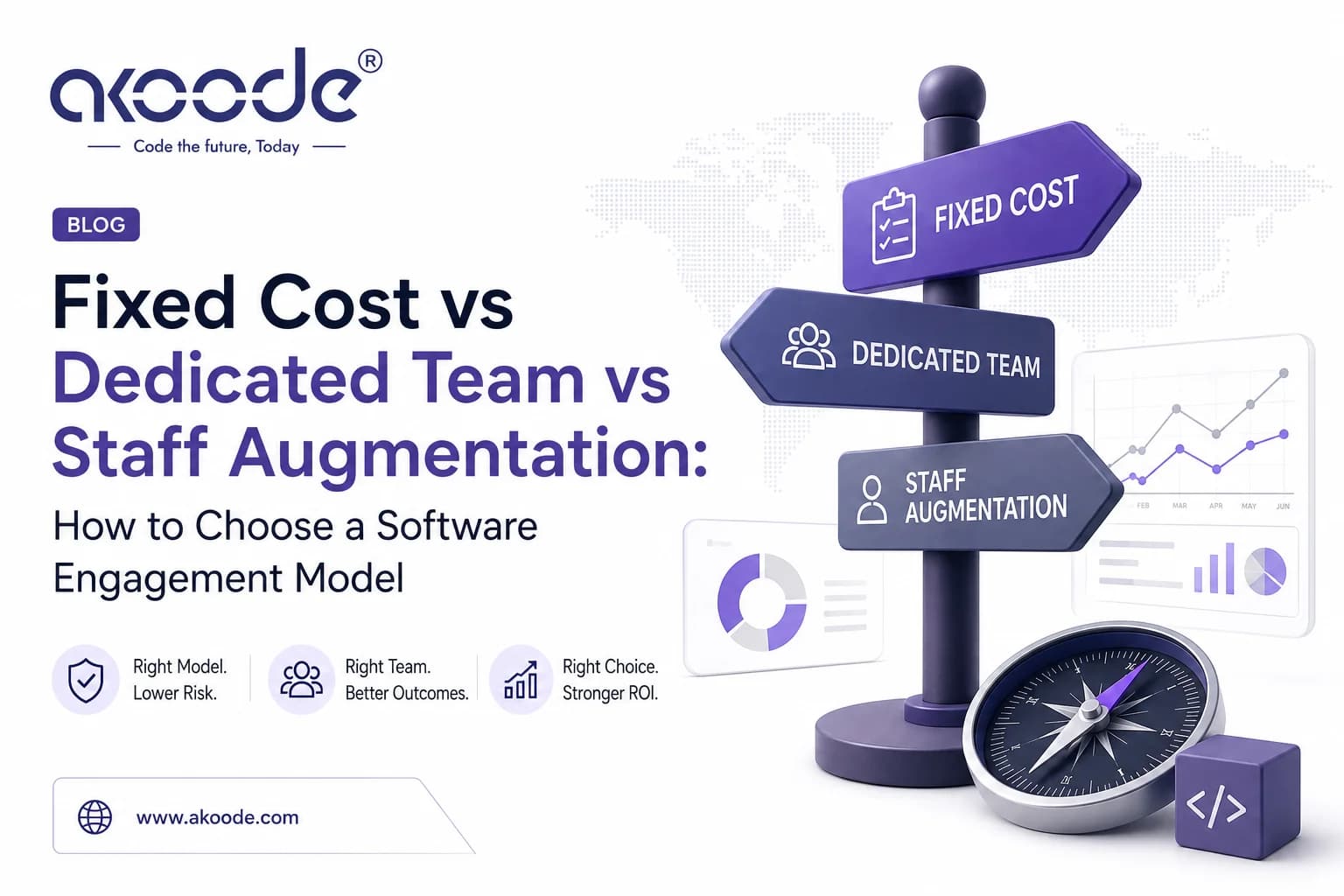
Fixed Cost — you buy a defined deliverable for a defined price. Certainty on budget, friction on change.
Dedicated Team — you buy engineering capacity by the month. Flexibility on scope, and the obligation to direct it.
Staff Augmentation — you buy people who work inside your process. Maximum control, and full accountability for delivery.
The variable that decides it is not your budget. It is how much of your requirement set you can genuinely lock down before anyone writes code — and how honest you are willing to be about that number.
Why the structure matters more than the vendor
The industry's track record here is not good, and it has not improved much in thirty years.
McKinsey, working with the University of Oxford, analyzed more than 5,400 IT projects with budgets above $15 million. <cite index="13-1">On average those projects ran 45 percent over budget and 7 percent over time, while delivering 56 percent less value than predicted, with software projects carrying the highest risk of cost and schedule overruns.</cite> <cite index="10-1">Broken out by type, software projects showed a 66 percent average cost overrun against 43 percent for non-software work.</cite>
Scope movement is the mechanism. <cite index="16-1">PMI's 2018 Pulse of the Profession found that 52 percent of projects completed in the previous twelve months had experienced scope creep or uncontrolled changes to scope, up from 43 percent five years earlier.</cite>
Read those two findings together and the conclusion is uncomfortable. Requirements change on roughly half of all projects. Cost overruns are the norm on large ones. And the most commonly cited causes — unclear requirements, shifting objectives, weak change control — are commercial and organizational problems, not technical ones.
Your framework choice will not save you from that. Your contract structure might.
The three models at a glance
Fixed Cost | Dedicated Team | Staff Augmentation | |
|---|---|---|---|
You are buying | A deliverable | Capacity | People |
Who owns delivery | Vendor | Vendor, you set priorities | You |
Pricing basis | One agreed project price | Monthly per engineer | Hourly or monthly per engineer |
Handles change | Badly, via change requests | Well | Well, if you drive it |
Typical duration | 6–16 weeks | 6 months and up | 3 months and up |
Time to start | 2–4 weeks (discovery first) | 1–2 weeks | 3–10 days |
Estimation risk sits with | Vendor | You | You |
Your management load | Low | Medium | High |
Fails when | Scope moves | Nobody owns prioritization | Your leads have no spare capacity |
Model 1: Fixed Cost
What it actually is
You agree a scope, a timeline, and a total price. The vendor carries the estimation risk. If the build takes 40 percent longer than they planned, that is their margin, not your budget.
That transfer of risk is the whole product, and you pay for it. Any competently priced fixed-cost quote carries a contingency buffer somewhere between 15 and 30 percent, depending on how much ambiguity is left in the spec. A vendor quoting without that buffer is either inexperienced or planning to recover it through change requests. Both are bad news, and the second is worse.
What it costs
Fixed pricing is estimated effort times a blended rate, plus contingency. In 2026, blended rates run roughly $15–$40 an hour across South Asia, $30–$60 across Eastern Europe and Latin America, and north of $100 for US onshore teams. Senior AI, security, and data engineering specialists carry a premium in every region. Treat those as planning ranges, not quotes.
One warning on comparison. A fixed price and an hourly rate are not the same unit. The fixed price usually includes discovery, project management, QA, rework, and contingency. The hourly rate usually includes none of them. Companies get burned by this constantly, and it is almost always the cheaper-looking option that ends up costing more.
When it genuinely works
An internal tool where the integrations are known and the users are already identified
A website or portal rebuild where the content model is settled
A migration with a fixed source and a fixed target
A compliance module where the requirement is written in legislation rather than in a product manager's head
A deliberately small first phase, scoped to test the working relationship before you commit to anything larger
Our rebuild for Patton Electronics, a Maryland contract manufacturer, sat squarely in this category. The requirement was structural and knowable up front. Fixed pricing served both sides.
Where it breaks
The failure mode is always the same. The business learns something after the contract is signed.
A customer interview changes the onboarding flow. Legal surfaces a data residency requirement. A competitor ships something that makes your v1 look dated. Under fixed cost each of those becomes a change request, which becomes a negotiation, which becomes two weeks in email.
Two things then happen simultaneously, and the second is worse than the first.
The relationship turns adversarial, because now every conversation about improving the product is also a conversation about money. And the team quietly starts building to the letter of the specification rather than to the outcome, because the specification is what they are contractually protected by.
You end up with software that matches the document and misses the point. Nobody set out to do that. The structure did it.
The clauses that decide whether this works
Negotiate the change mechanism before you negotiate the price. Specifically:
A written change-control process with a quoting SLA. Three business days to price a change is reasonable. Without a deadline, change requests become a stalling tactic.
An explicit exclusions list. What is not in scope matters more than what is. This is the single cheapest insurance policy in the contract.
A pre-approved change budget. Ten to fifteen percent of contract value, drawable without reopening the master agreement. It removes the friction from small, obviously correct changes.
Acceptance criteria written per deliverable, before build starts. Not at UAT. At UAT it is an argument.
Discovery priced and delivered separately. Any vendor willing to fix-price a complex build without discovery is guessing, and the guess will be recovered from you later.
Model 2: Dedicated Team
What it actually is
A ring-fenced group — engineers, QA, a delivery lead, usually fractional design and DevOps — working only on your product for a monthly cost. You set priorities. They own execution.
This is not outsourcing in the old sense. It is closer to renting a functioning engineering department, including the parts most people forget to value: code review culture, CI pipelines, on-call habits, and the institutional memory of why a decision was made eighteen months ago.
What it costs
Priced monthly per engineer, usually with a three-month minimum and 30-day rolling terms after that. Because the vendor is not carrying estimation risk, you are not paying the contingency premium built into fixed pricing. For anything running longer than about four months, a dedicated team is typically cheaper in absolute terms than the fixed-cost equivalent for the same output.
But model the real number, not the rate. The real number is the monthly rate times the number of months, plus the internal senior time required to direct it. Budget four to eight hours a week of genuine product ownership. Teams that do not get it drift, and drift is expensive at any rate card.
When it genuinely works
SaaS products where the roadmap is a living document
Anything where user feedback will change next quarter's build
Complex domains where context compounds — an engineer eight months into your codebase is worth two who joined last week
AI and machine learning work, where data quality issues and model performance uncertainty make honest fixed pricing close to impossible
Long-horizon programs where you need velocity to be predictable enough to plan a roadmap against
Our enterprise HR automation platform ran this way for exactly this reason. Payroll rules, leave governance, and statutory compliance kept producing edge cases no discovery phase would have found. Under fixed cost, every one of them is a change request. Under a dedicated team, they are just sprint items.
Where it breaks
It breaks when nobody on your side owns the backlog.
A dedicated team is a capacity engine. Aimed at a clear roadmap it compounds beautifully. Aimed at a vague ambition it burns exactly the same monthly rate while producing work nobody asked for. The vendor cannot fix this, and you should be suspicious of one who claims they can. Prioritization is a business decision.
The signals that you are drifting are consistent: sprint goals that read as activity lists rather than outcomes, demos where nobody from your side can say whether the sprint succeeded, and a backlog growing faster than it shrinks for three sprints running.
There is a quieter failure too. A team retained long enough that nobody questions its size. Review the pod composition every quarter. Some months you need five engineers. Some months you need three and a data specialist.
The clauses that decide whether this works
Named engineers in the SOW, with notice required before substitution. "We'll assign from our pool" means you are buying whoever is on the bench that Monday.
A scale-down clause, 30 days, no renegotiation of the master agreement. If a vendor will not quote it, the flexibility you are paying for is theoretical.
A monthly report showing scope added, scope completed, and scope deprioritized. The third column is the one that tells you the truth.
Repository access from day one. Not at delivery. Day one.
Model 3: Staff Augmentation
What it actually is
External engineers working inside your systems, your repos, your ceremonies. They report to your leads, attend your standups, and follow your definition of done. You own the sprint and the outcome.
What it costs
Hourly or monthly per person, typically 5 to 10 percent below the equivalent dedicated-team rate because the vendor is not supplying delivery management. That saving is real. Whether you keep it depends entirely on how much of your own management time gets consumed, and internal management time is never free.
When it genuinely works
You have an engineering organization and it functions. The gap is capacity, not capability.
You need a specific skill for a defined window — an ML engineer for a six-month model build, a mobile specialist for a platform migration, a DevOps engineer to fix a fragile deployment process
Local hiring would take four months and you need work starting in three weeks
Your codebase has conventions that matter and you want direct control over how they are followed
This is also the standard way US and UK companies test an offshore partner before committing to anything larger, and it is a sensible instinct. Two engineers for eight weeks tells you more than any sales process will. We actively encourage it with our US clients — a vendor confident in their engineers has no reason to resist a small paid start.
Where it breaks
It breaks when you do not have the engineering process you believe you have.
Augmentation hands all delivery management to you, which means it amplifies whatever your internal process already is. If onboarding takes three weeks, you pay for three weeks of low output. If your code review queue runs four days deep, your new engineers sit idle. If nobody has documented how deployment works, they will ask, and someone on your team will stop what they are doing to explain.
The other issue is accountability, and it is the one companies handle worst. If a fixed-cost project misses, that is the vendor's problem. If an augmented engineer underperforms, that is a conversation you have to initiate, and most people wait a month longer than they should. Set a two-week checkpoint with an explicit replacement clause at contract stage. Good vendors offer this unprompted.
What each model does to the conversation
This part rarely makes it into comparison articles, and it matters more than most of what does.
Under fixed cost, good ideas become expensive. So people stop raising them. Six weeks in, someone on your team notices a better way to handle a workflow and says nothing, because they know it means a change request. The cost of that silence never appears on an invoice.
Under a dedicated team, saying no gets harder. There is no contractual friction, so scope expands by accretion. Every individual addition is reasonable. The aggregate is a product with forty features and no center. This is why the product owner role is not optional.
Under staff augmentation, problems surface late. External engineers embedded in your team are structurally reluctant to tell you your architecture is wrong. They are guests. Ask directly, in one-to-ones, and make it clear the answer is wanted.
Every model has a conversation it suppresses. Knowing which one lets you go looking for it deliberately.
A decision framework you can run in fifteen minutes
Three questions. Answer them honestly, which is harder than it sounds.
1. What share of your requirements can you write down today and still believe in six months?
Above 80% — Fixed cost is viable and will probably save you money.
40–80% — Dedicated team. You know the direction, not the details.
Below 40% — Dedicated team, preceded by a paid discovery sprint. Do not fix-price uncertainty.
The honesty test: write the spec, hand it to someone who has never heard of the project, and ask them to explain back what needs building. If they can, you are in the first bracket. If they cannot, you are not, regardless of how thick the document is.
2. Do you have an engineering leader with genuine spare capacity?
Yes, with capacity — Staff augmentation is available to you.
Yes, but fully committed — Dedicated team. You need the vendor to supply delivery leadership.
No — Dedicated team or fixed cost. Augmentation without internal technical leadership is how projects fail quietly.
3. How long is this engagement?
Under 3 months — Fixed cost or augmentation.
3–12 months — Dedicated team usually wins on both economics and continuity.
Beyond 12 months — Dedicated team, with a documented plan for eventual internal transition.
When the three answers disagree, question one wins. Requirement stability is the dominant variable and everything else is secondary to it.
The hybrid approach most mature buyers actually use
Comparison tables imply you pick one model and live inside it. In practice the strongest engagements move between models as uncertainty falls.
Phase 1 — Fixed-price discovery. Two to three weeks, separately scoped. Output is a technical architecture, a prioritized backlog, a risk register, and an estimate you can defend to a board. Small enough to be genuinely fixed, valuable enough to stand alone. If the vendor is wrong for you, you learn it for the price of a discovery phase.
Phase 2 — Fixed-price build, or dedicated team. With requirements now real, a fixed price is fair to both sides — if the scope truly settled. If discovery revealed more uncertainty than you expected, that is not a failure of discovery. That is discovery working. Switch to a dedicated team.
Phase 3 — Dedicated team through launch and iteration. Real users generate real feedback and requirements go fluid again.
Phase 4 — Tapering augmentation. As you hire internally, the vendor team shrinks and shifts from delivery into skills transfer.
We structure most builds this way, including MVP work with early-stage founders and larger enterprise application programs. Each boundary gives you a cheap exit, which is precisely why it builds trust faster than one large commitment. Most vendors will not propose it, because a single long contract is commercially easier for them. Ask anyway.
Six things that should make you walk
They quote fixed cost before discovery. They are guessing, and you will fund the guess.
They propose a dedicated team for an eight-week, fully specified job. That is an upsell wearing a lanyard.
They will not put a scale-down clause in writing. The flexibility is decorative.
They cannot name the engineers. In dedicated and augmentation models you are buying specific people.
They subcontract. Ask directly: will any part of this be delivered by a third party? A yes puts a layer between you and the people writing your code, and it is the most common hidden source of quality variance in outsourced software. We do not subcontract at all, and I would push any vendor to state their position explicitly.
They agree with your chosen model immediately. A partner who has run a hundred projects should have an opinion and should be willing to argue for it.
Switching models mid-project
More common than vendors admit, and usually correct when it happens.
Fixed cost to dedicated team. Trigger: more than three change requests in two months. The scope is alive. Stop paying a contingency premium for certainty you no longer have. Convert at a milestone boundary and carry the remaining backlog across.
Dedicated team to augmentation. Trigger: you have hired an internal engineering lead and your own process is now stronger than the vendor's. Keep the engineers, drop the delivery management layer, take the rate reduction.
Do not switch mid-sprint, and do not switch off the back of one bad month. One bad sprint is noise. Three is a pattern.
How we handle this at Akoode
Every engagement starts with a structured discovery conversation, and we will tell you when the model you asked for is the wrong one.
We have talked clients out of fixed-price contracts when their requirements were visibly still moving, and talked others out of dedicated teams when a six-week fixed-scope build was all they needed. Recommending the smaller engagement costs revenue in the short term. It costs far less than a project that goes badly.
All three models run on the same standards: a senior engineer leading every engagement, no subcontracting, one delivery lead owning communication end to end, NDAs before technical discussion, and full IP transfer to you.
If you want to work through which structure fits, book a call with me directly. Bring your requirements in whatever state they are in. Half-formed is normal, and it is genuinely useful information for scoping the right structure.
You can also read how we run custom software development engagements and staff augmentation.
Frequently asked questions
What are the three main software development engagement models?
Fixed Cost, Dedicated Team, and Staff Augmentation. Fixed Cost sets a defined scope and total price with the vendor carrying estimation risk. Dedicated Team supplies a ring-fenced team at a monthly cost, with the vendor owning execution against priorities you set. Staff Augmentation places external engineers inside your existing team while you retain full delivery accountability.
Which engagement model is cheapest?
Staff augmentation usually carries the lowest headline rate, but headline rate is a poor predictor of total cost. For engagements beyond about four months, dedicated teams typically deliver the lowest cost per unit of output, because you are not paying the 15 to 30 percent contingency premium built into fixed-cost quotes. Factor in your own management time before comparing.
Is fixed cost safer than a dedicated team?
Safer for budget, riskier for outcome. Fixed cost protects you from overruns but penalizes every change you need after signing. Given that PMI found scope creep on 52 percent of projects, that protection frequently becomes a constraint on building the right product.
What is the difference between staff augmentation and a dedicated team?
Ownership of delivery. With augmentation, your engineering manager runs the work and external engineers integrate into your process. With a dedicated team, the vendor supplies delivery management, QA leadership, and architecture oversight alongside the engineers.
Can you switch engagement models mid-project?
Yes, and strong engagements usually do. A common progression is fixed-price discovery, then a fixed-price or dedicated build, then a dedicated team post-launch, then tapering augmentation as you hire internally. Negotiate transition terms at contract stage rather than under pressure later.
How long does it take to start under each model?
Augmentation is fastest, typically three to ten business days. Dedicated teams mobilize in one to two weeks. Fixed-cost projects need an additional one to two weeks because discovery must complete before scope and price can be fixed responsibly.
Do I need an in-house technical lead for staff augmentation?
Yes. Augmentation assumes you own delivery. Without an internal engineering leader who has real capacity for onboarding, code review, and unblocking, augmented engineers underperform regardless of individual quality. If that capacity does not exist, a dedicated team is the better structure.
Which model works best for AI projects?
Dedicated team or augmentation, almost always. AI builds involve data quality problems, model performance uncertainty, and iteration cycles that cannot be scoped up front with any honesty. A fixed-price AI contract usually means someone has agreed a price for an outcome nobody can yet guarantee.
What contract terms protect me regardless of model?
NDAs signed before technical discussion, full IP and source code assignment, repository access from day one, named engineers rather than pooled resourcing, a written change-control process, and a defined scale-down notice period. These apply across all three models.
How big should a dedicated team be?
Four to eight people covers most product builds — two to four backend and frontend engineers, one QA, one delivery lead, plus fractional design and DevOps. Below four you lose redundancy. Above eight you need a second pod and a coordination layer.
Written by Akhilesh Verma (Akhil) Founder and CEO of Akoode Technologies. Akoode has delivered 100+ software projects across 15+ industries for clients in India, the UK, and the United States.
Get In Touch Now
View More Our Blog